Showing posts with label temples. Show all posts

Sunday, February 4, 2018

Stepping Back a Thousand Years: A Night at Ekoin

-- Susan, every other Sunday

While researching my upcoming mystery Trial on Mount Koya, I spent some time on sacred Mount Kōya, the mountain that lies at the heart of Shingon Buddhism in Japan. While I've posted about other aspects of Mount Kōya in the past, I thought today I'd take you along for a virtual night at Ekoin, a thousand year-old temple where I've had the privilege to stay on two separate trips to Kōya-san.

The front gates of Ekoin

I arrived on a crisp autumn afternoon at 3pm--the temple's check-in time--and passed through the wooden gates to discover a lovely, inviting yard.

An island of peace in a troubled world.


The building on the right is the residence hall.

In the entry, I paused to remove my shoes and leave them on wooden racks designed for that purpose--and to slip on a pair of sandals, placed in the entry for use inside the temple. The resident priests wear these as well (or walk in socks), to preserve the wooden floors.

A priest took my luggage and led me down the interior hall--in the photo below, you can see the way the hall (on the left side of the photo) lies between two sets of sliding panels.


On one side (center frame), they separate the passage from the veranda and yard, and on the other (visible on the upper left side of the photo) from large, group guest rooms and rooms that hold the temple's art and treasures.

My guest room was on the second floor, down a hall with windows that offered a lovely view of the surrounding koya--a saddle on the peak from which the mountain derives its name.

The view from the upper hallway at Ekoin

The guest rooms haven't changed too much in the thousand-plus years since Ekoin's founding--with the exception of televisions (a convenience for modern guests, though I prefer to leave them off and experience the temple without electronic interference), telephones, propane heaters, and electric lights.

My guest room in the evening--after dinner--with the futon laid out for sleep

Although guest rooms are private, toilets are shared, and located at the end of the hall. Shower and bath facilities are also shared (but segregated by gender) and located on the ground floor, near the entry.

A traditional welcome awaited me in the room: a pot of hot water (for making tea) and a traditional pastry filled with sweet bean paste. A delicious, peaceful way to relax and unwind after a morning of hiking and research.

Temples serve delicious tea.

When I finished my tea, I explored the temple and its grounds, and took a walk through nearby Okunoin, Japan's largest cemetery. I returned to my room around 5pm and relaxed until 6, when a priest brought my dinner tray.

Dinner for one - two trays, plus rice and tea. Details two weeks from today.

Shojin ryori, or temple cuisine, is my favorite type of Japanese food. It's entirely vegetarian, and although I'll post in the future about the specific rules that apply, you can trust me when I say it isn't boring (and the photos prove it, too).

After dinner, I spent some quiet time in my room and went to bed early, because nobody sleeps late at a Buddhist temple--including the guests!

The temple bell rang at 5am, waking me from a delightful sleep and warning me that I only had 30 minutes to dress and get to the temple's worship hall for the morning service.

Morning services at Ekoin. The priests invited photos (but I took only this one, beforehand).

After the service, we walked across the yard to the goma hall for the fire ritual (something I've blogged about before).

The goma at Ekoin.

The ritual concluded around 6:45, whereupon I returned to my room to find a delicious breakfast waiting. (More on its contents in two weeks, when I'll post about temple cuisine.)

Unusual to Western eyes, perhaps, but delicious all the same.

Checkout time is 9am (I told you, nobody sleeps early in a temple!) so visitors staying only one night have time for a leisurely breakfast before checking out at the temple office. I left a little early, and headed out to see Danjo Garan, one of the first temple complexes established on Mount Koya.

One of the pagodas at Danjo Garan

Many Japanese temples offer overnight lodging, and although the experience doesn't equate to life in a temple, or even precisely to what a visitor might have experienced hundreds of years ago, it definitely gives at least a hint of what such an evening would have been like--and it also allows us to spend the night in a beautiful, peaceful place where years and the worries of the world can slip away like leaves in a flowing stream.

Sunday, August 20, 2017

Surprised by Unexpected Joy*

-- Susan, every other Sunday.

*Given the state of the world, we need all the unexpected joy we can find, anywhere we can find it.

I woke up on the morning of July 10, 2017 -- the last full day of my research-and-graduation-celebration trip to Japan with my son -- with plans to shoot some last-minute research photos at Sensoji, Tokyo's oldest Buddhist temple.

Incense burning before a memorial stone at Sensoji.

I'd already visited the temple once, on the first full day of our trip, but it had rained:

Rain on Nakamise Street - with the temple gate in the background.

Which made shooting research images (both at Sensoji and at neighboring Asakusa Shrine) challenging:

Shrine guardian in the rain.

Since my son had plans with friends, I hopped the Ginza Line subway and emerged in the shopping street near Sensoji. People thronged the streets, packed even more tightly than I anticipated. Sensoji is a popular tourist spot, as well as a functioning Buddhist temple, but I hadn't expected such a crowd.

The reason for all the people became apparent as I reached the gate: unbeknownst to me, I'd arrived on a festival day:

Yay! IT'S A FESTIVAL!
Since I'd never experienced a Japanese shrine or temple festival, I was beyond thrilled. (For this, I was even willing to overcome my usual distaste for crowds.)

Food vendors lined the pathways all around the temple grounds, selling a variety of festival treats.

Slushy drinks, Fried Chicken, and CHOCO BANANA on a stick.

He's selling giant crab legs. Seriously. I'm not kidding.

Other stalls sold beautiful ground cherry pod plants and stalks, as well as hand-painted glass lanterns.

Ground cherry pod, aka "Chinese Lantern Plant"
The scent of plants and the tinkling of lanterns filled the air, along with a pleasantly cooling mist from spritzers hanging above the stalls.

Plants or pods, the choice is up to you.

Asakusa Jinja, a Shinto shrine that sits adjacent to the worship hall at Sensoji, was also celebrating.

Entrance to Asakusa Jinja
Tanabata trees lined the approach to the shrine, in recognition of the July festival commemorating the once-a-year heavenly meeting of the weaver and the cowherd.

People write wishes on colored paper and tie them to the tanabata tree.

A vendor just inside the shrine was selling one of the coolest festival drinks in Tokyo right now: a flavored slush composed of shaved ice, sparkling water and flavored syrup, served in a plastic lightbulb and adorned with a smaller, LED light-up lightbulb toy.

Japanese slushy drink! (Not too sweet.)

The day was hot, and I was thirsty, so I bought one--in the name of research.

The grape one was so tasty I went back for a lemon one later on.

While I sat in the shade, enjoying my treat, a Japanese woman approached me and said, "You're so lucky! You're here today!"

"Thank you!" I said, "It was a surprise - I didn't realize today was a festival."

Her grin got even bigger. "You didn't know! So lucky! Today is the day of 46,000 prayers. Do you know this festival?"

When I admitted ignorance, she explained:

"We believe that if you pray at Sensoji on July 10, it's the same as saying 46,000 prayers. Also, today is also the ground cherry plant festival, so you get two matsuri (festivals) in one! You really didn't know?"

I shook my head. "I didn't. This is my last day in Japan, and I wanted to spend it at Sensoji."

She clapped her hands in delight. "You are so lucky. Make sure to say a prayer today. It will count 46,000 times."

I promised I would, and thanked her, and she headed off to the worship hall.

Although I'd only planned to spend a couple of hours at the shrine, I scratched the rest of my plans and spent the entire day enjoying festival food, shooting photos, watching people, and reveling in the presence of hundreds of happy people enjoying a day at the festival.

The hozomon gate, as seen from the worship hall veranda.

Children laughed and ran around. Teenagers ate iced sodas, fries, and takoyaki (deep-fried octopus balls - a festival favorite). Adults of all ages strolled the grounds, bought ground cherry plants, and admired the tinkling lanterns that hung everywhere.

Ground cherry pods on display.

I saw people of many races (though admittedly, most were Japanese), both tourists and natives, Buddhists and people who doubtless belonged to other religions yet had come to see this lovely and important holy place.

Everyone loves a matsuri.

I didn't see a single unhappy face the entire day, and I don't know when I last saw such a large group of people enjoying themselves so much.

Festival booths with the Tokyo Skytree in the background.

Eventually I had to leave to meet my son for our final dinner in Tokyo and a trip to the Owl Cafe, but before I did, I said a prayer, as the Japanese woman suggested.

More accurately, I said 46,000 prayers, all the same: that everyone in the world could experience the kind of unexpected, unadulterated joy I had that day.

Sunday, June 25, 2017

Tokyo's Oldest Temple: Sensoji

-- Susan, every other Sunday.
Japan has many ancient Buddhist temples and Shinto shrines, but Tokyo's Sensōji is one of the oldest and most significant.
Sensoji sits only 2km from Tokyo's famous Skytree (lit in blue).

Sensōji stands in Tokyo's Asakusa district, and holds the unique distinction of being among the world's most frequently visited religious sites. Over 30 million people visit the temple annually, either as tourists or to offer prayers to its guardian deity, Kannon.
Kannon (Guanyin in Chinese) is the Buddhist bodhisattva of mercy. According to history (or legend, depending on your view), a pair of fishermen drew a miraculous statue of the goddess from the nearby Sumida River in 628 - and shortly thereafter founded Sensōji to honor the goddess. 
Buddhas at Sensoji.
Although the original temple was destroyed by bombing during World War II, it has since been rebuilt on the model of the original.
Dominating the temple entrance (and the street beyond) is the Kaminarimon, or "Thunder Gate," which includes an enshrined image of the thunder god Raijin.
The Kaminarimon at night

Beyond the Kaminarimon, a long approach lined with shops:
Nakamise Street - a fantastic place to shop or snack.

Leads to the even larger Hozomon, or main entrance gate:
The massive Hozomon.

A pair of giant woven sandals hang on the back of the Hozomon. The sandals, or o-waraji, measure 4.5 meters tall and weigh 2500 kg (over 500 pounds) apiece:
One BIG shoe.

The sandals are considered "kami-sized," and symbolize the power of the nio guardians (deities who guard the hozomon, as well as the temple) whose statues sit in the bays on the other side of the hozomon:
He sees what you did there.

It takes 800 people to construct the sandals, and the town of Murayama donates a new pair of o-waraji to Sensoji every decade (and has done so since the 1940s)
Temple visitors touch the o-waraji in hopes of gaining powerful walking skills, and the ability to walk long distances without tiring. Sadly, I'm too short to reach them, but I'm hoping the visit alone is enough to give me the stamina to get through my travels in Japan over the next three weeks. My son and I fly out today, and I'm looking forward to having many more adventures to share when we return! 


Sunday, February 5, 2017

A Hairy Tale of Love and Justice in Japan

--Susan, every other Sunday

While visiting Japan last autumn, I spent a night at Tatsueji, a Shingon (esoteric) Buddhist temple on Shikoku - the third of Japan's four largest islands (counting from north to south).

The hondo (worship hall) at Tatsueji.

Tatsueji is #19 of the 88 Buddhist temples on the Shikoku Junrei, a pilgrim route which circles the island of Shikoku. Pilgrims (henro, in Japanese) walk the 750-mile circuit for a variety of reasons -  someday, I hope to walk the entire route myself.

Tatsueji, which lies in the southeastern part of Shikoku, about 30 minutes by train from Tokushima City, is also one of four sekisho, or spiritual checkpoints, where pilgrims are supposed to reflect on what they have learned from the journey so far. In spiritual terms, a sekisho was (and is) similar to the checkpoints between provinces, where travelers had to show their documentation and receive permission from the local lord, or daimyō, to proceed. At the sekisho, a pilgrim's "travel permit" was obtained through self-reflection and personal confirmation that (s)he had, indeed, been transformed in some way by the journey.

According to some, pilgrims who have not experienced personal transformation upon reaching a sekisho are supposed to turn around, go back to temple #1, and start over. Japanese legends also say that people who are impure of heart cannot pass through the gates of a sekisho temple.

Fortunately, I had no problem entering:

The view from the front gates of Tatsueji.

and the view from my room was spectacular:

The view from the guest room, Tatsueji.

The statue to the right of the pagoda is Kōbō Daishi, the priest who brought Shingon Buddhism to Japan from China, and established it as a major Japanese sect.

Kobo Daishi

Like most temples, Tatsueji's gates have guardian statues in its alcoves--but the left-side alcove also holds a tangle of rope and human hair, which is one of the temple's most sacred objects and a symbol of the temple's most famous legend.

The rope is actually to the left of this giant sandal - but sadly, it did not photograph clearly.

Centuries ago, a young woman named Okyō was sold into prostitution in Osaka because her family could not afford to keep her. The story varies a bit by source, but most versions agree that Okyō eventually killed one of her lovers in order to run away with another one; after the murder, Okyō and her surviving lover fled to the island of Shikoku, disguised themselves as pilgrims, and began walking the pilgrim trail in hopes of evading justice.

Upon their arrival at Tatsueji, Okyō's long hair became entangled in the bell rope for the temple bell (apparently the same bronze bell that still hangs in the temple tower):

Tatsueji's famous temple bell.

The priests cut her free, but Okyō realized that she could not escape her crime by running. Instead, she confessed to the temple priest and decided to spend the rest of her life nearby, meditating and living her life as a Buddhist hermit.

According to the legend, Okyō's former lover became a priest and spent the rest of his life working, praying, and meditating at Tatsueji.

The bell rope, twisted with hair, remains at the temple as a symbol and a reminder of Okyō's story.

The bell tower at Tatsueji, site of Okyō's transformation.

Tatsueji is not the only temple on the Shikoku pilgrim trail that claims a miraculous transformation; quite a few have legends of people who renounced their evil ways and made new starts upon, or shortly after, arrival at the holy sites.

Regardless of religion, personal belief, or the truth of legends like Okyō's story, the temples on Shikoku's pilgrim trail are both an important part of Japanese history and a perfect place for meditation and reflection on the traveler's personal journey.

I rose the following morning at dawn, refreshed--and, yes, a bit transformed by the experience.

Dawn, en route from Tatsueji to the train.

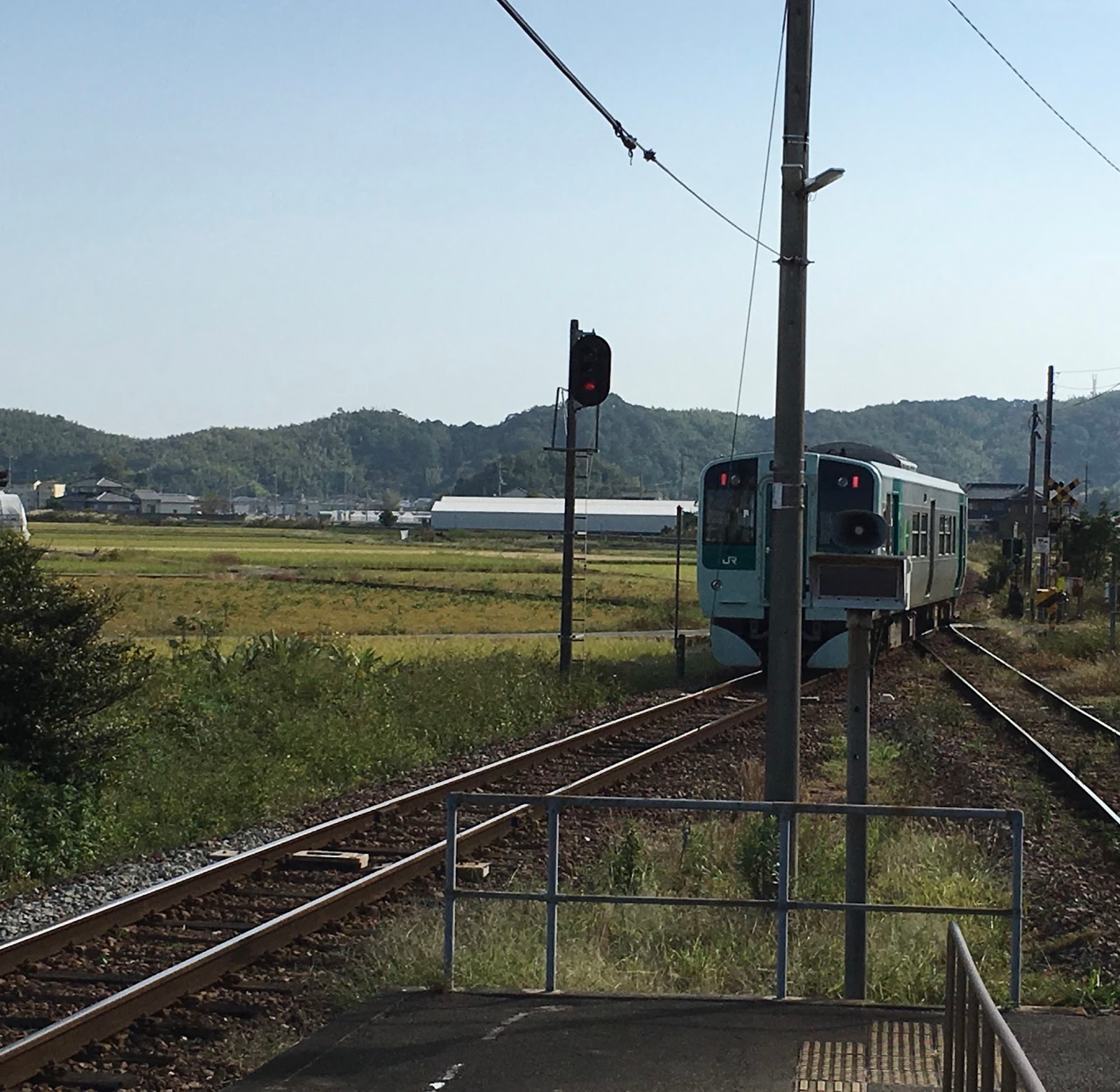
Which was good, because I had a train to catch -

Train departing from Tatsue Station.


and no time to start the journey over.

Sunday, November 27, 2016

A Visit to Koya's Sacred Fire

-- Susan, every other Sunday.

In the film The Dark Knight, Batman's butler, Alfred (played by Michael Caine) says that some men's actions cannot be understood by reference to logical motivations.

"...some men aren't looking for anything logical, like money," Alfred says, "...Some men just want to watch the world burn."

These days, too much of the world seems poised to burn, and far too many people seem inclined to light the torch and fan the flames.

Today, however, we're going to light a different kind of fire.

The sacred fire of a Shingon Buddhist goma.


The goma, or fire ceremony, is practiced by the Shingon Buddhist priests as part of their regular morning observances. Some temples perform the goma daily; at other temples, observance is less frequent but no less a vital part of Shingon practice.

While visiting Mount Koya (the heart of Koyasan Shingon, one of approximately 18 Shingon denominations, or sects, worldwide) I had the chance to spend the night at two Shingon temples, Kumagaiji and Ekoin, and to observe the fire ceremony at each temple.

The front gate of Kumagaiji

Although I normally refrain from photographing sacred rituals and spaces, the priests at Kumagaiji (and Ekoin) invited us to photograph, record, and share our experiences.

The goma is unique to Esoteric Buddhism, and involves the lighting of a sacred fire which represents the wisdom of the Buddha and is intended to cleanse (by burning) the root of peoples' suffering, enabling them to thereafter release themselves and their concerns to the Buddha's teachings.

Before the ceremony, worshippers write their prayers and wishes on wooden sticks, which will later be used to feed the sacred flames.

The wooden sticks (center right) upon which we wrote our prayers.


Both Kumagaiji and Ekoin performed the goma immediately after the morning prayer service. The morning service was conducted in the temple's hondo, or worship hall. When the service concluded, we walked from the hondo to a nearby, smaller temple building used specifically for the goma.

The goma temple at Kumagaiji


Inside, we removed our shoes and climbed to a platform where visitors sit to watch and participate in the goma.

A raised area at the center of the platform provided a place for the priest conducting the ceremony to sit and also held the bowl and other ritual implements used for the sacred fire.

The priest tending the sacred fire during the goma.


Behind them, an altar held images of the Buddha, including Fudō Myōō, sometimes also known as the Buddha of Compassionate Fire. (Fudō, the Immoveable One, is an important deity in the Shingon pantheon - and you'll be hearing more about him from me in future posts.)

Fudō Myōō, the Immoveable One


During the ritual itself, a priest prepares and lights the sacred fire, which rises several feet above the bowl as it cleanses and consumes the sticks (and prayers), transforming them into smoke.

The goma in progress. On the right, a priest plays the taikō.


A second priest beats a taiko (drum) and both priests chant specific prayers throughout the fire ceremony, invoking the Buddha's compassion and praying on behalf of the participants, their ancestors, and others on whose behalf the ceremony is conducted.

As the flames begin to die, the priest fans the sacred fire with a book of sutras.

Fanning the flames with sutras.


According to Shingon Buddhist belief, the act of burning the sticks does not, of itself, guarantee that the prayers will be answered or that individuals will cease to suffer. Shingon teachings also require individuals to seek and accept the Buddha's help and protection.

Fudō and other wisdom kings at the entrance to Kumagaiji.


Although I am not a Buddhist, I found the ceremony compelling and moving, and emerged from it touched by both the prayers and the cleansing qualities of the sacred fire.


Some people may want to watch the world burn with negativity, but I dearly hope that we -- as individuals and as a nation -- survive the flames and create a world cleansed of suffering, in which people strive to understand, respect, and love one another as individuals, celebrating our differences instead of reviling those who do not share our experiences and our views.

In fact, that was my goma prayer.