Showing posts with label Japanese history. Show all posts

Sunday, April 9, 2023

Cherry Blossoms and Castle Keeps - Springtime in Japan

 -- Susan, every other Sunday


Two weeks ago, some friends from the United States and I took a trip to Kyushu--Japan's southernmost major island--to visit some famous sites and enjoy some tasty regional food. As it happened, we also caught Kyushu's sakura (cherry blossoms) at the peak of their very short bloom, which turned an already-fantastic trip into something truly special.

Sakura are loved in Japan, not only as a sign of spring's return but also because their delicacy and very short lives remind us of the short, bittersweet nature of all beauty, and of life itself. 

That message takes on another level of depth when the sakura you're enjoying are blooming around the seven "hells" of Beppu (a set of seven natural volcanic springs, each with very unique characteristics) and the magnificent castles and gardens where samurai once walked. 

Sakura near Umi Jigoku (the Ocean Hell)


I've written about Beppu's famous hells before, but since my previous visit was in winter, I had no idea that beautiful blossoms were lurking behind the steam. 

Sakura at Umi Jigoku

After visiting five of the seven famous hells - all but one of which had sakura blooming in the surrounding trees, one of my friends said, "You know, hell suddenly doesn't seem all that scary anymore." (Particularly apt, seeing as this post goes up on Easter Sunday...)

The bubbling clay pools at Oniishibozu Jigoku (the hell of monks' heads, named because the bubbles emerging from the clay look a bit like the bald, round heads of Buddhist monks) reflected the trees in a way that drew a lot of blossom-watchers.


Cherry blossoms reflected in the pits of hell...

After visiting all seven hells, we paid a visit to Beppu Park, where dozens of enormous cherry blossom trees were all in bloom.

Sakura at Beppu Park
 

Up close and personal with spring


Beppu Park

Our trip also involved a stop in Kyoto where, to our surprise, the cherry blossoms were still blooming.

Cherry blossoms at Tenryu-ji, a Buddhist temple in Kyoto


More sakura at Tenryuji

Although there were a lot more tourists in Kyoto, too, the beautiful spring weather and cherry blossoms made it difficult to feel anything but thoroughly happy and alive.

Sakura by the train tracks in Kyoto's Arashiyama ward.

That said, my favorite cherry blossoms of the trip were the ones we found near Kumamoto Castle, in Kumamoto (Kyushu). 

Sakura at Kumamoto Castle


Another view of the castle with cherry blossoms

When my friends and I planned the trip, we thought the blossoms wouldn't be in bloom for another 2-3 weeks--it's difficult to plan a trip months in advance and ensure it coincides with the blossom season, because the sakura often bloom and die within a week (or sometimes less).


I feel truly fortunate that the weather (although unsettlingly warm for the end of March) gave us the chance to see so many blossoms in full bloom. The earth is awakening after the cold of winter, and the blossoms are an excellent reminder to enjoy, and make the most of, every day.


Sunday, February 26, 2023

Zao Onsen: Tasty Ramen, Ancient Ryokan, and Monsters Made of Snow

 -- Susan, every other Sunday

Last weekend, my friend (fellow author Jonelle Patrick) and I hopped a train to Yamagata Prefecture, three hours north of Tokyo, in the hope of seeing the famous "snow monsters" of Mt. Zao--a forest of heavily corniced trees created by freezing winds blowing down from Siberia and across the sea to Japan.

The monsters only exist for a few weeks each year, and between the screaming winds and winter storms (which sometimes shut down the gondolas you ride to the top, where the monsters are) it isn't always possible to see them, even if you make the trip.

The entrance to Takamiya Ryokan Miyamaso

Although the forecast looked promising when we booked the trip, Jonelle and I arrived at our traditional inn--Takamiya Ryokan Miyamaso--in the midst of a freezing rainstorm that had shut the gondolas down for the day, and it looked as if we weren't going to see them at all this trip.

We were both pretty bummed, but Miyamaso turned out to be an excellent "consolation prize." The inn has been in operation since 1716, and its hot spring baths are fed by a volcanic spring that comes up underneath the inn itself.


The volcanic hot spring that feeds the baths at Miyamaso

Our room was really three rooms, including a main room, a Japanese-style sitting room, and a funky step-down "lounge" with post-war couches--along with a separate en-suite toilet and bath, an entry hall, and a changing room.    


It was so large, we looked at one another and asked "how many people do they think we brought with us??"

The private sitting room (one of two)

Since the snow monsters were "no monsters" for the day, we wandered back through the little town (which was established during the second century (around 110)) and renovated after Zao Onsen became a popular retreat and resort during the 1950s, had excellent ramen at a local restaurant, and shot some pictures of the steaming hot spring rivers that run through town.

We also stopped in a local sake shop and bought a bottle of umeshu (Japanese plum liquor), which we brought back to the room and mixed with hot water for a delightful cocktail, before heading to try out the famous hot spring baths.


Umeshu - a great way to warm up on a chilly day.

The town was covered in snow (the freezing rain didn't make a dent in the snowbanks).  Steaming rivers run through Zao Onsen, fed by the many volcanic springs for which the town is famous. 

Steaming hot-spring river

Dinner was a many-coursed feast, accompanied by a tasting flight of local sake.


Local Yamagata Sake - every one, delicious!

The first of many beautiful and tasty courses

That night, the rain turned to snow, and we woke to a fresh, clean blanket of beautiful white, with more flakes falling all around. The innkeeper said the gondolas still weren't running, so we left our heavy gear at the inn and walked through town to take a few last photos before departing.  


Except, when we reached the gondola, we learned it WAS running after all! We didn't want to risk returning to the inn for our gear, so we stood in line in our standard winter outerwear--a two hour wait, outside, in the snow--and rode the gondolas up the snowy slopes to the summit, where we faced -15 temperatures (below -25 with wind chill) . . . and saw the monsters, after all.

The frosty beech-covered slopes of Mt. Zao

Snow monsters! At last!

A fabulous end to an already amazing winter trip - and another item checked off my (admittedly, pages long) "must-do" list for Japan.


Sunday, September 25, 2022

Soy Sauce and Donkey: A Pilgrimage BEFORE the (Kumano Kodo) Pilgrimage

-- Susan, every other Sunday

Two years ago next month, I hiked the sacred Kumano Kodo pilgrimage for the second time. This ancient trail is one of two pilgrimages registered as UNESCO World Heritage sites (the other is Spain's Camino de Santiago).

The day before the hike, I traveled south from Tokyo to Yuasa, a tiny town on the western coast of the Kii Peninsula that sits at the juncture where the coastal Kumano Kodo Kii-ji intersects with the Nakahechi--the "central route" that serves as the primary pilgrim trail.

If you've never heard of Yuasa, you're in good company. Even within Japan, it's not particularly well-known. 

However, I'm willing to bet you've heard of the reason Yuasa is famous. In fact, you probably have personal experience with Yuasa's primary culinary claim to fame . . . but more on that in a minute.
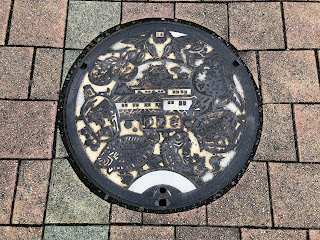
Like many Japanese towns, the manhole covers celebrate Yuasa's claim(s) to fame.

Due in part to its somewhat remote location, Yuasa remains a sleepy coastal fishing town. It sits about 2.5 hours south of Kyoto by a combination of express and local trains. 
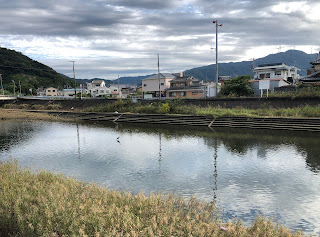
Heron fishing in the canal

Upon arrival, I checked in at my lodgings for the night: Miyoshi-so, a ryokan (traditional inn) that has been serving travelers on the Kumano Kodo pilgrim trail for over 100 years.

The entrance to Miyoshi-so

Welcome tea and a local monaka (crispy filled wafer)-style cookie

My guest room.

 After relaxing for a few minutes, I headed out to explore the town. I was scheduled to begin the seven-day trek along the Kumano Kodo Nakahechi the following morning, and wanted to see as much of Yuasa's history as I could that afternoon.

The town has a large historical preservation district, with lots of preserved warehouses, shops, and homes.

Preserved homes in Yuasa's historical district

At the northwest end of the historical district, a building that once served as a shoyu brewery is now home to the Kadocho Soy Sauce Museum--a veritable wonderland for those of us who like small, odd collections of historical artifacts, and also an informative display about Yuasa's claim to fame.
 
(I promised we'd get back to that.)

According to local history, Yuasa is the place where soy sauce was invented--not just "in Japan" but anywhere in the world. 
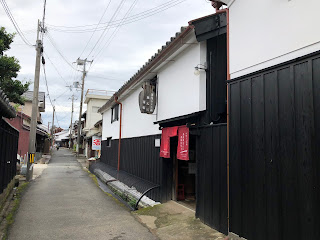
  

The entrance to the soy sauce museum

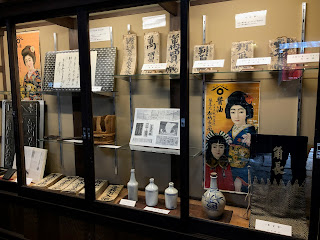
Old soy sauce ads, bottles, and artifacts.

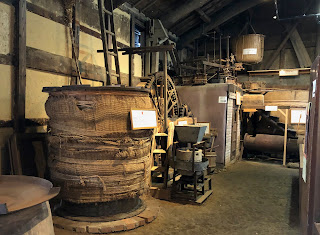
The implements used to brew traditional shoyu (soy sauce)

The displays were labeled (in Japanese) with brief explanations of each artifact's role in the shoyu brewing process. They were roughly "in order" from a brewing perspective, though as you can see in the photo above, the museum vibe leaned slightly farther toward "wacky grandpa's shoyu barn" than "true museum."

Not that I mind. When it comes to museums, I like them weird, and these artifacts felt much more "alive" than the ones you find in a sterile-type museum.

After viewing the soy sauce artifacts, I popped into the Kadocho shop across the street for some souvenirs. Kadocho still brews and sells soy sauce made the traditional way, with no preservatives and no unnecessary ingredients--including some that has nothing in it but soybeans, koji (the fermenting bacteria mixture) and salt. And after that, it was time for lunch.

At least, that was the plan.

Unfortunately, this little fishing town doesn't see much tourism--particularly mid-pandemic--and the only restaurant I found open in the historical district was a "fresh catch" place that had only fish on the menu.

(Note: I'm allergic to fish, so that option, though attractive to many people, was a hard pass where I'm concerned.)
More of Yuasa's preserved buildings

I started back toward the ryokan, hopes sinking ever lower as I realized even Google Maps had no idea where I could find a restaurant--or even a convenience store--that was open that day in this little town.

Just when I was ready to surrender all hope and wait for dinner (which fortunately was being prepared for me at the ryokan that night), I turned a corner and saw a white tiled building with a sign reading "Coffee Restaurant DONKEY"--and a flag out front that suggested it was open.
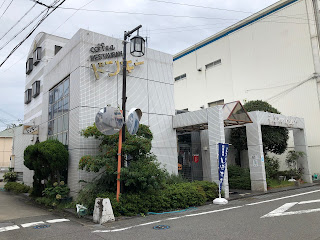
Coffee Restaurant ćƒ‰ćƒ³ć‚­-- ("Donkey")

The outside wasn't much to look at, but when it's well past noon, I haven't eaten since 5 a.m., I've walked five miles since breakfast, and dinner isn't until 6:30 . . . I ain't too picky. I made a beeline for the door and headed in.

An adorable grey-haired, grandmotherly woman (who turned out to be one of the owners) led me to a table and handed me a menu--with an apology that it was written in Japanese. Fortunately, that wasn't a problem--although choosing from the list of intriguing options proved more of a challenge than I expected.

In the end I settled on "special doria"--which was a leap of faith, because although I know that "doria" is a dish composed of white rice baked in cream sauce, usually topped with meat sauce (and sometimes cheese), the menu didn't mention what made this one "special."

And in Japan, that really could mean anything. 

Ten minutes later, the sweet proprietor emerged from the kitchen bearing the dish below: 
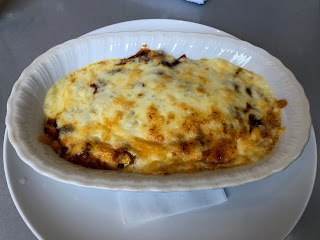
A special doria indeed

The meat sauce smelled homemade--and slightly sweet, which gave me a moment's pause, but I was so hungry I didn't pause for long. As it turned out, the sauce atop the rice was indeed homemade, and fell somewhere between marinara and barbecue sauce (it tasted like a combination of the two) with liberal chunks of minced tomato, carrot, and onion throughout. Stranger still, the rice was mixed with little pieces of . . . scrambled eggs, a little like what you'd expect to see in fried rice, although this rice was steamed and baked in a bechamel sauce (as usual for doria) not fried.)

Now, based on that description, I think we can all agree the dish shouldn't work. Objectively, it sounds just . . . wrong.

But in reality, it was absolutely delicious--the best doria I've ever eaten, bar none, and I eat them often. Long before I finished, I was already regretting the fact that it would probably be two years (at least) before I was able to eat the dish again (since I try to hike the Kumano Kodo in even-numbered years)

It has been a year and eleven months since that fateful lunch, and I still miss that special doria.

Fortunately, it is an even-numbered year, and I do have plans to hike the Kumano Kodo this November. In about eight weeks, if everything goes as planned, I'll head south to Yuasa, to spend another night at Miyoshi-so before setting off on another pilgrimage along the Kumano Kodo Nakahechi.

And you can bet I'll be visiting Donkey the day before.

For now, I'll leave you with a view of sunset in Yuasa, shot from the window of my room at Miyoshi-so...


... And the official start of the Kumano Kodo Nakahechi, at Takijiri Oji, a few minutes inland from Yuasa by local train.  In two more months, I'll be back on the trail - and I'm looking forward to taking you with me, in tales and photos from the trip. 


Sunday, September 11, 2022

Benten Among the Leaves

 --Susan, every other Sunday


While sorting photos last week, I came across an image I'd forgotten taking, but which instantly returned me to a very special time and place:


Koi on Koyasan

I shot the image at the entrance to a Shintō shrine on Koyasan--specifically, a shrine dedicated to Benten (also known as Benzaiten), the Buddhist deity "of all that flows" - from water to money, music, and even words. She's one of the "seven lucky gods" (shichifukujin), and curiously the only one who has a dedicated temple on Koyasan (the heart of Shingon Buddhist worship in Japan). 

Seeing a Shintō shrine dedicated to her is not as unusual as it might seem. Like many Buddhist divinities, Benzaiten is worshipped as part of the Shintō pantheon, as a syncretic deity.

What is a bit unusual, however, is the location of this Shintō shrine--just down the street from the Great Gate that marks the official entrance to the Danjo Garan temple complex, and thus officially within the temple precincts.

Entrance to the Benten Shrine

(The koi ponds (there are two) sit directly to the left and right of the torii shown above, and are filled with koi of all sizes and colors.) 

Technically, this shrine is a subshrine--the primary site for worship of Benzaiten on Koyasan, and the site where the deity is actually "installed" is atop the small mountain behind the shrine (the worship site at this shrine sits on the hillside at the base of the mountain)--a mountain known as Bentendake (Mt. Benten) in her honor.

The shrine atop Bentendake

That shrine is reached by means of a trail--known as the nyoninmichi, or "women's route" that crosses over all of the peaks encircling the sacred mountaintop plateau of Koyasan. Before the 20th century, when women were barred from entering the sacred precincts, female pilgrims hiked along the route as a form of prayer--but it wasn't only a women's route. Travelers of all genders, holy and secular, used the trail for a variety of purposes, including stopping to pay respects to the deities enshrined on the holy peaks.

The entrance to the trail up Bentendake

However, since Benzaiten/Benten was considered a special protector and guardian of Koyasan, it was important to have an easily accessible shrine--something less distant from the primary worship areas than the little shrine atop the wooded peak.

This small shrine at the base of the mountain serves that purpose.

The entrance to the stairs.

Through the entrance torii and across a small, open yard, a flight of stairs curls up the side of the mountain about 100 yards, to a recessed area where the worship hall sits. Like many Shinto subshrines, the worship "hall" is small, but very well-maintained. 


Torii (shinto gates) along the way designate the visitor's progression into increasingly sacred spaces.

The shrine is small and quiet. Few of the many visitors who come to Koyasan know Benten's story, or that Kobo Daishi, the priest who brought Shingon Buddhism to Japan and founded Koyasan as a center of Shingon study and worship, traveled to nearby Nara to petition Benzaiten to "come" to Koyasan and protect his newly founded holy site. According to Koyasan's historical records, Kobo Daishi carried Benzaiten (in spirit) back to the holy mountain and installed her at her temple, where he asked her to watch over the entire mountaintop complex.

In return, the priests of Koyasan honor Benzaiten, both on the mountaintop and at this secondary temple.

The view from the worship site.


The view from the worship site makes it easy to imagine the deity watching over the people who pass below--both in ancient days and now, although it seems few people make the climb to visit her these days.

Which is too bad.

Subshrines near the worship site.

Standing on the mountain, looking down, time seems to flow a little slower, and life feels a little less frantic. The wind flows through the leaves, and their rustling sounds like music.

It's a peaceful, holy place, no matter what your faith (or lack thereof) believes.

So, if you find yourself on Koyasan, and if you visit the Great Gate, keep an eye out for Benten's little shrine. Head up the path, and let time cease to flow for just a minute.


Or just stop and let the world go by for a moment now. 

That works too.


Sunday, July 31, 2022

Black Ships, Green Trees, and Sapphire Trains: An Afternoon in Izukyu Shimoda

 -- Susan, every other Sunday


162 years, 2 months, and 5 days ago (give or take an hour or two), Commodore Matthew Perry of the United States Navy arrived in Japan with a fleet of nine warships to sign the Treaty of Kanagawa, which officially ended Japan's 265-year period of isolation and opened trade with the west.


A black ship model on display outside Izukyu Shimoda station

That trip to Japan was Perry's second. The first occurred about a year before, when he sailed into Edo harbor with four other warships, and requested that the country end the sakoku period and open its ports to trade. 

That visit didn't go too well for either side.

Despite its weakened state and ailing shogun, the Tokugawa Shogunate refused to grant Perry's demands. Perry left a few weeks later (doubtless in high dudgeon), threatening to return in a year to force the opening of Japan, by war if necessary.

Perry returned in 1864 with twice as many "black ships" (é»’čˆ¹ -kurofune)--so named by the Japanese for the color of the hulls and the way the ships' tall stacks belched smoke into the air.

A black ship, immortalized on the manhole covers in Izukyu Shimoda


After some hemming and hawing, the failing Tokugawa Shogunate agreed to a treaty, which was signed a few weeks later at Ryosenji (了仙寺) a Buddhist temple on the southern tip of the Izu Peninsula, near the port of Izukyu Shimoda. 

The entrance to Ryosenji


The temple was founded in 1635, and prior to Perry's visit was used as a guesthouse for important government visitors to the area. 


The site where Japan reopened to the world

On May 25, 1854, the courtyard in front of the worship hall played host to Commodore Perry and Daigaku Hayashi, the plenipotentiary representative of the Tokugawa Shogunate, who signed the Shimoda Treaty--a 13-article supplement to the Treaty of Kanagawa that opened the Japanese ports of Shimoda and Hakodate to U.S. trading ships.

The temple sits at the end of one of Shimoda's quiet, canal-lined streets, past houses that look as if they might have witnessed Perry's march through the street that now bears his name. 

An old shop along the canal in Shimoda


Although the decision to reopen was not entirely voluntary, Japan has embraced the history of the black ships, and the treaty that not only gave the west access to Japanese ports, but gave Japan access to the technology, food, and culture of the west as well.

Another home on Perry Road

Today, the town of Shimoda has embraced its connection to the Black Ships and their commander. The streets, the shops, and even the manhole covers proudly proclaim the area's connection to Perry's fleet. You can buy "black ship soft serve" (yes, it's really black) or grab a meal at the Black Ship cafe. 

Each May, the town holds a "Kurofune Matsuri" that celebrates Perry's historic arrival with floats, parades, and festival foods. 

Viewed through Western eyes, this may seem odd. Why would a town celebrate the arrival of a fleet, and a commander, that forced open its ports against the country's will?

The best answer I can offer is: "because Japan."

Cross-cultural communication brings both challenges and benefits. By the 1850s, many Japanese people understood that their country could benefit from trade with the outside world; the shogunate was weak, and the commitment to isolation was not nearly as strong as it had been 200 years before, when the policy began. Were warships their chosen path to change? Almost certainly not. But once the events were over, the people here had a new choice to make: how to frame the narrative in the years to come. 

It's possible to disagree about the "best" way to handle events like these. It's possible to ask "why" and "how" and a million other questions, and each of those questions has its place.

But it's also possible to take a train from Tokyo, and ride three hours south down a rainy coast on a train called the Saphir Odoriko

The view en route to Izukyu Shimoda


... walk along the canal to the harbor

Izukyu Shimoda
... past a local shrine

Inari Shrine, Izukyu Shimoda

... and stand on the very spot where an ancient country opened its gates to the modern world


Ryosenji courtyard

And feel the weight of the history, with all its complexities, and understand that it's not your place to judge the people who went before--who made the choices they made, for good or ill, which now form part of the twisted, tangled web of the history we weave. 

And then, when the moment passes, you walk back to town and eat Black Ship ice cream.

Because Japan.