Showing posts with label Tokyo. Show all posts

Sunday, April 10, 2022

A Walk Among the Sakura in Tokyo


--Susan, every other Sunday

For a little over a week, the sakura (cherry blossoms) have been blooming here in Tokyo. Although large hanami (flower viewing) parties are still frowned on--mainly from a desire to avoid congestion in public spaces--fortunately, it isn't necessary to sacrifice elbow room to enjoy the flowers.

In fact, many of Japan's residential streets are lined with ornamental cherry trees, all of which have been putting on quite a show.
Sakura in bloom on the street in Meguro's Himonya ward

While the parks are lovely this time of year, I've never been much for crowds, and I'd already started wandering among the blossoms in my neighborhood even before the pandemic hit. 
One block from home...

After all...why rub elbows with a hundred strangers when you can have an entire street full of cherry trees all to yourself?

Beneath the blossoms

Regardless of the setting, I love to stand beneath the blooming trees and look up through the branches. Sakura don't have much smell (most of the time, it's far too faint to notice when you're looking at the trees) but they're beautiful to look at and they flutter in even the slightest breeze. 

This year, we're allowed to dawdle beneath the trees again--the caution tape many neighborhoods put up last year to prevent hanami parties has been removed, a welcome sign that we're easing back toward normal here in Tokyo.
The usual; "sakura flavored everything" is back in stores as well, including a new sakura Frappuccino at Starbucks--which I barely managed to taste before it was sold out absolutely everywhere. (I'm not surprised--a lot of sakura flavored treats taste more like soap than flowers, but Starbucks has it dialed in, and the Frappuccino was delicious.)

The flowers only last for a couple of days before the petals begin to fall. Even the slightest breeze sends them swirling to the ground by the thousands, in falls that look like delicate pink snow.

Pink petal "snow" on the sidewalks yesterday

Japanese people value sakura in part because they bloom and die so quickly. They represent the impermanence of beauty--and of life itself. Appreciating the blossoms is also learning to appreciate a fleeting, beautiful moment in time that never will come again. The blossoms will bloom again next year, of course, but while that moment may look the same, everything about it--including you, as you look up through the branches, will be different in that moment than it is this year.


Life has offered us many opportunities to stop and reflect in the past two years. It's offered many moments some of us probably absolutely wish will never come again. But every time the sakura bloom, they remind me to stop and look around and appreciate these fleeing moments--to enjoy the good, and learn from (or at least survive) the bad, because good or bad, they will not come again.

Each season, each day, as unique and precious as the delicate blossoms on the trees outside my door.


Wishing you a blessed, happy, and healthy spring.

Sunday, January 17, 2021

Remembering the Great Gyonin-zaka Fire

 --Susan, every other Sunday


Hello again from Tokyo! This week, I'd like to share a hidden historical gem that's close to home (for me at least): Daienji, a Tendai Buddhist temple not far from my home in Tokyo's Meguro Ward.


The main gate at Daienji

I visited the temple last weekend, as part of a walking pilgrimage to visit the shichifukujin, or "Seven Gods of Good Fortune"--a New Year tradition in Japan. The Seven Lucky Gods pilgrimage near my home in Meguro is the oldest one in Tokyo, and unusual in that each of the lucky gods is enshrined in a Buddhist Temple, rather than a Shinto shrine. 

Daienji, which sits about a five minute walk from Meguro station on a steep hill called Gyonin-Zaka, is the fourth of six temples on the pilgrimage (the previous temple, Myoenji, enshrines two of the gods of god fortune). The temple was founded in 1624 as a center of Tendai teaching and worship. The principal image is that of Dainichi Nyorai, the central deity of esoteric Buddhism.


An obelisk outside the temple gate

A secondary shrine within the temple grounds enshrines the deity Daikoku--the patron of wealth, farmers, and the kitchen. This is where people pray on the seven lucky gods pilgrimage, although most visitors pay respects to Dainichi Nyorai also.


One of the few purification fountains still running---but please don't use it at the moment.

The dragon-headed purification fountain pictured above sits just to the left of the main gate, at the temple entrance. Most of Japan's purification fountains currently are not in operation (many are dry for the first time in memory), and even those still running, like this one, have signs nearby asking people to forego the customary ritual cleansing of hands and mouths, to prevent the spread of COVID-19.


Main worship hall (hondo) of Daienji

The main temple yard contains not only the hondo (worship hall) but also the secondary shrine dedicated to the god of good fortune. To the right of the worship hall, you can see a seated Buddha partially covered in gold leaf. The statue represents Yakushi Nyorai, the god of healing, and for 500 yen (about $5 USD) you can purchase sheets of gold leaf to place on the Buddha's body. Apparently, if you lay the gold on the place that hurts, the Buddha will take your pain away. I wasn't hurting last weekend, so I can't tell you whether or not this works, but I'll keep it in mind the next time my ankle acts up.


The Seven Lucky Gods

Statues on the temple grounds represent the seven gods of good fortune.

Shaka Nyorai and the Arhats (also a surprisingly good band name)

In 1772, a massive fire swept through Edo (now Tokyo), destroying much of the city. The fire, now known as the Great Gyonin-Zaka Fire, is believed to have begun on the grounds of Daienji (although the precise cause is unknown). After the fire, the statues in the next few pictures were constructed and placed on the temple grounds as a memorial to the people who perished in the fire. 

The large seated figure above is Shaka Nyorai, the historical Buddha (Prince Siddhartha, Gautama Buddha). The small statues in the background are 491 arhats, or disciples of the Buddha, each of which has a different face, position, and expression.


More of the Arhats

Collections of 500 arhats can be seen across Japan; they represent various disciples of the Buddha and have been installed on mountainsides, and at various Buddhist temples. These were created as an act of worship, over a period of years. The oldest arhats bear inscriptions stating they were created in 1763, but most of the figures were made and installed after 1781. The Buddhas in the foreground were added after the temple was rebuilt in 1848.

As a native Californian transplanted to and living in Japan, it's a humbling experience to visit a local temple--just a 40-minute walk from my apartment--and to realize that it has stood here longer than the country of my birth (to say nothing of my native state) has even existed. 

It's also a good reminder that history isn't only something we read about in books. It lives, and breathes, down every street and in every paving stone. Sometimes you have to look for it, but the search is well worthwhile when it unearths a hidden treasure like Daienji. 

Monday, October 22, 2018

Japan Sojourn

Annamaria in Japan, with Susan


Here is a more or less chronological pictorial account of my first couple of days with Susan, touring and climbing mountains in Japan.

The journey began with a couple of spectacular days in California.


Then it was on to Tokyo:


Need I say more?

Sunday, September 3, 2017

An Owling Good Time in Tokyo

-- Susan, every other Sunday

With the world in chaos, and stress levels rising, I face a choice when my Sundays here at MIE roll around: address the world's troubles or try to offer an island of peace. Admittedly, Jeff makes my decision easier - his willingess to dive into the breach on Saturdays allows me to retreat to the fluffier side of blogging.

And it doesn't get much fluffier than the place I'm taking you today.

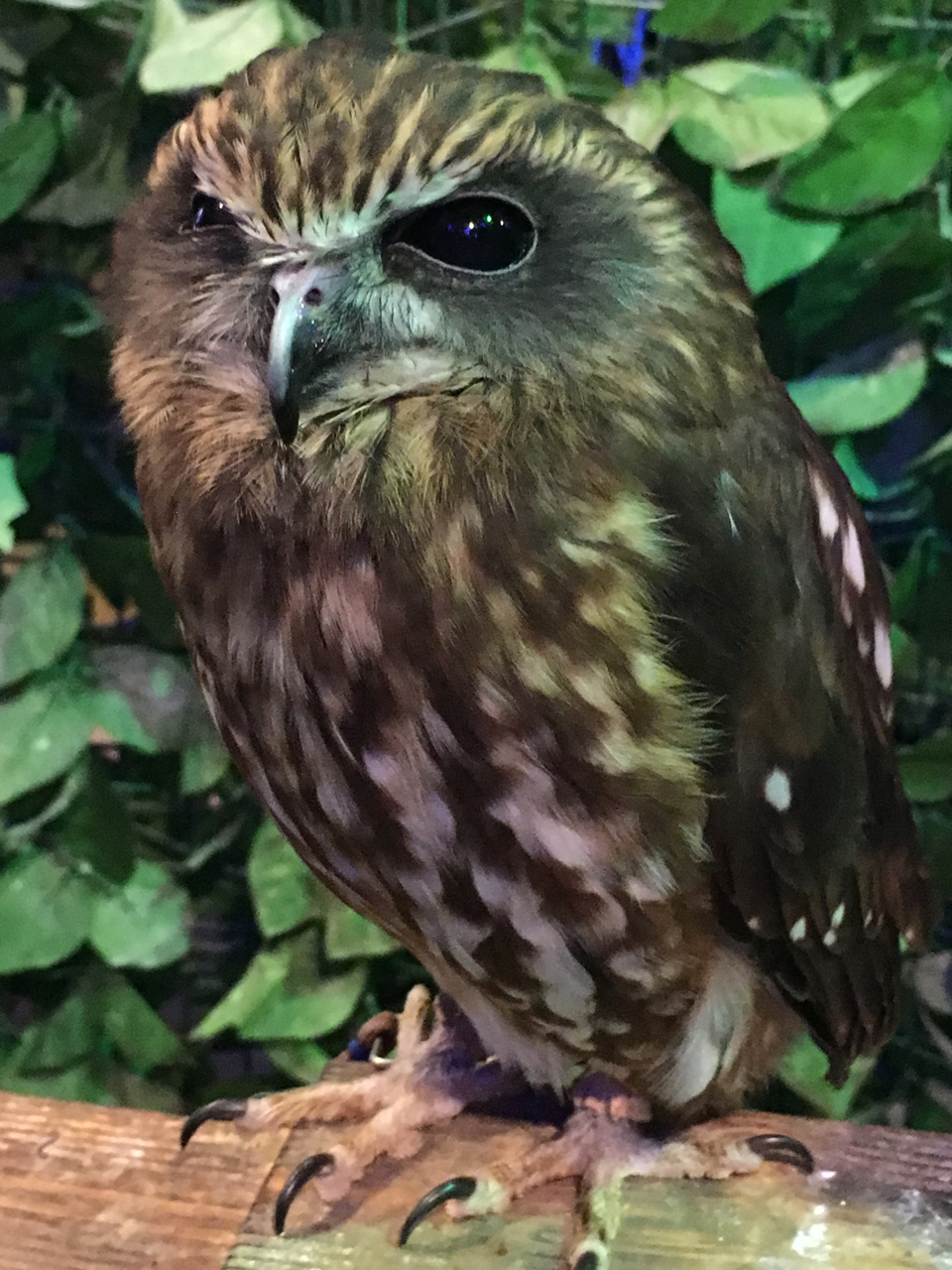
Her name is Holi Moli.

Most people have heard of Cat Cafes - coffee houses where cats roam freely so customers who like animals but can't own one can pet and play with cats while sipping lattes or iced tea.

But this Tokyo phenomenon has now given birth to an even stranger offspring: the OWL CAFE.

As the name suggests, it's a cafe where people go to pet and interact with owls.

Yes, live owls.


Much more fun than the dead kind.

I discovered the existence of Owl Cafes last spring, shortly before my last research trip to Japan, and since I've always wanted to touch a living owl, I hoped to pay one a visit.

As it happened, I stumbled across an owl cafe in Asakusa on the very first day of my trip, while doing research at Sensoji (Tokyo's oldest Buddhist temple, about which I've blogged here before). To escape from the rain, I wandered down a shopping arcade near the temple, and came across the most unusual--and compelling--barker I'd ever seen.

Tell me you wouldn't have gone inside too...


I didn't hesitate. I headed up the stairs, paid the cover charge (about $8.00, which entitles you to a drink and unlimited time with the owls), disinfected my hands (per the entry policy) and headed in.

Visitors are allowed to pet most of the owls -- the ones that don't like being touched have signs that say "Please look, but do not touch me" in both English and Japanese - but instructed to use the back of the hand (most likely to avoid harm to everyone).

Come at me, bro.

There were also other posted warnings.

Everybody poops. Sometimes, above you.


While some owl cafes are set up like standard coffee shops, with tables and wait staff who bring an owl to the customer's table for a time-limited visit, the owl cafe in Asakusa is built to resemble a jungle, with 12-15 owls sitting on perches and others roaming, flying, or wandering about on their own.

Barn owl!!

(Even more owls are in a resting room, away from the public - the owls are only "on" for a couple of hours at a time, and even then most of them can leave the public areas and fly into the rafters if they want to.)

The room is fairly dark - I suspect the owls are "time shifted" to think it's evening during operating hours, because most were alert and interested in the visitors.

Love the mustache.

Before visiting, I wondered whether the owls enjoyed being petted. Based on my experiences, both here and with other types of birds, they do. They leaned into my hand, fluffed up slightly the way birds do when happy, and didn't try to move away.

A happy owl.

For the record: petting an owl feels the way I believed that clouds must feel when I was very young. They're almost too soft to believe, and the amount of airspace beneath their feathers makes petting one feel like it almost disappears beneath your hand.  

I enjoyed my trip so much I went back a second time with my son, who also wanted to experience an owl cafe.

A boy and his owls.

He liked it as much as I did--and for the same reasons. Not only did we get to interact with owls, but the birds were clearly healthy, well-fed, alert, and not being forced to interact with us against their will. While some (the dozen or so that were actively "on duty") were tethered, the tethers were long enough to allow them to move around and to escape from visitors if they chose.

At least a dozen others were completely un-tethered, and most of them were still interacting with visitors. The ones that didn't want to be touched simply walked away or watched us from the parts of the cafe we could not enter.

On display, but not interested in being touched.

I loved it so much that I'll definitely go back, the next time I'm in Tokyo.

I finally found my own photobomber.

In fact, with no apologies . . . my son and I both had an 'owling good time.


Sunday, August 20, 2017

Surprised by Unexpected Joy*

-- Susan, every other Sunday.

*Given the state of the world, we need all the unexpected joy we can find, anywhere we can find it.

I woke up on the morning of July 10, 2017 -- the last full day of my research-and-graduation-celebration trip to Japan with my son -- with plans to shoot some last-minute research photos at Sensoji, Tokyo's oldest Buddhist temple.

Incense burning before a memorial stone at Sensoji.

I'd already visited the temple once, on the first full day of our trip, but it had rained:

Rain on Nakamise Street - with the temple gate in the background.

Which made shooting research images (both at Sensoji and at neighboring Asakusa Shrine) challenging:

Shrine guardian in the rain.

Since my son had plans with friends, I hopped the Ginza Line subway and emerged in the shopping street near Sensoji. People thronged the streets, packed even more tightly than I anticipated. Sensoji is a popular tourist spot, as well as a functioning Buddhist temple, but I hadn't expected such a crowd.

The reason for all the people became apparent as I reached the gate: unbeknownst to me, I'd arrived on a festival day:

Yay! IT'S A FESTIVAL!
Since I'd never experienced a Japanese shrine or temple festival, I was beyond thrilled. (For this, I was even willing to overcome my usual distaste for crowds.)

Food vendors lined the pathways all around the temple grounds, selling a variety of festival treats.

Slushy drinks, Fried Chicken, and CHOCO BANANA on a stick.

He's selling giant crab legs. Seriously. I'm not kidding.

Other stalls sold beautiful ground cherry pod plants and stalks, as well as hand-painted glass lanterns.

Ground cherry pod, aka "Chinese Lantern Plant"
The scent of plants and the tinkling of lanterns filled the air, along with a pleasantly cooling mist from spritzers hanging above the stalls.

Plants or pods, the choice is up to you.

Asakusa Jinja, a Shinto shrine that sits adjacent to the worship hall at Sensoji, was also celebrating.

Entrance to Asakusa Jinja
Tanabata trees lined the approach to the shrine, in recognition of the July festival commemorating the once-a-year heavenly meeting of the weaver and the cowherd.

People write wishes on colored paper and tie them to the tanabata tree.

A vendor just inside the shrine was selling one of the coolest festival drinks in Tokyo right now: a flavored slush composed of shaved ice, sparkling water and flavored syrup, served in a plastic lightbulb and adorned with a smaller, LED light-up lightbulb toy.

Japanese slushy drink! (Not too sweet.)

The day was hot, and I was thirsty, so I bought one--in the name of research.

The grape one was so tasty I went back for a lemon one later on.

While I sat in the shade, enjoying my treat, a Japanese woman approached me and said, "You're so lucky! You're here today!"

"Thank you!" I said, "It was a surprise - I didn't realize today was a festival."

Her grin got even bigger. "You didn't know! So lucky! Today is the day of 46,000 prayers. Do you know this festival?"

When I admitted ignorance, she explained:

"We believe that if you pray at Sensoji on July 10, it's the same as saying 46,000 prayers. Also, today is also the ground cherry plant festival, so you get two matsuri (festivals) in one! You really didn't know?"

I shook my head. "I didn't. This is my last day in Japan, and I wanted to spend it at Sensoji."

She clapped her hands in delight. "You are so lucky. Make sure to say a prayer today. It will count 46,000 times."

I promised I would, and thanked her, and she headed off to the worship hall.

Although I'd only planned to spend a couple of hours at the shrine, I scratched the rest of my plans and spent the entire day enjoying festival food, shooting photos, watching people, and reveling in the presence of hundreds of happy people enjoying a day at the festival.

The hozomon gate, as seen from the worship hall veranda.

Children laughed and ran around. Teenagers ate iced sodas, fries, and takoyaki (deep-fried octopus balls - a festival favorite). Adults of all ages strolled the grounds, bought ground cherry plants, and admired the tinkling lanterns that hung everywhere.

Ground cherry pods on display.

I saw people of many races (though admittedly, most were Japanese), both tourists and natives, Buddhists and people who doubtless belonged to other religions yet had come to see this lovely and important holy place.

Everyone loves a matsuri.

I didn't see a single unhappy face the entire day, and I don't know when I last saw such a large group of people enjoying themselves so much.

Festival booths with the Tokyo Skytree in the background.

Eventually I had to leave to meet my son for our final dinner in Tokyo and a trip to the Owl Cafe, but before I did, I said a prayer, as the Japanese woman suggested.

More accurately, I said 46,000 prayers, all the same: that everyone in the world could experience the kind of unexpected, unadulterated joy I had that day.