Showing posts with label history. Show all posts

Thursday, September 4, 2025

Au Revoir

Wendall ~ TBD

I have been immeasurably lucky to have been part of Murder is Everywhere for the last two and a half years.


It’s hard to imagine a group more supportive and kind than my compatriots here – all writers I admire for their imagination, range of knowledge and expertise, curiosity, conviction, and humor.


Most of us at Bouchercon 2023 in San Diego.
 

Through their blogs and their books, I’ve traveled from South Africa to Italy, from Greece to Scotland, from India to Singapore, seen art and architecture from all over the world, learned so much about international history and politics, and gathered new insights into ways the creative process can work.


Jeff, Sujata, Annamaria, and me at LCC in Tucson.

I’ve also had the privilege of sharing comments with many of you who’ve been kind enough to read my pieces.


So, it is with a heavy heart that I have to step away from the blog, at least for a while.


As I go, I’ll leave you with a few thoughts.


First, libraries and librarians are the bedrock of our culture and our profession.  They are responsible for my lifetime love of both reading and research. From my first “reading challenge” in second grade, which included Harriet the Spy, The Phantom Tollbooth, and The Yearling,  to the hours and hours I spent over the years in research libraries, like the Graduate Library at UNC, the (late) Colindale Newspaper Library, and my forever favorite, the Humanities Reading Room in the British Library.


One of my early faves.

I love the British Library so much that I set a hunk of Fogged Off there and included a totally fictional, and hysterical, research librarian. 


Approaching the BL.

 
And inside the Reading Room.

We must do everything we can to protect and support them.


Second, even though many of us sell the majority of our books on Amazon, it’s up to us and all our readers to make sure the independent bookstore continues as a source of stories and community. I’m pretty sure that almost every crime writer in Southern California has been helped by Anne Saller at Book Carnival and Debbie Mitsch at Mystery Ink and I owe an eternal debt to Pete Mock and Keebe Fitch at McIntyre’s in Pittsboro, North Carolina, for amazing support of my Cyd Redondo series. 


Anne Saller catches an action shot! Me, Jennifer Chow, Naomi Hirahara, and Ellen Byron had a blast in 2021.


What would we do without Book Carnival???

 
Pete Mock, Tim Maleeny, and me at McIntyre's in my hometown.

Me getting ready to write in the window of the wonderful Book Soup on the Sunset Strip.


Face in a Book is beloved by my Northern California friends, and there are so many of these amazing spaces still going. So, wherever you are, if you have a favorite, put it in the comments. Of course support your favorite authors and friends, but I for one am making a commitment to go to at least one reading/signing this fall for a writer I’m unfamiliar with.


Third, don’t let the bastards get you down/take no prisoners!


I will always be grateful for those of you who read widely, who want to travel to other times and places, and who are kind enough to read our books. 


Have a great time, all of you who are going to Bouchercon. I won't be there, but I do have a new story, "Actor Sex," in the anthology Hollywood Kills, which will have a signing there with many of the other wonderful writers. 


All of my short stories are set in 90s LA (hence the chiffon gloves). In this one, a cynical casting assistant chases down a "headshot" killer.


You can still find me on my website at https://wendallthomas.com at my author page on FB: https://www.facebook.com/CydRedondoMysteries/ and on my Instagram page: https://www.instagram.com/ewendallthomas/


Fondest to you all, near and far,


 Goodbye, farewell. . .


~ Wendall


Wednesday, June 18, 2025

Sweet as Syros

 Sujata Massey


I didn't think of Greece as being a big country. But when I dug into the geography while planning my recent trip, I found Greece has a significant mainland plus over 6000 islands and islets, with 227 of them habitable. 

227 islands!

These potential 227 choices present a dilemma to anyone who is interested in the Mediteranean and visits Greece more than once. The question is: if you’ve discovered an island that captivates you, should you return? Or do go on visiting more places that you’ve heard are special?

Greeks on the mainland also love their islands. I also have heard they tend to align with a particular island, often because of family history, and visit it a few times a year. They build relationships and have a home away from home.


Vaporia District


I suspect most foreign tourists (myself included) tend to relentlessly explore as many as they can. Yet certain islands will always get the largest numbers of people, and they are Santorini, Mykonos, Corfu, Rhodes, and Crete, the place where Tony and I started our trip. But now we were having a new adventure on the way to the island of Syros


Port of Ermoupolis


We traveled by ferry, the same strategy we’d used for island-hopping back in 1990. Fortunately, there are plenty of ferry companies in Greece that run much more smooth and comfortable transportation than in the past. I remember from the late time I visited in 1990. Huge ferries like those run by the efficient Seajets company can take 2100 passengers and hold up to 600 cars. Rides can be as short as half an hour or as long as twelve hours, with plenty of stops at islands large and small. Ferries have seating similar to a plane’s economy, business and first-class sections, albeit far more relaxing and uncrowded.  Restrooms, bathrooms, and coffee and snack bars abound—and it’s easy to change your seat, as long as you are in the correct cabin. 

The ride from Crete to Syros was about six hours, so we went with a “platinum” seating category. You check your luggage in an area on the entry deck, where cars park around the sides. I felt a little nervous to leave our two suitcases in the luggage rack for Syros, but I was relieved to see most of the passengers and luggage was clustered in the area bound for Santorini (of course). This made the accidental removal of our suitcases seem less likely.

Upstairs, we relaxed with coffee in our comfortable window seats with extendable footrests. We heard lots of American English around us all the way to Santorini. It was just two hours from Crete to Santorini, and at that destination, two-thirds of the cabin disembarked. Within ten minutes, another great throng filled in the seats, most heading for Piraeus, the port near Athens. 


A seawall of tumbled marble


The word Cyclades is an Anglicized reworking of the Greek word Kyklades referring to the circular position of this island group in the South Agean Sea. 32 out of the Kyklades’ 220 islands are inhabited—and some of the uninhabited ones have great historical and spiritual significance and have legal protection against visitation. Syros is the largest island in the Cyclades, with a population just over 21,000, and is known as the island that stays open year-round. Syros is still a place where people work in the shipyards or farming and making cheeses, honey and also having art and craft galleries and shops. But primarily, Syros has the long-lived prestige of being the legislative center of the Kyklades, ensuring a constant stream of Greek citizens with legal business. There is a neoclassical urbanity to most buildings in Ermoupolis that gives this island a more international feeling than other Greek islands I've had the pleasure of visiting. 


Town Hall of Ermoupolis


Apollon Theater


Entrance to Historical Museum of Hermoupolis


Archaeological evidence of human habitation on the island goes back to 3000 B.C. Through the turbulence of the Crusades and beyond, different countries claimed Syros as theirs, but this island did not suffer as much as some other places. Syros had the unique situation of being a place with both Catholicism and Greek Orthodox churches, making it a refuge for some during political upheaveals. This legacy of immigration and self-sufficiency, plus an excellent location close to Asia Minor, made Syros a center for shipbuilding and textile production in the 19th century. It became the second richest location in Greece (after Athens) during this era, and is still known as the capitol of the Cyclades islands.  With prosperity, the arts thrived—and at one point there were five opera houses on the island. Its predominantly neoclassical architecture is different from the boxy, small white houses throughout most Kyklades islands. Life goes on year-round for local people, and there’s now a significant cohort of artists, designers and digital nomads living on the island. 

Restored interior Apollon Theater


I was impressed by the old-fashioned look of the curving harbor when the ferry pulled in. Only about twenty people got off. A waiting taxi carried us on a brief uphill climb to our lodgings, Hotel Aristide, a renovated Venetian palazzo owned by the writer Oana Aristide, her sister and mother. The design and comfort was exquisite and it's been recognized as a Michelin-starred hotel. There are quite a few hotels in historic mansions scattered through Ermoupolis. 


Hotel Aristide


Kriti Suite bedroom


Kirti had a terrace and plunge pool


How incredible it seemed that all the streets were paved in marble—soft hues of cream, gray and pink that were accented in the colors of the stucco houses. 


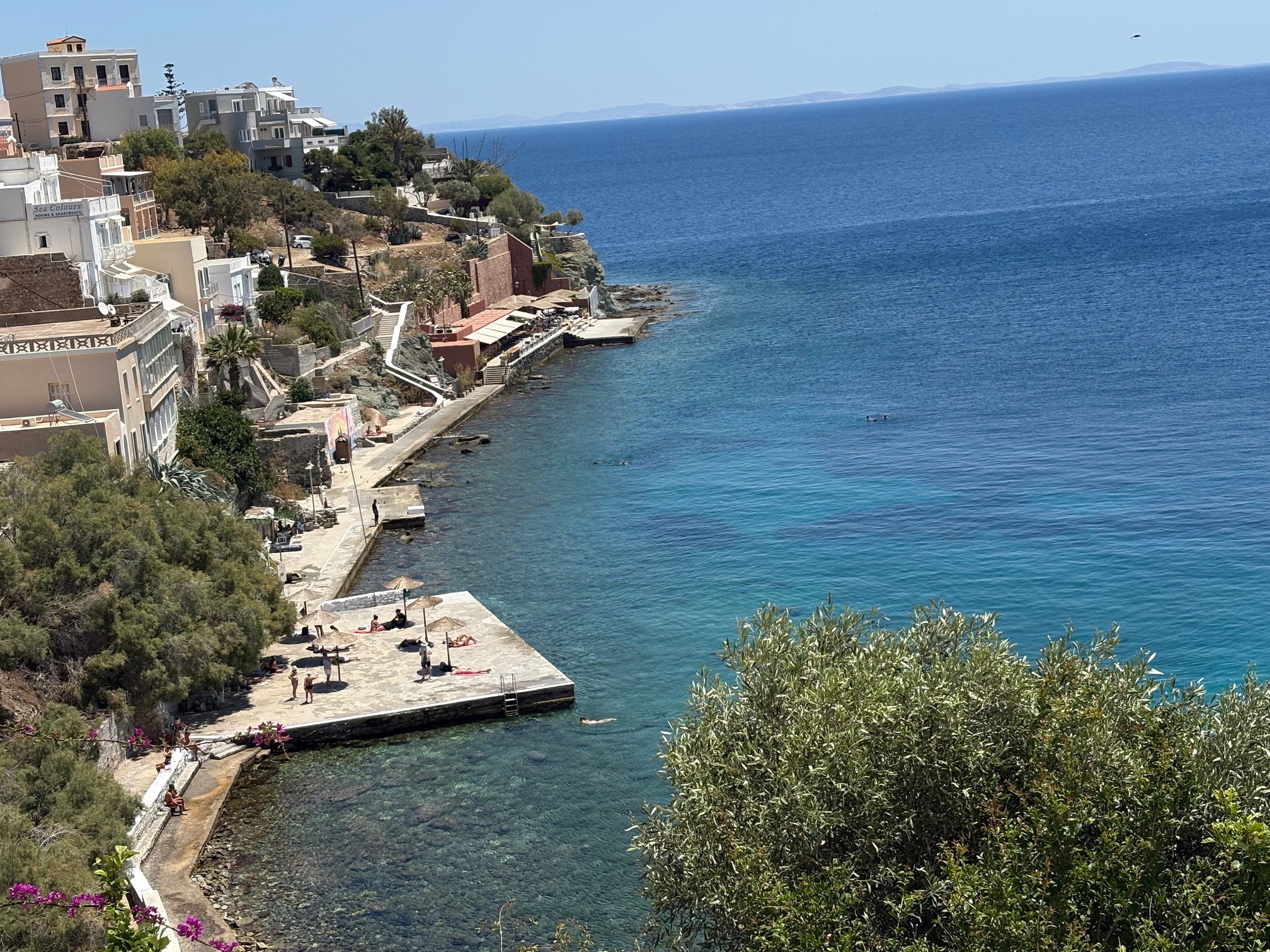
Later I was to learn marble is an intrinsic part of Syros's geology. Huge marble boulders made up the seawall near the port, and all other areas of Ermoupolis were cobbled in marble—the more industrial neighborhoods had tumbled marble, rather than the polished tiles of the Vaporia district. 


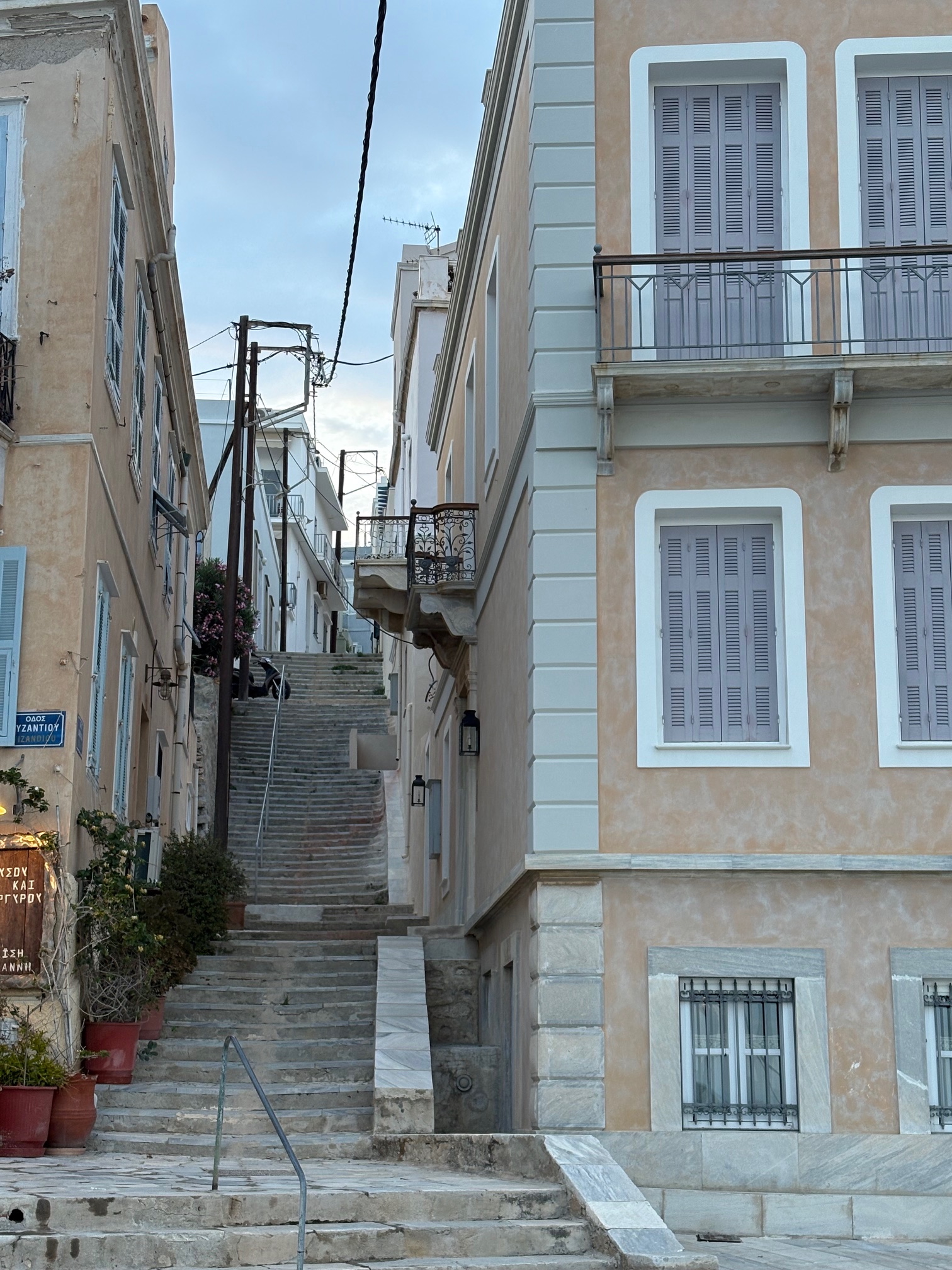
Flights of outdoor marble steps led upward from many streets on the island and opened into charming lanes, with houses set on either side. Not only did we see many small historic houses occupied by local families, there were also plenty of abandoned dwellings awaiting renovation. Historic preservation guidelines in Ermoupolis are strict, and while this ensures the area looks uniformly like itself, progress can be slow. Probably if I had stayed a few days longer in Ermoupolis, I would have been swept up in real estate fever myself. 


The neighborhoods were drop-dead beautiful—and the bonus was that the townspeople were friendly and there was an existing infrastructure of lovely restaurants and shops. Fabulous public buildings like the neoclassical Apollon Theater, modeled on La Scala, still hold regular performances, and we heard about a rock concert with international artists taking place just after we would head out. 

A small number of artists have camped out for good on a special part of the island, the historically Catholic village of Ano Syros. This is a white-washed paradise full of narrow exterior staircases that can only be traversed on foot. 


Ano Syros Lane and Agio Giorgios Cathedral, below


Tony and I had planned to walk from Vaporia to Ano Syros using Apple Maps. After experiencing just a few uphill staircases, though, my right knee protested. So, we went down the stairs to the town square and got a cab ride. The driver stopped at the edge of the village and urged us onward. We followed to the village’s famous Catholic church, Agio Giorgios. This was first built in 1200 and was rebuilt several times, including after a 1617 destruction by Ottoman invaders. Now it is known as the cathedral for the Roman Catholic Archdiocese of Syros and Milos.

The highly decorated sanctuary hadn’t changed since the 1830s and provided a deep, contemplative space from its spot at the top of the island. We stayed there for a while, imagining worshippers of the past--and all the steps they would have taken, several times a week, for their spiritual wellbeing. Syros is a windy island, which would certainly add to the challenge, especially during winter.

After a refreshing lemonade in a small cafĆ©, we skipped down a few hundred steps and then took a straight path back to Ermoupolis. We ran right into a small archaeological museum and stepped through the door and saw treasures that had been unearthed in the 19th century and originally sent on to a museum Athens. All these were returned to the island, due to the islanders’ strong feelings, and this museum that they built to prove they could respectfully share the island's history with visitors. 

Only a few museums exist on the island, and they all run on odd hours, a few days a week—at least in the shoulder season. And the delight was we didn’t share space with many other people, any time we were in such a venue. We noticed tourists tended mostly to be Greek and over thirty. Where were the partying kids so common elsewhere in Greece? 


A university lies somewhere on the 32-square-mile island, but I didn’t see it, nor any beach resorts. The truth was, we stayed close to Ermoupolis because we didn’t want to rent a car again. The stress of navigating very narrow, busy streets in Crete had worn us out. Ermoupolis is very walkable, so we took taxis three times on the island. We were surprised that the drivers wouldn’t take tips, and the fares they asked us for were quite low: ranging from 5 to 10 euros. This built a feeling of gratitude and trust.


Although English is less widely spoken on Syros than Crete or nearby Mykonos, a small but significant contingent of foreigners live year-round on Syros. These are digital nomad families who rent apartments and send their children to a flexible "worldschool" and daycare set up by Boundless Life, a company that has a few sites in other European countries. It’s an interesting strategy that schedules families to arrive together at a certain time, live in furnished apartments, share coworking space and develop friendships. A French musician who moonlighted as restaurant manager at the Aristide, and who's lived on the island more than twelve years, thinks the digital nomad program has been a plus. Alex pointed out the program rents properties from local landlords during the cold season and families buy what they need from local merchants and restaurants and shops. Most significantly, there is now an English medium school with an international baccalaureate to the island--building opportunities for cultural and linguistic connection. 


Tony was looking more Greek every day


The negative impact of tourism, especially crowding of public areas and conversion of local housing to Airbnbs, has been a source of anger in Portugal and Spain. It seems to be less virulent in Greece. Could this be because Greece's visitors are spread out over so many islands? Granted, there are islands with tourist overload--see Part 3, yet to come in this trilogy of blog posts! 

I was happy to investigate many small mom-and-pop restaurants serving mostly Greek and Italian food, as well as local fish, octopus and squid. Syros has a delightful market area selling local cheeses, honey, meats, fruit and freshly caught fish. In the heart of it is a casual restaurant called Street Food where I had an outstanding, simple meal of spinach rice, and chickpeas braised in tomato. 


And what great cappucino can be ordered at the dozens and dozens of coffee shops! Many cafes could be found near the port, in the shopping district, and around the lovely town square. One of Greece’s most famous ice cream shops, Django, has its original location in the market area of Syros. It was here that I ordered a cup of sorbet, a half portion of pistachio and vanilla sorbet each. I wouldn’t have thought of mixing my order, but the young man behind the encounter insisted that it was the only correct combination. I liked the strength of his opinion--and the sorbet tasted like full-fat gelato!


Our appetite was strong on Syros, and the most delicious and enjoyable meal we had was a lunch cooked in a cooking class in one of the glorious old Vaporia mansions. Here we met Eliza, a Greek lady from the mainland, retired from being a translator, who fell in love with an islander and the island herself. Eliza and her husband Kostas renovated Villa Maria, a late 19th century Venetian-style palazzo on a narrow lane that serves as both an inn and a cooking school. During Eliza’s Saturday class, we met four other Americans and a German. 


Fava married with capers and red onions


Tirititim: aSyros specialty with zucchini and egg


Some of my favorites out of the seven dishes we cooked were fava, yellow split peas with caramelized red onions and capers; a delectable baked dish of eggplant and potatoes and tomatoes that was not moussaka; vine leaves baked with a tangy solid yogurt filling; and a dessert pie of baked milk and semolina. The simplicity of Greek ingredients makes the vegetables stand out and the food taste heavenly. Eliza kindly emailed her precious regional recipes to all of us, and I approximated the fava just a few days ago.


Eliza's traditional kitchen


It's hard to put into words why Syros put such a spell on me. Perhaps it was the mix of sophisticated and simpler but charming houses set against the coastline, or maybe it was the lowkey friendliness and honesty of the locals. Syros is kind to tourists: and because it doesn’t depend on them for life, that makes a significant difference. 

After five pleasant days, I sailed away thinking: I might like to break my explore, explore, explore pattern when it comes to Greece, because I'd love to imagine Syros could be my own homecoming isle. 


Wednesday, March 12, 2025

Where is this?

SUJATA MASSEY 


I traveled in India this winter. Have you been to this same place?


Relax! The tigers are stone


Very large medallions around the lights


Sweet children, one of whom got this house


Commemoration of British and Indian trooping celebration


Nets over the sky keep out birds


So many grand performances happened here


Somebody's got to polish the throne

So, can you guess where I visited?


Wednesday, March 27, 2024

When A Bridge Falls

 SUJATA MASSEY


                                                    Photo courtesy PBS


Like so many Baltimoreans, I spent yesterday on the phone telling friends and relatives that I was alive. No, I hadn’t been anywhere near the Francis Scott Key Bridge early Tuesday morning. But I was following the news from before sunrise, because my email carried an emergency bulletin from the city. A bridge had collapsed—not just any bridge, but one bearing the name of The Star Spangled Banner’s author—a man who had witnessed the British attack on the Baltimore Harbor during the War of 1812 and written the song in honor of the defending Americans at Fort McHenry.


One of the first matters raised in the press and private conversation was whether this shocking collision had been an attack. A falling bridge reminded me of falling towers. And ships are supposed to be protected with backup systems should power be lost--so what happened?


The Dali, a cargo ship carrying containers bound for Sri Lanka, reportedly had its lights flicker off before they came back on, leading to speculation that a generator did kick in. Still, the crew realized they could not control the ship’s propulsion and issued a May Day signal. Fortunately, the alert was received and communicated instantly by the Maryland Department of Transportation. Police closed vehicle entry to the bridge just before the Dali hit one of the bridge’s major supports. 


That was too late for a small group of construction workers atop the bridge, because after the collision, the bridge collapsed in forty seconds. Two men were rescued from the water, and the Coast Guard has announced that it’s unlikely the remaining six workers could have survived the cold waters this long. Of course, some cars might have already been on the bridge when it was closed; so there may be more cars and bodies submerged in the water.  


According to a colleague who knew the crew, they were immigrants from El Salvador, Mexico, Honduras, and Guatemala. The workers were employed by a Baltimore County contractor who supplied labor for bridge repair and construction. Baltimore is the country’s largest point of entry for foreign cars, and overall, its third largest industrial port. And it’s one of the nation’s oldest ports, dating from the beginning of the 17th century, when tobacco was the chief imported product. The early locations were Fells Point, a beautifully preserved waterfront district, and then and Inner Harbor that edges our downtown area. The original owners of the 1897 house I live in had a saloon on Water Street near that harbor, which was a bustling, rowdy locale. As decades passed, more areas to receive cargo were built further out from the city itself. The northwest areas of the Patapsco River are the location of side of the Helen Delich Bentley Port of Baltimore, the chief industrial port. 


The Dali was built by Hyundai in South Korea in 2016. After the Dali had an accident involving propulsion at the Antwerp, Belgium Harbor, its first owner sold it to a Singapore Company, Grace Ocean Pte Limited. The ship’s technical state was managed by a company called Synergy that reportedly has a history of three worker deaths on their vessels since 2018. The 22 crew members of the Dali are Indian, and they are still on the boat, along with many of the 4600 20-foot containers of cargo. It seems miraculous that the whole crew survived the bridge collapse. 


Civil engineers, boat experts, and veteran seafarers will be busy explaining the cause of the accident—ship company, bridge design, and perhaps something else--for months to come. 


Yet I imagine that the construction workers on the bridge were in the wrong place at the wrong time only because they’d had to leave dangerous homelands. Upon arrival in Baltimore, they found jobs that ensured American comfort: raking leaves, cleaning bathrooms, digging up and repaving roads.  For the Dali’s Indian crew, the motivation was likely similar. The promise of a decent paycheck sends many young Indians abroad to jobs where they work overly long hours under difficult conditions


Until the bridge accident is cleaned up, Baltimore’s port will be closed to traffic. The cost of the lost business, and rebuilding the bridge, are huge; even if the latter is paid for by U.S. taxpayers and shipping insurance. But it’s also a very great cost to our humanity, if we forget that those most hurt by the bridge crash are the folks do the invisible work of making our life easier. And we will likely never know their names. 

Wednesday, November 29, 2023

Held up in Fort Cochin

 SUJATA MASSEY


It feels like only yesterday that I was driving out of Kumarakom Village, in the Kottayam district near Lake Vembanad. That's how much of lasting impact the gorgeous, green state of Kerala in South India has, even on my fifth visit.

From Kumarakom, it was 53 kilometers north to Kochi, with its historic port district still called Fort Cochin.Originally, this port town was part of the kingdom of Kochi, but in 1503, the territory was gifted by Kochi's Rajah to the Portuguese who'd provided military support in war with a neighboring ruler. The Portuguese lost Kochi to Dutch colonizers in 1663, and then in 1814, the Dutch decided to swap the region with the British for a larger prize: Malaya. 

Our driver knew the freeway was packed with traffic that Saturday, so he took us on scenic byways through little villages, where we saw people shopping at stands like this one. I had tasted a few varieties of bananas while staying at Kumarakom Lake Resort, but passing by these fruit vendors I heard that there are close to 100 varieties growing in Kerala. The banana is the state's favorite fruit, and as I researched Kerala bananas later, I learned that unfortunately 25 to 40 percent of the crop is lost each year due to insufficient storage. It reminds me of what I've heard about the high food waste per household in the United States. But oh, how much I'd rather eat the tiny sweet bananas of Kerala, which can be sautĆ©ed,  boiled, and also turned into snacking chips. 


It was a pleasant hour-and-a-half journey to Fort Cochin, a district that seemed more densely packed with tourists than I remembered from my previous visits. Late October was still monsoon weather, meaning a torrential downpour of at least 90 minutes around 6 pm, but there were umbrellas in the lobby at Forte Kochi, our small hotel on Princess Street. And yes, there were plenty of bananas every day at the breakfast buffet.


This particular hotel was originally a grand 19th century house built by the Dutch that later became the home of a prominent Jewish merchant family. This family added a mikvah in the courtyard. Colors are bright, from the stucco to the tiled stairs, and the spiral ironwork stairs are typical for Fort Cochin.

The ritual bath is still preserved, albeit with a guarding chain to keep guests from wandering down the steps into very murky water. 


At present, the hotel is owned by a Kerala-based hotelier with a Christian name--Paul John. That name and the multicultural staff we met everywhere in Kochi reflect the diversity of many cultures living together peacefully for centuries--from the Dravidian people who had been the first known occupiers of the land that later hosted both Muslim and Hindu kingdoms, as well as the Protestant and Catholic Christian Indians whose ancestors had settled here before Christianity had arrived in Europe. Then there were Middle Eastern immigrants including Muslim traders and Jewish sailors. A beautifully preserved synagogue still stands in Fort Cochin, although the Jewish population in all of Kerala is said to have reduced to just fifteen people. 

To deeply engage with Kerala's history means reading. I was delighted to see that right around the corner from the hotel was an independent bookstore in a historic house called Idiom.Inside Idiom's cozy ground floor, I found many shelves of old and new books, with a special focus on history and culture of the area.
I'd been trying to remember the title of a highly-praised nonfiction book about Travancore's famous maharanis, and Thushara, the co-owner, helped me find it: Manu Pillai's book, The Ivory Throne: Chronicles of Travancore. I also couldn't resist Aliyah, The Last Jew in the Village, a historical novel originally written in Malayalam by Sethu. 


Book-buying was followed by an afternoon pause to let the rain arrive, have its way with the town, and then subside. It was time to walk to dinner at a delightful restaurant, Fusion Bay. But conversation inside the restaurant was overwhelmed for twenty minutes by the loud sound of fireworks, traffic and beating drums. We hurried outside to join the throngs of people watching a parade that included everyone from men on motorcycles to nuns. An image of Jesus was carried aloft, and we suddenly realized it was All Saints Day, and this was likely a church parade delayed a bit by the monsoon rain.


 The next morning, we went for a pre-breakfast walking tour with an excellent local guide. He explained the colorful paintings on some of the old house walls were part of one of Kochi's past Biennale expositions of international art. It's not clear if the Biennale will continue, due to financial constraints, but the art will endure. We also walked to the area where local men still catch fish using gigantic fishing nets, and through old parks and residential district with more eye-candy houses.


We left Fort Cochin that afternoon to visit to the nearby city of Ernakalum in order to lose a few hours at the Kerala Folklore Museum. Started by the late George Thaliath and continued by his wife and children, this museum  holds thousands of objects, large and small, ranging from temple statuary to paintings and poison-testing dishes used in old royal courts. The vast scope household and temple artifacts and art of various periods made the immensity of Kerala's history almost overpowering. Perhaps because my head is stuck in the 1920s, I zoomed in on a painting of a lovely young aristocratic woman in painting from that time. The museum also has a lovely gift shop like I've never seen that sells antique and modern crafts, and artisan-made textiles and jewelry.


My time for Fort Cochin was just two nights, but Air India complications with a five-times-delayed flight from the Kochi Airport meant that we almost didn't leave. I had the same experience with a much-delayed Air India flight from Cochin twenty-six years ago, and that delay lasted six days! It's one thing to hole up in a nice hotel room when it rains, but nobody wants to be held up for more than 18 hours when other airlines are running flights to the same place. Therefore, after a few hours, we gave up on Air India and booked on Indigo for a 2 am flight to Mumbai. As frustrating as the situation was, there was something adventurous about flying in the middle of the night from a mostly deserted airport terminal. And then, before the sun had risen, we had reached Mumbai.