Showing posts with label shojin ryori. Show all posts

Sunday, July 8, 2018

A Shojin Ryori Meal on Koyasan

--Susan, every other Sunday

Last week I spent two lovely (if rainy) days on Koyasan, one of Japan's most famous peaks and the setting of my newest Hiro Hattori novel, Trial on Mount Koya, which released last week.

The trip served several functions: first and foremost, I climbed to the summit of Bentendake - one of Koya's peaks that sits along the historical "women's pilgrim trail" - the only part of Koyasan that women could enter until the 19th century.

The Shinto shrine on the summit of Bentendake


This was the fifteenth of my hundred summits, and since I climbed it on release day it also served as a "happy birthday" to the new book. In a twist of poetic justice (and irony), I arrived on Mount Koya directly ahead of a thunderstorm--just as Hiro and Father Mateo do in the novel--and found myself racing the clouds to the top of the mountain, hoping as they did that the storm would hold off long enough for me to reach my goal.

A section of the women's pilgrimage trail.

Spoiler alert: I made it.
On the summit of Bentendake

As it turned out, the rain held off long enough for me to pay an extended visit to Koyasan's holy temples and Japan's largest cemetery, Okunoin. After finishing a lovely hike, I headed to Ekoin, the thousand year-old temple where I like to stay on Koyasan. My room was ready:

Koyasan guest room.

And shortly thereafter, a priest arrived with my dinner trays.

"The Main and the Second Tray" - a typical evening meal.

(At Ekoin, as at many temple lodgings on Koyasan, the evening meal is served in your room, allowing you to partake at leisure and meditate on the colors, textures, and flavors of your meal.)

Ekoin and other shukubo (temple lodgings) throughout Japan prepare meals in the shojin ryori style. "Shojin Ryori" means temple cuisine--a sophisticated, vegan style of cooking developed over centuries by and in Buddhist temples.


Mountain greens with grated daikon (radish).

Although these meals incorporate no animal products, the cooking style has many rules designed to ensure that the food inspires thought and meditation, and helps to balance the diner's body, mind, and spirit.

Gomadofu - tofu made entirely from sesame seeds instead of soy.

A meal cooked in shojin ryori style adheres to the "rule of five" - meaning it contains five flavors (salty, bitter, sour, sweet, and umami) and five colors (red, yellow, green, black, and white), all of which are derived exclusively from preparation of natural, seasonal ingredients.

Vegetarian "sashimi" - with the taste of bell pepper, mountain greens,  and ginger
The meals also strive to offer a variety of cooking techniques and textures, including a soup:

Dashi (broth) made from roasted soybeans with vegetables and tofu

A fried element (or two):

Vegetarian spring roll filled with mushrooms and tofu.
As well as steamed and baked components.

Root vegetables (potato, carrot, taro, and lotus) with tofu.
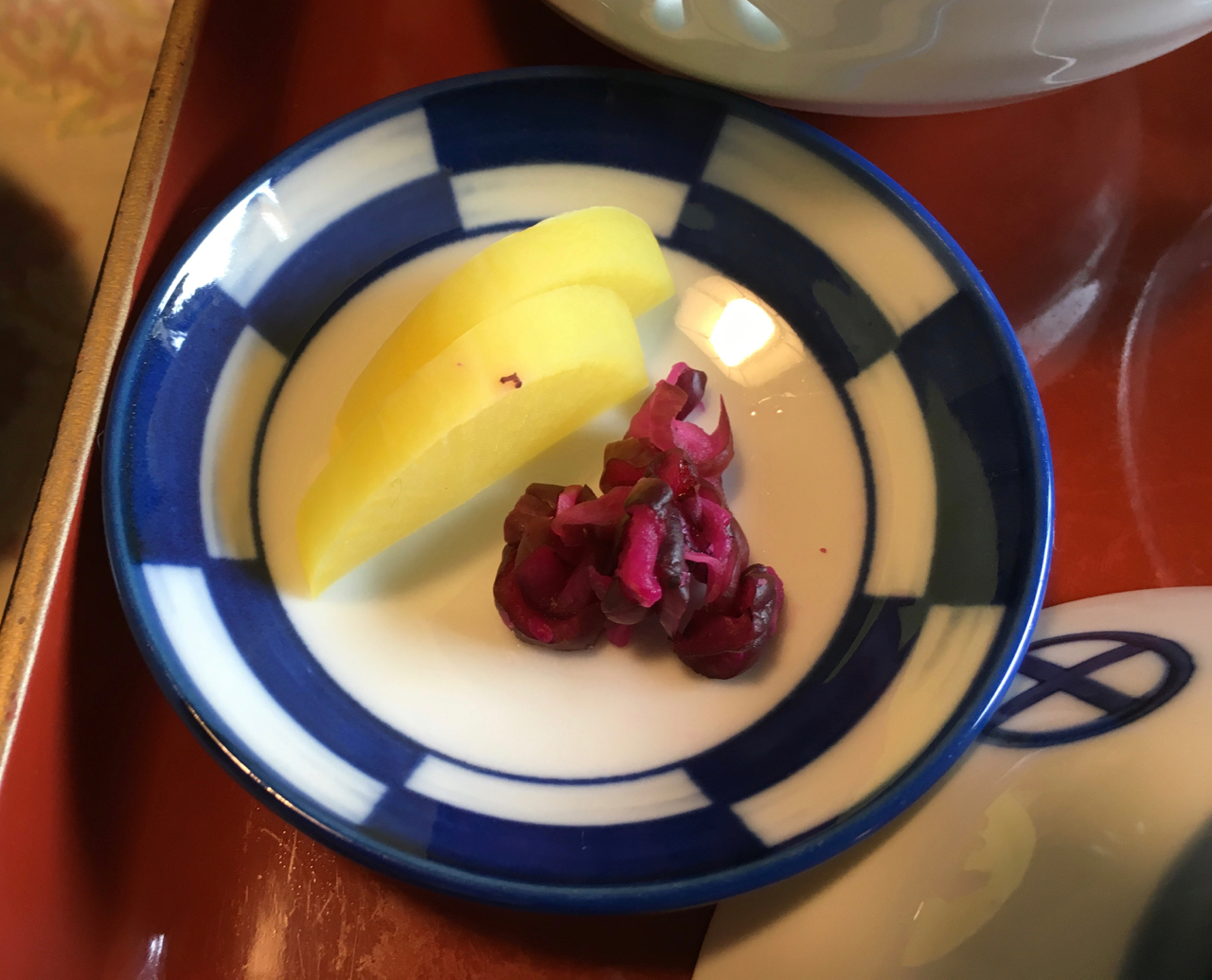
Tsukemono (pickles), rice, and tea are also a standard part of every meal.

Pickled daikon (the yellow slices) and shibazuke - eggplant and cucumber pickled in red miso (hence the purple color) 

No two shojin ryori meals will ever be the same - I spent two nights at Ekoin this trip, and my dinner trays were almost entirely different on each night.

Vegetarian noodles with mountain vegetables

The dishes you see here were from my first night's dinner. (I'll blog about the second night at my own website later on this year.)

Tempura: lotus root, sweet potato, baby corn, mushroom, kubocha squash - with matcha (green tea) salt for dipping.

Dishware for shojin ryori offerings is also carefully chosen to complement the colors, shapes, and textures of the food.

Grapefruit and watermelon.

Diners can - and are expected to - move back and forth between the offerings, experiencing a range of colors, tastes, and textures throughout the meal. While some of the dishes may look odd, or seem unusual to Western palates, I assure you every bite of every plate is absolutely delicious - a wonderful way to celebrate a book release and my fifteenth mountain climb.

And the view from the room was nothing to sneeze at, either...

Guest room view, Ekoin, Koyasan

Eventually the storm arrived (though fortunately without the killings that accompanied the one in my novel...) but I didn't mind. If you've got to be stuck on a mountain in a storm, Koyasan is a lovely and peaceful place to spend the day.


Sunday, February 4, 2018

Stepping Back a Thousand Years: A Night at Ekoin

-- Susan, every other Sunday

While researching my upcoming mystery Trial on Mount Koya, I spent some time on sacred Mount Kōya, the mountain that lies at the heart of Shingon Buddhism in Japan. While I've posted about other aspects of Mount Kōya in the past, I thought today I'd take you along for a virtual night at Ekoin, a thousand year-old temple where I've had the privilege to stay on two separate trips to Kōya-san.

The front gates of Ekoin

I arrived on a crisp autumn afternoon at 3pm--the temple's check-in time--and passed through the wooden gates to discover a lovely, inviting yard.

An island of peace in a troubled world.


The building on the right is the residence hall.

In the entry, I paused to remove my shoes and leave them on wooden racks designed for that purpose--and to slip on a pair of sandals, placed in the entry for use inside the temple. The resident priests wear these as well (or walk in socks), to preserve the wooden floors.

A priest took my luggage and led me down the interior hall--in the photo below, you can see the way the hall (on the left side of the photo) lies between two sets of sliding panels.


On one side (center frame), they separate the passage from the veranda and yard, and on the other (visible on the upper left side of the photo) from large, group guest rooms and rooms that hold the temple's art and treasures.

My guest room was on the second floor, down a hall with windows that offered a lovely view of the surrounding koya--a saddle on the peak from which the mountain derives its name.

The view from the upper hallway at Ekoin

The guest rooms haven't changed too much in the thousand-plus years since Ekoin's founding--with the exception of televisions (a convenience for modern guests, though I prefer to leave them off and experience the temple without electronic interference), telephones, propane heaters, and electric lights.

My guest room in the evening--after dinner--with the futon laid out for sleep

Although guest rooms are private, toilets are shared, and located at the end of the hall. Shower and bath facilities are also shared (but segregated by gender) and located on the ground floor, near the entry.

A traditional welcome awaited me in the room: a pot of hot water (for making tea) and a traditional pastry filled with sweet bean paste. A delicious, peaceful way to relax and unwind after a morning of hiking and research.

Temples serve delicious tea.

When I finished my tea, I explored the temple and its grounds, and took a walk through nearby Okunoin, Japan's largest cemetery. I returned to my room around 5pm and relaxed until 6, when a priest brought my dinner tray.

Dinner for one - two trays, plus rice and tea. Details two weeks from today.

Shojin ryori, or temple cuisine, is my favorite type of Japanese food. It's entirely vegetarian, and although I'll post in the future about the specific rules that apply, you can trust me when I say it isn't boring (and the photos prove it, too).

After dinner, I spent some quiet time in my room and went to bed early, because nobody sleeps late at a Buddhist temple--including the guests!

The temple bell rang at 5am, waking me from a delightful sleep and warning me that I only had 30 minutes to dress and get to the temple's worship hall for the morning service.

Morning services at Ekoin. The priests invited photos (but I took only this one, beforehand).

After the service, we walked across the yard to the goma hall for the fire ritual (something I've blogged about before).

The goma at Ekoin.

The ritual concluded around 6:45, whereupon I returned to my room to find a delicious breakfast waiting. (More on its contents in two weeks, when I'll post about temple cuisine.)

Unusual to Western eyes, perhaps, but delicious all the same.

Checkout time is 9am (I told you, nobody sleeps early in a temple!) so visitors staying only one night have time for a leisurely breakfast before checking out at the temple office. I left a little early, and headed out to see Danjo Garan, one of the first temple complexes established on Mount Koya.

One of the pagodas at Danjo Garan

Many Japanese temples offer overnight lodging, and although the experience doesn't equate to life in a temple, or even precisely to what a visitor might have experienced hundreds of years ago, it definitely gives at least a hint of what such an evening would have been like--and it also allows us to spend the night in a beautiful, peaceful place where years and the worries of the world can slip away like leaves in a flowing stream.