Showing posts with label Shingon. Show all posts

Sunday, February 4, 2018

Stepping Back a Thousand Years: A Night at Ekoin

-- Susan, every other Sunday

While researching my upcoming mystery Trial on Mount Koya, I spent some time on sacred Mount Kōya, the mountain that lies at the heart of Shingon Buddhism in Japan. While I've posted about other aspects of Mount Kōya in the past, I thought today I'd take you along for a virtual night at Ekoin, a thousand year-old temple where I've had the privilege to stay on two separate trips to Kōya-san.

The front gates of Ekoin

I arrived on a crisp autumn afternoon at 3pm--the temple's check-in time--and passed through the wooden gates to discover a lovely, inviting yard.

An island of peace in a troubled world.


The building on the right is the residence hall.

In the entry, I paused to remove my shoes and leave them on wooden racks designed for that purpose--and to slip on a pair of sandals, placed in the entry for use inside the temple. The resident priests wear these as well (or walk in socks), to preserve the wooden floors.

A priest took my luggage and led me down the interior hall--in the photo below, you can see the way the hall (on the left side of the photo) lies between two sets of sliding panels.


On one side (center frame), they separate the passage from the veranda and yard, and on the other (visible on the upper left side of the photo) from large, group guest rooms and rooms that hold the temple's art and treasures.

My guest room was on the second floor, down a hall with windows that offered a lovely view of the surrounding koya--a saddle on the peak from which the mountain derives its name.

The view from the upper hallway at Ekoin

The guest rooms haven't changed too much in the thousand-plus years since Ekoin's founding--with the exception of televisions (a convenience for modern guests, though I prefer to leave them off and experience the temple without electronic interference), telephones, propane heaters, and electric lights.

My guest room in the evening--after dinner--with the futon laid out for sleep

Although guest rooms are private, toilets are shared, and located at the end of the hall. Shower and bath facilities are also shared (but segregated by gender) and located on the ground floor, near the entry.

A traditional welcome awaited me in the room: a pot of hot water (for making tea) and a traditional pastry filled with sweet bean paste. A delicious, peaceful way to relax and unwind after a morning of hiking and research.

Temples serve delicious tea.

When I finished my tea, I explored the temple and its grounds, and took a walk through nearby Okunoin, Japan's largest cemetery. I returned to my room around 5pm and relaxed until 6, when a priest brought my dinner tray.

Dinner for one - two trays, plus rice and tea. Details two weeks from today.

Shojin ryori, or temple cuisine, is my favorite type of Japanese food. It's entirely vegetarian, and although I'll post in the future about the specific rules that apply, you can trust me when I say it isn't boring (and the photos prove it, too).

After dinner, I spent some quiet time in my room and went to bed early, because nobody sleeps late at a Buddhist temple--including the guests!

The temple bell rang at 5am, waking me from a delightful sleep and warning me that I only had 30 minutes to dress and get to the temple's worship hall for the morning service.

Morning services at Ekoin. The priests invited photos (but I took only this one, beforehand).

After the service, we walked across the yard to the goma hall for the fire ritual (something I've blogged about before).

The goma at Ekoin.

The ritual concluded around 6:45, whereupon I returned to my room to find a delicious breakfast waiting. (More on its contents in two weeks, when I'll post about temple cuisine.)

Unusual to Western eyes, perhaps, but delicious all the same.

Checkout time is 9am (I told you, nobody sleeps early in a temple!) so visitors staying only one night have time for a leisurely breakfast before checking out at the temple office. I left a little early, and headed out to see Danjo Garan, one of the first temple complexes established on Mount Koya.

One of the pagodas at Danjo Garan

Many Japanese temples offer overnight lodging, and although the experience doesn't equate to life in a temple, or even precisely to what a visitor might have experienced hundreds of years ago, it definitely gives at least a hint of what such an evening would have been like--and it also allows us to spend the night in a beautiful, peaceful place where years and the worries of the world can slip away like leaves in a flowing stream.

Sunday, October 29, 2017

Walking With Kobo Daishi - A Visit To Okunoin

--Susan, every other Sunday

On both of my last two trips to Japan, I spent significant time beneath the towering ancient cedars of Okunoin - Japan's largest cemetery.

A map of Okunoin. Kobo Daishi's mausoleum is at the top, and the entrance at the bottom left.

The cemetery stretches over a mile from end to end, and has over 200,000 graves--some of which serve as the spiritual grave sites for multiple people rather than just one.

The Nissan Corporation tomb - erected on behalf of all employees, past and present.

The cemetery begins at Ichi-no-hashi (the first bridge), where a paved path leads visitors into the cedar-lined path that runs through Okunoin from end to end.

Visitors bow before crossing Ichi-no-hashi into Okunoin.

Lanterns along the side of the path illuminate the way on cloudy days and after dark. (The cemetery is open year round, 24 hours a day - and it is haunted, but not in a menacing way, as I've written about here before.)

Illuminating the way.

According to Shingon doctrine, anyone buried--in part or entirely--at Okunoin will return to life first at the time Miroku (the Buddha of the Future) returns to earth at the end of days. For that and other reasons, since the cemetery's founding in the 9th century, many adherents of the Shingon faith (and others -- anyone can be buried at Okunoin, if (s)he believes in the teachings of Kobo Daishi, Buddhist or not) have wanted to be buried on the mountain.

Buddhas in their kerchiefs and bibs

Kobo Daishi, the priest who brought Shingon Buddhism to Japan from China, is buried there too - though Shingon doctrine states he's actually still alive, in a state of eternal meditation that will continue until Miroku returns.


You can't photograph Kobo Daishi's mausoleum, so here's a buddha for you instead.

Visiting Okunoin, and seeing his mausoleum, is often referred to as "Visiting Kobo Daishi" - and he has many, many visitors. Okunoin is a popular tourist destination for Buddhists and non-Buddhists, Japanese people, and foreign visitors.

It doesn't hurt that the cemetery has glorious foliage displays each autumn, either.

Autumn blazing at Okunoin.

Or that its graves have incredible character:

The best Buddha anywhere.

Some monuments are built on behalf of companies for the benefit of their employees, like the Nissan tomb I posted above. There's even a tomb erected by a termite company--on behalf of the insects it kills in the course of business. (I don't have a picture of that one either, because despite three days of exploring, I haven't found it yet. Stay tuned. I haven't given up.)

Many side paths branch off from the main one.

Many famous Japanese people are buried (or have mausoleums or monuments) there, including several shoguns and numerous daimyō (medieval warlords).

The mausoleum of Uesugi Kenshin, erected during the 16th century.

Their monuments stand directly beside those of ordinary people, men and women whose names and achievements are now mostly lost to history.

Many tombs. Many lives.


In all my travels, I have never been to a place as silently peaceful as Okunoin. The cedars rise to the sky like protective sentinels, guarding the dead who lie beneath.

The graves don't ever seem to end.
The well-tended graves and kerchiefed Buddha statues speak of a place where the dead may not be visible, but remain as loved and remembered as any living person could ever hope to be.

Dead, but not forgotten.

It is a place where even the most troubled, stressed-out heart can find peace, and where anyone with reverence for the spirit and the residents of the place is not only welcome, but invited to walk and think and be.


It is a holy place, where real, lasting peace feels possible, tangible, and close.

These photos don't do justice to its beauty, so I hope, if you ever have the chance, you'll go and visit Kobo Daishi beneath the trees.


I can assure you, it will be a day well spent.


Sunday, February 5, 2017

A Hairy Tale of Love and Justice in Japan

--Susan, every other Sunday

While visiting Japan last autumn, I spent a night at Tatsueji, a Shingon (esoteric) Buddhist temple on Shikoku - the third of Japan's four largest islands (counting from north to south).

The hondo (worship hall) at Tatsueji.

Tatsueji is #19 of the 88 Buddhist temples on the Shikoku Junrei, a pilgrim route which circles the island of Shikoku. Pilgrims (henro, in Japanese) walk the 750-mile circuit for a variety of reasons -  someday, I hope to walk the entire route myself.

Tatsueji, which lies in the southeastern part of Shikoku, about 30 minutes by train from Tokushima City, is also one of four sekisho, or spiritual checkpoints, where pilgrims are supposed to reflect on what they have learned from the journey so far. In spiritual terms, a sekisho was (and is) similar to the checkpoints between provinces, where travelers had to show their documentation and receive permission from the local lord, or daimyō, to proceed. At the sekisho, a pilgrim's "travel permit" was obtained through self-reflection and personal confirmation that (s)he had, indeed, been transformed in some way by the journey.

According to some, pilgrims who have not experienced personal transformation upon reaching a sekisho are supposed to turn around, go back to temple #1, and start over. Japanese legends also say that people who are impure of heart cannot pass through the gates of a sekisho temple.

Fortunately, I had no problem entering:

The view from the front gates of Tatsueji.

and the view from my room was spectacular:

The view from the guest room, Tatsueji.

The statue to the right of the pagoda is Kōbō Daishi, the priest who brought Shingon Buddhism to Japan from China, and established it as a major Japanese sect.

Kobo Daishi

Like most temples, Tatsueji's gates have guardian statues in its alcoves--but the left-side alcove also holds a tangle of rope and human hair, which is one of the temple's most sacred objects and a symbol of the temple's most famous legend.

The rope is actually to the left of this giant sandal - but sadly, it did not photograph clearly.

Centuries ago, a young woman named Okyō was sold into prostitution in Osaka because her family could not afford to keep her. The story varies a bit by source, but most versions agree that Okyō eventually killed one of her lovers in order to run away with another one; after the murder, Okyō and her surviving lover fled to the island of Shikoku, disguised themselves as pilgrims, and began walking the pilgrim trail in hopes of evading justice.

Upon their arrival at Tatsueji, Okyō's long hair became entangled in the bell rope for the temple bell (apparently the same bronze bell that still hangs in the temple tower):

Tatsueji's famous temple bell.

The priests cut her free, but Okyō realized that she could not escape her crime by running. Instead, she confessed to the temple priest and decided to spend the rest of her life nearby, meditating and living her life as a Buddhist hermit.

According to the legend, Okyō's former lover became a priest and spent the rest of his life working, praying, and meditating at Tatsueji.

The bell rope, twisted with hair, remains at the temple as a symbol and a reminder of Okyō's story.

The bell tower at Tatsueji, site of Okyō's transformation.

Tatsueji is not the only temple on the Shikoku pilgrim trail that claims a miraculous transformation; quite a few have legends of people who renounced their evil ways and made new starts upon, or shortly after, arrival at the holy sites.

Regardless of religion, personal belief, or the truth of legends like Okyō's story, the temples on Shikoku's pilgrim trail are both an important part of Japanese history and a perfect place for meditation and reflection on the traveler's personal journey.

I rose the following morning at dawn, refreshed--and, yes, a bit transformed by the experience.

Dawn, en route from Tatsueji to the train.

Which was good, because I had a train to catch -

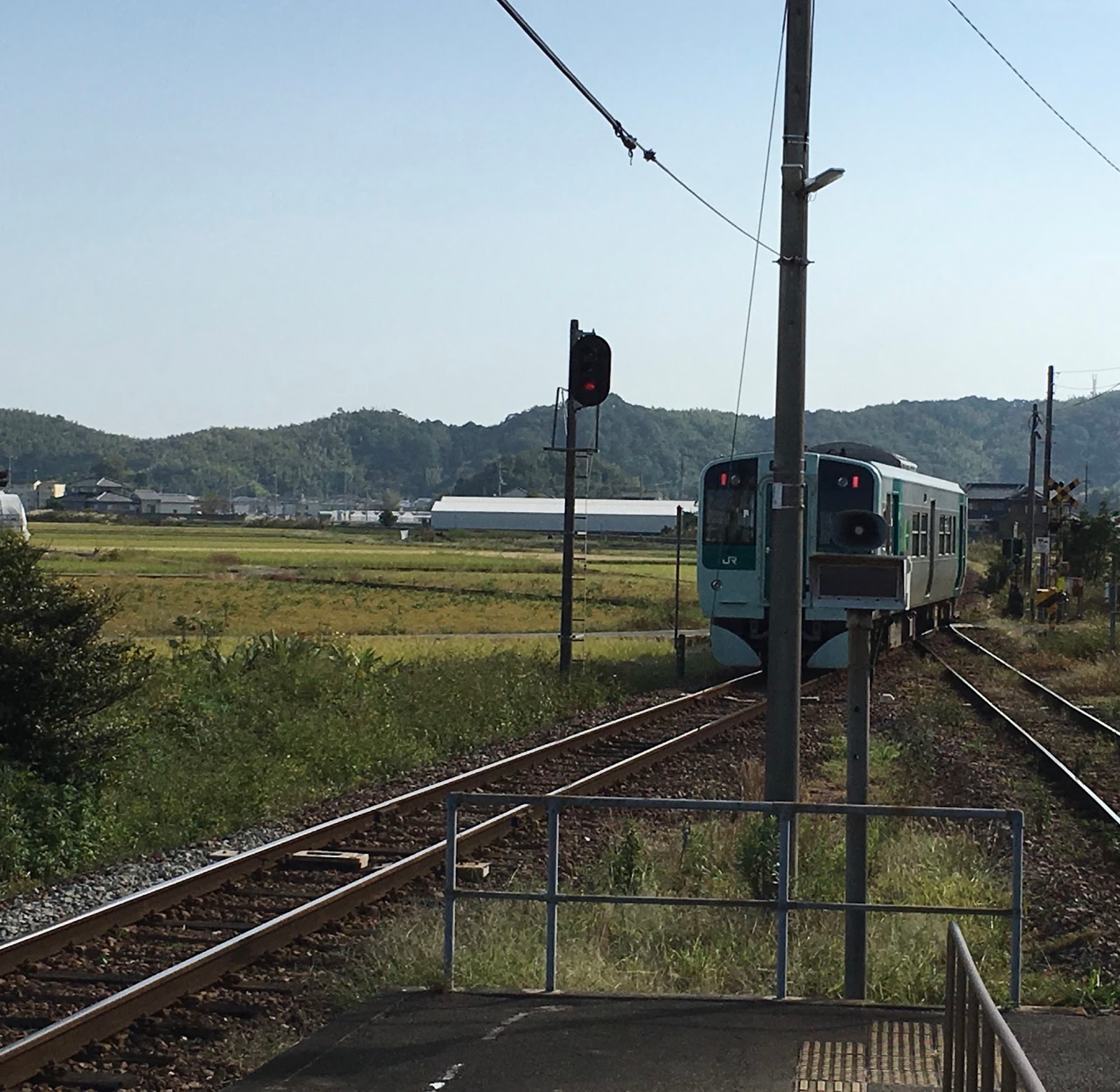
Train departing from Tatsue Station.


and no time to start the journey over.