Showing posts with label Japanese culture. Show all posts

Sunday, June 11, 2023

Another Classic From Susan Spann: From Tohoku With Love...and Horses.

[Five years ago yesterday, Susan announced her self-imposed challenge to scale 100 Japanese peaks over the next 12 months. Another challenge she met and overcame.]

Sunday--Susan 

 
June is here, and with it the official start of my hyakumeizan odyssey--over the next twelve months, I'll be attempting to climb all 100 of the nihon hyakumeizan (100 Famous Mountains of Japan). It's a hefty task, considering that the Japanese climbing season starts in June and ends when mid-to-late November snow shuts off the peaks.

For the mathematically inclined, that basically means I need to climb a mountain every other day from now until the snow flies.

The summit of Mount Iwaki - hyakumeizan #2
Did I mention the rainy season starts in June?

With little time to spare, I kicked off the climbs with a trip to Tohoku, a region located in the northernmost part of Japan's largest island (Honshu).
Looks a little like Mordor, if you didn't know better...

To test my fitness, I planned for a pair of back-to-back climbs with a single rest day in between.

Half way to the summit - and pointing where I need to go.
Fortunately, the weather and my knees held out, and I summited all four peaks.

The summit of Mount Hakkoda (this is where the previous photo pointed).

I planned to spend my rest day in Morioka--a city I knew little about, aside from the fact that it's known for the Chagu Chagu Umakko Matsuri (Festival) that takes place the second weekend in June (this weekend, in case you're counting).

A horse decked out for Chagu Chagu Umakko

The festival originated centuries ago, when farmers in the Morioka area festooned their horses with elaborate costumes and bells ("chagu chagu" is the sound the bells on a trotting horse make in Japanese) and paraded the horses to the local Shintō shrines for special blessings. Horses were exceptionally valuable, and their labor was critical to the farmers' survival, so the farmers hoped the festival would ensure the horses' health and continuing welfare.

Today, the festival still involves parading the jingling horses to the shrine in Morioka. Children in traditional costumes ride on the horses' backs--hence the last word, "Umakko," which means "horse children."

I couldn't afford to delay my first Tohoku climbs by a week to see the festival, but it bummed me out that I'd miss the horses. (I've loved them all my life, and rode competitively in high school.)

Imagine my surprise when I reached Morioka for my rest day . . . and discovered it coincided with a matsuri (festival) celebrating all of the festivals of the Morioka region--including Chagu Chagu Umakko!

Hooray! A festival!

I watched a parade with dancers from several of the regional matsuri:

The name of this one basically translates "flower hat festival"
Ate festival food near the site of the Morioka Castle ruins, and spent a delightful almost-hour at the "Chagu Chagu Umakko Horse Encounter" park, getting up close and personal with some of the hundred horses that would participate in this weekend's matsuri.

The regalia looks heavy, but these draft horses can bear the weight.
Including one very sleepy little foal:

At one point he was actually snoring.

The lesson here--and it's not a new one--is that travel often provides us with amazing opportunities if we don't over-schedule and leave ourselves open to the adventure that presents itself. Whether you want to attribute it to God, the Universe, Karma, or just turtles all the way down, it's impossible to deny that there's a larger force than us at work out there, and that it's pretty darn amazing at planning really cool surprises, if we leave ourselves open to them.

A lovely surprise indeed.


I came to Japan in search of adventure and, as always, it does not disappoint. I'm looking forward to seeing what the rest of this adventure has in store.

 --Susan

Sunday, April 9, 2023

Cherry Blossoms and Castle Keeps - Springtime in Japan

 -- Susan, every other Sunday


Two weeks ago, some friends from the United States and I took a trip to Kyushu--Japan's southernmost major island--to visit some famous sites and enjoy some tasty regional food. As it happened, we also caught Kyushu's sakura (cherry blossoms) at the peak of their very short bloom, which turned an already-fantastic trip into something truly special.

Sakura are loved in Japan, not only as a sign of spring's return but also because their delicacy and very short lives remind us of the short, bittersweet nature of all beauty, and of life itself. 

That message takes on another level of depth when the sakura you're enjoying are blooming around the seven "hells" of Beppu (a set of seven natural volcanic springs, each with very unique characteristics) and the magnificent castles and gardens where samurai once walked. 

Sakura near Umi Jigoku (the Ocean Hell)


I've written about Beppu's famous hells before, but since my previous visit was in winter, I had no idea that beautiful blossoms were lurking behind the steam. 

Sakura at Umi Jigoku

After visiting five of the seven famous hells - all but one of which had sakura blooming in the surrounding trees, one of my friends said, "You know, hell suddenly doesn't seem all that scary anymore." (Particularly apt, seeing as this post goes up on Easter Sunday...)

The bubbling clay pools at Oniishibozu Jigoku (the hell of monks' heads, named because the bubbles emerging from the clay look a bit like the bald, round heads of Buddhist monks) reflected the trees in a way that drew a lot of blossom-watchers.


Cherry blossoms reflected in the pits of hell...

After visiting all seven hells, we paid a visit to Beppu Park, where dozens of enormous cherry blossom trees were all in bloom.

Sakura at Beppu Park
 

Up close and personal with spring


Beppu Park

Our trip also involved a stop in Kyoto where, to our surprise, the cherry blossoms were still blooming.

Cherry blossoms at Tenryu-ji, a Buddhist temple in Kyoto


More sakura at Tenryuji

Although there were a lot more tourists in Kyoto, too, the beautiful spring weather and cherry blossoms made it difficult to feel anything but thoroughly happy and alive.

Sakura by the train tracks in Kyoto's Arashiyama ward.

That said, my favorite cherry blossoms of the trip were the ones we found near Kumamoto Castle, in Kumamoto (Kyushu). 

Sakura at Kumamoto Castle


Another view of the castle with cherry blossoms

When my friends and I planned the trip, we thought the blossoms wouldn't be in bloom for another 2-3 weeks--it's difficult to plan a trip months in advance and ensure it coincides with the blossom season, because the sakura often bloom and die within a week (or sometimes less).


I feel truly fortunate that the weather (although unsettlingly warm for the end of March) gave us the chance to see so many blossoms in full bloom. The earth is awakening after the cold of winter, and the blossoms are an excellent reminder to enjoy, and make the most of, every day.


Sunday, March 26, 2023

Springing Into the Season With Cherry Blossoms in Tokyo

 -- Susan, every other Sunday


The Spring Equinox is a national holiday in Japan, and this year it happened to coincide with the peak sakura (cherry blossom) blooms--which are popping out a couple of weeks earlier than normal.

Sakura blooming in Mizumoto Park, Katsushika, Tokyo


Fortunately, the weather has been lovely, which meant a lot of walks to enjoy the blossoms as they appeared.
Up close and personal with the blossoms.

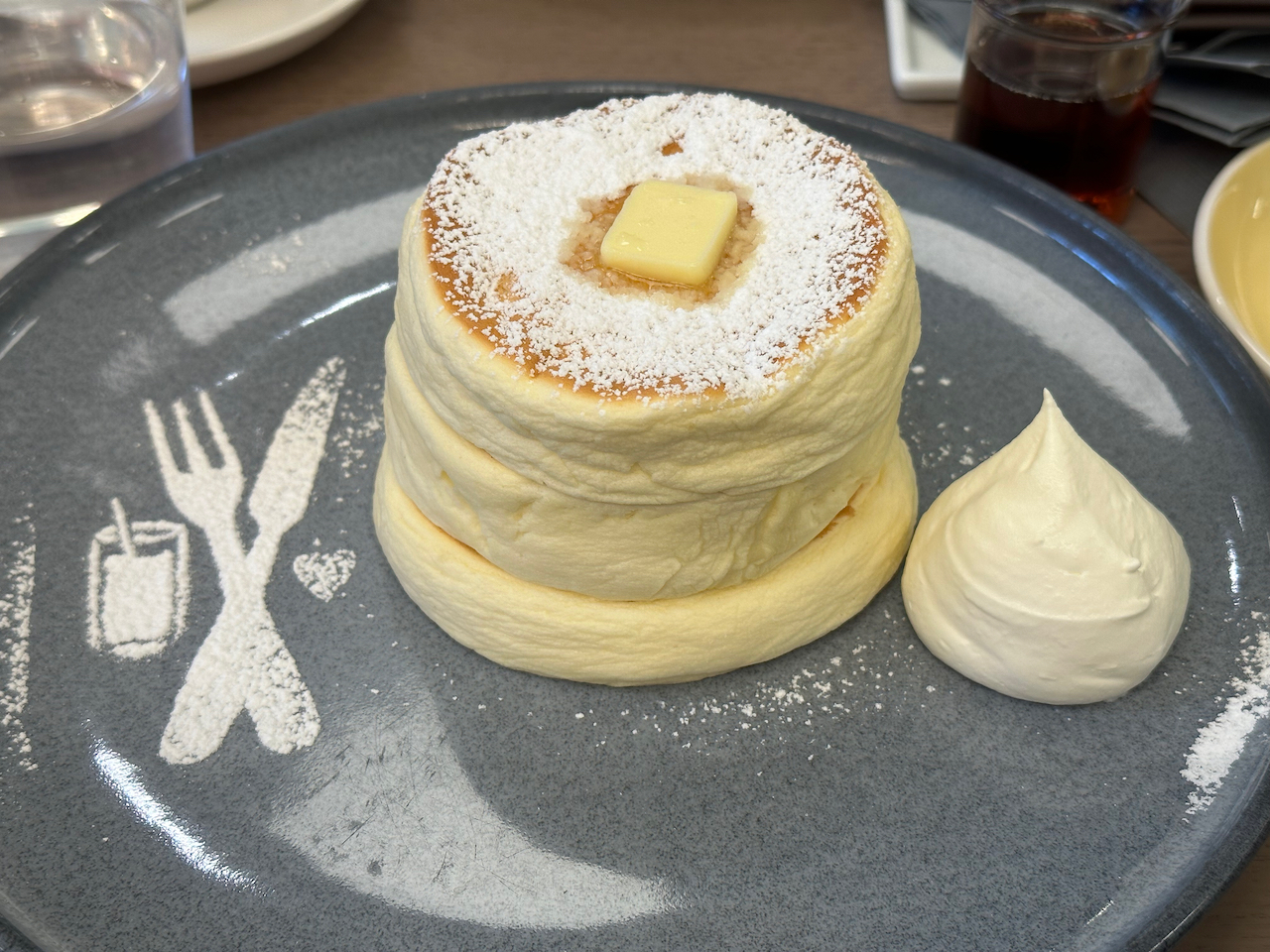
One cloudy morning, I met a writer friend to see the blossoms in a different part of town. We started out with Tokyo's famous "jiggly" souffle pancakes in Tokyo's Harajuku district...

Jiggly pancake!

And then made our way to the park, where we found not only sakura, but a murder in progress:

Murder is, indeed, everywhere...


Grey skies aren't ideal for pictures, but the blossoms themselves were beautiful

Spring is here.

Sakura season also means an enormous range of specialty drinks, desserts, and sweets. Which, of course, I feel honor-bound to sample.

Take one...or nine...for the team.

The spring equinox itself was beautiful, with blue skies and many, many blossoms.

Sakura near Tokyo

The parks in and around Tokyo are bursting with beautiful trees, and people are finally able to enjoy traditional hanami (flower/sakura viewing) picnics, as the restrictions of the past three years have been lifted. Huzzah!!

A perfect place for a picnic beneath the cherry blossoms

The blossoms last only a very few days, and this afternoon's rain will shorten their lives even further, but that's also part of the reason the sakura play such a vital role in Japanese culture. Their fleeting beauty reminds us that life itself is beautiful and short, and that we should be in the moment, love the moment, and appreciate both the beauty around us and the bittersweet sorrow that comes with the knowledge that this, too, will pass away. 

We blink, and the moment is gone, never to return.


As the blossoms bloom and fall, I hope you're finding the time to enjoy the beauty around you today, and that you can get out and walk in the sun, or even in the rain.  May your spring be healthy and joyful!

Have you seen cherry blossoms in bloom? If not, would you like to someday?


Sunday, January 29, 2023

Trains, Wonderful Trains....

 --Susan, every other Sunday


I've always loved trains. There's something about the nature of travel by rail that slows you down, (while simultaneously speeding you up as you miss the traffic). I didn't have many chances to ride on trains while living in the States, but since coming to Japan, I'm making up for lost time.

Most people have heard of Japan's ultra-high speed shinkansen--the "bullet trains" that have impressed the world for decades--and the crowded Tokyo metro trains that carry millions of people to and from work and play on a daily basis.

But these don't even scratch the surface . . . from tiny, one-car rural trains to the fanciful "Joyful Trains," sightseeing trains, and even trains dedicated to eating local specialties "on the move," Japan is a country that loves its rails--and there's a lot of rail to love.  

Today I thought I'd share a few of the ones I've ridden during the past few years:

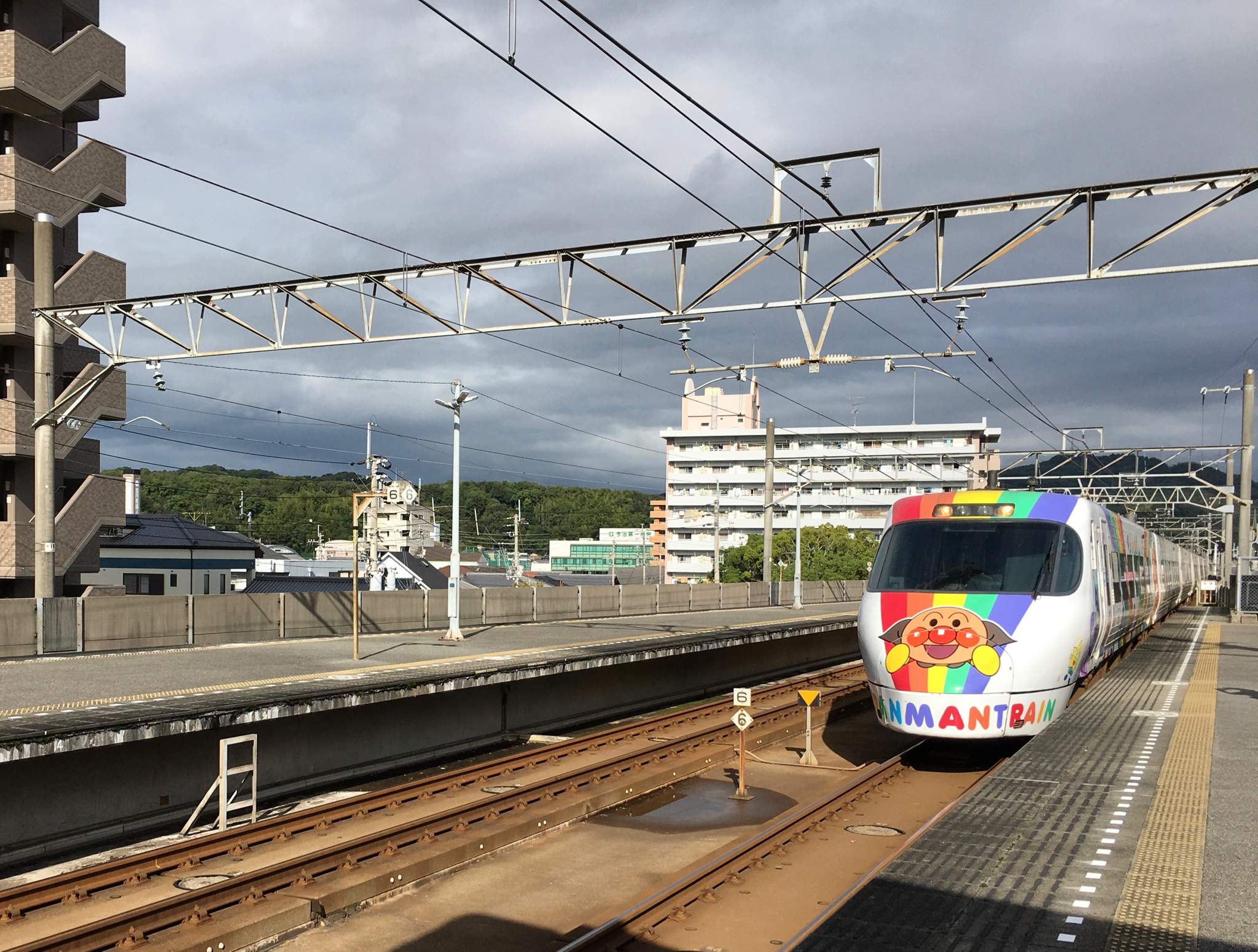
The AnPanMan train in Shikoku features characters from the popular children's anime (called AnPanMan), whose heads and bodies are made of different types of special bread.

Here comes the AnPanMan express!

Anpan is a round bread filled with adzuki bean paste (called "an" in Japanese). Anpanman is enormously popular with Japanese children - and while riding this train, I saw more than a dozen little kids standing near various crossings, waving to the train as we passed by.


Anpanman and friends

I may not have grown up on a diet of anpan(man), either real or on TV, but I loved this train. Even the memory makes me happy.

More anpanman ...

There are dozens of "character trains" like this around Japan, featuring everything from Thomas the Tank Engine to Pikachu, Hello Kitty, and many more. 

Specialty food trains are also popular. One of the leading candidates is actually close to home: the FujiView Sweets Express, which runs on the FujiQ railway to Kawaguchiko Station in the Fuji Five Lakes district.
 
The Fujiview Sweets Express, living up to its name

While the last three cars always operate as a standard train, and don't require reservations, on weekends the first car becomes the "Sweets Express"--a reservation-only experience that includes incredible views (including Mt. Fuji, in good weather) and a special dessert menu that changes seasonally. 

Car 1 - the sweets car

Car 1 - all aboard for dessert...

Instead of standard seating, the inside is set up like a cafe; when you board, the staff take you to your assigned seat or table. The huge windows make for amazing views.

My seat!

I've ridden twice - once in the summer and once in the winter. I'll definitely go again, too. 

Winter sweets: chocolate mousse "Fuji" and raspberry-chocolate eclair "sweets express"

Dessert with a view

No post about trains in Japan would be complete without a shinkansen - the fastest of which is currently the Hayabusa (the Japanese word for peregrine falcon) that runs on the Tohoku Shinkansen lines, north of Tokyo.

Hello, Hayabusa!

For rapid travel one step down from the shinkansen, Japan has a lot of futuristic-looking express trains, which cover distances much faster than standard trains, though not quite at the shinkansen's 150+MPH speed. They also look like transformers come to life: 

The real-life mandalorian...

When heading north from Tokyo, you may get to ride a conjoined shinkansen, like the one below. The red train (in front) is a "slower" shinkansen, bound for Akita Prefecture, while the sleek green machine is a Hayabusa bound for Hokkaido (the northernmost terminus of the shinkansen lines). From Tokyo Station to Morioka Station (about two hours north of Tokyo), the trains are joined together, to take advantage of the Hayabusa's powerful engines. At Morioka they uncouple; the red train heads west to Akita, while the Hayabusa keeps racing north alone.  

This is where baby trains come from.

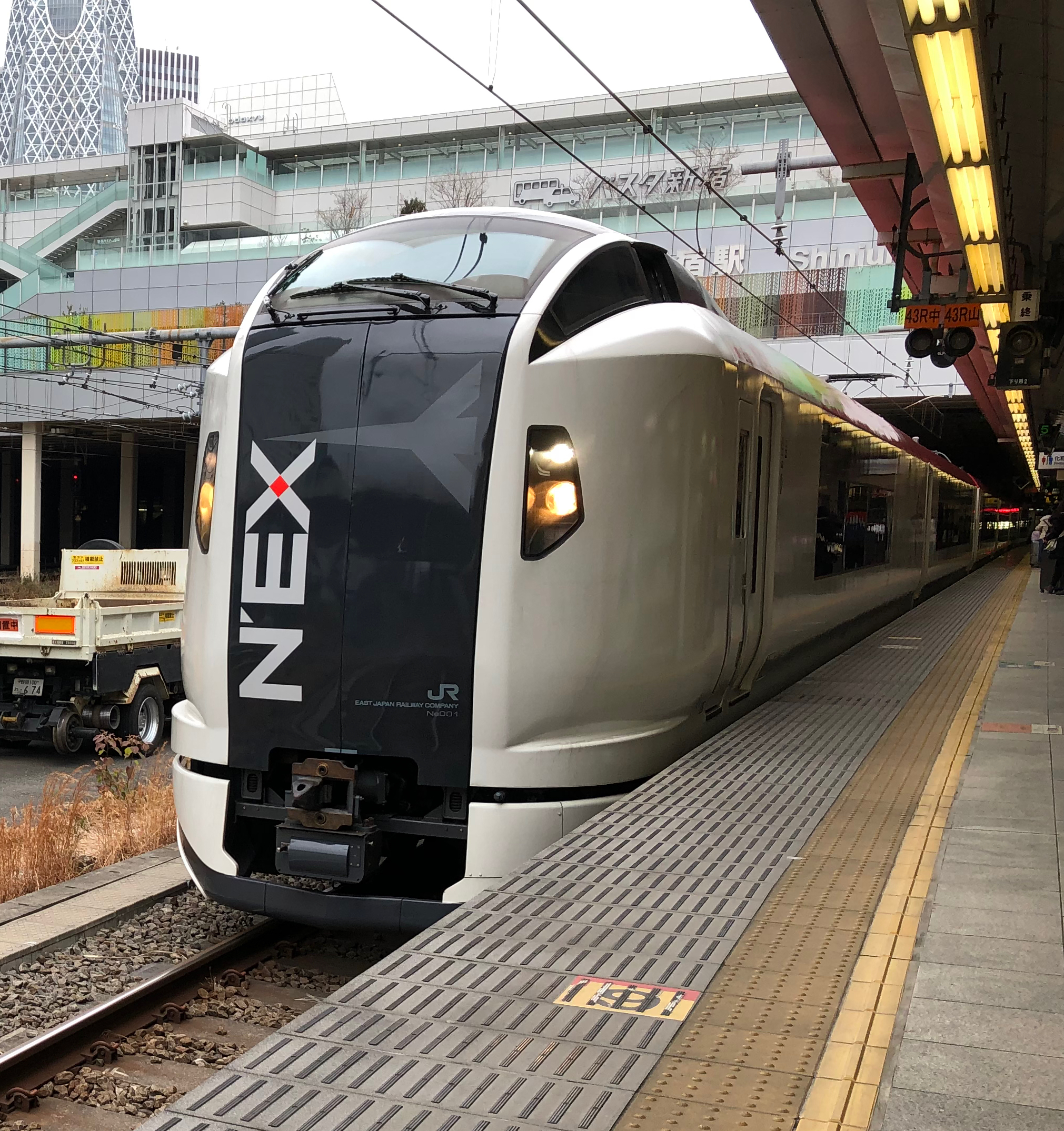
I've even ridden fancy trains without leaving Tokyo. The sleek N'Ex runs north to south through Tokyo, with its northernmost end at Narita Airport (N'Ex means Narita Express). Like many Japanese express trains, all of its seats are reserved, and you need a designated seat ticket to get on board. 

All aboard the Narita Express

Japan even has a number of historic trains still in operation - or, like the one below, on display at museums and parks near the tracks where they used to run. I haven't ridden any of the old steam engines yet, but it's high on my list.

A steam locomotive on the historic Kiso Road

The workhorses of Japanese rail remain the little local trains, which usually have between 1 and 3 cars, depending on the needs of the communities where they run.

The local Tobu train, at Ryuokyo, Tochigi Prefecture

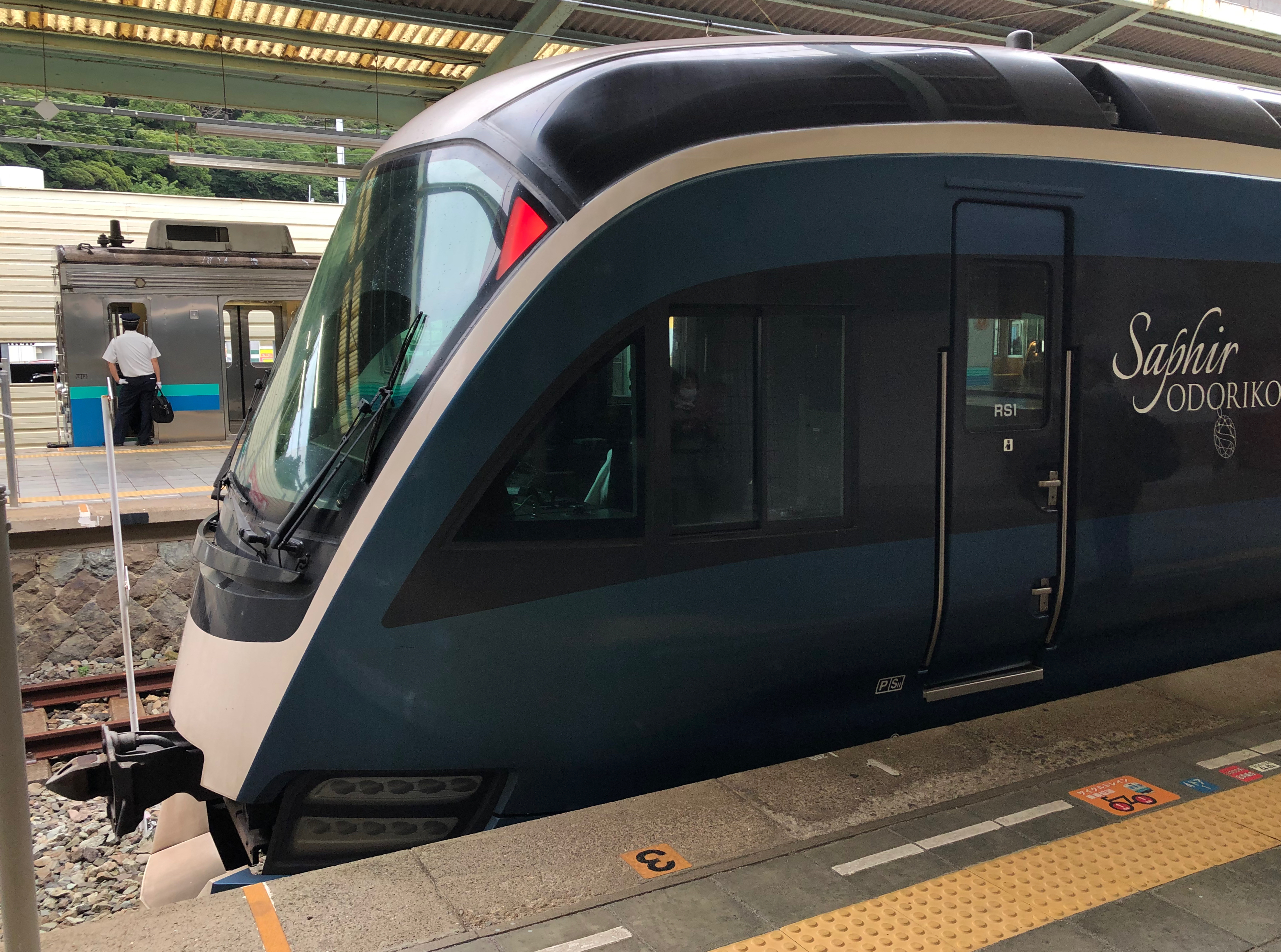
Sightseeing trains are gaining popularity. While some people ride them purely for transport purposes, the rail companies advertise special trains like the Saphir Odoriko below as a destination in and of themselves.  

Saphir Odoriko, Izu

And they're not wrong. The Saphir runs along the coast between Tokyo and the southern tip of the Izu Peninsula, about 3 hours from Tokyo. All of the cars have a view of the ocean, and it's a lovely way to spend a relaxing afternoon.

Still other trains feature exterior "wrap" designs intended to draw attention to special aspects of the area in which they run, or local history or culture. 

Wakayama History on a train

The traditional samurai images on this train in Wakayama prefecture are designed to share a little about the history of the region, and inspire interest in travel to local historical sites. 


In the last few years, Japan has increased its focus on sustainability (always an important part of Japanese culture, but now being taken to a more global level). And yep, it's made its way to the trains as well, with the Sustainable Smile Panda, a special train in Wakayama Prefecture that hopefully makes riders think about conservation of animals and the environment. 

Sustainable Smile Panda

In addition to the cute design, signs inside the train remind riders about the importance of conservation and sustainability, and explain that the train is using prototype engines that reduce emissions, conserve fuel, and use alternative fuels; the hope is that this technology will spread throughout Japan in the years to come. 

Don't look now, but I think they're watching us.

In case you hadn't noticed, it's also really, really cute.

Pandas in Wakayama

A lot of the special trains I've ridden to date were happy accidents, but I like them so much that I'm turning into a nori-tetsu (乗り鉄) - the Japanese term for a train enthusiast who enjoys riding trains (as opposed to a model train collector). In the years to come, I plan to ride as many special trains as possible - and I promise I'll take you along, both on my own blog and here at MIE!

All aboard!!

So... are you a train enthusiast too? Or would you rather not be ridden out of town on a rail?