Sunday, December 22, 2019

Hatsumode: A New Year Tradition in Japan

--Susan, every other Sunday

For my last post of the year, and my last in the 20-teens, I'm taking you into the future  . . . for a look at two of my (many) favorite Japanese traditions:

Kamado Jinja, in Kyushu, just after New Year 2019

Joya no Kane (除夜の鐘) and Hatsumode (初詣)

In Japan, New Year's Eve is not customarily celebrated with Bacchanalian revels and confetti. Instead, most people spend the evening at home (or eating out) with family, preparing to welcome the New Year--and all the potential promises it holds.

Sensoji, Tokyo's oldest Buddhist temple

As midnight approaches, people flood into the grounds of Buddhist temples across Japan. Precisely at midnight, the priests begin to run the enormous bronze bell(s) on the temple grounds. Each bell is run 108 times - one for each of the passions and desires that Buddhists believe bind people to this world, and prevent us from reaching enlightenment. The ringing also creates a bridge between the old year and the new.

Attending joya no kane is said to bring good fortune, and good health, in the year to come. It is also one of the many sacred rituals that mark the passage of time, the seasons, and life here in Japan.

One of many bells that will welcome the new year

On New Year's morning, Japanese families flock to Shinto shrines (and Buddhist temples) for hatsumode, the first shrine visit of the New Year.  Since January 1, 2, and 3 are holidays here in Japan, some people also visit on January 2 or 3 (and people actually make hatsumode visits to shrines and temples throughout the month of January, though traditionally you're supposed to do it during the first few days of the new year.)

Kamado Jinja, dressed in a fresh coat of snow for New Year

Most shrines offer special goshuin--stamps and calligraphy, placed in a special book called a goshuincho--on New Year's day, as well as hamaya, or "demon breaking arrows."

My hamaya from 2019 - the year of the Boar

Purchasing a hamaya, and displaying it in your home, is supposed to provide protection for your house and family during the year to come. The following January, you return the arrow to the shrine, where it is burned in a sacred fire.

Many shrines are located at the base of mountains; in most cases, there is also a shrine on the mountaintop.
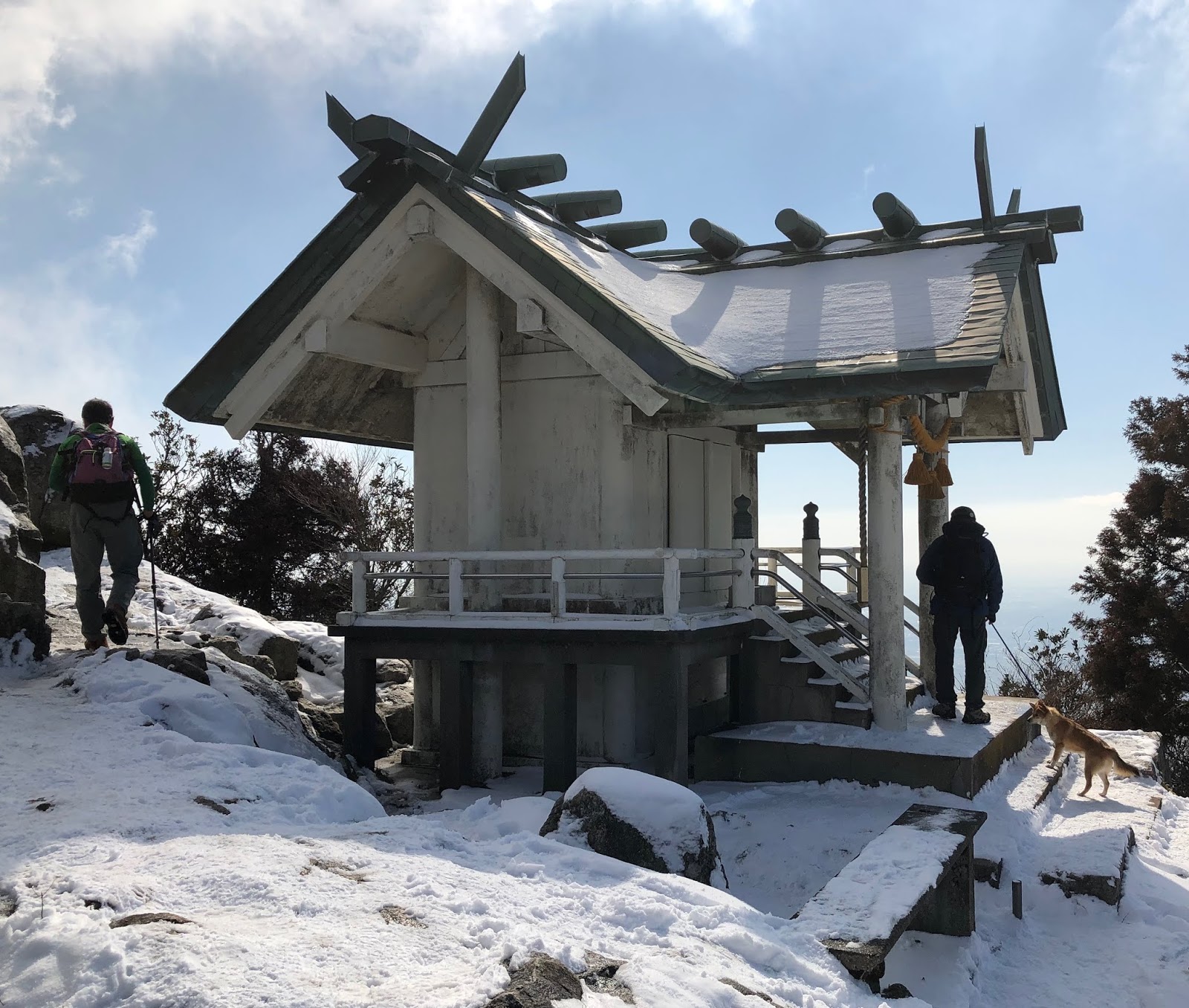
Kamado Jinja, atop Mt. Homanzan

Those of us who like to climb will often make our hatsumode visit to a mountain shrine, and climb to the top before getting our goshuin and hamaya. 

A beautiful January morning on Mt. Homanzan


(There are a lot more people on the mountains in winter than you might think, though the vast majority do stay at the bottom.)

Happy New Year 2019!

This year's joya no kane and hatsumode will be particularly meaningful, as we send out 2019 and welcome 2020--the start of a whole new decade.
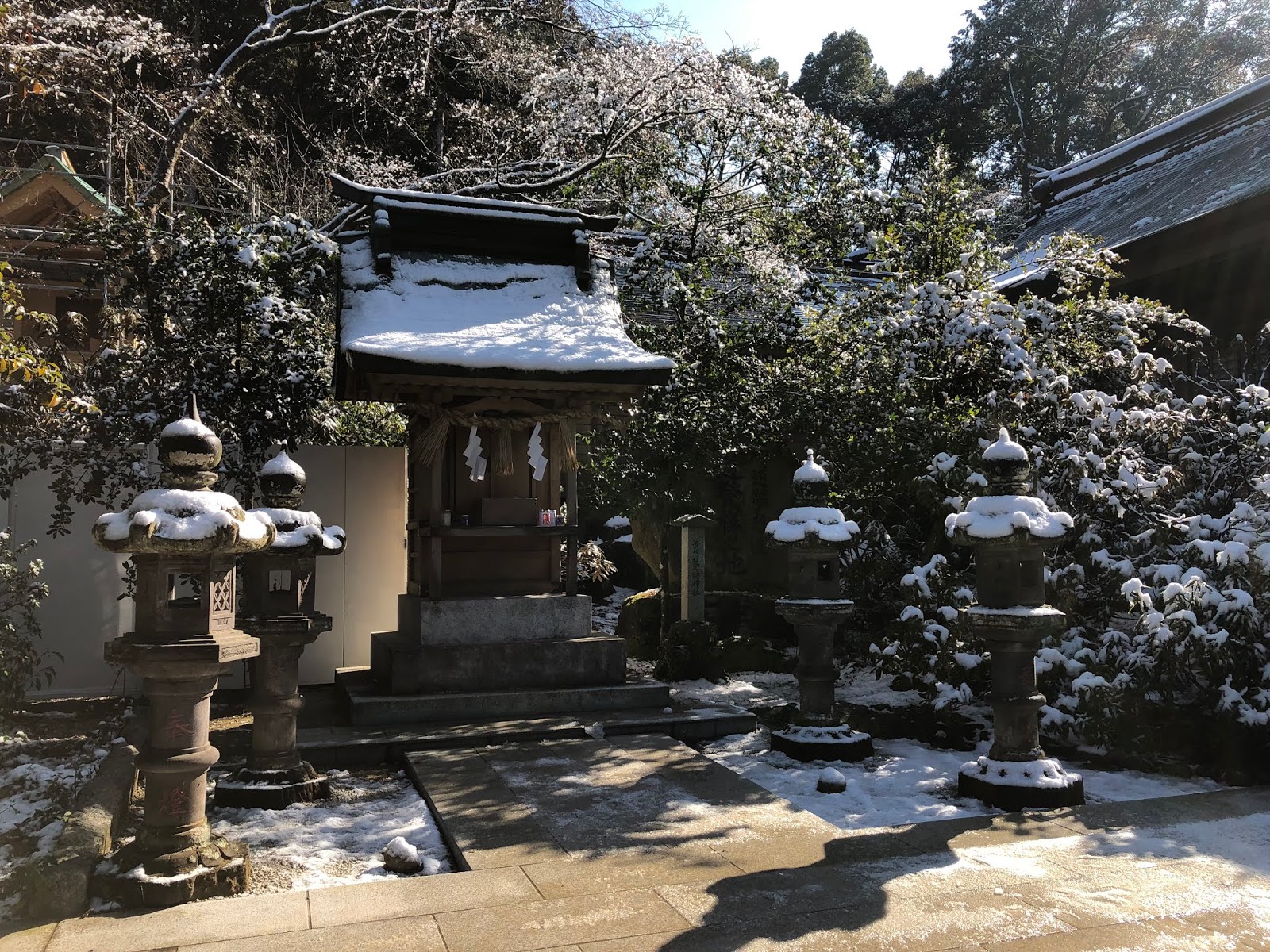
Ready to welcome 2020 - the year of the Mouse!

As it happens, they will have particular meaning for my family, because my parents, as well as my brother and his wife, are coming to spend the holidays in Japan, which means that--in accordance with Japanese tradition--I will have my entire extended family with me to welcome the New Year.

(Me, waiting for my family...)

I wish each and every one of you a happy, blessed and bright New Year, wherever you are and whatever your traditions.

What are your plans to welcome 2020?

Saturday, December 21, 2019

A Mystery Writer's Night Before Christmas Redux--Again


Jeff—Saturday
N.B. For some reason my post did not go up as scheduled at Midnight!  Worse still, I've been so distracted by upcoming nuptial bliss that I did not notice until this very moment. Sorry about that folks.

It’s almost Christmas Eve! To all of you from the many different corners of our world who so kindly follow us on MIE, the very best of the Holiday Season, no matter how you may choose to celebrate the time.  For many of us it’s all about family traditions, and as I’m blessed to be part of the MIE family I have a little tradition of my own I like to sneak in here during the holiday season.  It’s a little something I composed for my Christmas Eve post a few years back and whether or not you’d like seeing it again, it’s a tradition so we’re stuck with it…though updated to include the new members of our MIE family. I take great pleasure in brutally fracturing the classic poem, “Twas the Night Before Christmas” by Clement Clarke Moore or Henry Livingston—history is still not sure who wrote it, so apologies to both. 

Livingston
Moore


Twas the night before Christmas, when all through the house
Not a laptop was stirring, nor even a mouse.
The reviews were hung by the chimney with care,
In hopes that new readers would soon find them there.

The critics were nestled all snug in their beds,
While visions of best-seller danced in my head.
And DorothyL in her wimsey, and I in my cap,
Had just settled our brains for the hiatus nap.

When out on the Net there arose such a chatter,
I sprang from my bed to see what was the matter.
Away to the keyboard I flew like a flash,
Tore open the browser and dove in with a splash.

The glow on the screen cast like new-fallen snow,
A lustre of brilliance onto writing so-so.
When, what to my wondering eyes should appear,
But the sight of a blog with ten writers so dear.

With a little bold driver so quick with a thrill,
I knew in a moment he hailed from Brazil.
More rapid than eBooks their creations they came,
And he whistled, and shouted, and called them by name!

“Now, Kubu! now, Aimee! now, Charlie and Emma!
On, Vera! On, Justin! on, Hiro and Rei!
To the top of the Times! to the top of them all!
Now Anderson, slash away! slash away pall!”

As wry thoughts, that before the final deadline fly,
When they meet with an obstacle soar to the sky.
So off to their blog-posts these non-courtiers flew,
With a sleigh full of ploys, and opinions not few.

And then, in a twinkling, I saw not from aloof,
The prancing and gnawing of hard comments and spoof
Taking aim at some points so to bring them to ground,
Brought on by hard thinkers from near and far ‘round.

The writers were dressed from each head to each foot
In bold clothes that were tarnished with gashes well put.
A bundle of ARCs each had flung on its back,
They looked like kind peddlers bringing books to a rack.

Their eyes—how they twinkled! Their dimples how merry!
Their cheeks like Jeff Bezos’s, their noses like sherry!
One’s droll little mouth was drawn up like a bow,
‘Til his bottle of bourbon fell out on the snow.

The stump of a pipe he held tight in his teeth,
Threw up smoke of the kind to fire scotch from the heath.
He had a broad face that would fill up the telly,
And as he reached for his bottle mumbled, “Just jelly.”

Neither chubby nor plump, more like jolly and svelte,
I laughed when I saw him, ‘til his stare I felt.
But a wink of his eye and no twist to my head,
Soon gave me to know I had nothing to dread.

They all spoke not a word, but went straight to their work,
And filled all the bookshelves, then turned with a jerk.
And crossing their fingers aside of their noses,
And giving great nods, passed around the Four Roses.

They kept all at play ‘til the ladies gave whistle,
Then each turned as one to read an epistle.  
And I heard them exclaim, ‘ere my charger lost might,
“Happy Christmas to all, and to all a good-fright!”

And, of course,“Kala Kristougenna.”


—Andreas Kaldis

Jeff's 2020 Speaking Engagements and Signings (in formation)


Thursday, March 12-Sunday, March 15, 2020 
San Diego, CA
LEFT COAST CRIME—San Diego Marriott Mission Valley
Panels yet to be announced

Monday, March 16, 2020, 11AM-2PM
Saddlebrooke, Arizona 85739
FRIENDS OF SADDLEBROOKE LIBRARIES 
30th Anniversary Authors Luncheon
SaddleBrooke Clubhouse
40010 S. Ridgeview Blvd.
Author Speaking and Signing

Thursday, June 4--Sunday, June 7, 2020
BRISTOL, UK
CRIMEFEST—Mercure Bristol Grand Hotel

Panels yet to be announced 

Friday, December 20, 2019

Hanging with the real writers!


“I think it is important to note that the novel, as a piece of art, which it undoubtedly is, does not just happen. One needs to give birth effectively to the creative process. One needs to isolate oneself and centre oneself in aid to feel the true creativity of the narrative process as it begins to flow. One, inevitability, has doubt that the surrealism and the underlying metaphors of the book will be miscast and indeed, misplaced in a world that is not yet ready for that juxtaposotioning of the narrative framework and the imaginative text when it is considered by, and indeed constricted by, the narrative prose.”

I think they went on to say a whole lot but I was asleep by then.
                            

I am jesting of course, but it is interesting when crime writers (the lovely lot that we are) get together with OTHER WRITERS. Others including the romantic fiction writers (  you can recognise them by their  expression of eternal disappointment;  imagine spending  your entire writing life dealing with Colin Firth getting out the water in that shirt, when  in real life you are married to a Glaswegian  bloke.)

                                       
 The nature poets always look as if they need a wash and as Billy Connolly would say, they have a wee dent in the back of the leg where a border collie usually walks.  The performance poets, I have noticed, are thin faced and have a tendency to wear jaunty hats.  I have no idea why. They do wave their arms about a lot. And are usually very grim in their subject matter; “I  am a foetus and I was pulled   from the womb screaming by an accountant on a number 12 bus going round the Elephant and Castle”. You know the sort of thing. (Actually the number 12 bus goes to Dulwich.)


 And then there are the nodders. Few crime writers are nodders. Nodders belong on late night chat shows on channel 4, on a black sofa, dimly lit studio, they whisper rather than talk and take everything very seriously indeed. Especially  themselves.
                                  

So for Book Week Scotland, I had a few events all over the country, mixing with other writers. One performance poet had us doing an impersonation of slightly disappointed heather (the shrub not a girl called Heather.. or maybe it was….).  They all, apart from me and the last one, talked very earnestly about their work and I wondered what they were like to work with as a writer who gets paid to do what they do. My editor and I have great fun. I  think I am an easy author to work with, writing a book is really a team effort with plots and  covers, tweaks and the dreaded semi colon. 

But overall, the other writers did say, (or seemed to say) that the writing was  almost a passive process – they had to wait to see if it happened, when it happened they would type out the results.

 So I am going to try that for the next book- just sit and wait until it comes along. I am going to sit in the dark and nod a lot.

Caro 20th Dec 2019

Thursday, December 19, 2019

The trouble with elephants


Michael—Thursday


Anyone who cares about animals at all loves elephants. It’s easy to understand why. They have interesting personalities, the females are excellent mothers, protecting and caring for their calves, and they have apparently complex communication including infra-sound rumples that are transmitted through the ground. They also seem happy to interact with humans, provided they are given space and respect. Many of these are documented in the late Laurence Anthony’s book The Elephant Whisperer (that I reviewed HERE). There are even some hints in the book that suggest a relationship between Lawrence and his elephants (or between the elephants and their Lawrence) that transcends normal communication.


Unfortunately, like most happy stories, there’s an intrinsic tension, and I wrote about that HERE in Condoms for elephants. Elephants require an enormous amount to eat—something like 350 lbs of vegetation every day. They have seven complete sets of teeth, and once those are gone, they starve to death. It must be challenging to be always hungry, and they usually rest during the heat of the day in order to use most of the cooler night for feeding. They have essentially no natural enemies—other than man—and tend to be successful if relatively slow breeders. Left to their own devices, elephant populations grow slowly but surely, with the herds led by their matriarchs wandering over vast areas in search of food. They sense rain and head to those areas for the new growth.


The problem is what happens in drought conditions. The elephants move through the bush devastating it, eating everything they can find. That includes any tree bark that they can reach, and once the tree is ringed, it dies as nutrients can’t reach the leaves. Worse, elephants will break off large branches or push over trees altogether in order to reach a few mouthfuls of leaves that they fancy. And they do this even if there is no shortage of food. It’s a strange behaviour, because most animal species (present company excluded) interact with their environments quite well, and certainly don’t go about destroying their future food supply. There isn’t a convincing theory about why they behave this way—and apparently always have. Surely it’s not a successful evolutionary trait.

Of course, now elephants are severely restricted in their movement. In the seventies there was a horrendous die off of elephants in Kenya. The conservation authorities there believed that given their large and connected conservation areas, leaving the elephants unmanaged was the correct and natural strategy. Unfortunately, drought conditions led to the loss of thousands of elephants who died miserably of starvation and left behind devastation that seriously affected other species such as the black rhino.

In more recent times the relentless demand for ivory, drought, and the restriction of their range has led to a decrease in elephant numbers by about two thirds over the last fifty years to below half a million world-wide. And now politics has entered the fray.

Under Ian Khama, Botswana banned trophy hunting and the transport of trophies overseas. His policy has always been that the best way of exploiting Botswana’s superb wildlife resources is through high-end tourism with a relatively small numbers of visitors who support a variety of jobs and do little harm. The strategy has been a contributor to Botswana’s success. However, Khama’s successor—President Masisi—sees things differently, and that’s probably not independent of his feud with Khama. Their personal animosity led to Khama leaving the governing party and supporting the opposition in the last election. Khama was accused of elitism and lack of concern for small farmers in areas where crops were often attacked by hungry elephants. He was also berated for the loss of hunting revenue to the country. There were mutterings about corruption. Masisi reintroduced trophy hunting, citing the overpopulation of elephants in the country.

It's become a huge issue in Botswana with the local people on both sides. While it is true that elephants certainly aren’t currently endangered in Botswana, it’s unfortunate that the issue is now being argued against the background of personal animosity and party politics.

As for the longer term, elephant populations are decreasing in most African countries and climate change will almost certainly devastate some of their natural feeding ranges.


Enjoy them while you can.

Wednesday, December 18, 2019

Sujata's Writing Road, 2019

Sujata Massey

With debut author Tori Eldridge at Chevalier's in Los Angeles


I grew up in the age of point-and-shoot simple cameras, which at the time seemed beyond magically simple. But in the last ten years, the cell phone camera has thrown old-fashioned cameras to the curb. We are now responsible for being the chroniclers of our lives.

I feel that stopping what I'm doing to take pictures takes me out of the moment, so I don't do it a whole lot. But when I travel, or have special friends come my way, I go straight to the camera app on my phone.

Here are some of my favorite moments saved over the last year--my grateful thanks to the invisible assistants who did a lot of the snapping. These pictures remind me how many people--family, writing friends, readers, and booksellers--have brought joy into my workalike. I was thrilled to launch the second book in my Perveen Mistry series, The Satapur Moonstone, and humbled by the recognition given to the book before it, The Widows of Malabar Hill. And this made photo-ops!

 For all these journeys, and so much more, I am grateful. You may notice a lot of books in these pictures. Whoever guesses the right number deserves their own prize.


Crime Writers of Color founder Kellye Garrett came to my house to make drinks  


Twin Cities roundup: my stepmom Manju and good friends at Once Upon a Crime


My mother Karin and her longtime pal Don Johnson, an expert on Indian textiles 


This was one of the biggest book talks on the tour due to Margaret and Kathy's efforts


I was having a lonely dinner in Houston before a signing discovered two readers, Tara and Priyanka, were in the same bar!


There was literally a tornado hitting Kansas when I posed with Raven Books' Danny Caine 


Janet Rudolph's legendary mystery bookclub read Widows!


What an honor to have audiobook narrator Sneha Mathan read for me in Seattle


Getting into position for Nancy Pearl's web talk show, Book Lust


I drove to Santa Barbara for lunch and met a bunch of newsletter subscribers!


The  hand-carved award for Best Historical Mystery at the Left Coast Crime Con 


Celebrating the sheer glass Macavity win for Best Historical at Bouchercon with  Soho's Rudy, Juliet and Bronwen


With my husband just before winning the Mary Higgins Clark prize at the Edgars in NY


To touch a hot-of-the-press book for the first time is a real thrill!