Showing posts with label The Widows of Malabar Hill. Show all posts

Wednesday, February 10, 2021

The Price of a Meal

Sujata Massey


Someone who's part of my inner circle is working on a novel. He made a richly detailed first draft and is engaged in getting feedback from a few trusted friends. Two early readers of his book commented the story had too many references to food. One even suggested that he reduce the number of group dinners in the story down to two grand banquets.


I feel for any writer having to make choices about cutting out an aspect of storytelling that they enjoyed creating. And it's not wise to cater to everyone's opinion. 


My Dear One was asking me for advice about this. And I told him that I think food in books is important. However, the cost of not handling food correctly can be reader boredom. 


Every sentence that goes into a book should advance it. And therefore, when characters sit for meals in books, they can’t just eat. 


Mushroom soup has poison potential


If that sounds confusing, let me start in a backwards fashion Here’s what meals in books should not be: 


Time fillers, thrown in because you are passing through the chronology of a character's day.  Such as…after finishing the interview at the police station, Joe and Jane went to a restaurant across the street and had fish and chips, two cokes, brownies for dessert. It was a tasty meal that was easy on the wallet. Then Jane checked her watch and suggested to Joe they go to the park to see if they could find what the police might have had missed.  


A menu of your favorite things, just because they came to mind while writing. For instance:  Angelina opened the menu and ordered French Onion Soup, followed by lo mein with chicken and shitake mushrooms, and chocolate mousse, with a Bud Light on the side.


A way to simplistically broadcast to the reader that certain foods are eaten in certain countries. Ciao, I’m in Italy, so it’s pizza time! Or Namaste, because I’m in Delhi, I’m going to get some spicy curry!


Eggs Kejriwal is a more culturally specific dish than 'curry'


In my Dear One’s case, he hadn’t committed these well-known faux pas. He merely wanted to share food as a means of explaining culture: the same way he offers delicious, varied international meals to family and friends. He was inviting his readers to a feast in every country the characters visited.


I shared my belief that food is one of the most tantalizing means to advancing a plot--in so many ways.


 Peach salad for a health-conscious tea


Whether in homes or restaurants, aboard boats or inside tents, meals are opportunities for action and plot advancement. Meals provide meeting point for lovers, enemies, old friend and embittered relatives. Even in the case of a person dining alone, there’s a possibility for sunlight to spark off a crystal goblet and reveal an overlooked clue in a baffling mystery. 


Conversations between characters over a meal also are gold. And not just words, but the ways in which people eat, and also do things like swallow hard, throw down their napkins, or play with their forks. Someone’s zest for a meal, or lack of appetite, is telling. 


 Also, the kind of food that’s served reveals a lot about the meal’s host, and about the diner. In The Widows of Malabar Hill, my heroine Perveen Mistry visits a British home in colonial Bombay and is offered an uncharacteristically modest afternoon tea of fruit and sandwiches. This points out the fact that the hostess, Lady Gwendolyn Hobson-Jones, is more devoted to weight watching and appearances than pleasing appetites—and also, by her menu choices, doesn’t embrace Indian food and culture. Later in the story, Gwendolyn’s daughter Alice comes to the Mistry home and is offered a typical Parsi lunch that includes a rich fish curry, eggs, meat, many vegetables, breads, rice, and sweets. Alice begs to know what every food is called and wants to make sure the usual amount of chilies weren’t spared. Alice’s enthusiastic dining endears her to Perveen’s mother and also lets the reader know that while she might appear to be an outsider, she’s a progressive woman who wants to bend herself to becoming part of India, rather than dominate it. 


I not not only love eating food--I like reading recipes, cooking, and dreaming. And what I prepare, while I'm working on a book, often reflects what I'm trying to learn about. Eating poached eggs cooked atop sautéed spinach and tomatoes with green chili and ginger puts the taste of Parsi India into me. And I don't follow any particular dietary track. I’ll pan fry crumpets one day and bottle up a fresh turmeric, salt and lime pickle the next. 


Roasted vegetables can build many dishes...and plots

My unorthodox cooking habits reveal that cooking is as much a form of creative exploration for me as writing is. However, when I sit down to eat something, I don' think about food as adventure or character or story. I'm there for the taste. 


Wednesday, February 12, 2020

Mary Higgins Clark, Speaking for Women


Sujata Massey

Mary Higgins Clark, Queen of Suspense

Literature became less suspenseful on Jan 31, the day that Mary Higgins Clark slipped out of the world. 

Often called the Queen of Suspense, the 92-year-old author published more than 66 books in a forty-four year career. She was in Naples, Florida, working on a book when she passed away from complications of old age.

Mary was a native New Yorker who grew up in the Depression and suffered the loss of her father to heart attack while a young girl, and her husband to the same disease while she was raising their five children. That loss, however, did not result in the expected situation of her living out the rest of her days in hardship. 

Mary's tragedy put into motion the creative writing career she'd always wanted--to move from short stories to novels. She started out writing between 5 and 7 in the morning, then got her kids out the door, and then went by train from New Jersey into Manhattan to her office job at a script-writing company. When I think about how busy these workdays must have been, and then add on the five children in morning and evening, my head spins!

A lot is being said about the exemplary fortitude of Mary, and of her genius in creating a signature genre of domestic suspense novel that has exploded in the last few years.  

But what I find most significant about Mary Higgins Clark is that she told secrets about women's lives  at a time that women were routinely silenced for their supposedly unimportant observations. Through her novels,Mary illustrated the wrongheadedness of the silencers, without seeming to be composing anything more than a vastly thrilling commercial novel. 

After the breakout of her second book, Where are the Children?, MHC was able to write full-time. From that point on, every book she wrote was a national bestseller.  Her longtime publisher, Simon&Schuster, estimates she’s sold more than 100 million books in the United States alone. 


The original book cover in 1975

I first caught sight of a Mary Higgins Clark book at my local B. Dalton bookstore in the mid-1970s. I should have been in the children's section, but had ventured over to adult mystery, because I had become a fan of Conan Doyle and Christie.Where are the Children? had a book jacket showing an isolated house in a windy field, and you could tell a bad storm was coming. I quickly discerned the story's premise was  that children had disappeared and might have been killed by their mother. It seemed too much to handle. Now that I'm older and wiser, I’m sure Mary would have approved of the eleven-year-old me walking away from her blockbuster novel.

Recently, I listened to the audiobook version of Where are the Children? Now that child abuse is not a huge cultural secret, there was a veiled child on the cover, making it even creepier. 


I found the most disturbing parts were the chapters narrated by the killer/kidnapper. I fast-forwarded during most of his narration. But there was a lot else that I took in to with fascination. She transported me back to my memories of the early 70s. It was a time that America was split between “squares” and “rebels.” You were either a Nixon fan or absolutely against everything he stood for. To say you supported equality for women meant you were a “women’s libber,” which was usually uttered as an epithet.

The novel’s flawed protagonist, Nancy Eldridge, is no "women's libber." She is a housewife admired by the Cape Cod community where she lived for her gentle ways with her children. Nancy is very private because she is mired in an earlier trauma. There is no talk of women's liberation; she's married to a dear man who wants nothing more to protect her, just as she believes her first husband did.

The trauma is shared with the reader early on. Nancy recalls her college-age marriage to a professor. When she had two young children, her health and memory began to fail and the children disappeared and were later found murdered.  Nancy’s first husband, Carl, drowns himself in apparent grief when Nancy is charged with the children’s murders. She knows she didn't kill them--but she doesn't remember much about the time, and a witness claims she spoke of killing them. Nancy is released from prison on a technicality and leaves the countryThen, seven years later, when she’s remarried and living quietly on Cape Cod with a second husband and their two young children, they suddenly disappear on the morning of her birthday—which is also the anniversary of the earlier abductions. Nancy is sure they’ve been kidnapped and will be killed just as her first children were. She collapses. The police, after learning her past, think she’s their killer.

Nancy presents as a hysterical woman at a time when women were often considered hysterical and incapable of speaking for themselves. A psychiatrist using a truth serum is the key to uncovering what happened before, and he insists to the police chief that this might have bearing on the present crisis. The novel is packed with many paternalistic males, some of whom conspire to help Nancy, and others who suspect her. And there are three other strong women characters in the book, including a real estate secretary, a housewife and a grocery store owner,  who are repeatedly shut down by the men around them. A very negative male character presented to the reader is a military deserter, a recognition of the country's divided feelings about the draft.

While Mary Higgins Clark had something very important to say about how society hushed up women and children, including those who are wounded by sexual abuse, she always did it through the lens of popular fiction. She wrote the kind of book that conservatives would pick up and consider just an other exciting book. The feminism goes down easy, like the cup of coffee or glass of wine her heroine enjoys when she is feeling relaxed and safe.

As decades passed, the books piled up and the heroines became career women. At their sides were good men who might be community members, although an attractive young one would usually serve as a love interest. There were always strong women characters close by the heroine. These ladies are often older relatives or secretaries, and presented by the author with glowing recognition of their attractiveness, compassion, and insight. These women know something's wrong--and they speak up. 

MHC had every book become a bestseller and was celebrated as a Grandmaster by the Mystery Writers of America. But she'd seen over the decades, how mysteries starring men racked up Edgar awards while those featuring women as anything other than victims, mothers or girlfriends were scarce. Mary asked her publisher to assist her in establishing an award for mysteries about women. She had strict criteria for the award winning book's protagonist. The character was to be a woman without professional crime fighting occupation, to be someone with mostly positive family relationships who becomes sucked into a threatening situation that she must overcome using her own courage. The book also had to be free of explicit violence and sex and harsh profanities. The award is not exclusively for women writers; a male writer, Bill Floyd, has won, and the mother-son writing team of Charles Todd also took the prize on year.


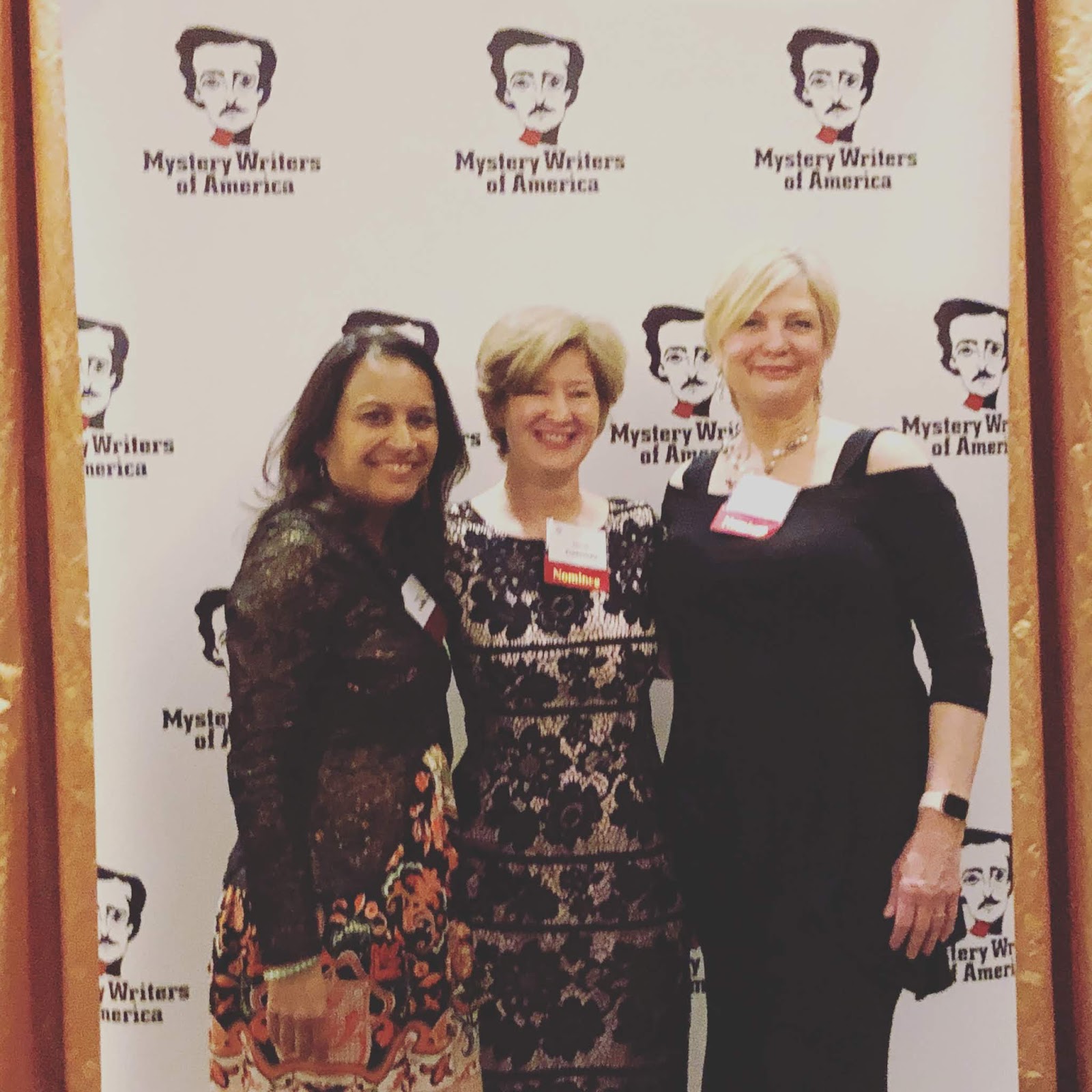
To my right are Mariah Fredericks and Paula Munier


To select the Mary Higgins Clark Award, a judging committee of MWA members reads hundreds of novels that are whittled down to an announced shortlist of usually five or six books. Out of these nominees, a winner is announced at the Edgars dinner.

I was stunned to be nominated for The Samurai’s Daughter in 2004. In 2019, I was again nominated for a book in my new series, The Widows of Malabar Hill, which shared the nomination with books by Mariah Fredericks, Dianne Freeman, Julia Keller and Paula Muncier. Widows turned out to win that night, and I experienced so much surprise and joy that my heroine, Bombay lawyer Perveen Mistry, was now part of the MHC tradition. Mary was not at the Edgar Awards Dinner that night. We missed her.

I wonder what she would have thought, if we'd met. I don’t see myself as being close to MHC in style of writing or structure--and certainly, I lag behind her in productivity and sales. But she might have liked my heroine. A long time ago, I decided to commit to writing books about intelligent women who support themselves and those around them. It just felt natural. 

This is how a lot of us go through life. We are sailing along minding our business, and something awful happens. Our crisis could be one of many terrible things: an incident of racism in the neighborhood, a family member’s pain, a financial setback or the news of a friend's serious illness. We throw ourselves into action and try our best, no matter the outcome. 

In the books of Mary Higgins Clark, we see ordinary women saving the universe. 

Ourselves amplified, everywhere.


Wednesday, December 18, 2019

Sujata's Writing Road, 2019

Sujata Massey

With debut author Tori Eldridge at Chevalier's in Los Angeles


I grew up in the age of point-and-shoot simple cameras, which at the time seemed beyond magically simple. But in the last ten years, the cell phone camera has thrown old-fashioned cameras to the curb. We are now responsible for being the chroniclers of our lives.

I feel that stopping what I'm doing to take pictures takes me out of the moment, so I don't do it a whole lot. But when I travel, or have special friends come my way, I go straight to the camera app on my phone.

Here are some of my favorite moments saved over the last year--my grateful thanks to the invisible assistants who did a lot of the snapping. These pictures remind me how many people--family, writing friends, readers, and booksellers--have brought joy into my workalike. I was thrilled to launch the second book in my Perveen Mistry series, The Satapur Moonstone, and humbled by the recognition given to the book before it, The Widows of Malabar Hill. And this made photo-ops!

 For all these journeys, and so much more, I am grateful. You may notice a lot of books in these pictures. Whoever guesses the right number deserves their own prize.


Crime Writers of Color founder Kellye Garrett came to my house to make drinks  


Twin Cities roundup: my stepmom Manju and good friends at Once Upon a Crime


My mother Karin and her longtime pal Don Johnson, an expert on Indian textiles 


This was one of the biggest book talks on the tour due to Margaret and Kathy's efforts


I was having a lonely dinner in Houston before a signing discovered two readers, Tara and Priyanka, were in the same bar!


There was literally a tornado hitting Kansas when I posed with Raven Books' Danny Caine 


Janet Rudolph's legendary mystery bookclub read Widows!


What an honor to have audiobook narrator Sneha Mathan read for me in Seattle


Getting into position for Nancy Pearl's web talk show, Book Lust


I drove to Santa Barbara for lunch and met a bunch of newsletter subscribers!


The  hand-carved award for Best Historical Mystery at the Left Coast Crime Con 


Celebrating the sheer glass Macavity win for Best Historical at Bouchercon with  Soho's Rudy, Juliet and Bronwen


With my husband just before winning the Mary Higgins Clark prize at the Edgars in NY


To touch a hot-of-the-press book for the first time is a real thrill!


Wednesday, November 6, 2019

Bouchercon 2019: Texas Welcome

Sujata Massey


I went to Dallas last weekend for Bouchercon, a 50-years-old-and-counting annual mystery convention.The weather was cold, yet the Texans were warm. So were the folks I chatted with among the flood of 1800 mystery lovers who arrived from all points. This year's theme was suited to conventional thinking about Dallas: Diamonds, Denim and Death!

Every day was filled with book talk. This was done on panels, in the book room, the bar, the hallways. I met people from as far as Israel and India, and as close as Indianapolis. I met so many new friends that I hope to see again.


Retired diplomat Alfredo Barela knows me through Rei Shimura


Soho's publisher Bronwen Hruska coating with author Francine Mathews


Even though Bouchercon is ostensibly about attending panels of crime novelists and publishing  professionals, there are many side parties and special activities. Soho Press, my publisher, specializes in mysteries by authors from around the world, and they threw a special reception for author Peter Lovesey, who was celebrating the eighteenth adventure of his brilliant police detective, Superintendent Peter Diamond. I tore almost one hundred raffle tickets for people wanting the Diamond book bonanza. This was another slick way to make friends.


Being charmed by author Teresa Dovalpage


Peter Lovesey's grand giveaway being awarded by our editor Juliet Grames


With the Soho publishing gang


I feel so much at home with a publisher like Soho, who is enthusiastically committed to publishing great fiction with characters who are diverse in national backgrounds--and not sprinkled in for color, but because they are compelling people and their stories are unforgettable. At the Soho International Guest of Honor party, Peter Lovesey announced a new Soho contest for first-time authors with a paid advance and publication. He got his start with a literary contest in England, and that's similar to how I broke into print (the Malice Domestic Unpublished Writers Grant Contest).


Loved signing near author Felicia Mason and cinematographer Semone

When I began going to Bouchercon in 1996, the majority attendance was white men. Gender dominated the atmosphere in the bar and in the pale rooms. For the most part, Bouchercon no longer has that feeling of an old boy network. The con feels like a place for many people to express what it is they bring to mystery or love about it. I hear about mystery book groups, field research in New Zealand, and secret hikes into off-limit areas. Also crafts, quilts, and cocktail recipes.


Anthony noms for Kellye Garrett, Lori-Rader Day, James W Ziskin,  Holly West


In addition to panels where we can learn the secrets behind beloved books, the convention is also a haven for awards ceremonies. The convention bestows a fan-voted prize called the Anthony, which is named after the inspiration of the convention, the late New York Times book critic Anthony Boucher, said to be the first journalist who treated mystery fiction as serious literary works. Other mystery-centric organizations like Mystery Readers International give out the Macavity awards for general mystery fiction, and the Private Eye Writers of America awards the Shamus awards for professional investigator novels and stories. The Barry and the Dillinger are also coveted awards at Bouchercon. But that's not enough for Bouchercon. its organizers also shower honors on booksellers, fans, and other special people who have built the power of mystery fiction. The overall theme is love and thanks for keeping our literary world booming.


S.A. Cosby, Anthony Winner

If you go to enough conventions, you may no longer wear a size six little black dress, but there are some sizable advantages. Being an old-timer means you can enjoy seeing friends and newcomers light up as they receive their first requests for books to be signed, and maybe even awards for them.   This year brought a special thrill when my friend Shawn (S.A. Cosby), whose first novel comes out next year with Forge, won the Anthony for best short story. He had moved me to tears a few nights earlier reading this prize winning story, The Grass Beneath My Feet, aloud in the hotel bar.

Yes. Only with mystery lovers, is there read-aloud story time in bars.


Holding the Mcavity tight to my heart with Soho's publisher, Bronwen Hruska

On Halloween night itself, I was humbled to win the Macavity Award for The Widows of Malabar Hill. It turned out to be a beautiful crystal keepsake that will be take pride of place alongside a fabric Macavity cat award I won many years ago for The Flower Master. The nominees in this category were so excellent, I think any one of us could have won. So I am especially grateful, following the amazing awards this book has already gathered.


I was also nominated for a Shamus award given by the Private Eye Writers of America. I was very surprised that Perveen Mistry was seen as fitting into this category--she's a legal investigator, not a gumshoe. I hardly minded losing to Kristen Lepionka, who wrote a great modern PI novel featuring  woman, What You Want To See.

Att the Shamus awards dinner, some words were casually said that led to many follow-up dialogs on FaceBook and Twitter about how we can welcome people we don't know well into our various tight-knit mystery worlds. Some of the conversations were quite heated, while others were healing. Anyway, it wasn't until a few days after I got home that I could put away this other baggage, too.

When the new books go on the shelf, the old suitcase returns to the attic, and the wrinkled receipts go to the tax box, I no longer have visions of diamonds, denim and death.

It's time to stop chatting and start writing again.


Wednesday, July 31, 2019

A Road Map of Bombay

Sujata Massey


Lately, my work in progress has been dragging its feet. Maybe it's because I'm writing from my home in Baltimore, while I long to revitalize myself with a walk through Fort, the historic Bombay neighborhood I write about in the Perveen Mistry novels. Even though I've been there in person, I feel like I need to be led along the streets again.

If I could step into an old map, it would fix everything, wouldn't it?

Maps inside a book are like sugar in dessert. You don't need it, but it's so much nicer when it's there.


Philip Schwartzberg's map created for Widows 


My relationship with maps did not start out well. I used to be terrified of when my parents were driving, and we got lost. The driving parent would call out for someone (the spouse or eldest child in the car--yours truly) to study a large, cumbersome road map and discern the correct way back. It seemed I  could never read the map fast enough nor could I orient myself in a direction other than the printed paper. Because of the way my brain processes direction, I was not a natural fit with maps--though I need them, because I have a terrible instinct for misdirection.

I began feeling less overwhelmed by maps when I lived in Japan. This was the era when I was a foreigner in Japan doing groundwork for a first novel. I wanted to write a mystery that felt real; and for me, that meant naming actual streets and train stations. The little line maps on the back of every shop or restaurant's business card were my salvation in cities like Tokyo and Yokohama where many streets didn't have names, just numbered buildings.

After publication of my first book, The Salaryman's Wife, I learned how attentive readers are to details of place. If I located a known building on the wrong corner, I would hear about it. But just as quickly as people catch errors, they also delight in hearing the names for almost-forgotten places.

In India, many city and street names have changed due to political progress--and here I am, sounding like an old person, talking about "Bombay" instead of Mumbai and "Bruce Street" instead of Homi Modi Street. I search out the oldest-looking places and commit them to my camera, and my heart.


On the way to Crawford Market


Apollo Bunder, with the Taj Hotel


After independence in 1947, Indians refused to continue speaking of streets named for men who were the enforcers of its colonial past. Many city and street names on maps officially changed from English government officials to Indian heroes, although verbally, the English names are often still used in spoken directions by locals. Ironically, there is at least one area renamed after a British person: Horniman Circle. Benjamin Horniman was a progressive British journalist who was thrown out of the country in the early 1900s for writing supportively of Mahatma Gandhi. The handsome driving circle in South Mumbai framed by offices and shops had previously been named in honor of the 13th Lord Elphinstone, one of Bombay's governors. If I hadn't learned who Mr. Horniman was, I might have mistakenly misnamed the circle in my novel. Interestingly, there still is an Elphinstone College in Bombay (named after the second Lord Elphinstone) as well as Wilson College, named for the Scottish Presbyterian missionary educator who founded it.

 Horniman Circle (once Elphinstone Circle)


For quite a few years, I have been gathering such arcane details from old guidebooks and maps. Some of my key sources are huge, vintage reference books like the Imperial Gazetteers of British India, and  old city guidebooks, especially if they have maps. The best place in the United States I know to find such wonders is the Ames Library within the University of Minnesota.


Rare antique travel guides to Bombay at Ames Library


The newly translated vintage guide


Karl S. Baedeker was the famous publisher of 19th and early 20th century travel guides that originated in Germany, a country with people still passionate about travel. The Baedeker guides were  meant to help Westerners see marvelous places beyond their imaginations, all the while in comfort and security. Baedeker guides were often translated into English. However, the 1914 Baedeker's only guide to India was published in 1914, and due to hostilities between Germany and Britain, never found an English language publisher. Not until 1985 was the guide translated into English by Michael Wild.  I was grateful to be able to buy the modern translation and picked up from it some interesting details about the city from an early 20th century German viewpoint.

Because old maps are very helpful, I was tempted when I discovered a 1967 Bombay folding map being auctioned on eBay by a seller in England with a starting price of 49 pounds. Once airmail delivery was included, the map would run me about $77 US dollars.


I've bought moisturizers that cost more, but I hesitated. My worry was this mysterious map on eBay would be focused exclusively on tourism venues. I knew it also would have plenty of Indian street names, so I would continue to need to cross-reference street names.


The seller had posted some photos of the map booklet that looked promising, so I pressed the button to bid. It was the last day of the auction, and it turned out I was the only person on earth interested in a Tej Brothers 1967 Bombay Street Map.


Two weeks later, a neat little package in a sturdy, waterproof envelope arrived from England. The map booklet had traveled safely between two pieces of cardboard inside the package. It was just the right size to put inside a handbag, yet it was utterly fresh, as if it had never been opened up and read. To say this map is in perfect condition is an understatement. Some of the booklet pages unfold into very large, easy to read maps which are rich in color and landmarks.


The booklet also has listings of popular name of restaurants and hotels, movie houses and shops. I can't wait to show it to my stepfather, who was a young man-about-town during the map's prime.

In the week that I've been studying it, the map's provenance has intrigued me. Because there is absolutely no smell of mold or deterioration from moisture, I believe the map probably left India many years ago and was kept in a cool, dry location. I wonder: was the map's first owner someone who meant to use it while exploring Bombay, but instead relied on the directions of a human companion? Or did the planned trip to Bombay get cancelled? Could it be the map never had a real owner, but just resided for decades in a travel agent's file cabinet?

I've come to realize that a map can offer much more than geographic placement or inspiration for story; it can be a mystery unto itself.

Wednesday, May 8, 2019

The Right Kind of Malice

Sujata Massey

When I began writing fiction, I didn't know conventions for writers even existed. (I think the Murder is Everywhere gang might excommunicate me for the confession). Before I was published, I joined   the wonderful international program Sisters in Crime. Experienced women writers in that group told me that I would learn a lot to help myself at mystery conventions. For example, I could hear famous mystery novelists talk about how they wrestled with plots; make friends of readers who knew everything and everyone, and maybe even catch up with a literary agent.
Signature collector Risa hits up novelist Vivien Chien

The first mystery convention I visited was Malice Domestic, a fabulous convention that advertises it is "not everyone's cup of tea." Malice does not usually have pleasant connotations, but if you meet a Malice reader, chances are she will hug you before the conversation is over.

Photographer Iden Ford, Welsh author Cathy Ace, and author Donna Andrews

Mystery authors drawn here are primarily (but not exclusively women and the style of mystery storytelling is "traditional" (no gratuitous sex or violence). Yes, the favored mysteries are chock full of suspense and bad things happen--usually a murder that must be solved--but the reader will not feel like vomiting at language and painful images in a Malice book. Also, the mysteries of choice tend to be series books, rather than stand-alones.
My friend Patsy Asher in the hospitality lounge. Writers have filled a table with promo items!

And Malice Domestic is itself a long-running series, if you talk about location. Unlike many conventions, this one does not move around: it has been in the Washington DC suburbs for all of its 31 years, save a couple of years in downtown Washington, when something mysterious happened in an elevator that made the convention shoot back to the suburbs. Currently it's housed over a three-day weekend at a Marriott Hotel in North Bethesda.

Because of the recurring DC area location, many of the fans are from DC, Maryland, Virginia, Pennsylvania and Ohio. It takes me about an hour to get to the con by car or train. What could be easier?
Kathy Harig with her assistant Dorothy from Mystery Loves Company Books in Oxford, MD.  are the primary sellers of new mysteries.

However--writers come here from Canada, England, and all over the country--and they also tend to be repeat offenders. Male mystery folk are welcomed like brothers come home from college, but to my unscientific eye they make up less than ten percent. Bloggers are a new crowd that came in over the last fifteen years or so...these hardworking, usually unpaid book reviewers are great company.

Hanging with Blogger Dru Ann Love of Dru's Musings

I began my association with this crew when I won a Malice Domestic Unpublished Writers Grant. In 1996, I submitted a partial manuscript of my first mystery novel into a contest that was overseen by longtime serious mystery readers on the Malice board including Bill F. Deeck, a marvelous mystery man who sadly passed away too young--and as a result, the award is now named in his honor. There are other awards, too: the Agathas, named in homage to the mother of the traditional series mystery, Agatha Christie. Malice attendees nominate their favorite novels, stories and true crime books that relate to writing mystery and the traditional mystery genre from the previous year. These are extremely coveted awards because they come in the shape of a teapot. Yes, an actual working teapot that is custom made to the convention's specifications, with a lovely new design revealed each season.
Beth Schmelzer, retired children's librarian, has been influential in bringing children's mystery authors to  Malice

I returned to Malice Domestic last weekend. Over the 23 years that have passed, I think I only missed six conventions because I'd moved to Minnesota. I always wind up having long, happy conversations with the friends I've met over the years--and I make new ones each time. In a way, Malice is like the high school you should have gone to, where everyone is welcoming, and everyone wants to read (as opposed to playing sports).
At my banquet table, you'll see mystery writers Maya Corrigan and James Ziskin from left.

This year, I was on quite a high because The Widows of Malabar Hill was one of five nominees in the Best Historical Mystery category. This first novel in my Perveen Mistry series brought me very good luck at the Left Coast Crime convention and the Edgar Awards, so I figured my luck had run out. And just look at these fabulous fellow writers who were nominated.

My fellow best historical nominee LA Chandler, left, and writer Lea Wait on right


I nearly passed out when I heard that I won...I managed to float through the ballroom up to the stage but proceeded on the exit stairway rather than the entry stairway, so I had to go down again to get my beautiful teapot before making my acceptance speech.
The teapot is just right for tea with my agent Vicky Bijur

Several days later, I am still reeling from the shock of this recognition for Perveen Mistry. I am so happy that a book set in India, telling a tale of strong women facing adverse circumstances and ending on an upbeat note, made it into the hearts of so many readers.

I am about to launch the second Perveen Mistry, The Satapur Moonstone. I don't expect lightning to strike twice, but the joyful celebration at the Malice convention will buoy me through whatever comes next.

My forthcoming tour has May dates listed below. More to come with my next posting in two weeks.

Wednesday, May 15: Ivy Bookshop, Baltimore, MD
Thursday, May 16: Astoria Bookshop, Queens, NY
Monday, May 20: Murder by the Book, Houston, TX
Tuesday, May 21: Boswell's, Milwaukee, WI
Wednesday, May 22: Once Upon a Crime, Minneapolis, MN
Thursday, May 23: Mystery to Me, Madison, WI
Friday, May 24: The Raven, Lawrence, Kansas
Saturday, May 25: Poisoned Pen, Scottsdale, AZ
Monday, May 27: Facebook Live Book Discussion For All Readers Worldwide (at Facebook's Sujata Massey Author Page)