Showing posts with label Elephants. Show all posts

Thursday, October 12, 2023

Everyone loves elephants

 Michael - Alternate Thursdays

Useful trunks again

Everyone loves elephants. It’s easy to understand why. They have interesting personalities, the females are excellent mothers, protecting and caring for their calves, and elephants are most entertaining with their wonderful trunks. In fact, those trunks are amazing organs. An elephant has an extraordinary sense of smell, and the trunk is always in motion testing the air for scents. After all, it is a mobile nose.  It's also a sensitive touch organ that can feel its way through foliage and branches. The book I discussed last time, An Immense World by Ed Yong, mentions that elephants easily detect their favorite plants even when obscured in lidded boxes and surrounded by other types of vegetation, and that they can distinguish between humans the way a dog can. More importantly for the elephants, the trunk is used to check members of the herd. One researcher conducted a messy experiment of collecting fresh urine from the muddy ground, and driving ahead of an elephant group. She would then deposit it on the ground some way in front of the group. If the urine was from an elephant of another group, it was ignored; if from an elephant of the group, it was checked and then the group proceeded. But if the sample came from a member of the group behind the sniffer, it caused surprise and much additional checking. So not only did the elephants know who the source was, but also where they expected that individual to be.

"toeing" can indicate listening through the feet

Elephants also have apparently complex communication using infra-sound rumbles that are transmitted through the ground and sensed by their feet. In theory, the waves travelling through the earth could reach the other side of the world! What elephants deduce from these seismic signals is a much harder question, and they aren’t telling at the moment.

They also seem happy to interact with humans, provided they are given space and respect. This is described in the book by the late Laurence Anthony The Elephant Whisperer. There are even some hints in the book that suggest a relationship between Lawrence and his elephants (or between the elephants and their Lawrence) that transcends any form of communication that we can analyze scientifically.

Tree damage in the Chobe National Park

Unfortunately, like most happy stories, there is an intrinsic tension. Elephants require an enormous amount to eat—something like 350 lbs of vegetation every day. They have seven complete sets of teeth, and once those are gone, they starve to death. It must be challenging to be always hungry, and they usually rest during the heat of the day in order to use most of the cooler night for feeding. They have essentially no natural enemies—other than man—and tend to be successful if relatively slow breeders. Left to their own devices, elephant populations grow slowly but surely, with the herds led by their matriarchs wandering over vast areas in search of food. They sense rain and head to those areas for the new growth.

Lovely in the river!

The problem is what happens in drought conditions. The elephants move through the bush devastating it, eating everything they can find. That includes any tree bark that they can reach, and once the tree is ringed, it dies since nutrients can’t reach the leaves. Worse, elephants will break off large branches or push over trees altogether in order to reach a few mouthfuls of leaves that they fancy. And they do this even if there is no shortage of food. It’s a strange behavior, because most animal species (present company excluded) interact with their environments quite well, and certainly don’t go about destroying their future food supply. There isn’t a convincing theory about why they behave this way—and apparently always have. Surely, it’s not a successful evolutionary trait.

Of course, now elephants are severely restricted in their movement. In the seventies there was a horrendous die off of elephants in Kenya. The conservation authorities there believed that given their large and connected conservation areas, leaving the elephants unmanaged was the correct and natural strategy. Unfortunately, drought conditions led to the loss of thousands of elephants who died miserably of starvation and left behind devastation that seriously affected other species such as the black rhino.

In more recent times the relentless demand for ivory, drought, and the restriction of their range has led to a decrease in elephant numbers by about two thirds to below half a million world-wide. And now politics has entered the fray.

Under Ian Khama, Botswana banned trophy hunting and the transport of trophies overseas. His policy has always been that the best way of exploiting Botswana’s superb wildlife resources is through high-end tourism with a relatively small numbers of visitors who support a variety of jobs and do comparatively little harm. That strategy has contributed to Botswana’s success. However, Khama’s successor—President Masisi—sees things differently, and that’s probably not independent of his feud with Khama. He accused Khama of elitism and a lack of concern for small farmers in areas where crops were often attacked by hungry elephants. He was also berated for the loss of hunting revenue to the country. There were mutterings about corruption. Masisi reintroduced trophy hunting, citing the overpopulation of elephants in the country.

It became a huge issue in Botswana with the local people on both sides. While it's true that elephants  aren’t currently endangered in Botswana, it’s unfortunate that the issue is now being argued against the background of personal animosity and party politics.

As for the longer term, elephant populations are decreasing in most African countries and climate change will almost certainly devastate some of their natural feeding ranges.

Enjoy them while you can.

Thursday, March 25, 2021

The Addo elephants and friends

 Michael – Thursday

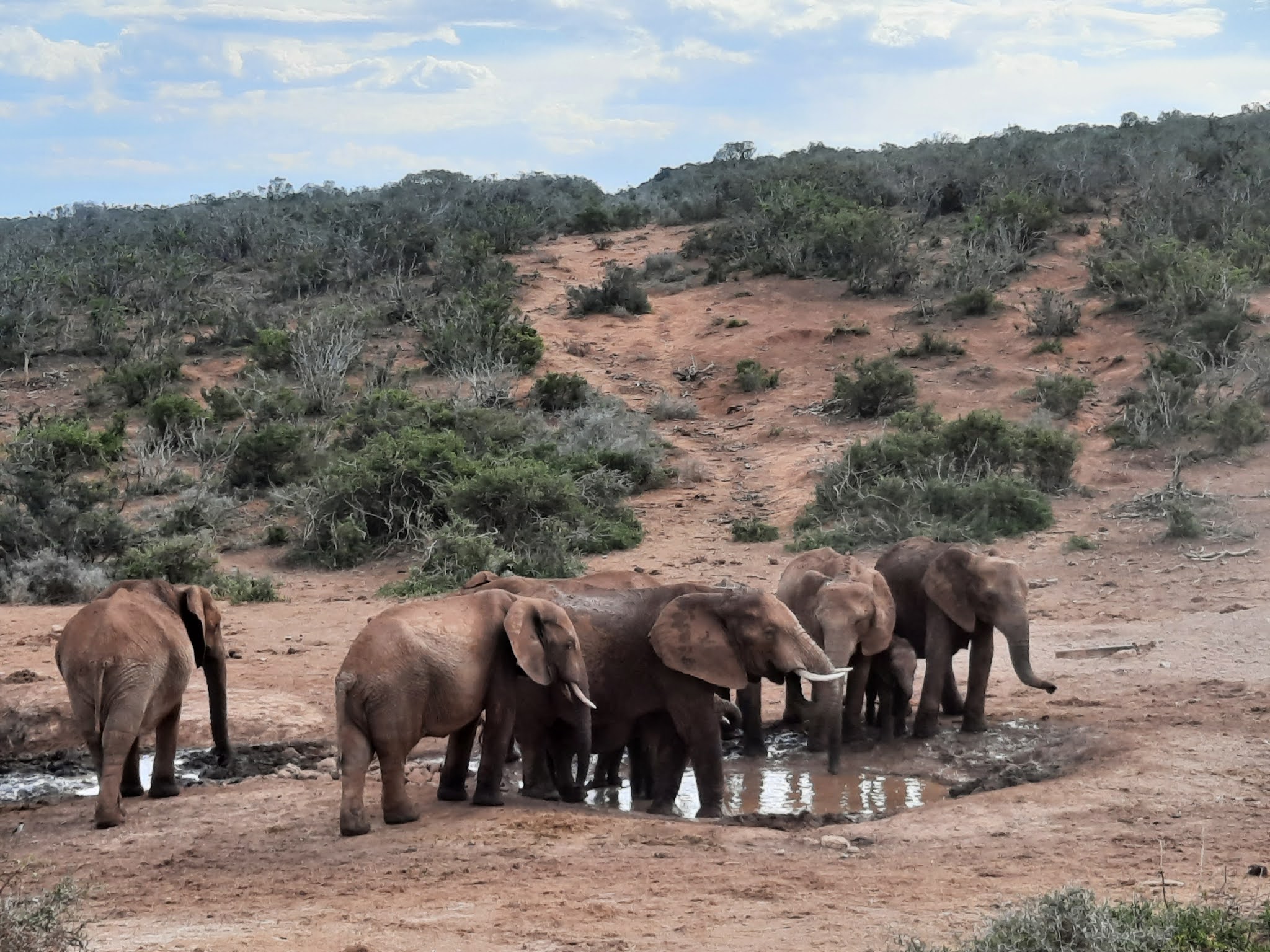
A couple of weekends ago I had the pleasure of visiting the Addo Elephant National Park with two friends, Ken and Sharon.

Map showing the extent of Addo

Currently, the park stretches about 130 km west to east and 80 km north to south, and encompasses five of South Africa’s seven biomes. It even includes some marine areas. It lies close to South Africa’s sixth largest municipality, Nelson Mandela Bay in the Eastern Cape so attracts local as well as foreign tourists. Probably the last time I visited the park was about fifty years ago, and in those days it covered only a small area. The elephants were held in a separate enclosure and you could only watch them from outside the fence. In fact, the only time you were likely to see them was in late afternoon when truckloads of oranges and vegetables were dumped into the enclosure over the fence near the camp and the elephants came to have their snack. It was all a bit zooish. It’s totally different today. The park has a many times larger area, several overnight camps, and extensive roads, some sealed. The elephants go where they like, and for food they have to settle for the thick shrub vegetation that covers most of the area. Ken is an honorary ranger for the Garden Route National Park, and knowledgeable about Addo and its wildlife, so it was a privilege as well as a great pleasure to visit Addo with them.

The camp we stayed at is well spread out, and each chalet nestles privately in the thick bush.


View across the camp


At this time of year, the Karoo Boer-bean splashes red through the bush

The elephant theme even extends to the towels!


The area has a rather unsavory history. By 1900, most of the elephants in the area had been shot by ivory hunters, and much of the other game had gone the same way. The remaining elephants were causing damage to the crops and infrastructure in the area, and in 1900 a local hunter was killed by one. This sparked an outcry to “deal with” the elephants once and for all. In 1919 a professional hunter was tasked with eliminating them, and over the next few months he shot 114 and captured and sold two young calves to a circus. A year later, there were only 16 elephants left. Only the intervention of some sympathetic farmers saved the Addo elephants from extinction.

Spot the tuskless ones

Most of the females lack tusks, which is believed to be an effect of the past ivory hunting. It was once thought that the Addo elephants were a different subspecies, but they aren’t significantly genetically distinct from the ones in the Kruger National Park area. Perhaps this error was fortunate. Possibly the Addo park would never have existed if there hadn’t been a belief that something genetically unique was being preserved.

A rare sight of the Caracal or African Lynx
Love those ears!

Now, in addition to the animals that always lived in the area, some of the larger herbivores and even lions have been reintroduced. We saw a magnificent black-maned lion (apparently known as Jack) near the fence. Sharon spotted him with binoculars. He was so far away that you could hardly see him with the naked eye.

Flightless dung beetle at work

Another important species endemic to the area that is being protected at Addo is at almost the opposite end of the animal spectrum from the elephant – the flightless dung beetle, only about four centimetres long. Most dung beetles spend their time flying around pretty randomly on the look-out for dung – elephant dung is a particular favorite – for food and brood material for their grubs, but this species has no wings. This cramps their search style, and the fact that they can’t warm up by flying means that temperature control is an issue. Sometimes they feed and night, sometimes during the day.

Addo road sign
After rain they are all over the place, and after a day of rain, Ken had to  zig-zag along the road to avoid them. It’s claimed that they are the only  animals proven to use the Milky Way for navigation on dark nights, but  I’m not quite sure how that works. Apparently, they see light as a slit and so they can orient themselves relative to the brightest point. (“Navigate” means they don’t go round in circles, which is not an efficient way of finding dung. Or anything else.)


Another tricky post-rain pedestrian

It’s a great area to visit and one which is malaria free. The best part is that the elephants are completely unconcerned about cars. That is not the case in the Kruger area where one of my friends came back from a game drive with a smashed wing mirror and terrified passengers to prove it. Sharon took the video. I wouldn’t try this in Kruger…


Don't try this at home!

I’m looking forward to meeting these two fellows again one of these days!


Thursday, December 19, 2019

The trouble with elephants


Michael—Thursday


Anyone who cares about animals at all loves elephants. It’s easy to understand why. They have interesting personalities, the females are excellent mothers, protecting and caring for their calves, and they have apparently complex communication including infra-sound rumples that are transmitted through the ground. They also seem happy to interact with humans, provided they are given space and respect. Many of these are documented in the late Laurence Anthony’s book The Elephant Whisperer (that I reviewed HERE). There are even some hints in the book that suggest a relationship between Lawrence and his elephants (or between the elephants and their Lawrence) that transcends normal communication.


Unfortunately, like most happy stories, there’s an intrinsic tension, and I wrote about that HERE in Condoms for elephants. Elephants require an enormous amount to eat—something like 350 lbs of vegetation every day. They have seven complete sets of teeth, and once those are gone, they starve to death. It must be challenging to be always hungry, and they usually rest during the heat of the day in order to use most of the cooler night for feeding. They have essentially no natural enemies—other than man—and tend to be successful if relatively slow breeders. Left to their own devices, elephant populations grow slowly but surely, with the herds led by their matriarchs wandering over vast areas in search of food. They sense rain and head to those areas for the new growth.


The problem is what happens in drought conditions. The elephants move through the bush devastating it, eating everything they can find. That includes any tree bark that they can reach, and once the tree is ringed, it dies as nutrients can’t reach the leaves. Worse, elephants will break off large branches or push over trees altogether in order to reach a few mouthfuls of leaves that they fancy. And they do this even if there is no shortage of food. It’s a strange behaviour, because most animal species (present company excluded) interact with their environments quite well, and certainly don’t go about destroying their future food supply. There isn’t a convincing theory about why they behave this way—and apparently always have. Surely it’s not a successful evolutionary trait.

Of course, now elephants are severely restricted in their movement. In the seventies there was a horrendous die off of elephants in Kenya. The conservation authorities there believed that given their large and connected conservation areas, leaving the elephants unmanaged was the correct and natural strategy. Unfortunately, drought conditions led to the loss of thousands of elephants who died miserably of starvation and left behind devastation that seriously affected other species such as the black rhino.

In more recent times the relentless demand for ivory, drought, and the restriction of their range has led to a decrease in elephant numbers by about two thirds over the last fifty years to below half a million world-wide. And now politics has entered the fray.

Under Ian Khama, Botswana banned trophy hunting and the transport of trophies overseas. His policy has always been that the best way of exploiting Botswana’s superb wildlife resources is through high-end tourism with a relatively small numbers of visitors who support a variety of jobs and do little harm. The strategy has been a contributor to Botswana’s success. However, Khama’s successor—President Masisi—sees things differently, and that’s probably not independent of his feud with Khama. Their personal animosity led to Khama leaving the governing party and supporting the opposition in the last election. Khama was accused of elitism and lack of concern for small farmers in areas where crops were often attacked by hungry elephants. He was also berated for the loss of hunting revenue to the country. There were mutterings about corruption. Masisi reintroduced trophy hunting, citing the overpopulation of elephants in the country.

It's become a huge issue in Botswana with the local people on both sides. While it is true that elephants certainly aren’t currently endangered in Botswana, it’s unfortunate that the issue is now being argued against the background of personal animosity and party politics.

As for the longer term, elephant populations are decreasing in most African countries and climate change will almost certainly devastate some of their natural feeding ranges.


Enjoy them while you can.

Thursday, March 24, 2016

Drought


It doesn’t matter what you believe the reasons are for why the climate is changing, the reality is that things are changing.  And changing quickly.  In all sorts of unexpected ways.

In a sense, it is the unpredictability of the changes that has caught us off guard. Throughout the world, weather patterns are weird - places having higher highs or lower lows; areas, normally dry, having floods; areas, normally wet, having droughts.  

For many people arguing about the role humans have played in climate change is the extent to which they get involved.  Their involvement is academic.  Certainly they read about what may happen if the oceans rise a metre or so.  What will happen to Miami or New York City, not to mention many Pacific Ocean islands and island nations that may disappear all together?

They may also notice a rise in some food prices.  But few actually experience what climate change can really mean to a community.

South Africa is experiencing a terrible drought this summer – not all of the country, of course, but much of the food-basket areas in the centre of the country, as well as the area around Cape Town, where severe water restrictions are in place.

I read about the fact that the farmers of the Free State province won’t have any crops this year.  

Non-existent crops in the Free State
Dams are empty or nearly so.
Dead sheep
I see hundreds of plastic bottles of water outside filling stations, all donated, that will be transported to the affected areas.  

There are hundreds of water collection points around the country.

People queuing for water.

Waiting for water.
I see photographs of cracked, arid soil with nothing growing.  I speak to people who normally use local beef to make biltong - the South Africa equivalent of jerky, but who now are importing beef so they can keep their businesses alive.  Many of the local cattle have died.

However, other than paying increased costs if I don’t cut my average water consumption in Cape Town by 20%, I don’t actually experience the effects of the drought firsthand.  I can still get water whenever I want it.

This week, for the first time, I saw for myself the effects of the drought firsthand.

I travelled to Ingwelala, a private game reserve bordering the famed Kruger National Park.  Normally it is rich in game because of its abundant grazing and browsing, as well as its dams, full of water pumped from boreholes.

This year, the dams are still full, but there are few animals because there is no grass to eat.  Having water to drink is nice, but if there is nothing to eat, it’s time to leave and find something better elsewhere.

What is strange is that the bushes and trees seem to have found water deep underground and are in decent shape, but there is no grass whatsoever – just barren sand.

No grass

Nothing for grazers to eat
The most noticeable difference from normal times is the devastation of trees and bushes by elephants desperate for something to eat.  Hungry elephants have toppled hundreds of trees just to get to the few delicious leaves at the top.  The same elephants have uprooted hundreds, if not thousands, of bushes to get to the moisture of the root systems.  


Apparently elephants find some moisture around the roots

Could be a scene after a WWI bombardment

More devastation


Elephants are breaking through electric fences into camp to get to the fresh-water pipes.

Baobabs store water in the trunk.  Elephants often dig into the trunks to get to the moisture.  Rocks placed around the base of the tree are designed to keep the ellies away.

Concrete pyramids to keep ellies away
To make things worse, the elephants are so stressed that they are behaving unpredictably.  An Ingwelala member, casually watching some elephants, was chased for no reason for over 600 metres by an irritable elephant, which needed to blow off some steam.  Fortunately nobody was hurt.  My co-author, earlier in the year was also charged, and friends Aron and Jenny had their car damaged by an irritated ellie - while they were in it!

Elephant charging Aron and Jennie's car - photo by very scared passenger (Roger Taylor)
We normally have a few hippos on the property, but they’ve also left because here is nothing to eat.  A friend who just returned from Kruger told me that the hippos there are in such bad shape that they are foraging during the day (instead of at night).  Many are severely undernourished.  In fact, Kruger is considering culling hippos because of the drought.  Read more about it here.  

Kubu would definitely be short-tempered if he found himself in such a situation.  

Even though it is a very depressing sight to drive around Ingwelala, there are a few bright spots:  the impala and kudu are doing well, probably because they can browse as well as graze; the giraffes are fine because they can reach those succulent leaves high up, and the lions and leopards are in hog heaven (that doesn’t sound right!) because all they have to do is hang around a waterhole and dinner comes to them.
Giraffes are browsers - fortunately for them.
The kudu are in good condition - they browse as well.
The warthogs hogging a small pond.
The point I’m trying to make is that if you want to understand the real effects of climate change, go and stay somewhere where changes are having a dire impact, where lives are at stake, where the future is uncertain.

PS.  After I had finished writing this blog, I came across this video of a game park, Madikwe, in another part of South Africa.  As I said, the weather is weird everywhere.  Click here to watch.


Saturday, November 24, 2012

Greece Is Slaughtering Its Elephants.


What elephants?  Bear with me (no pun) and you'll see.

Forty years ago, amid another life, I attended an event in a close friend’s Upper Eastside NYC apartment filled with glitterati out of a Dominick Dunne novel.  The nation was in turmoil, torn apart and galvanized into intractable positions over the Vietnam War.  That night we were introduced to a decorated navy man and his organization, John Kerry and Vietnam Veterans Against the War.

It was a fundraiser and I was standing next to a local TV reporter buddy I suspected felt just as fiscally out of place in that crowd as did I.  I still smile when I think of him leaning over and whispering to me, “Jeffrey, what are we doing here?”  Today, that’s not a question Geraldo Rivera would likely ask in any crowd.:)

The highlight of the evening came when I was introduced to a group of three men chitchatting in a corner.  They graciously brought me into their conversation, though to be honest—and as hard as it may be to believe—my total contribution was a star-struck “hello” and on-cue nods to the back and forth among Messers Kevin McCarthy (actor and brother of author Mary McCarthy), Andy Warhol, and Kurt Vonnegut.

It was all a blur, except for one comment made by Kurt Vonnegut that I shall never forget.  And perhaps never fully understood until this morning as I contemplated what to write for today’s post.

Kurt Vonnegut, 1922-2007
In response to a question from Kevin McCarthy about what each regretted most about The War, Vonnegut said, “The elephants.  The slaughter of the elephants.”

Yes, elephants are a symbol of strength, honor, stability, and patience; a vibrant bulldozer of obstacles to success.   But I didn’t see that, and my immediate reaction I dared not voice: “What an isolated, intellectually pretentious thing to say in the face of all the human suffering experienced there every day.”

That just goes to show how little I knew then…or now.

I doubt there is an informed individual anywhere on earth who is unaware of Greece’s fiscal crisis.  On top of that, each day more learn of a homegrown terrorist organization seeking to cleanse “their” country of those they believe are not “true Greeks.”

But this is not about any of that, for ultimately Greece alone will bear the burdens of its fiscal and national identity decisions. Yes, there will be financial turmoil in world markets and undoubtedly some will suffer, but the world will adjust and go on to prosper.  

No, this is about the ongoing slaughter of Greece’s elephants.

The best and brightest of the nation’s youth are fleeing Greece in torrents unmatched in decades.  They see no future in an economy geared to protecting the connected and already successful, where all the bickering and battles between those in favor of and those opposed to the status quo are seen only as words, and change is not expected no matter whom the ultimate victor.

I ask you Greece, does it really matter who wins if you’ve slaughtered your elephants? 

Jeff—Saturday