Showing posts with label Syros. Show all posts

Wednesday, June 18, 2025

Sweet as Syros

 Sujata Massey


I didn't think of Greece as being a big country. But when I dug into the geography while planning my recent trip, I found Greece has a significant mainland plus over 6000 islands and islets, with 227 of them habitable. 

227 islands!

These potential 227 choices present a dilemma to anyone who is interested in the Mediteranean and visits Greece more than once. The question is: if you’ve discovered an island that captivates you, should you return? Or do go on visiting more places that you’ve heard are special?

Greeks on the mainland also love their islands. I also have heard they tend to align with a particular island, often because of family history, and visit it a few times a year. They build relationships and have a home away from home.


Vaporia District


I suspect most foreign tourists (myself included) tend to relentlessly explore as many as they can. Yet certain islands will always get the largest numbers of people, and they are Santorini, Mykonos, Corfu, Rhodes, and Crete, the place where Tony and I started our trip. But now we were having a new adventure on the way to the island of Syros


Port of Ermoupolis


We traveled by ferry, the same strategy we’d used for island-hopping back in 1990. Fortunately, there are plenty of ferry companies in Greece that run much more smooth and comfortable transportation than in the past. I remember from the late time I visited in 1990. Huge ferries like those run by the efficient Seajets company can take 2100 passengers and hold up to 600 cars. Rides can be as short as half an hour or as long as twelve hours, with plenty of stops at islands large and small. Ferries have seating similar to a plane’s economy, business and first-class sections, albeit far more relaxing and uncrowded.  Restrooms, bathrooms, and coffee and snack bars abound—and it’s easy to change your seat, as long as you are in the correct cabin. 

The ride from Crete to Syros was about six hours, so we went with a “platinum” seating category. You check your luggage in an area on the entry deck, where cars park around the sides. I felt a little nervous to leave our two suitcases in the luggage rack for Syros, but I was relieved to see most of the passengers and luggage was clustered in the area bound for Santorini (of course). This made the accidental removal of our suitcases seem less likely.

Upstairs, we relaxed with coffee in our comfortable window seats with extendable footrests. We heard lots of American English around us all the way to Santorini. It was just two hours from Crete to Santorini, and at that destination, two-thirds of the cabin disembarked. Within ten minutes, another great throng filled in the seats, most heading for Piraeus, the port near Athens. 


A seawall of tumbled marble


The word Cyclades is an Anglicized reworking of the Greek word Kyklades referring to the circular position of this island group in the South Agean Sea. 32 out of the Kyklades’ 220 islands are inhabited—and some of the uninhabited ones have great historical and spiritual significance and have legal protection against visitation. Syros is the largest island in the Cyclades, with a population just over 21,000, and is known as the island that stays open year-round. Syros is still a place where people work in the shipyards or farming and making cheeses, honey and also having art and craft galleries and shops. But primarily, Syros has the long-lived prestige of being the legislative center of the Kyklades, ensuring a constant stream of Greek citizens with legal business. There is a neoclassical urbanity to most buildings in Ermoupolis that gives this island a more international feeling than other Greek islands I've had the pleasure of visiting. 


Town Hall of Ermoupolis


Apollon Theater


Entrance to Historical Museum of Hermoupolis


Archaeological evidence of human habitation on the island goes back to 3000 B.C. Through the turbulence of the Crusades and beyond, different countries claimed Syros as theirs, but this island did not suffer as much as some other places. Syros had the unique situation of being a place with both Catholicism and Greek Orthodox churches, making it a refuge for some during political upheaveals. This legacy of immigration and self-sufficiency, plus an excellent location close to Asia Minor, made Syros a center for shipbuilding and textile production in the 19th century. It became the second richest location in Greece (after Athens) during this era, and is still known as the capitol of the Cyclades islands.  With prosperity, the arts thrived—and at one point there were five opera houses on the island. Its predominantly neoclassical architecture is different from the boxy, small white houses throughout most Kyklades islands. Life goes on year-round for local people, and there’s now a significant cohort of artists, designers and digital nomads living on the island. 

Restored interior Apollon Theater


I was impressed by the old-fashioned look of the curving harbor when the ferry pulled in. Only about twenty people got off. A waiting taxi carried us on a brief uphill climb to our lodgings, Hotel Aristide, a renovated Venetian palazzo owned by the writer Oana Aristide, her sister and mother. The design and comfort was exquisite and it's been recognized as a Michelin-starred hotel. There are quite a few hotels in historic mansions scattered through Ermoupolis. 


Hotel Aristide


Kriti Suite bedroom


Kirti had a terrace and plunge pool


How incredible it seemed that all the streets were paved in marble—soft hues of cream, gray and pink that were accented in the colors of the stucco houses. 


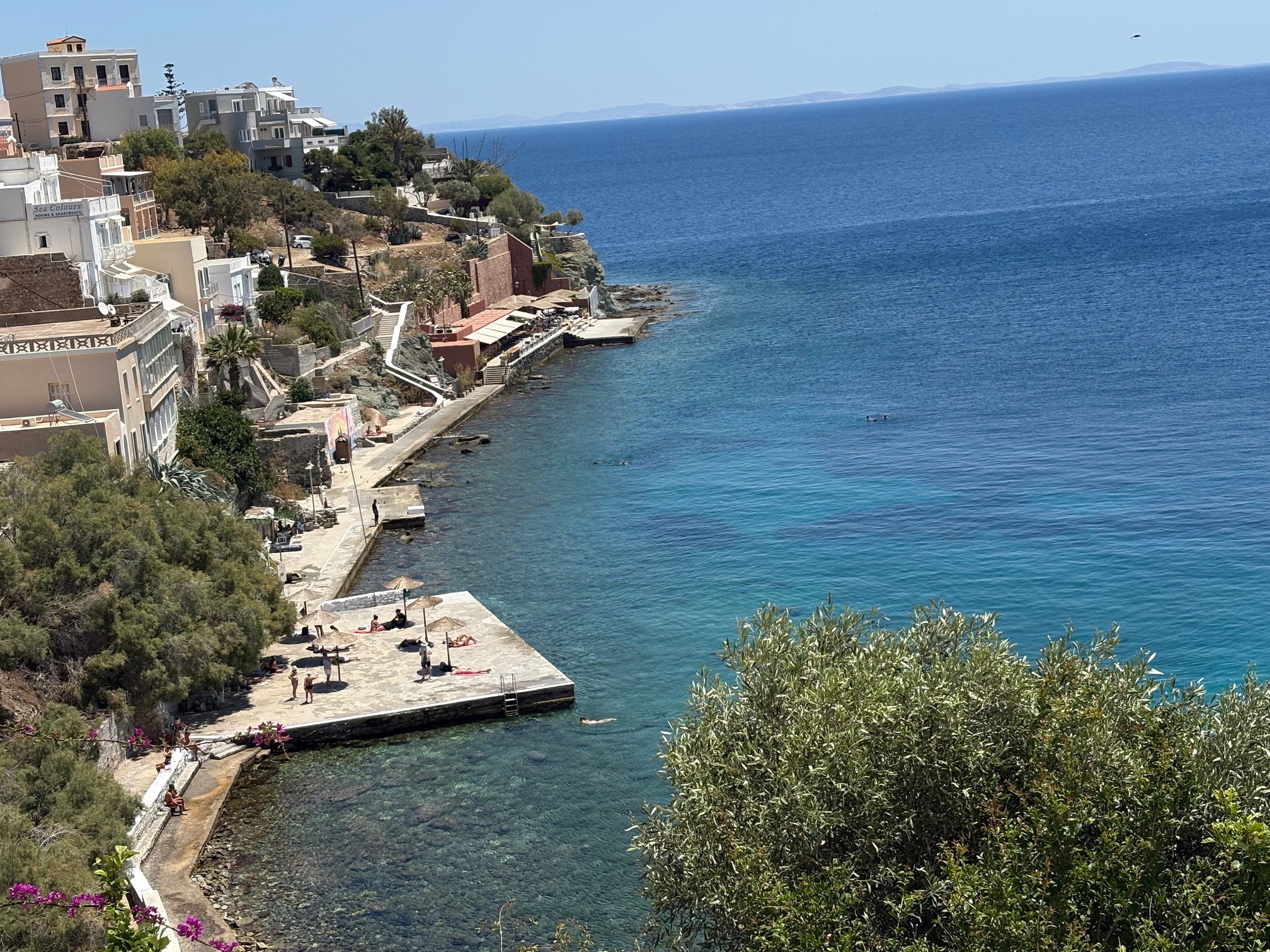
Later I was to learn marble is an intrinsic part of Syros's geology. Huge marble boulders made up the seawall near the port, and all other areas of Ermoupolis were cobbled in marble—the more industrial neighborhoods had tumbled marble, rather than the polished tiles of the Vaporia district. 


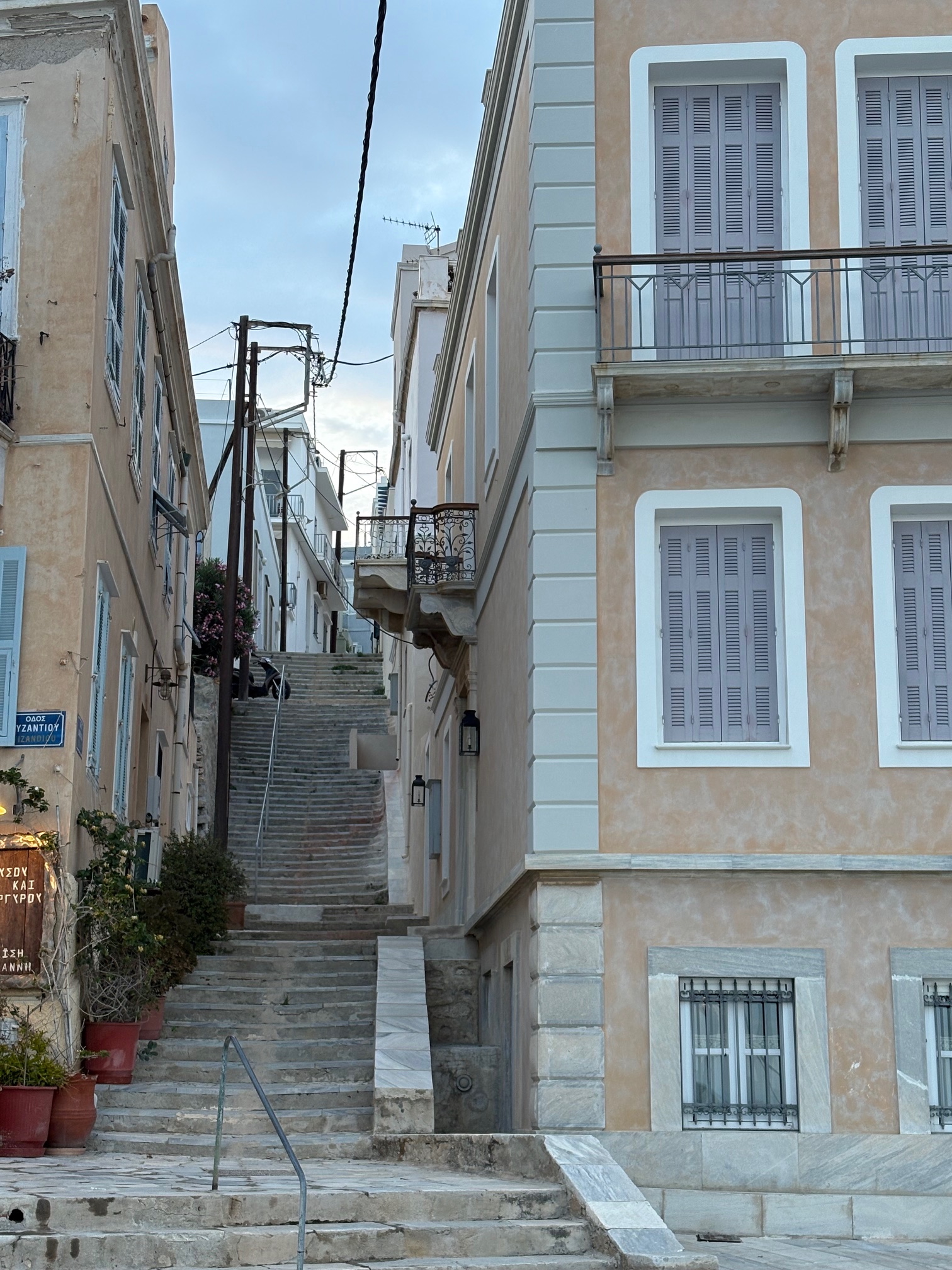
Flights of outdoor marble steps led upward from many streets on the island and opened into charming lanes, with houses set on either side. Not only did we see many small historic houses occupied by local families, there were also plenty of abandoned dwellings awaiting renovation. Historic preservation guidelines in Ermoupolis are strict, and while this ensures the area looks uniformly like itself, progress can be slow. Probably if I had stayed a few days longer in Ermoupolis, I would have been swept up in real estate fever myself. 


The neighborhoods were drop-dead beautiful—and the bonus was that the townspeople were friendly and there was an existing infrastructure of lovely restaurants and shops. Fabulous public buildings like the neoclassical Apollon Theater, modeled on La Scala, still hold regular performances, and we heard about a rock concert with international artists taking place just after we would head out. 

A small number of artists have camped out for good on a special part of the island, the historically Catholic village of Ano Syros. This is a white-washed paradise full of narrow exterior staircases that can only be traversed on foot. 


Ano Syros Lane and Agio Giorgios Cathedral, below


Tony and I had planned to walk from Vaporia to Ano Syros using Apple Maps. After experiencing just a few uphill staircases, though, my right knee protested. So, we went down the stairs to the town square and got a cab ride. The driver stopped at the edge of the village and urged us onward. We followed to the village’s famous Catholic church, Agio Giorgios. This was first built in 1200 and was rebuilt several times, including after a 1617 destruction by Ottoman invaders. Now it is known as the cathedral for the Roman Catholic Archdiocese of Syros and Milos.

The highly decorated sanctuary hadn’t changed since the 1830s and provided a deep, contemplative space from its spot at the top of the island. We stayed there for a while, imagining worshippers of the past--and all the steps they would have taken, several times a week, for their spiritual wellbeing. Syros is a windy island, which would certainly add to the challenge, especially during winter.

After a refreshing lemonade in a small café, we skipped down a few hundred steps and then took a straight path back to Ermoupolis. We ran right into a small archaeological museum and stepped through the door and saw treasures that had been unearthed in the 19th century and originally sent on to a museum Athens. All these were returned to the island, due to the islanders’ strong feelings, and this museum that they built to prove they could respectfully share the island's history with visitors. 

Only a few museums exist on the island, and they all run on odd hours, a few days a week—at least in the shoulder season. And the delight was we didn’t share space with many other people, any time we were in such a venue. We noticed tourists tended mostly to be Greek and over thirty. Where were the partying kids so common elsewhere in Greece? 


A university lies somewhere on the 32-square-mile island, but I didn’t see it, nor any beach resorts. The truth was, we stayed close to Ermoupolis because we didn’t want to rent a car again. The stress of navigating very narrow, busy streets in Crete had worn us out. Ermoupolis is very walkable, so we took taxis three times on the island. We were surprised that the drivers wouldn’t take tips, and the fares they asked us for were quite low: ranging from 5 to 10 euros. This built a feeling of gratitude and trust.


Although English is less widely spoken on Syros than Crete or nearby Mykonos, a small but significant contingent of foreigners live year-round on Syros. These are digital nomad families who rent apartments and send their children to a flexible "worldschool" and daycare set up by Boundless Life, a company that has a few sites in other European countries. It’s an interesting strategy that schedules families to arrive together at a certain time, live in furnished apartments, share coworking space and develop friendships. A French musician who moonlighted as restaurant manager at the Aristide, and who's lived on the island more than twelve years, thinks the digital nomad program has been a plus. Alex pointed out the program rents properties from local landlords during the cold season and families buy what they need from local merchants and restaurants and shops. Most significantly, there is now an English medium school with an international baccalaureate to the island--building opportunities for cultural and linguistic connection. 


Tony was looking more Greek every day


The negative impact of tourism, especially crowding of public areas and conversion of local housing to Airbnbs, has been a source of anger in Portugal and Spain. It seems to be less virulent in Greece. Could this be because Greece's visitors are spread out over so many islands? Granted, there are islands with tourist overload--see Part 3, yet to come in this trilogy of blog posts! 

I was happy to investigate many small mom-and-pop restaurants serving mostly Greek and Italian food, as well as local fish, octopus and squid. Syros has a delightful market area selling local cheeses, honey, meats, fruit and freshly caught fish. In the heart of it is a casual restaurant called Street Food where I had an outstanding, simple meal of spinach rice, and chickpeas braised in tomato. 


And what great cappucino can be ordered at the dozens and dozens of coffee shops! Many cafes could be found near the port, in the shopping district, and around the lovely town square. One of Greece’s most famous ice cream shops, Django, has its original location in the market area of Syros. It was here that I ordered a cup of sorbet, a half portion of pistachio and vanilla sorbet each. I wouldn’t have thought of mixing my order, but the young man behind the encounter insisted that it was the only correct combination. I liked the strength of his opinion--and the sorbet tasted like full-fat gelato!


Our appetite was strong on Syros, and the most delicious and enjoyable meal we had was a lunch cooked in a cooking class in one of the glorious old Vaporia mansions. Here we met Eliza, a Greek lady from the mainland, retired from being a translator, who fell in love with an islander and the island herself. Eliza and her husband Kostas renovated Villa Maria, a late 19th century Venetian-style palazzo on a narrow lane that serves as both an inn and a cooking school. During Eliza’s Saturday class, we met four other Americans and a German. 


Fava married with capers and red onions


Tirititim: aSyros specialty with zucchini and egg


Some of my favorites out of the seven dishes we cooked were fava, yellow split peas with caramelized red onions and capers; a delectable baked dish of eggplant and potatoes and tomatoes that was not moussaka; vine leaves baked with a tangy solid yogurt filling; and a dessert pie of baked milk and semolina. The simplicity of Greek ingredients makes the vegetables stand out and the food taste heavenly. Eliza kindly emailed her precious regional recipes to all of us, and I approximated the fava just a few days ago.


Eliza's traditional kitchen


It's hard to put into words why Syros put such a spell on me. Perhaps it was the mix of sophisticated and simpler but charming houses set against the coastline, or maybe it was the lowkey friendliness and honesty of the locals. Syros is kind to tourists: and because it doesn’t depend on them for life, that makes a significant difference. 

After five pleasant days, I sailed away thinking: I might like to break my explore, explore, explore pattern when it comes to Greece, because I'd love to imagine Syros could be my own homecoming isle. 


Saturday, January 6, 2024

News From My Sick Bed


Saturday––Jeff


Yesterday, I missed my traditional Saturday posting time because of a horrendous stomach flu, but now I’m back in the game. 


Precisely one month from today–that’s February 6th for the finger counting challenged––AT ANY COST, my 13th Chief Inspector Andreas Kaldis mystery thriller, will be released by my new Publisher, Severn House, an imprint of Canongate Books.


That means this is my once-a-year opportunity to blatantly promote myself in the hope of convincing all my friends and fans to preorder AT ANY COST at any of these sites—and perhaps stop by one of my live in-person book signings listed at the end of this post (more will be added the closer we get to February):


BOOKSHOP.ORG

BARNES & NOBLE

BAM!

AMAZON


European customers can order AT ANY COST from Grantham Book Services, or through Severn House’s Sales Director Michelle Duff at michelle@severnhouse.com


And if you’ve already ordered it, THANK YOU and consider this a plea for a five-star review on Goodreads (four stars is acceptable if you never give five stars except to family :).


Those Goodreads reviews are important…especially for a new publisher.


So, what can I tell you besides please order AT ANY COST?


How about if I share my in-depth answers to questions put to me by Eleni Sakellis of the New York City-based Greek and English language versions of The National Herald (in Greek, Ethnikos Kirix).  She’s an astute interviewer who’s followed my career since the beginning…for which I’m eternally grateful to Eleni and The National Herald--the Greek-American community’s newspaper of record.


Take it away, Eleni, in your front page story!


Hearing that the next book in your favorite series is about to be published is one of the joys of being a mystery fan. So fans of the Chief Inspector Andreas Kaldis series, rejoice! At Any Cost, the 13th book in the bestselling mystery series by Jeffrey Siger, is set to be released on February 6. Siger spoke with The National Herald about his compelling new book and also shared a sneak peek at his next one, #14 in the series.


TNH. What inspired this particular mystery?


JMS.  Your question is a sterling example of how the simplest of questions can elicit an inordinately complex answer.  In this instance that’s especially so because I am a “seat of the pants” writer who works without any outline whatsoever and allows my seed of an idea to germinate and grow as it wishes in whatever direction it chooses. For years, I’d toyed with writing about the horrific forest fires that plague Greece each summer, with an emphasis on those who profit from torching the land.  But try as I might, I couldn’t see that issue alone generating the sort of gravitas implicit in the societal issues at the core of the other books in my Chief Inspector Andreas Kaldis series.


In July 2021, after a year and a half of Covid isolation, and even longer time away from Greece, I returned home to Mykonos, looking as always for a theme for my next book. A trip to Syros, an island I adore and always think of as the Grande Dame of the Cyclades, led me to wondering how Syros’ citizens felt about their island’s role as the region’s economic power having long past it by, while unimaginable prosperity had come to other Cycladic islands, such as Mykonos and Santorini.


What if there were a way to restore that glorious past without sacrificing its soul to tourism?


At around that time I became more aware of something called the metaverse and chatbots; artificial intelligence terms everyone now knows but were not that prominent in the summer of 2021. Then along came China pressing ahead heavily into establishing itself as a world power in the metaverse, Russia expanding its own propaganda efforts to meddle in other nations’ affairs, and an oil rich middle eastern nation seeking to use its wealth to obtain a seat at the table of major world powers. It was a eureka moment for inspiring my plotline.  A consortium of three of the world’s richest autocratic nations seeking to change the world order by establishing the hub of 21st century artificial intelligence development in a state-of-the-art facility at the cradle of democracy. All I was missing was a Greek location offering sufficient electric power to meet the extraordinary demands of the required technology.


It was as if the Fates were reading my thoughts, for it was then that I learned of the Greek government’s commitment to establishing major wind power operations on wildfire devastated Evia, and potentially transmitting that newly generated power to the Cyclades via Syros! All the bits and pieces of inspiration had come together, ordaining Syros as the setting for my new book. Now all I had to do was write it.


TNH. How long did the process take from idea to publication?


JMS.  The simple answer would be two-and-a-half years.  The more complicated one is that I started writing the book in late summer 2021, delivered it to my then publisher in late summer 2022 with the expectation it would come out in late 2022 or early 2023. That did not happen and so I took it to my new publisher who promised to publish it in February 2024.  


TNH. What made you decide on Syros as the setting?


JMS.  As I set out in more detail in response to your first question, Syros has always drawn me to it as the perfect setting for a story exploring how a community with a glorious past, now struggling to maintain its old ways, might respond to an unexpected opportunity offering riches and status in a measure beyond the island’s wildest dreams. It is an existential dilemma, for if accepted could well prove to be a deal with the devil, but if rejected, a decision mourned forever for what might have been.


TNH. What are you working on next?


JMS.  Book #14 has a working title of “Not Dead Yet,” and is tentatively set in the middle of the Mediterranean Sea, the southern Peloponnese coastline, and Athens. Here’s the opening scene:


The media had declared him dead a week ago, yet there he was, grizzled, tattered-clothed, and shoeless, plodding bear-like along a rugged Mediterranean shoreline head-down and oblivious to the pain inflicted upon his naked feet by the rough, uneven rocks. The breezy late-summer afternoon turned slightly chilly once the sun had completed its ritual deep orange setting, but the crisp sea-scented air and starlight-filled sky drove him on.


Until he found the body.


He stood stiff-backed and stared.


Then lay down beside her.


And cried.


–Jeff


Jeff’s upcoming events:


2024

All Live Events


Thursday, February 8, 7:00 p.m. MT
The Poisoned Pen Bookstore
Author Speaking and Signing
Scottsdale, AZ


Saturday, February 10, 2:00 p.m. PT
Book Carnival
Author Speaking and Signing
Orange, CA


Thursday, February 15, 7:00 p.m. PT
Third Place Books
Author Speaking and Signing
Lake Forest Park, WA


Wednesday, February 21, 6:00 p.m. ET
Mysterious Bookshop
Author Speaking and Signing
New York, NY


Friday, February 23, 7:00 p.m. ET
Mystery Lovers Bookshop
Author Speaking and Signing
Pittsburgh, PA


Thursday, February 29, 7:00 p.m. PT
Vroman’s Bookstore
Author Speaking and Signing
Pasadena, CA

Saturday, June 3, 2023

SYROS: Grande Dame Island of Greece's Cyclades


Jeff­­–Saturday


Ninety miles southeast of Athens sits the island of Syros, the administrative center for the Cyclades, occupying an area slightly less than twice the size of Manhattan but with a population of 1,680,000 less (22,000).


Archaeological excavations place an Early Bronze Age civilization on Syros (3200-2200 B.C.E.), but according to Homer (8th-century B.C.E.), Phoenicians (1500-300 B.C.E.) were the first known inhabitants of Syros, naming the island from their words for “wealth” and “happy.” Later occupiers (including Ionians, Persians, Macedonians, Romans, Venetians, Turks, and Russians) and immigrant refugees, each seeking precisely that same prize, brought the island boom and bust times in the millennia that followed.


There were also pirates back then, roaming the Mediterranean and instilling terror in all who sailed or stood in their path.  They weren’t the romanticized Hollywood versions of the breed, but callous slaughterers, rapists, and slavers.  Innocents who lived by the sea placed their faith in castle walls and mountain fortresses for protection against their tormentors. At times defenses held. At times they did not. 


Syros’ capital city of Ermoupoli, though, stands barely two centuries old, founded essentially by refugees flocking to Syros to escape Asia Minor, the Ottoman devastation of Chios in 1822, and its victimization of other eastern Aegean islands. 


Above Ermoupoli sits the medieval upper village of Ano Syros, called Apano Chora by some and simply Chora by the locals.  It was the island’s first settlement, erected in Byzantine times to help protect its inhabitants from pirates plaguing the Aegean. Largely because of their inhabitants’ respective origins, medieval Ano Syros and 19th-century Ermoupoli differed in architecture, religion, culture, and general way of life. 


Ano Syros’s mostly Catholic roots and centuries-old ways and trades stood in stark contrast to what the flood of new Orthodox refugees brought to the island.  Anxious to establish the cosmopolitan, cultured, and sophisticated lifestyles they’d been forced to leave behind, in a matter of decades they’d turned Ermoupoli from a comparatively unpopulated seaside into Greece’s leading mercantile capital. But by far the most visibly evident difference between the two adjoining locales lay in their respective architectures. 


Ano Syros lay out upon a hillside in amphitheater fashion, made up of largely one- and two-story whitewashed traditional Cycladic-style stone structures fitted with utilitarian, form-follows-function modifications, such as half-doors—split horizontally and vertically—allowing fresh air and easy communication with neighbors, second-floor balcony doors built without a balcony for much the same purpose, unfenced courtyards open to the lanes, and other practical alterations, such as slicing away corners to allow laden donkeys and carts to pass by unobstructed. 


Down by the harbor lay Ermoupoli’s very different world of wide streets, majestic neo-classical public buildings, commercial structures, private residences, churches, marble statues, and elaborate mansions of those refugees who’d brought prosperity to the island. They included merchants, bankers, shipowners, and industrialists, who, within a decade, helped turn Ermoupoli into Greece’s largest urban center of its time, and the birthplace of Greece’s first industrial efforts, including iron works, textiles, flour mills, and tanneries.


The great wealth and civic dedication of many of Syros’s new citizenry brought with it unparalleled infrastructure and cultural development, including water supply and drainage systems, a street plan, a pier, shipbuilding facilities that once were the busiest in Greece, harborside warehouses, a quarantine station, an opera theater house, Greece’s first high school, and an exquisite collection of marble-adorned neoclassical buildings ranging from the simple to palatial. The most dominant by far being Ermoupoli’s town hall, a striking football field-size neoclassical beauty built between 1876 and 1898 facing upon an even larger town square.


It came as no surprise that in choosing a name for their new town, the inhabitants chose to name it after Hermes, the god of commerce.


But Syros’s great aristocratic run as Greece’s 19th-century shipbuilding and repair center ended at the close of that century with the proliferation of railroads, the opening of the Corinth Canal, and the harbor and shipyards at Athens’ port city of Piraeus—all driven by the determination and wealth of other capitalists possessing different visions of the future.


World War II ushered in a brutal Italian occupation of the isle, bringing famine and poverty, sharp discord between Catholic and Orthodox islanders, and death to 8,000 of its people.  But perhaps the single most significant factor in bringing Syros to its knees, was a Titanic-like tragedy during Easter Week 1945 that wiped out virtually all the island’s leadership class. 


On May 2, 1945, a one-time Norwegian whaler turned mine sweeper, given to the Greek navy in 1943 for continued service as a minesweeper, sailed out of Piraeus for Syros, Chios, and Samos.  By May 1945 the Sperchios operated more as a civilian cargo and ferry boat than military vessel, given the toll the Greek ferry fleet had suffered during the still-live war.  The badly overloaded Sperchios sailed that evening with goods destined for its ports of call and passengers anxious to return home from business dealings in Athens. Most were headed to Syros.


Though enemy warships no longer presented the concern they once did, there still were minefields to contend with, and as the Sperchios worked its way back and forth through those fields, its captain made a sudden turn, capsizing the ship, and sending most on board to their death.


Among the dead were many from Syros’s most influential, successful families, including its most powerful clan: the Ladopoulos family, which had led the island’s finance, business, industry, shipping, politics, charity, and social life. 


The sinking of the Sperchios brought great mourning to many on Syros and soured the future for all. Without leadership, businesses began to fail, bankruptcies followed, banks foreclosed, buildings emptied and fell to ruin.  Some said the island still hadn’t recovered and point to grand commercial and residential structures once owned by those fabled families that have been allowed to crumble.


Others said things began to turn around for Syros in the early 1980s with the revival of Ermoupoli’s shipyards, and that a recent change in ownership of the shipyards promised even more jobs for the island's twenty-two thousand residents, supplementing those existing in agriculture and in support of the island’s role as the administrative center of the Cyclades.


The massive tourism influx that fired the development of many of the Cyclades, such as Mykonos and Santorini, has not (yet) changed Syros’ laid-back atmosphere—a blessing some say—and visitors looking for a more culture-oriented, family-friendly Cycladic experience now flock to this Grande Dame of the Cyclades to enjoy its Venice-like vibe—sans canals and plus steps.


At least that’s how I see it. And why my next Chief Inspector Andreas Kaldis novel (#13)–coming in February 2024 from Severn House–is set there.


––Jeff