|
I didn't think of Greece as being a big country. But when I dug into the geography while planning my recent trip, I found Greece has a significant mainland plus over 6000 islands and islets, with 227 of them habitable.
227 islands!
These potential 227 choices present a dilemma to anyone who is interested in the Mediteranean and visits Greece more than once. The question is: if you’ve discovered an island that captivates you, should you return? Or do go on visiting more places that you’ve heard are special?
Greeks on the mainland also love their islands. I also have heard they tend to align with a particular island, often because of family history, and visit it a few times a year. They build relationships and have a home away from home.
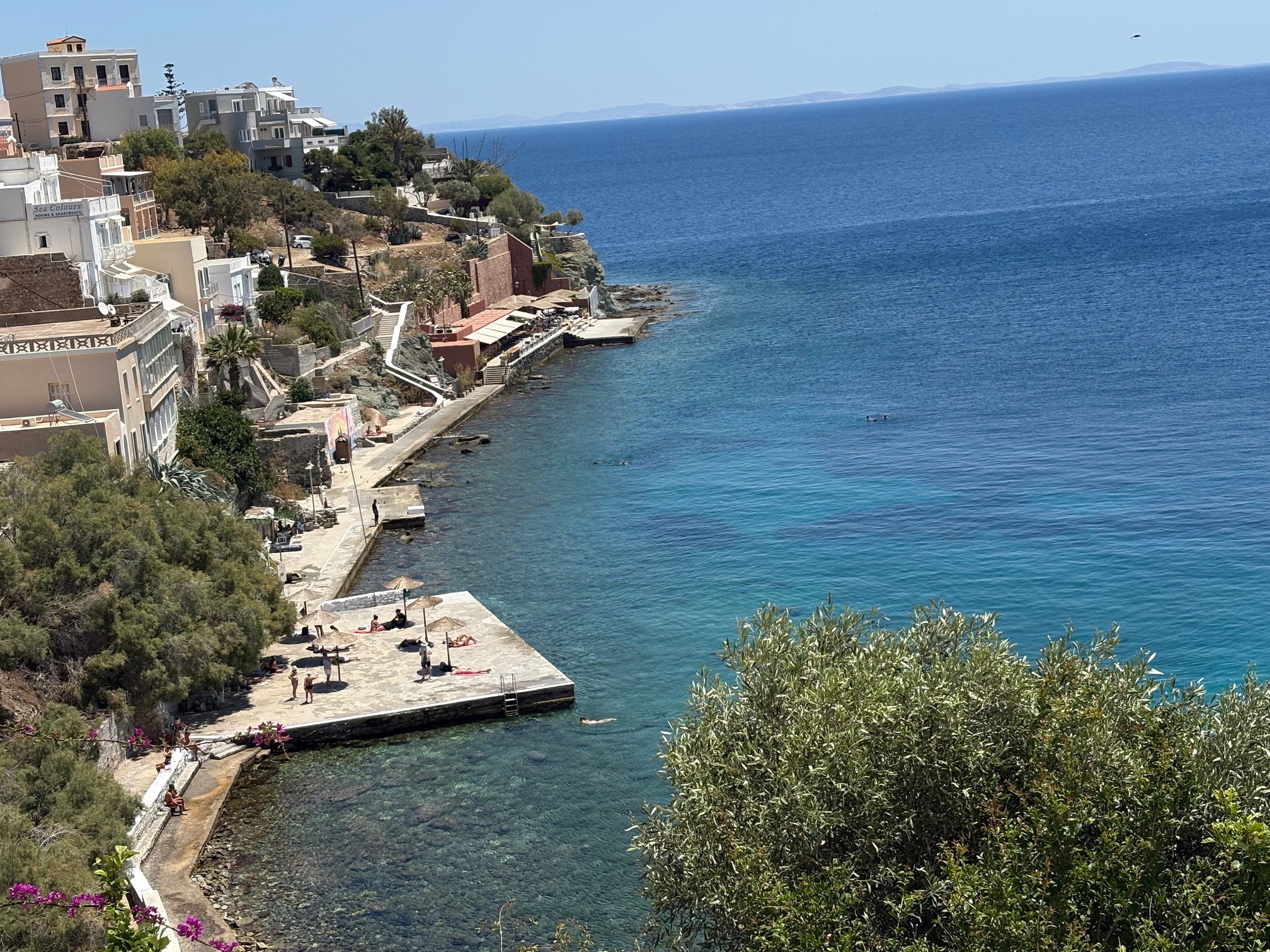
 |
| Vaporia District |
I suspect most foreign tourists (myself included) tend to relentlessly explore as many as they can. Yet certain islands will always get the largest numbers of people, and they are Santorini, Mykonos, Corfu, Rhodes, and Crete, the place where Tony and I started our trip. But now we were having a new adventure on the way to the island of Syros.
 |
| Port of Ermoupolis |
We traveled by ferry, the same strategy we’d used for island-hopping back in 1990. Fortunately, there are plenty of ferry companies in Greece that run much more smooth and comfortable transportation than in the past. I remember from the late time I visited in 1990. Huge ferries like those run by the efficient Seajets company can take 2100 passengers and hold up to 600 cars. Rides can be as short as half an hour or as long as twelve hours, with plenty of stops at islands large and small. Ferries have seating similar to a plane’s economy, business and first-class sections, albeit far more relaxing and uncrowded. Restrooms, bathrooms, and coffee and snack bars abound—and it’s easy to change your seat, as long as you are in the correct cabin.
The ride from Crete to Syros was about six hours, so we went with a “platinum” seating category. You check your luggage in an area on the entry deck, where cars park around the sides. I felt a little nervous to leave our two suitcases in the luggage rack for Syros, but I was relieved to see most of the passengers and luggage was clustered in the area bound for Santorini (of course). This made the accidental removal of our suitcases seem less likely.
Upstairs, we relaxed with coffee in our comfortable window seats with extendable footrests. We heard lots of American English around us all the way to Santorini. It was just two hours from Crete to Santorini, and at that destination, two-thirds of the cabin disembarked. Within ten minutes, another great throng filled in the seats, most heading for Piraeus, the port near Athens.
 |
| A seawall of tumbled marble |
The word Cyclades is an Anglicized reworking of the Greek word Kyklades referring to the circular position of this island group in the South Agean Sea. 32 out of the Kyklades’ 220 islands are inhabited—and some of the uninhabited ones have great historical and spiritual significance and have legal protection against visitation. Syros is the largest island in the Cyclades, with a population just over 21,000, and is known as the island that stays open year-round. Syros is still a place where people work in the shipyards or farming and making cheeses, honey and also having art and craft galleries and shops. But primarily, Syros has the long-lived prestige of being the legislative center of the Kyklades, ensuring a constant stream of Greek citizens with legal business. There is a neoclassical urbanity to most buildings in Ermoupolis that gives this island a more international feeling than other Greek islands I've had the pleasure of visiting.
 |
| Town Hall of Ermoupolis |
 |
| Apollon Theater |
 |
| Entrance to Historical Museum of Hermoupolis |
Archaeological evidence of human habitation on the island goes back to 3000 B.C. Through the turbulence of the Crusades and beyond, different countries claimed Syros as theirs, but this island did not suffer as much as some other places. Syros had the unique situation of being a place with both Catholicism and Greek Orthodox churches, making it a refuge for some during political upheaveals. This legacy of immigration and self-sufficiency, plus an excellent location close to Asia Minor, made Syros a center for shipbuilding and textile production in the 19th century. It became the second richest location in Greece (after Athens) during this era, and is still known as the capitol of the Cyclades islands. With prosperity, the arts thrived—and at one point there were five opera houses on the island. Its predominantly neoclassical architecture is different from the boxy, small white houses throughout most Kyklades islands. Life goes on year-round for local people, and there’s now a significant cohort of artists, designers and digital nomads living on the island.
 |
| Restored interior Apollon Theater |
I was impressed by the old-fashioned look of the curving harbor when the ferry pulled in. Only about twenty people got off. A waiting taxi carried us on a brief uphill climb to our lodgings, Hotel Aristide, a renovated Venetian palazzo owned by the writer Oana Aristide, her sister and mother. The design and comfort was exquisite and it's been recognized as a Michelin-starred hotel. There are quite a few hotels in historic mansions scattered through Ermoupolis.
 |
| Hotel Aristide |
 |
| Kriti Suite bedroom |
 |
| Kirti had a terrace and plunge pool |
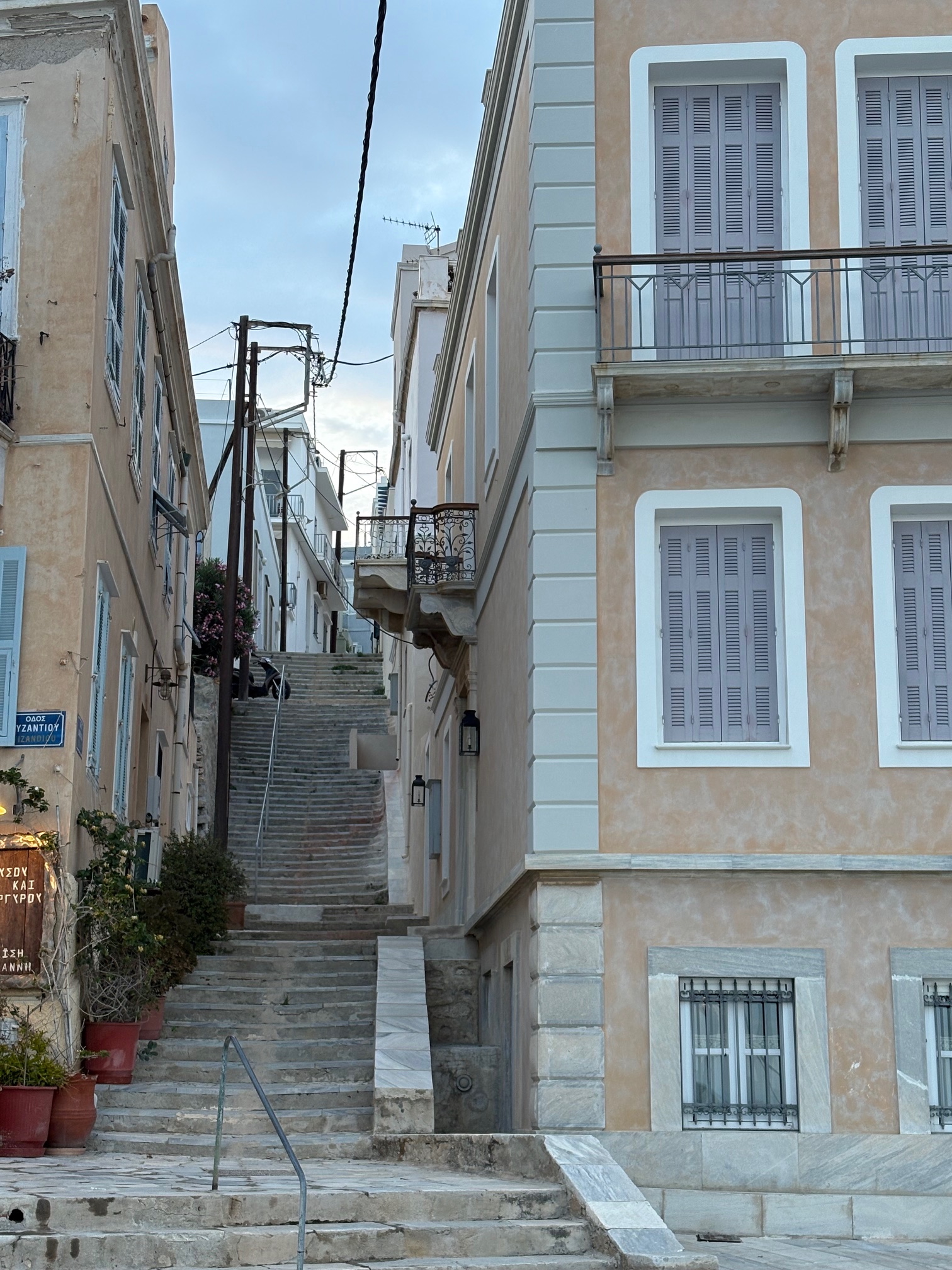
How incredible it seemed that all the streets were paved in marble—soft hues of cream, gray and pink that were accented in the colors of the stucco houses.

Later I was to learn marble is an intrinsic part of Syros's geology. Huge marble boulders made up the seawall near the port, and all other areas of Ermoupolis were cobbled in marble—the more industrial neighborhoods had tumbled marble, rather than the polished tiles of the Vaporia district.


Flights of outdoor marble steps led upward from many streets on the island and opened into charming lanes, with houses set on either side. Not only did we see many small historic houses occupied by local families, there were also plenty of abandoned dwellings awaiting renovation. Historic preservation guidelines in Ermoupolis are strict, and while this ensures the area looks uniformly like itself, progress can be slow. Probably if I had stayed a few days longer in Ermoupolis, I would have been swept up in real estate fever myself.


The neighborhoods were drop-dead beautiful—and the bonus was that the townspeople were friendly and there was an existing infrastructure of lovely restaurants and shops. Fabulous public buildings like the neoclassical Apollon Theater, modeled on La Scala, still hold regular performances, and we heard about a rock concert with international artists taking place just after we would head out.
A small number of artists have camped out for good on a special part of the island, the historically Catholic village of Ano Syros. This is a white-washed paradise full of narrow exterior staircases that can only be traversed on foot.
 |
| Ano Syros Lane and Agio Giorgios Cathedral, below |

Tony and I had planned to walk from Vaporia to Ano Syros using Apple Maps. After experiencing just a few uphill staircases, though, my right knee protested. So, we went down the stairs to the town square and got a cab ride. The driver stopped at the edge of the village and urged us onward. We followed to the village’s famous Catholic church, Agio Giorgios. This was first built in 1200 and was rebuilt several times, including after a 1617 destruction by Ottoman invaders. Now it is known as the cathedral for the Roman Catholic Archdiocese of Syros and Milos.
The highly decorated sanctuary hadn’t changed since the 1830s and provided a deep, contemplative space from its spot at the top of the island. We stayed there for a while, imagining worshippers of the past--and all the steps they would have taken, several times a week, for their spiritual wellbeing. Syros is a windy island, which would certainly add to the challenge, especially during winter.
After a refreshing lemonade in a small café, we skipped down a few hundred steps and then took a straight path back to Ermoupolis. We ran right into a small archaeological museum and stepped through the door and saw treasures that had been unearthed in the 19th century and originally sent on to a museum Athens. All these were returned to the island, due to the islanders’ strong feelings, and this museum that they built to prove they could respectfully share the island's history with visitors.
Only a few museums exist on the island, and they all run on odd hours, a few days a week—at least in the shoulder season. And the delight was we didn’t share space with many other people, any time we were in such a venue. We noticed tourists tended mostly to be Greek and over thirty. Where were the partying kids so common elsewhere in Greece?
A university lies somewhere on the 32-square-mile island, but I didn’t see it, nor any beach resorts. The truth was, we stayed close to Ermoupolis because we didn’t want to rent a car again. The stress of navigating very narrow, busy streets in Crete had worn us out. Ermoupolis is very walkable, so we took taxis three times on the island. We were surprised that the drivers wouldn’t take tips, and the fares they asked us for were quite low: ranging from 5 to 10 euros. This built a feeling of gratitude and trust.
 |
Although English is less widely spoken on Syros than Crete or nearby Mykonos, a small but significant contingent of foreigners live year-round on Syros. These are digital nomad families who rent apartments and send their children to a flexible "worldschool" and daycare set up by Boundless Life, a company that has a few sites in other European countries. It’s an interesting strategy that schedules families to arrive together at a certain time, live in furnished apartments, share coworking space and develop friendships. A French musician who moonlighted as restaurant manager at the Aristide, and who's lived on the island more than twelve years, thinks the digital nomad program has been a plus. Alex pointed out the program rents properties from local landlords during the cold season and families buy what they need from local merchants and restaurants and shops. Most significantly, there is now an English medium school with an international baccalaureate to the island--building opportunities for cultural and linguistic connection.
 |
| Tony was looking more Greek every day |
The negative impact of tourism, especially crowding of public areas and conversion of local housing to Airbnbs, has been a source of anger in Portugal and Spain. It seems to be less virulent in Greece. Could this be because Greece's visitors are spread out over so many islands? Granted, there are islands with tourist overload--see Part 3, yet to come in this trilogy of blog posts!
I was happy to investigate many small mom-and-pop restaurants serving mostly Greek and Italian food, as well as local fish, octopus and squid. Syros has a delightful market area selling local cheeses, honey, meats, fruit and freshly caught fish. In the heart of it is a casual restaurant called Street Food where I had an outstanding, simple meal of spinach rice, and chickpeas braised in tomato.

And what great cappucino can be ordered at the dozens and dozens of coffee shops! Many cafes could be found near the port, in the shopping district, and around the lovely town square. One of Greece’s most famous ice cream shops, Django, has its original location in the market area of Syros. It was here that I ordered a cup of sorbet, a half portion of pistachio and vanilla sorbet each. I wouldn’t have thought of mixing my order, but the young man behind the encounter insisted that it was the only correct combination. I liked the strength of his opinion--and the sorbet tasted like full-fat gelato!

Our appetite was strong on Syros, and the most delicious and enjoyable meal we had was a lunch cooked in a cooking class in one of the glorious old Vaporia mansions. Here we met Eliza, a Greek lady from the mainland, retired from being a translator, who fell in love with an islander and the island herself. Eliza and her husband Kostas renovated Villa Maria, a late 19th century Venetian-style palazzo on a narrow lane that serves as both an inn and a cooking school. During Eliza’s Saturday class, we met four other Americans and a German.
 |
| Fava married with capers and red onions |
 |
| Tirititim: aSyros specialty with zucchini and egg |
Some of my favorites out of the seven dishes we cooked were fava, yellow split peas with caramelized red onions and capers; a delectable baked dish of eggplant and potatoes and tomatoes that was not moussaka; vine leaves baked with a tangy solid yogurt filling; and a dessert pie of baked milk and semolina. The simplicity of Greek ingredients makes the vegetables stand out and the food taste heavenly. Eliza kindly emailed her precious regional recipes to all of us, and I approximated the fava just a few days ago.
 |
| Eliza's traditional kitchen |
It's hard to put into words why Syros put such a spell on me. Perhaps it was the mix of sophisticated and simpler but charming houses set against the coastline, or maybe it was the lowkey friendliness and honesty of the locals. Syros is kind to tourists: and because it doesn’t depend on them for life, that makes a significant difference.
After five pleasant days, I sailed away thinking: I might like to break my explore, explore, explore pattern when it comes to Greece, because I'd love to imagine Syros could be my own homecoming isle.