Showing posts with label Cyclades. Show all posts

Saturday, March 21, 2026

Freedom or Death: A Greek Battle Cry

 Jeff–Saturday

MANTO MAVROGENOUS
March 25th is fast approaching.  It's a two-for-one holiday in Greece: Annunciation and Greek Independence Day.  The former celebrates Mary learning from Archangel Gabriel that she was with child, and the later marks the day in 1821 when Greek Orthodox Bishop Germanos of Patras raised the Greek flag at the Monastery of Agia Lavra in Greece’s Peloponnese and inspired a more than eight-year struggle (1821-1829) to throw off nearly 400 years of Ottoman rule.

Bishop Germanos raising the flag (Theordore Vryzakis)

In towns and villages across Greece, school children proudly parade the country’s blue and white flag.  Aflutter, the flag is reminiscent of Greek seas but it holds a deeper meaning.  The white cross honors the contribution of the church to the country’s enduring battle for freedom and its nine blue and white bars honor the nine syllable rallying call shouted across the land during Greece’s struggle for Independence: Eleftheria i Thanatos—Freedom or Death.  (Though some say they represent the nine letters of ελευθερια in the Greek word for freedom, the idea is the same.). 

Petros Mavromichalis
Greece’s larger cities also hold military parades, and Greek communities around the world join in celebration with parades of their own.  But this is not about any of those events, or for that matter whether the Revolution actually began a week earlier in another part of the Peloponnese when the ruler of its Mani region, Petros Mavromichalis, raised his war flag in Mani’s capital city of Areopoli and marched his troops off against the Turks.

No, this is about a small Cycladic island’s personal War of Independence heroine, Manto Mavrogenous (1796-1848).  Her statue stands at the foot of the main square on Mykonos’ harbor,  and soon it will be surrounded by palm frondsan ancient symbol of triumph, victory, and the sacred sign of Apolloin honor of a life truly worthy of an epic film.  Or a tragic opera.

Manto Mavrogenous Square, Mykonos

Born in Trieste to a wealthy, aristocratic Greek merchant family, Manto Mavrogenous studied philosophy and history, was fluent in several languages, and drew her fire for Greek independence from her father, a member of Filiki Eteria, the secret society dedicated to freeing Greece from Ottoman rule. 

She was thirteen when her family returned to its roots in the Cycladic islands, first to Paros and after her father’s death to Tinos.  War broke out when she was twenty-five and she left for Mykonos, the place of her family’s origins, to convince its leaders to join in the Revolution.  But what she offered Mykonos and indeed all of Greece was far more than words.  When Ottomans attempted to land on Mykonos, she commanded the forces that repelled them.  She used her fortune to outfit ships and crews that battled pirates and the Ottoman fleet, and to send soldiers to fight for freedom on mainland Greece, as well as to support the families of those who fought.

Manto even sold her jewelry to support the fight and pressed the world to allow Greece to be free.  This is from her letter to The Women of Paris: “The Greeks, born to be liberal, will owe their independence only to themselves.  So I don’t ask your intervention to force your compatriots to help us. But only to change the idea of sending help to our enemies.” 

Demetrius Ypsilantis
In the early years of the war she met Demetrius Ypsilantis, a well-educated son of a prominent family, brother of the leader of Filiki Eteria, and a politically connected war hero.  (Yes, that city in Michigan was named after him, a town perhaps better known today for “the world’s most phallic building,” the Ypsilanti Water Tower.)  They became engaged and Mavrogenous’ beauty, bravery, and selfless commitment to Greek independence brought her fame across Europe. 

Bust of Demetrius erected in foreground of "The Brick Dick" of Ypsilanti.

It seemed a fairy tale, but that was not to be.

During their engagement Mavrogenous’ home was totally destroyed by fire and her fortune stolen.  She moved in with Ypsilanti but in time he broke off the engagement.  Deeply depressed and virtually penniless, she never recovered.

Her memoirs were written on Mykonos but she spent most of the balance of her life amid poverty in Greece’s first modern capital, Nafplio, before finally moving to Paros where she died penurious and in oblivion at fifty-four.

The great debts owed to her for financing so much of Greece’s Revolution were never repaid.  Unless you count the palms, thanks, and honors bestowed each March 25.

The back of a Greek coin worth less than a penny

Freedom or Death.

––Jeff

Wednesday, July 2, 2025

More, More Mykonos!

 Sujata Massey


It's rare luck to be out traveling and run into friends from home. But that is what happened last month: we went to two islands of my choice first, and then to Mykonos because that's where Jeff and Barbara were.  


My friendship with crime fiction author and co-blogger Jeff Siger began at a mystery convention more than ten years ago. I had the added pleasure soon afterward of meeting his wife, the  artist  Barbara Zilly. I was impressed to learn that Jeff had been a regular seasonal dweller on Mykonos for years, giving him a local's knowledge to use for his writing. Since Jeff has been an honorary Mykonian for about 40 years, and spends quite a few months there, it's more like a home stay merged with work. Tony and I are contemplating being overseas much more, so this was a splendid chance to learn from the professionals.  


During the short, smooth, ferry ride I pondered our destination. Mykonos is quite small, and its’ name has something to do with a pile of stones, which certainly reflects the way it looks, or maybe also because it’s named after a a legendary long-ago ruler, Mykonos, a son or grandson of Apollo. I also heard from Jeff that it's known as Island of the Winds. The triple-possibility explanation of the island's name reminded me of all the multiple explanations for place names in India. Also like most districts in India, Mykonos is a very crowded place. The nine-mile-long island has 10,700 regular residents, but manages to be Greece's second-most touristed destination after Santorini. 


We’d visited Santorini on our 1990 Greece trip and found the hordes of people made it hard to enjoy the spectacular cliff views. These days, we knew Santorini had become even busier, and we expected the same for Mykonos. This was traditionally an island with working class and poor dwellers that shot into the limelight in1961,when American First Lady Jacqueline Kennedy visited with her sister, Lee Radziwell, and a few others. Jackie's time on the Pile of Stones was part of a larger tour of Greece, but of all the locales, apparently Mykonos became her favorite. After marrying Aristotle Onassis in 1968, might her heart have gone to his private island, Skorpios? I wonder.


In the 1980s, Mykonos exploded as a jet-set party destination, and as we got off, we saw so many fellow tourists who fit that decadent description, as well as three-generation family groups from all corners of the earth. Essentially, it was like the crowd at any international airport around Thanksgiving. 


The wait at Mykonos Port to get a taxi was a lot longer than the 3-minute ride up a stony hill to Hotel Rhenia, a business owned by Jeff and Barbara’s hotelier friends. We checked in at a sunny courtyard, where the embraces from Jeff and Barbara were just as warm. The sky was dazzling blue, and we could see multiple cruise ships pulled in. How many of the people crowding the port were from the cruise ships, I wondered? I learned later, the cruisers go back during the day; and nighttime is for the partiers staying on the island.


That night, the winds whipped as we strolled Chora, the old original village that is the town’s epicenter for shopping, food and nightlife. The style memo was young, fancy, sexy, and wild. We were. beyond it all, though. As we ambled past shops and restaurants, Jeff and Barbara were greeted like returning neighbors who had been away too long. The Sigers know EVERYONE. The museum founders, the restaurant chefs, the jewelry store guards and the managers, the opticians, the restaurant chefs, the boutique owners, the artists, the local characters . . . a two block walk turned into a receiving line of dozens of incredibly friendly people. 


Jeff and Barbara brought us to a favorite spot where we had a luscious dinner at a nouvelle cuisine restaurant. There, we planned for the next day: off-road touring in the couple’s rugged jeep to some beaches, and other destinations that would not be overrun by the crowds we were squeezing through in Chora. It would be nice not to see another Rolex store or chocolate boutique!


The next day's trip rambled and rolled from paved roads to dirt and stone paths, many of them narrow and uphill. Jeff drove like Mario Andretti, backing up and executing hairpin turns without the slightest hesitation. We raced along country roads where the tourists were nonexistent but occasional vehicles would need to play nice with Jeff. He was intent to show us the pleasant swimming beaches most tourists don't know. So SSHH!!

These locations included the small Kalafatis Beach with only two people on it, and two famous rock islands in the sea nicknamed the Mounds of Aphrodite--you can come to your own conclusion about what that means. I was getting the feeling there are all kinds of names for the features of Mykonos.


 After a great lunch including greens, beans and squid at a taverna on Fokos Beach, another quiet spot, we reached the island’s famous working monastery in the village of Ano Mera. Panagia Tourliani translates as the Virgin Mary of Tourlos, also patron saint of the island. 


Built and rebuilt during medieval times through the 19th century, the monastery is simultaneously both a white-washed Cyclades classic--and its interior full of as much gold and treasure-laced decor as Greek Orthodox churches elsewhere. We toured the stunning main church filled with icons and dripping with golden chandeliers. Upstairs, some of the monastery ooms hold treasures of ancient religious clothing, texts and items used in worship. Barbara speaks Greek very well and related that a monk had told her that it was a good we hadn’t come the next day—when four cruise ships’ worth of passengers were scheduled to visit. Once again we had been lucky!


That evening we were still too filled from the delicious lunch to want to eat anything more. I packed up my carry-on and swatted at gnats who’d come in the open windows of our hotel bungalow. Jeff was resting and Tony and Barbara hung out with drinks in the hotel courtyard. 


It was the last night for us after two weeks in Greece. While I hated to leave, I also felt renewed. I had seen so much water, so much sun, so many indescribable antiquities. Even in the presence of mass tourism, these gems remain to be found, and I was grateful to Jeff and Barbara for showing us Mykonos's hidden side. 


Wednesday, June 18, 2025

Sweet as Syros

 Sujata Massey


I didn't think of Greece as being a big country. But when I dug into the geography while planning my recent trip, I found Greece has a significant mainland plus over 6000 islands and islets, with 227 of them habitable. 

227 islands!

These potential 227 choices present a dilemma to anyone who is interested in the Mediteranean and visits Greece more than once. The question is: if you’ve discovered an island that captivates you, should you return? Or do go on visiting more places that you’ve heard are special?

Greeks on the mainland also love their islands. I also have heard they tend to align with a particular island, often because of family history, and visit it a few times a year. They build relationships and have a home away from home.


Vaporia District


I suspect most foreign tourists (myself included) tend to relentlessly explore as many as they can. Yet certain islands will always get the largest numbers of people, and they are Santorini, Mykonos, Corfu, Rhodes, and Crete, the place where Tony and I started our trip. But now we were having a new adventure on the way to the island of Syros


Port of Ermoupolis


We traveled by ferry, the same strategy we’d used for island-hopping back in 1990. Fortunately, there are plenty of ferry companies in Greece that run much more smooth and comfortable transportation than in the past. I remember from the late time I visited in 1990. Huge ferries like those run by the efficient Seajets company can take 2100 passengers and hold up to 600 cars. Rides can be as short as half an hour or as long as twelve hours, with plenty of stops at islands large and small. Ferries have seating similar to a plane’s economy, business and first-class sections, albeit far more relaxing and uncrowded.  Restrooms, bathrooms, and coffee and snack bars abound—and it’s easy to change your seat, as long as you are in the correct cabin. 

The ride from Crete to Syros was about six hours, so we went with a “platinum” seating category. You check your luggage in an area on the entry deck, where cars park around the sides. I felt a little nervous to leave our two suitcases in the luggage rack for Syros, but I was relieved to see most of the passengers and luggage was clustered in the area bound for Santorini (of course). This made the accidental removal of our suitcases seem less likely.

Upstairs, we relaxed with coffee in our comfortable window seats with extendable footrests. We heard lots of American English around us all the way to Santorini. It was just two hours from Crete to Santorini, and at that destination, two-thirds of the cabin disembarked. Within ten minutes, another great throng filled in the seats, most heading for Piraeus, the port near Athens. 


A seawall of tumbled marble


The word Cyclades is an Anglicized reworking of the Greek word Kyklades referring to the circular position of this island group in the South Agean Sea. 32 out of the Kyklades’ 220 islands are inhabited—and some of the uninhabited ones have great historical and spiritual significance and have legal protection against visitation. Syros is the largest island in the Cyclades, with a population just over 21,000, and is known as the island that stays open year-round. Syros is still a place where people work in the shipyards or farming and making cheeses, honey and also having art and craft galleries and shops. But primarily, Syros has the long-lived prestige of being the legislative center of the Kyklades, ensuring a constant stream of Greek citizens with legal business. There is a neoclassical urbanity to most buildings in Ermoupolis that gives this island a more international feeling than other Greek islands I've had the pleasure of visiting. 


Town Hall of Ermoupolis


Apollon Theater


Entrance to Historical Museum of Hermoupolis


Archaeological evidence of human habitation on the island goes back to 3000 B.C. Through the turbulence of the Crusades and beyond, different countries claimed Syros as theirs, but this island did not suffer as much as some other places. Syros had the unique situation of being a place with both Catholicism and Greek Orthodox churches, making it a refuge for some during political upheaveals. This legacy of immigration and self-sufficiency, plus an excellent location close to Asia Minor, made Syros a center for shipbuilding and textile production in the 19th century. It became the second richest location in Greece (after Athens) during this era, and is still known as the capitol of the Cyclades islands.  With prosperity, the arts thrived—and at one point there were five opera houses on the island. Its predominantly neoclassical architecture is different from the boxy, small white houses throughout most Kyklades islands. Life goes on year-round for local people, and there’s now a significant cohort of artists, designers and digital nomads living on the island. 

Restored interior Apollon Theater


I was impressed by the old-fashioned look of the curving harbor when the ferry pulled in. Only about twenty people got off. A waiting taxi carried us on a brief uphill climb to our lodgings, Hotel Aristide, a renovated Venetian palazzo owned by the writer Oana Aristide, her sister and mother. The design and comfort was exquisite and it's been recognized as a Michelin-starred hotel. There are quite a few hotels in historic mansions scattered through Ermoupolis. 


Hotel Aristide


Kriti Suite bedroom


Kirti had a terrace and plunge pool


How incredible it seemed that all the streets were paved in marble—soft hues of cream, gray and pink that were accented in the colors of the stucco houses. 


Later I was to learn marble is an intrinsic part of Syros's geology. Huge marble boulders made up the seawall near the port, and all other areas of Ermoupolis were cobbled in marble—the more industrial neighborhoods had tumbled marble, rather than the polished tiles of the Vaporia district. 


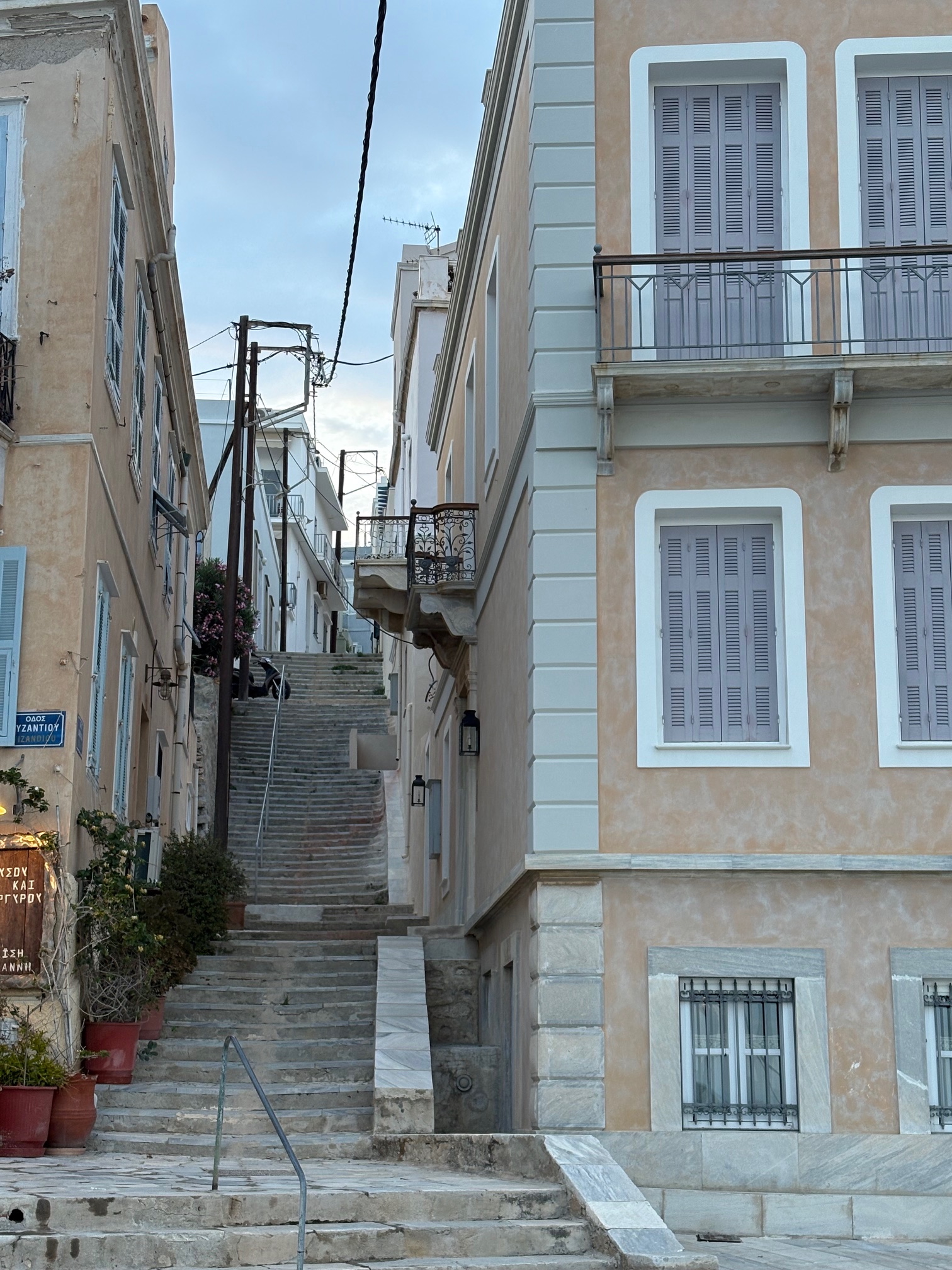
Flights of outdoor marble steps led upward from many streets on the island and opened into charming lanes, with houses set on either side. Not only did we see many small historic houses occupied by local families, there were also plenty of abandoned dwellings awaiting renovation. Historic preservation guidelines in Ermoupolis are strict, and while this ensures the area looks uniformly like itself, progress can be slow. Probably if I had stayed a few days longer in Ermoupolis, I would have been swept up in real estate fever myself. 


The neighborhoods were drop-dead beautiful—and the bonus was that the townspeople were friendly and there was an existing infrastructure of lovely restaurants and shops. Fabulous public buildings like the neoclassical Apollon Theater, modeled on La Scala, still hold regular performances, and we heard about a rock concert with international artists taking place just after we would head out. 

A small number of artists have camped out for good on a special part of the island, the historically Catholic village of Ano Syros. This is a white-washed paradise full of narrow exterior staircases that can only be traversed on foot. 


Ano Syros Lane and Agio Giorgios Cathedral, below


Tony and I had planned to walk from Vaporia to Ano Syros using Apple Maps. After experiencing just a few uphill staircases, though, my right knee protested. So, we went down the stairs to the town square and got a cab ride. The driver stopped at the edge of the village and urged us onward. We followed to the village’s famous Catholic church, Agio Giorgios. This was first built in 1200 and was rebuilt several times, including after a 1617 destruction by Ottoman invaders. Now it is known as the cathedral for the Roman Catholic Archdiocese of Syros and Milos.

The highly decorated sanctuary hadn’t changed since the 1830s and provided a deep, contemplative space from its spot at the top of the island. We stayed there for a while, imagining worshippers of the past--and all the steps they would have taken, several times a week, for their spiritual wellbeing. Syros is a windy island, which would certainly add to the challenge, especially during winter.

After a refreshing lemonade in a small café, we skipped down a few hundred steps and then took a straight path back to Ermoupolis. We ran right into a small archaeological museum and stepped through the door and saw treasures that had been unearthed in the 19th century and originally sent on to a museum Athens. All these were returned to the island, due to the islanders’ strong feelings, and this museum that they built to prove they could respectfully share the island's history with visitors. 

Only a few museums exist on the island, and they all run on odd hours, a few days a week—at least in the shoulder season. And the delight was we didn’t share space with many other people, any time we were in such a venue. We noticed tourists tended mostly to be Greek and over thirty. Where were the partying kids so common elsewhere in Greece? 


A university lies somewhere on the 32-square-mile island, but I didn’t see it, nor any beach resorts. The truth was, we stayed close to Ermoupolis because we didn’t want to rent a car again. The stress of navigating very narrow, busy streets in Crete had worn us out. Ermoupolis is very walkable, so we took taxis three times on the island. We were surprised that the drivers wouldn’t take tips, and the fares they asked us for were quite low: ranging from 5 to 10 euros. This built a feeling of gratitude and trust.


Although English is less widely spoken on Syros than Crete or nearby Mykonos, a small but significant contingent of foreigners live year-round on Syros. These are digital nomad families who rent apartments and send their children to a flexible "worldschool" and daycare set up by Boundless Life, a company that has a few sites in other European countries. It’s an interesting strategy that schedules families to arrive together at a certain time, live in furnished apartments, share coworking space and develop friendships. A French musician who moonlighted as restaurant manager at the Aristide, and who's lived on the island more than twelve years, thinks the digital nomad program has been a plus. Alex pointed out the program rents properties from local landlords during the cold season and families buy what they need from local merchants and restaurants and shops. Most significantly, there is now an English medium school with an international baccalaureate to the island--building opportunities for cultural and linguistic connection. 


Tony was looking more Greek every day


The negative impact of tourism, especially crowding of public areas and conversion of local housing to Airbnbs, has been a source of anger in Portugal and Spain. It seems to be less virulent in Greece. Could this be because Greece's visitors are spread out over so many islands? Granted, there are islands with tourist overload--see Part 3, yet to come in this trilogy of blog posts! 

I was happy to investigate many small mom-and-pop restaurants serving mostly Greek and Italian food, as well as local fish, octopus and squid. Syros has a delightful market area selling local cheeses, honey, meats, fruit and freshly caught fish. In the heart of it is a casual restaurant called Street Food where I had an outstanding, simple meal of spinach rice, and chickpeas braised in tomato. 


And what great cappucino can be ordered at the dozens and dozens of coffee shops! Many cafes could be found near the port, in the shopping district, and around the lovely town square. One of Greece’s most famous ice cream shops, Django, has its original location in the market area of Syros. It was here that I ordered a cup of sorbet, a half portion of pistachio and vanilla sorbet each. I wouldn’t have thought of mixing my order, but the young man behind the encounter insisted that it was the only correct combination. I liked the strength of his opinion--and the sorbet tasted like full-fat gelato!


Our appetite was strong on Syros, and the most delicious and enjoyable meal we had was a lunch cooked in a cooking class in one of the glorious old Vaporia mansions. Here we met Eliza, a Greek lady from the mainland, retired from being a translator, who fell in love with an islander and the island herself. Eliza and her husband Kostas renovated Villa Maria, a late 19th century Venetian-style palazzo on a narrow lane that serves as both an inn and a cooking school. During Eliza’s Saturday class, we met four other Americans and a German. 


Fava married with capers and red onions


Tirititim: aSyros specialty with zucchini and egg


Some of my favorites out of the seven dishes we cooked were fava, yellow split peas with caramelized red onions and capers; a delectable baked dish of eggplant and potatoes and tomatoes that was not moussaka; vine leaves baked with a tangy solid yogurt filling; and a dessert pie of baked milk and semolina. The simplicity of Greek ingredients makes the vegetables stand out and the food taste heavenly. Eliza kindly emailed her precious regional recipes to all of us, and I approximated the fava just a few days ago.


Eliza's traditional kitchen


It's hard to put into words why Syros put such a spell on me. Perhaps it was the mix of sophisticated and simpler but charming houses set against the coastline, or maybe it was the lowkey friendliness and honesty of the locals. Syros is kind to tourists: and because it doesn’t depend on them for life, that makes a significant difference. 

After five pleasant days, I sailed away thinking: I might like to break my explore, explore, explore pattern when it comes to Greece, because I'd love to imagine Syros could be my own homecoming isle. 


Saturday, March 23, 2024

A Looming Threat for the Greek Isles


Saturday––Jeff

“The combination of increased water consumption and prolonged drought is depleting resources in the Cyclades.”

That’s the headline of an in-depth investigative report by environmental reporter Giorgos Lialios, published yesterday in Ekathimerini, Greece’s newspaper of record.  It’s a subject I’ve observed firsthand for over a decade and listened even longer to locals openly worry over.  

What follows is Mr Lialios’ report.  The words are all his, not mine, but I know many of the islands mentioned well (no pun intended), what with my wife and I spending much time on many of them and my setting a half-dozen of my books on those islands.  I take his article as a call to action. We shall see.


Year after year, the pressure increases. On the one hand, there is the explosive growth of tourism, followed by an increase in consumption; on the other, there is drought. The small Aegean islands are preparing for the start of the tourist season with their reservoirs empty, their boreholes pumping brackish water, and an increasing dependence on desalination. The first victim of this difficult situation is what agricultural production is left on the islands, according to the doctrine of “water for the people first and then everything else.”

In 2023, rainfall in the Aegean will be limited for a third consecutive year. “Especially in the Cyclades and southern Crete, which are the areas with the least rainfall, 2023 was a bad year,” explains Kostas Lagouvardos, meteorologist and research director at the National Observatory of Athens. “The last good year for the Aegean was 2019, with a lot of rain in the east and south. Since then, rainfall has been below average. Especially in the Cyclades, where the rainy season lasts only five or six months, it only takes two bad years to create a problem.” In 2023 Andros received 363 millimeters of rain, compared to an average of 506 mm, Tinos received 299 mm, compared to an average of 330 mm, Naxos received 270 mm, compared to an average of 306 mm, and Ios received 195 mm, compared to an average of 285 mm. 


As a result, the Aegean islands are preparing for a difficult year. “The reservoirs on the islands are empty. Many islands will have problems this year. And the first victims will be crop growers and livestock breeders. If it doesn’t rain, there is no vegetation, so the farmer has to buy fodder. Last year the farmers of Naxos bought bales of clover from Bulgaria,” explains Ilias Nokas, head of the Directorate of South Aegean Water at the Decentralized Administration of the Aegean.

“Naxos has two dams. Last year they had 375,000 cubic meters of water, this year they have 30,000 cubic meters of water,” says Dimitris Lianos, mayor of the island. “We’re going to struggle this year. It’s not just tourism that’s important to us, but also agriculture and livestock farming. The first to be affected are the farmers. Potato farmers are already thinking of not planting this year because they will not be able to water their crops. It will be a difficult year for everyone. However, compared to most of the Cyclades islands, Naxos is still in a better position. “The island has water, we have two boreholes at a depth of 171 meters with very good quality water and the level has not dropped. What the island needs is a master plan for water supply. Unfortunately, because of localism, we cannot make more rational use of the water supply – some villages exploit springs and do not allow others to be supplied with water. The town of Naxos now has a desalination plant. We also need irrigation networks and targeted policies for farmers and livestock farmers so that they do not give up; the primary sector is our added value.”


Mykonos

On islands where meeting the needs of tourism is the only priority, empty reservoirs aggravate an already difficult situation. Mykonos is a typical example. “The Municipal Water Supply and Sewerage Company of Mykonos has two dams and two desalination plants to supply water to the island,” explains the company’s chairman, Dimitris Lazaridis. “The Marathi dam, with a capacity of 3 million cubic meters, and the Ano Mera dam, with a capacity of 1 million cubic meters, are almost empty due to the continuous drought, and they are not being used.”

Drought is not the only problem. The Aegean islands have seen a surge in tourism in recent years, with a corresponding increase in water consumption. A typical example of the gradual increase in water consumption is the arid island of Santorini. According to data from the Municipal Enterprise for Water Supply and Sewerage (DEYA) of Thera, a decade ago (2013), water consumption on the island reached about 929,000 cubic meters. In 2023, it reached 2.36 million cubic meters of water (an increase of 13.8% compared to the previous year).

The huge increase in consumption is also reflected in the other “flagship” of the Cyclades, Mykonos.

According to data from the Mykonos DEYA, the consumption of water in 2020 (year of quarantine) was 955,505 cubic meters, in 2021 it increased to 1,174,254 cubic meters (+22.9%), in 2022 to 1,513,068 cubic meters (+28.8%), and reached 1,618,069 cubic meters in 2023 (+7%). In other words, if we consider that 2020 was not an ordinary year due to Covid-19, water consumption on Mykonos will increase by 37.8% in two years (from 2021 to 2023). “Moreover, the DEYA data does not reflect the whole picture, as 40% of the island is not covered by the water supply network. The total water consumption of the island is estimated at 2.5-3 million cubic meters per year,” Nokas said. “Like many islands, Mykonos is a place where people build where they want and then meet their needs either with private boreholes – which are overpumped, resulting in poor quality water – or by buying water. However, the increase in consumption also affects the areas that have networks because they are not properly designed. On Mykonos, for example, the network was originally built to serve only Hora, the island capital, and now supports all the outlying areas without any specifications. The island’s biological treatment plant, which was designed for a population equivalent of 50,000 and serves over 100,000 in the summer, has a similar problem. Everything is operating at capacity.”


Challenges

The administrative structure – i.e. the division of responsibilities for water – does not help the situation. Water management on the Greek islands is governed by a complex and deficient system. In the most organized cases, there is a municipal water and sewerage company responsible for the network and water production. In the less organized cases, the water is managed by an agency within the local municipality. The licensing and control of private wells, either for water supply or irrigation, drilled outside the network, is the responsibility of the water directorates of the decentralized administrations, where one or two people are called upon to manage everything. Finally, the regions have water management departments that deal with inspections and complaints.

“When it comes to water consumption, tourism has the last word,” says Nokas. Desalination is not enough. In Ermoupoli, on the island of Syros, when the first plant was built, it had a capacity of 1,200 cubic meters, and today it has reached 5,000 cubic meters, and it is still not enough. Moreover, with the increase in energy costs, the island’s DEYA, which a few years ago had a reserve of 1 million euros, is now 5 million euros in the red, which it cannot pass on to the water bills, since water is already very expensive. According to the Ministry of the Environment and Energy, there are currently 31 desalination plants in operation in the Cyclades and another 15 in the Dodecanese.


Illegal drilling

The problems are not confined to the Cyclades. On Skiathos, which is supplied exclusively by boreholes, the underground water level is falling every year. “The peculiarity of Skiathos is that we have water, the island is self-sufficient. The town of Skiathos is supplied by five municipal wells, while hotels and private individuals on the island have their own wells. In addition, since the water from the central well is no longer potable, we have installed 25 public taps in the town with potable water from another source,” says Ioannis Sarris, director of the Skiathos DEYA.

“The DEYA has no authority to license or control the wells. It has no idea what quantities are being pumped. We have done the best we can – in recent years we have replaced almost the entire internal water supply network and significantly reduced losses. What worries us is that every year the level of the water in the boreholes goes down, and the reserves tend to go down. At the same time, actual consumption is increasing due to tourism. A serious problem is illegal drilling – on Skiathos we have more than 2,000 illegal boreholes. In my opinion, especially on islands where the water comes from an enclosed area, the water should be controlled by the community as a whole and not piecemeal.” According to the Department of Hydroeconomics of the Regional Unit of Magnesia and the Sporades, 238 applications for private wells have been submitted for Skiathos, 11 for Skopelos and five for Alonissos.


“Our island has the peculiarity of being big and small at the same time,” notes Kalymnos Mayor Yannis Mastrokoukos. “Although we are small in area, we have a permanent population of 17,000. This means that we have a significant demand for water throughout the year. It’s not just about tourism, as our own attitude toward water has changed: in terms of using it for cleaning, watering gardens, filling swimming pools… things that were unthinkable two generations ago, when people had learned to live with much less water.” The island is currently supplied mainly by boreholes, and there is a desalination plant for the northern part of the island which is popular with tourists.

He concludes: “The underground reserves are running out and we are now forced to turn to desalination as well. There is already a tender being prepared, funded by the Ministry of the Interior, for the supply of three small desalination plants and another by the Regional Authority of the South Aegean for a large plant for the town of Kalymnos. Of course, desalination is not a panacea. Ideally, if we could expand the use of renewables to meet the demand and make up for grid leakage, it would be more viable as an option.” 


Let’s see what happens.


––Jeff