Showing posts with label food. Show all posts

Sunday, September 18, 2022

MAN PLANS, GOD SMILES, SATAN LAUGHS

(otherwise titled: I shall be dieting this winter…)

Zoë Sharp


I recall a friend sending me the following piece years ago. I’ve no idea what the title is, but at the time it made me laugh.


Now I view it more as a cautionary tale...


In the beginning, God covered the earth with broccoli, cauliflower and spinach, with green, yellow and red vegetables of all kinds so Man and Woman would live long and healthy lives.


Then using God’s bountiful gifts, Satan created Cookie Dough Ice Cream and Magnums.


And Satan said, “You want hot fudge with that?”


And Man said, “Yes!”


And Woman said, “I’ll have one too—with chocolate chips.”


And lo they gained 10 pounds.


And God created the healthy yoghurt that Woman might keep the figure that Man found so fair.


And Satan brought forth white flour from the wheat and sugar from the cane and combined them.


And Woman went from size 12 to size 14.


So God said, “Try my fresh green salad.”


And Satan presented Blue Cheese dressing and garlic croutons on the side.


And Man and Woman unfastened their belts following the repast.


God then said, “I have sent you healthy vegetables and olive oil in which to cook them.”


And Satan brought forth deep-fried coconut king prawns, butter-dipped lobster chunks, and chicken-fried steak, so big it needed its own platter.


And Man’s cholesterol went through the roof.


Then God brought forth the potato, naturally low in fat and brimming with potassium and good nutrition.


Then Satan peeled off the healthy skin and sliced the starchy centre into chips and deep fried them in animal fats, adding copious quantities of salt.


And Man put on more pounds.


God then brought forth running shoes so that his Children might lose those extra pounds.


And Satan came forth with a cable TV with remote control so Man would not have to toil changing the channels.


And Man and Woman laughed and cried before the flickering light and started wearing stretch jogging suits.


Then God gave lean beef so that Man might consume fewer calories and still satisfy his appetite.


And Satan created Mcdonald's and the 99p double cheeseburger.


Then Satan said, “You want fries with that?”


And Man replied, “Yeah, and Super Size ’em.”


And Satan said, “It is good.”


And Man and Woman went into cardiac arrest.


God sighed and created quadruple bypass surgery, available free on the National Health Service.


And then Satan chuckled and created the NHS Waiting List.


This week’s Word of the Week is vade mecum, a Latin phrase, which has no English equivalent but—translated literally—means ‘go with me’. It is used in reference to a book that is a wise and helpful guide through life—something one would be loath to be without. Your Desert Island book of choice, perhaps? To have written something that is considered a vade mecum would be the pinnacle of any writer’s career.


Sunday, March 14, 2021

Rite of Spring

 --Susan, every other Sunday


Seasonal foods are one of the (admittedly, countless) things I love about living in Japan. 


An autumn dinner in Yuasa, Wakayama Prefecture

Everything from restaurant menus to grocery stores, and even the items on display at conbini (Japan's omnipresent, supercharged convenience stores) changes radically with the turning of the year--and not just quarterly. 

Some of the older, more traditional restaurants and teahouses recognize 24--and in extreme cases, 72--different seasons in every year. These exceptionally detailed seasons relate to the relative positions of the earth and sun, and have an impact on which crops are most "in season" at any time of year.

The components of this traditional breakfast (it's a savory meal in Japan)
change weekly--if not more often.

This week (March 14) falls near the middle of Keichitsu, which is the seasons "where hibernating insects awaken and show themselves." (Fortunately, this does not include cicadas--which get their own season, in early July.)


Winter breakfast. No bugs allowed.

March is also the time when Japanese people turn their thoughts--and palates--from ume (plum) blossoms to their more internationally-renowned counterparts: the sakura. And, as always, where the thoughts of Japanese people go, the menus follow.

Sakura - Ueno Park, April 2019

March is "all-sakura-all-the-time" season when it comes to specialty foods--some of which are admittedly stranger than others. Unfortunately, as my son will gladly tell you, far too many sakura-flavored items "taste like a mixture of cough syrup and soap."

However, since I'm on a year-long quest to sample a new food every day for a book I'm writing about culinary adventures in Japan, it seemed like a good opportunity to see whether I could bust the myth that sakura flavored foods are merely soap-and-cough-syrup-flavored hype and see whether any are actually delicious.

As it turns out, the task was easier than expected. Here are just a few of the sakura treats on offer in Tokyo this year--and I can happily confirm that (to my great surprise) most of them were actually quite tasty:


Sakura Dacquoise - more salty than sweet, and vaguely soapy,
but it did have bits of real sakura blossom in it.
Probably won't buy it again, but I'm glad I tried it.

At the conbini - Starbucks "sakura milk with strawberry jelly"
For the record, this one DID taste like soap.

Sakura Okoshi - a traditional snack made with puffed rice and peanuts.
Very light, naturally floral flavor. 10/10 will eat annually.

"Sakura latte with warabimochi" (bracken root dumplings)
The least artificially colored, and one of the tastiest of the bunch. 
Also, I love warabimochi.

It wouldn't be Japan without a sakura kit-kat.
Did NOT expect to like this--file it under "biggest surprise"
because it was actually pretty good.

The undisputed winner so far: sakura blossom and white chocolate scone from a local bakery
Yes, that's a real pickled flower on top, and there were more inside.

Starbucks is famous for its seasonal offerings in Japan.
This is the "sakura-berry Frappuccino"
Unlike the mass-produced conbini offering, this one is actually quite tasty.

Sakura season has just begun here in Japan--the first large areas of blossoms were sighted in Kyushu last week, and at last report, Hiroshima Prefecture's cherry trees have begun to bloom as well. The trees here in Meguro (southern Tokyo) are setting buds, and I'll be watching them like a hawk on my daily walks from point on, though I don't expect to see them blooming for another two weeks or so.

The sakura-flavored-food season will continue to surge through the sakura bloom, and die off just as quickly when the blooms are gone--by mid-April at the latest. At that point, the summer treats will start to appear. 


But, for the moment, cherry blossoms reign supreme.  

So, tell me: cherry blossom foods. Are you in, or is this one a pass for you?


Wednesday, February 10, 2021

The Price of a Meal

Sujata Massey


Someone who's part of my inner circle is working on a novel. He made a richly detailed first draft and is engaged in getting feedback from a few trusted friends. Two early readers of his book commented the story had too many references to food. One even suggested that he reduce the number of group dinners in the story down to two grand banquets.


I feel for any writer having to make choices about cutting out an aspect of storytelling that they enjoyed creating. And it's not wise to cater to everyone's opinion. 


My Dear One was asking me for advice about this. And I told him that I think food in books is important. However, the cost of not handling food correctly can be reader boredom. 


Every sentence that goes into a book should advance it. And therefore, when characters sit for meals in books, they can’t just eat. 


Mushroom soup has poison potential


If that sounds confusing, let me start in a backwards fashion Here’s what meals in books should not be: 


Time fillers, thrown in because you are passing through the chronology of a character's day.  Such as…after finishing the interview at the police station, Joe and Jane went to a restaurant across the street and had fish and chips, two cokes, brownies for dessert. It was a tasty meal that was easy on the wallet. Then Jane checked her watch and suggested to Joe they go to the park to see if they could find what the police might have had missed.  


A menu of your favorite things, just because they came to mind while writing. For instance:  Angelina opened the menu and ordered French Onion Soup, followed by lo mein with chicken and shitake mushrooms, and chocolate mousse, with a Bud Light on the side.


A way to simplistically broadcast to the reader that certain foods are eaten in certain countries. Ciao, I’m in Italy, so it’s pizza time! Or Namaste, because I’m in Delhi, I’m going to get some spicy curry!


Eggs Kejriwal is a more culturally specific dish than 'curry'


In my Dear One’s case, he hadn’t committed these well-known faux pas. He merely wanted to share food as a means of explaining culture: the same way he offers delicious, varied international meals to family and friends. He was inviting his readers to a feast in every country the characters visited.


I shared my belief that food is one of the most tantalizing means to advancing a plot--in so many ways.


 Peach salad for a health-conscious tea


Whether in homes or restaurants, aboard boats or inside tents, meals are opportunities for action and plot advancement. Meals provide meeting point for lovers, enemies, old friend and embittered relatives. Even in the case of a person dining alone, there’s a possibility for sunlight to spark off a crystal goblet and reveal an overlooked clue in a baffling mystery. 


Conversations between characters over a meal also are gold. And not just words, but the ways in which people eat, and also do things like swallow hard, throw down their napkins, or play with their forks. Someone’s zest for a meal, or lack of appetite, is telling. 


 Also, the kind of food that’s served reveals a lot about the meal’s host, and about the diner. In The Widows of Malabar Hill, my heroine Perveen Mistry visits a British home in colonial Bombay and is offered an uncharacteristically modest afternoon tea of fruit and sandwiches. This points out the fact that the hostess, Lady Gwendolyn Hobson-Jones, is more devoted to weight watching and appearances than pleasing appetites—and also, by her menu choices, doesn’t embrace Indian food and culture. Later in the story, Gwendolyn’s daughter Alice comes to the Mistry home and is offered a typical Parsi lunch that includes a rich fish curry, eggs, meat, many vegetables, breads, rice, and sweets. Alice begs to know what every food is called and wants to make sure the usual amount of chilies weren’t spared. Alice’s enthusiastic dining endears her to Perveen’s mother and also lets the reader know that while she might appear to be an outsider, she’s a progressive woman who wants to bend herself to becoming part of India, rather than dominate it. 


I not not only love eating food--I like reading recipes, cooking, and dreaming. And what I prepare, while I'm working on a book, often reflects what I'm trying to learn about. Eating poached eggs cooked atop sautéed spinach and tomatoes with green chili and ginger puts the taste of Parsi India into me. And I don't follow any particular dietary track. I’ll pan fry crumpets one day and bottle up a fresh turmeric, salt and lime pickle the next. 


Roasted vegetables can build many dishes...and plots

My unorthodox cooking habits reveal that cooking is as much a form of creative exploration for me as writing is. However, when I sit down to eat something, I don' think about food as adventure or character or story. I'm there for the taste. 


Tuesday, February 2, 2021

FOOD IS EVERYWHERE--DIVE INTO THE SOUP: Part One

 Kwei--Wednesday


I thought I would give everyone a bit of a break from my usual "heavy topic" posts. Your 2020/21-exhausted brain cells (and mine, for that matter) can take a load off their feet.

When I joined Soho Press and wrote my first draft for MURDER AT CAPE THREE POINTS, whenever I mentioned a particular meal indigenous to Ghana, my lovely editor Juliet Grames asked for more details. "What's in it? What does it look like?" She said she wanted more "food porn," which I'm not sure is PC nowadays, but anyway that's what she said. Don't shoot the messenger.

Now, bear in mind I am not a chef or food expert, but Ghanaian food is easy to encapsulate. The first component is a starchy food in one form or the other: rice, plantain (which look like large bananas), cassava, yam (not what Americans call yam), cocoyam (it has a chocolatey color), and corn. 

Cassava (which is used to make tapioca), yam, and cocoyam are all starchy tubers like potatoes, carrots, parsnips, and rutabagas. 


Pile of Ghanaian yams (James Dalrymple/Shutterstock)

Incidentally, yam is both the singular and collective form in Ghana. You say you're going to the market to buy "yam," no matter how many you're getting.

Now, all of these staples can be fried, boiled, or baked. (Fried yam, like french fries, are crisp and delicious, but notably more starchy.) All of them can also be made into a secondary form. Yam, plantain, cassava, and cocoyam can be boiled and then pounded to create a soft, pillowy, glutinous mass called fufu. (There's a lot of that in my novels.) Plantain-and-cassava fufu is more popular in southern Ghana, but yam fufu is preferred in the northern regions. Personally, I prefer yam. 

Traditionally, fufu is pounded in a large wooden mortar with a giant pestle, but someone found a way to create "instant" fufu by adding water to the flour of the corresponding starch while slowly cooking. That's the only practical way to prepare fufu in Europe or the USA.

"Pounding fufu"(Shutterstock)


Prepared cassava-plantain fufu and soup (Shutterstock)

The milled form of these staples can also be fermented: steamed fermented cornmeal yields kenkey, which is most famous with the Ga people, and cooked fermented corn and cassava yields banku.

Ghanaians often refer to their meals by the starch. In the US, if someone asks you what you had for lunch/dinner, you might respond, "grilled fish," or "baked chicken," but in Ghana your answer might be, "rice," "fufu," "banku." These are not eaten on their own, however. There will be something like a stew, or sauce with fish, chicken or meat prepared in different fashions.

The basic stews/soups are: groundnut (peanut butter), palm nut, and light soup.

Groundnut stew/soup, enhanced with various spices, has an exquisite and rich taste. It can be eaten with rice balls (sticky rice)or fufu. My mother made amazing groundnut stew/soup.  

Groundnut soup with chicken (Shutterstock)

But nothing beats the utter lusciousness of palm nut soup, which is a rich red-brown. It traditionally goes with fufu, but does well with rice balls too.

Light soup is prepared by steaming fish or meat with seasonings, onion, garlic and ginger in a saucepan. Tomato paste is then added. Chili peppers, garden eggs and tomatoes are boiled, blended and added to the saucepan. Water is added to bring the soup to its desired thickness. There's also pepper soup, which is like it sounds.

Wait a second. I think I misspoke. This isn't as easy as I dismissed it as. There's a lot more to it now that I'm actually talking about it. So, since it's getting late, I'll sign off here and plan for Part 2. Okay, I admit it--that's a cliffhanger of a sort.


Wednesday, January 15, 2020

Gochujang revisited

Sujata's computer took ill in India last week! Can you imagine going on an extended fact-finding trip to the other side of the world only to lose one's computer? Fortunately, there are other ways of communicating, so Sujata asked me to repost one of her earlier blogs.

It was not that easy because I have liked so many of them. But, given that I enjoy food, particularly South-East Asian food - Indian, Thai, Vietnamese, Indonesian - I decided to find a food-related blog. Lots of those to choose from. Eventually I decided on an Asian food blog, but not from the south east.

I hope by the time this goes up that Sujata's computer is out of intensive care and recovering well.

Here's the post originally published on 2/15/2017.

_______________________________________


I've had a little too much Thai, Indian and Vietnamese restaurant food lately. Even good food can become boring. Looking for another Asian taste, I decided to go after the obvious: Korean food.

Fortunately, there are a lot of Korean immigrants around Baltimor. I've dined at places ranging from multi-starred restaurants in the suburbs to the casual Korean take-out counter at R House, the great new food hall in Baltimore's Remington neighborhood. This has been a fun project.

I've noticed that in almost every dish, a special flavor tickled my tastebuds. That is the taste of gochujang.
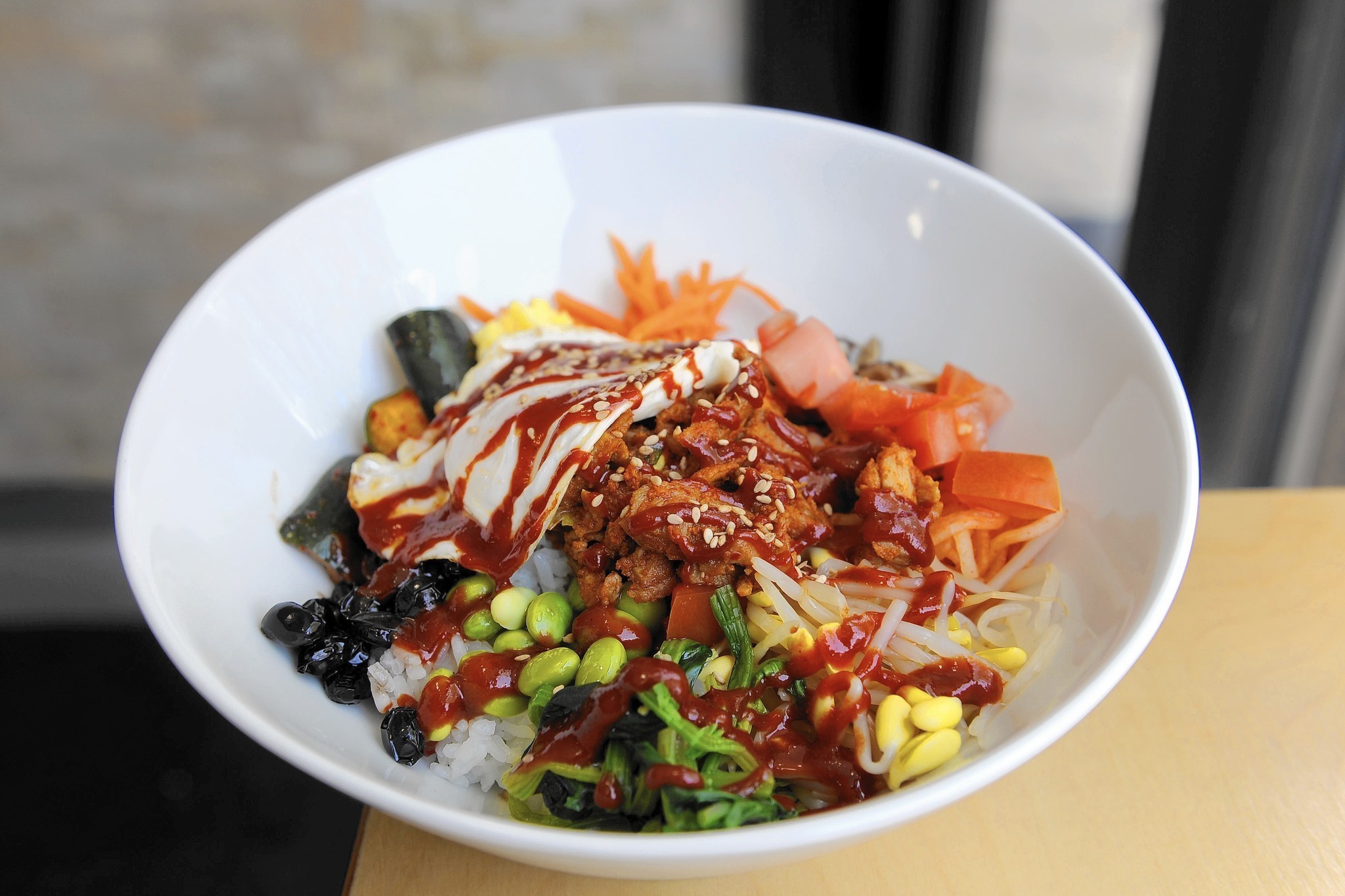


BeBim at R House does fast casual Korean


I first tasted gochujang in the delicious marinated grilled meat dish called bulgogi. It gives the robust red color and flavor to Korean stew dishes known as jigae and is also stirred up and served as a condiment  

The elevator pitch for gochujang is "a cross between miso paste and Asian chili sauce." But this paste is not nosebud-clearing spiky-hot like Sriracha sauce, another favorite condiment of mine. Gochujang has a good, deep kind of hot and a complex, almost-meaty dimension foodies call  umami.
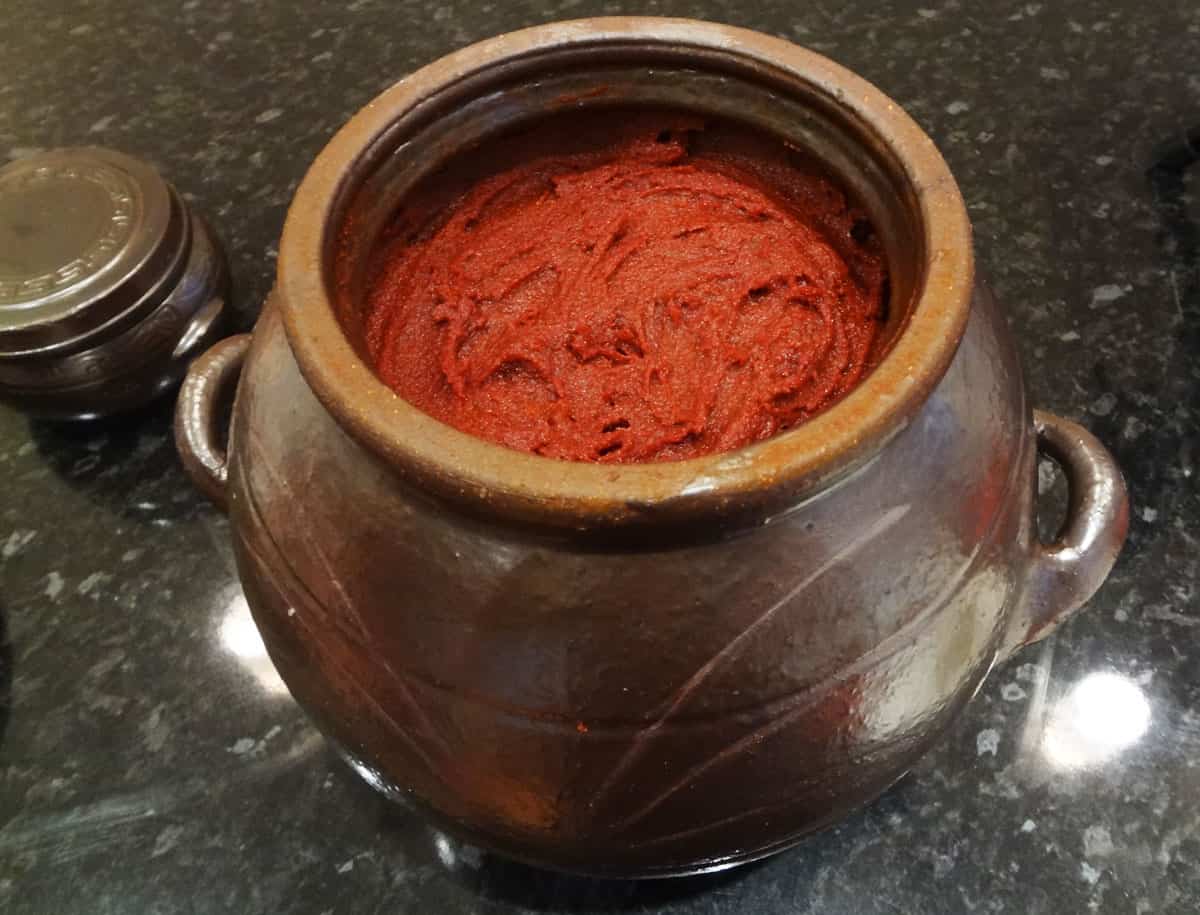


Watch a short video of how to make gorgeous gochujang at http://www.maangchi.com/recipe/gochujang


Gochujang ha become buzzy in the West for the last five years, although it dates back to at least the sixteenth century in Korea. Someone clever took the mellow Korean chili known as gochu, dried it, and crushed it. This was mixed with powdered rice, powdered fermented dried soybeans, sprouted barley and salt. Fresh gochujang paste is stored in a ceramic crock outdoors for six months before eating. The fermentation creates the healthy lactobacillus to support healthy digestion; and the chili element within the food inhibits spoilage. Chilies contain capsicum, which some say helps fight obesity.  In any case, gochujang has some other great nutrients: Vitamin B2, Vitamin C, protein and carotene. It tastes like heaven, but it isn’t junk food.

Korean purists still make gochujang by hand, just as people in Japan still make tofu and miso. Fortunately, there are a few potters interested in making the proper jars, which must be screened at the top to allow ventilation. It's almost like the composting I'm trying to do in an old trashcan in my yard. 

I wanted to get a gochujang fix the easy way. That meant shopping. I found many tubs of it on the shelf of the Asian supermarket a few miles from my house. After the gochujang tub opened, it needs to go into the refrigerator. I put it there while I pondered what to do next.


There were many choices. I can’t count the ways I’ve seen gochujang as an ingredient in non-Korean recipe, particularly as a drizzling sauce or mixed in with mayonnaise. One of the first things i did was make gochujang mayonnaise that was used for many purposes.

I also decided to put a spoonful of gochujang in the soy-stock mixture I use for vegetable stir-fry. A dish with Chinese origins was changed--and not for the worse!


While I was taking baby spoonfuls out of my pepper paste tub, the food people have crafted grand new recipes. 
British cooking author and TV host Nigella Lawson blended Italy and Korea in her original recipe for Korean Calimari and then she blended India and Korea in Korean Keema. 


Nigella's Korean Calimari


Turkey and gochujang are a popular combination. I like the ingredients in Blogger Lemon Lime Lisa’s gochujang turkey meatballs which would be a great party hors d'oeuvre.

Here’s a great slideshow roundup of gochujang-flavored dishes from  Bon Appetit   

Without realizing it, I used up my whole gochujang tub on silly little ideas. I wanted to do something big. One Saturday, I went shopping for a new container of gochujang and decided to lavish it on a small pork loin.

First, I browned the 3 lb hunk of pork in a little oil. Then I added in 1/3 cup gochujang paste,1/8 cup soy sauce, 1/8 cup of honey and ½ cup of chicken stock. I let the loin braise in the spicy potion for 8 hours, until cooked through and very soft. I took out the loin to rest and boiled down the remaining red-brown cooking liquid to make a velvety brown sauce. Okay, I apologize for the lack of photograph; when the pork was ready, I had no impulse control.

The pork loin was a bit too much for just my husband and me to eat. Still, it was excellent, from the first night, when it was presented like a roast with polenta on the side; to the next day’s lunch, when it went inside a tortilla wrap along with lettuce and radishes; to the grand finale two days later, soft tacos with fresh chopped vegetables.


By the end of my gochujang experiment, I wasn't bored. I was filled by another of capsicum's supposed benefits: euphoria.

Wednesday, February 15, 2017

Gochujang Glory


I've had a little too much Thai, Indian and Vietnamese restaurant food lately. Even good food can become boring. Looking for another Asian taste, I decided to go after the obvious: Korean food.

Fortunately, there are a lot of Korean immigrants around Baltimor. I've dined at places ranging from multi-starred restaurants in the suburbs to the casual Korean take-out counter at R House, the great new food hall in Baltimore's Remington neighborhood. This has been a fun project.

I've noticed that in almost every dish, a special flavor tickled my tastebuds. That is the taste of gochujang.


BeBim at R House does fast casual Korean


I first tasted gochujang in the delicious marinated grilled meat dish called bulgogi. It gives the robust red color and flavor to Korean stew dishes known as jigae and is also stirred up and served as a condiment  

The elevator pitch for gochujang is "a cross between miso paste and Asian chili sauce." But this paste is not nosebud-clearing spiky-hot like Sriracha sauce, another favorite condiment of mine. Gochujang has a good, deep kind of hot and a complex, almost-meaty dimension foodies call  umami.


Watch a short video of how to make gorgeous gochujang at http://www.maangchi.com/recipe/gochujang


Gochujang ha become buzzy in the West for the last five years, although it dates back to at least the sixteenth century in Korea. Someone clever took the mellow Korean chili known as gochu, dried it, and crushed it. This was mixed with powdered rice, powdered fermented dried soybeans, sprouted barley and salt. Fresh gochujang paste is stored in a ceramic crock outdoors for six months before eating. The fermentation creates the healthy lactobacillus to support healthy digestion; and the chili element within the food inhibits spoilage. Chilies contain capsicum, which some say helps fight obesity.  In any case, gochujang has some other great nutrients: Vitamin B2, Vitamin C, protein and carotene. It tastes like heaven, but it isn’t junk food.

Korean purists still make gochujang by hand, just as people in Japan still make tofu and miso. Fortunately, there are a few potters interested in making the proper jars, which must be screened at the top to allow ventilation. It's almost like the composting I'm trying to do in an old trashcan in my yard. 

I wanted to get a gochujang fix the easy way. That meant shopping. I found many tubs of it on the shelf of the Asian supermarket a few miles from my house. After the gochujang tub opened, it needs to go into the refrigerator. I put it there while I pondered what to do next.


There were many choices. I can’t count the ways I’ve seen gochujang as an ingredient in non-Korean recipe, particularly as a drizzling sauce or mixed in with mayonnaise. One of the first things i did was make gochujang mayonnaise that was used for many purposes.

I also decided to put a spoonful of gochujang in the soy-stock mixture I use for vegetable stir-fry. A dish with Chinese origins was changed--and not for the worse!


While I was taking baby spoonfuls out of my pepper paste tub, the food people have crafted grand new recipes. 
British cooking author and TV host Nigella Lawson blended Italy and Korea in her original recipe for Korean Calimari and then she blended India and Korea in Korean Keema. 


Nigella's Korean Calimari


Turkey and gochujang are a popular combination. I like the ingredients in Blogger Lemon Lime Lisa’s gochujang turkey meatballs which would be a great party hors d'oeuvre.

Here’s a great slideshow roundup of gochujang-flavored dishes from  Bon Appetit   

Without realizing it, I used up my whole gochujang tub on silly little ideas. I wanted to do something big. One Saturday, I went shopping for a new container of gochujang and decided to lavish it on a small pork loin.

First, I browned the 3 lb hunk of pork in a little oil. Then I added in 1/3 cup gochujang paste,1/8 cup soy sauce, 1/8 cup of honey and ½ cup of chicken stock. I let the loin braise in the spicy potion for 8 hours, until cooked through and very soft. I took out the loin to rest and boiled down the remaining red-brown cooking liquid to make a velvety brown sauce. Okay, I apologize for the lack of photograph; when the pork was ready, I had no impulse control.

The pork loin was a bit too much for just my husband and me to eat. Still, it was excellent, from the first night, when it was presented like a roast with polenta on the side; to the next day’s lunch, when it went inside a tortilla wrap along with lettuce and radishes; to the grand finale two days later, soft tacos with fresh chopped vegetables.


By the end of my gochujang experiment, I wasn't bored. I was filled by another of capsicum's supposed benefits: euphoria.

Wednesday, March 23, 2016

Another Excuse for a New Year's Party!

Sujata Massey


A welcoming Parsi gentleman I will always remember; India International Centre 1989

A few decades ago, when I was on a father-daughter trip to India, I came fact to face with my future.

Not my sweet husband (although plenty of people I met on that trip offered to find me one).

That fateful evening in March, 1989, I suddenly found myself in the midst of a party celebrating Navroze, or the Persian New Year, a major spiritual and social occurrence based on the spring equinox. Nowrooz, Navroz, Navroze, Naw-Ruz, Nowroz, and several other spellings all mean "New Day" in Persian. This is the date that changes slightly every year: when the length of sunlight equals night.

It is the start of the lunar calendar calculated by Persians about three thousand years ago. In those days, the state religion was Zoroastrianism. However, it seems that anyone whose ancestors spent time in Iran, whether Zoroastrian, Muslim, Baha'i or Kurdish, observes this new year.  Some communities celebrate three days...others almost two weeks.

 I knew none of this going in. That long ago evening at the India International Centre in New Delhi. I was strolling about, killing time until the dining hall opened and my father and I could get something to eat. I drew near a splendidly decorated pavilion.

Are they twins or just close sisters? Parsi girls at the 1989 Navroze celebration

I felt I were gazing into a magic world. Darling little girls wore white lace frocks, ladies were draped in luxurious saris and all the gentlemen were clad traditional white suits with unusual headgear (Later I learned these were lacquered turbans called fetahs). I admired the scene until a kindly elder  insisted I join them. I had my first rapturous taste of spicy, sophisticated Parsi food (Parsi transliterates to "Persian" and refers to the Zoroastrian immigrants who arrived in Gujarat starting in 600 AD).

My first taste of Parsi hospitality must have been auspicious, because many years later, I find myself revisiting the March New Year in fictional form. I'm currently writing a novel starring a Zoroastrian family in 1920s Bombay. Just last week I was writing about the rigorous house cleaning that before the New Year. There's a lot to it!


Perzen Patel, a Parsi cuisine expert in Mumbai, with her fabulous pantry


My friend Perzen Patel, aka the Bawi Bride, is a Parsi caterer and food blogger in Mumbai. For Perzen, the Persian New Year means a lot of family visiting and a tremendous amount of cooking for friends and customers. Several weeks before the holiday, she sent this enticing email to her friends and blog followers, and customers.

This year to bring in Navroze I thought we'd go the extra mile and really create a menu that is beyond the ordinary. So, I've put my thinking cap on and planned a lovely special that you can avail any day from Saturday 19 - Monday 21 March. 
Our menu is as follows:
- Kheema Pattice---savory mashed potato and lamb patties
- Badam Malai Chicken Pulao--a savory rice pilaf studded with chicken cooked in cream with almonds 
- Masala ni Dar--spicy lentils
- Kid Gosht--lamb curry
- Patra ma Prawns--prawns steam-cooked in banana leaves
- Lagan nu Custard--sweet baked pudding garnished with raisins and cashews

All of this yummy food for the special price of ₹1550 per plate including delivery with each plate as a whole enough for two people.


Translation: that's about $25 for a New Year's feast for two! If you're curious, try Perzen's custard recipe highlighted above or the many delicious home recipes on the Bawi Bride website.
All these elements appear on a Nawroz table

Perzen says that if the celebratory Navroze meal is home-cooked (which is typical), at least one fish dish would be included for good luck. There might also be a nougat sweet, Gaz, imported from Iran. Perzen's favorite non-culinary part of the holiday is the Haft Seen table laid out with seven lucky edibles that start with the "S" sound in Persian. These range from sumac to apple and garlic and herbs. A key item on the table is the mirror,  placed there so visiting relatives can look into it and reflect on their past year and any blessings.
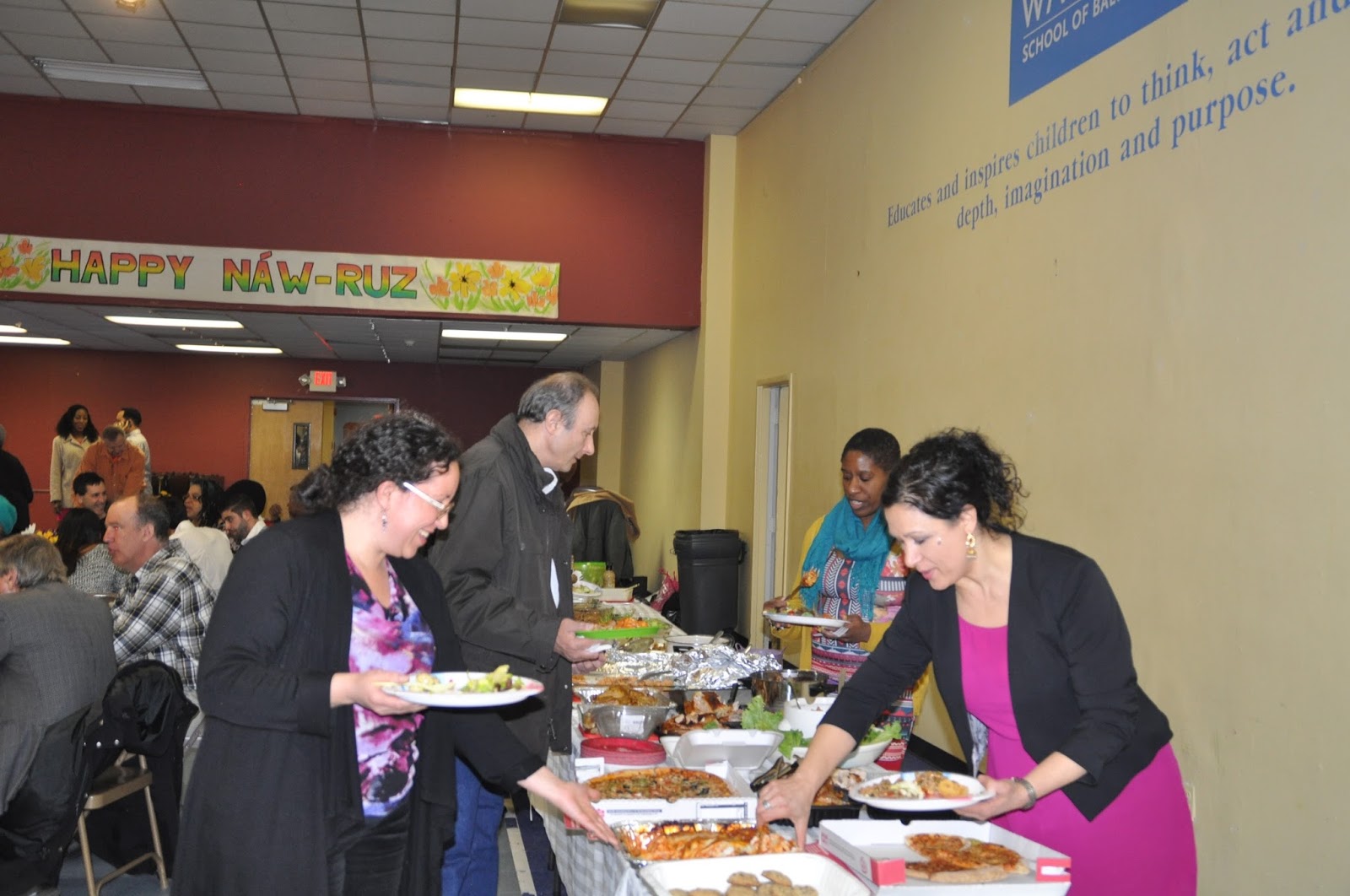
The Baltimore Naw-Ruz buffet 

A Baltimore friend, Sheila Mohajer Hofert, is a Baha'i who fled Iran with her family in the early 1980s. The Baha'i start their New Year at approximately the same time as Zoroastrians and Iranian-origin Muslims. One difference is the Baha'i  fast from sunrise to sunset for the last 19 days before Naw-Ruz. Sheila says the fasting  makes one "more understanding of the people who are hungry in the world--and to become more aware of our bodies and our emotions. For example, working on treating others kindly when you personally don't feel very well."

This year, on March 19, more than 200 Baha'is and their friends gathered to enjoy food, song, and prayers.

I also asked Sheila her favorite aspect of Naw-Ruz. She wrote: "As winter gradually fades away and the paleness of the world is replaced with fresh colors and fragrance, it brings with the promise of the new day. It remind me of he cyclic nature of our universe and the cyclic nature of our lives, which are constantly filled with crises, followed by victory."
Young Musicians at the Baha'i Naw-Ruz event 


Life will always get better. Naw-Ruz Mubarak!