Showing posts with label cooking. Show all posts

Wednesday, January 28, 2026

Snowed In!

Sujata Massey


I secretly anticipated a really big storm would hit the East Coast in 2026. 

It's not that I have psychic powers. I simply enjoy almanacs and folk wisdom about nature--and I keep my eyes out.One of these American folk legends is that when the acorns abound, snow is going to be profuse. And Baltimore was certainly overwhelmed by acorns a few months ago. The explanation is that this is something called a “mast year”—an abundant seed/nut production every 2-5 years resulting in more acorns than animals can consume: meaning, more trees for all of us. Yet this mast year, we had three winter’s worth of snow in one day. And isn't a lot of snow great for baby trees?

We had a small snow a week ago as a test; light enough to shovel easily and sprinkle down the pretty bright blue crystals of pet-safe snow-melting material. Oh, for those halcyon days of having my feet on the pavement—and not mincing over snow with my abdomen braced to keep my balance! With this particular storm, I find my legs are fatigued from all the subtle adjustments and shifts from slick ice to falling into unexpected depths of snow.

Ice seems to be bad everywhere in America this winter. I saw a picture in the Atlantic's online edition of woman who looks like a younger version of me captured by ICE agents titled  Welcome To The American Winter. Freezing weather, terrible bounty hunters, a woman fallen to the ground. Images of death and abuse of power and hard weather--as well as a national uprising like we've never seen.

Minnesotans are standing up against masked men prowling the icy streets, who incidentally can’t seem to keep their balance on snow banks. Yet a huge swath of the United States, from south to the northeast, is blesedly not under mass deportation evasion, but is nonetheless flummoxed by deep layers of ice and snow ranging from eight to thirty inches. In Baltimore, I think the snowfall was as high as 18 inches, depending on how the winds blew. I plunged thigh-deep on my walk today seeking out a bank machine from which to retrieve cash to pay for a snow plow service that never showed up.

Winter Storm Fern is not my first East Coast snowstorm. I've lived here over thirty years and usually have excitement about snow forecasts. I find the groaning sound of salt trucks dumping material on the streets comforting—it goes back to my childhood in Minnesota. I also love the scraping sounds of sleds and snow shovels on the street.I gaze in admiration at Baltimore neighborhoods transforming like film sets back into the 1800s, because nothing looks more charming than an old house set in snow. 

This storm, though, has thrown my age--and weaknesses--at me. The snow is so high and so hard that I can’t shovel as I usually enjoy doing—even a week earlier, during a two-inch storm. Yes, we salted before this particular blizzard with Pet-Melt, and I did a bit of shoveling during the storm, but it wasn't enough. Tony and I decided to make life simpler and hire professionals with machinery. So far the first two snow removal companies we made advance arrangements haven’t been able to come. We are waiting on a third, fingers crossed. You really need to take are of snow yourself.

The tradition in our house is to make a pot of chilli on a snow day. I started this when our children were small. I usually threw together a vegetarian chili made from canned red beans  and tomatoes, plus lots of fresh onion, garlic and spices. I’d also bake cornbread and cookies. We’d invite one or two families who could walk over to eat and chat with us, while the snow fell. The party felt like we were getting away with something!

Now that Tony is usually works from home, he’s taken on chilli-cooking with great professionalism. He mines the internet to find the exact out-of-print Fine Cooking recipe that he knows. He appreciates chilli so much that he initially proposed making two variations—one white and one red—but I talked him into choosing his favorite and letting me make a vegetarian alternative. At this point, we both knew we had limited hours before the snow hit, and we were cooking for a crowd. He agreed to my point—as long as he could also bake a carrot cake.

Who would argue with that?

On the final non-snow day, he shopped. It meant driving thirty minutes to a John Brown, a butcher in the Baltimore County who sells especially delicious grassfed beef. Here he picked up 7 pounds of sirloin tip. Then it was returning to the city and Mom’s Organic Market for canned beans in short supply, cream cheese, carrots and currants. Then he made a short walk to Eddie’s Market in our neighborhood for the black beans that were completely sold out at Mom’s. The man was exhausted, and then he had to unpack it all and start chopping, because the chilli would be served the next day. While he played at “The Bear” in our kitchen, I made invitations on paper to all the neighbors on the block. I decided, why not ask everyone—including the folks living in apartments, who we saw coming and going but just didn’t know?

The chilli recipe was extravagant, rising to the rim of the 16-quart stockpot. And after bubbling for a few hours, it needed to chill overnight. The pot was too tall for the fridge—but one perk of bad winter weather is the outdoor refrigerator every Minnesotan knows. My twist was sliding the stockpot underneath the dining table on the deck. I then laid a tablecloth on that table so the snow didn’t fall through it and bury our highly anticipated dish.

Snow day dawned on Sunday with flakes falling fast on the diagonal. I kept on sweeping snow from the porch and shoveling the front walk and out to the street, so our guests would be able to arrive at 12:30 onward. In between I made corn muffins and laid the table for the party. We weren’t sure how many people would come, so we put out mugs to fill with the chilli, which would stay hot in a slow cooker.  My second dish was a vegetarian shepherd’s pie made on Saturday. It was simple, a layer of richly seasoned tepary beans underneath mashed potatoes. Yes we could have made a green salad, but why? It wasn’t a normal, polite sit-down lunch with china. It was a snowstorm chili party, which meant you could eat casually in any room holding your food in one hand and a spoon in the other. 

We didn’t know who or how many would come—but the result was just right. About fifteen people, many of them not known to us. Three of these millennial households brought batches of fantastic home baked cookies. There was plenty of wine and water and kombucha. 

What a party it was! Our youngest guest was ten months, and our oldest in the neighborhood of eighty. I met 10 new people, right in my own house. I realized the beauty of living in a neighborhood that mixed homeowners and renters; students, retirees and workers. It makes for a great party mix. 

We have a lot of snow, but we are so lucky not to have lost power. And luckier still to have had new friends in our house—bringing a sense of not being alone, even when marooned.

Thursday, October 30, 2025

Happiness is under 30 minutes: Scones

Karen Odden - every other Thursday 

When I was growing up, my mother did not like to cook. It was a different era; more food came out of cans (anyone remember La Choy Chow Mein, with the dry noodles in the separate can on top?); and the term “farm to table” did not exist, at least not in the Rochester suburb where I grew up. 

As an adult, I learned to cook for my kids – workmanlike, weekday meals such as chicken parmesan, stir-fry, and risotto – with recipes, and with guidance from my husband, who grew up in a family that Cooked with a capital C. (That capital C should be in a font twice that size, italicized, and in bold. Just saying.) 
Thanksgiving was a three-day cooking extravaganza complete with hand-torn loaves of stale bread for stuffing and an enormous turkey, mashed potatoes and gravy, succotash, homemade cranberry relish (two kinds), and five kinds of pie. His mother filled an entire wall with pots and pans, each particular to a use, on a cork-board along the staircase down to the basement, in addition to the cookware in the kitchen cupboards. My husband still does all the holiday cooking – it’s he who makes French onion soup from scratch and the Beef Wellington in phyllo dough for Thanksgiving every year. (Guests welcome!) 

But my special, small niche in the kitchen is baking. I have a killer triple-decker carrot cake recipe, with lemon cream cheese frosting, that people sometimes ask for, very specifically, when I say, “What can I bring?” to a dinner party. (As in, it may be why I’m invited.) I have a popular lemon tart, with the zing of lemon zest and a shortbread crust. And I make Craisin and white-chocolate scones, light and moist and perfect for breakfast or dessert, that have never failed to please. Bookstore owner and mystery maven Barbara Peters now calls them "the official Poisoned Pen scones," after I repeatedly brought them to my book launches. 

(For those who don't know, the Pen is an indie bookstore in Old Town Scottsdale that specializes in mystery and holds many author events both in person and virtually, so anyone can watch. November guests include Charles Finch, Tasha Alexander, Janet Evanovich, T. Jefferson Parker, and Julia Spencer-Fleming. https://poisonedpen.com/. )

Baking is like writing, somewhat. 

You gather an array of ingredients (characters), and you combine them in a particular order, give or take (meet, fall in love, become enemies). Blend the wet first, then add the dry. Knead, but don’t work the dough too much. Add spices, flavoring to taste (strew clues throughout). It requires perfect attention to the rules with some things (have an inciting incident, spellcheck) but leeway with others (the crime can happen earlier or later). For example, I am scrupulous about my flour measurements (spoon it into the measuring cup; never, ever just dip the cup measure into the flour, or you will use too much) but I always put in more white chocolate chips than the recipe calls for because I like them a bit sweet and the dough has very little sugar. I rough chop the Craisins, which the original recipe doesn’t call for, because then you get that bit of tartness in every bite. (Note -- when I was in Scotland, I discovered there is a Major Controversy about scone shape. They like them in clumpy rounds; mine are pie shaped. They might not even count as scones in the UK. Furthermore, I have also been instructed on the pronunciation of the word: my friend Wendy H. Jones, in Scotland, pronounces it more like "scawns" than "scones.") 
 
After writing all day, I long to work with my hands, engage my senses of taste and smell, and spend time without a screen. So baking is a pleasure. 

For anyone who wants it, this is the scone recipe, adapted from one that friends Evan and Tami gave me, as I’ve amended over the years. They're easy and sure to please.

Happiness is under 30 minutes.  

Ingredients:

1 ¾ c flour, plus some for dusting the surface when kneading 
¼ c sugar 
2 ½ tsp baking powder 
½ tsp salt 
5 Tbsp unsalted butter, chilled and cut into pieces 

1 large egg, beaten 
1 tsp vanilla 
6 Tbsp half-and-half 
¾ c Craisins (chopped/halved) 
¾ c white chocolate chips (I use Nestle; some other brands are larger and don’t combine as well unless you halve them) 

Instructions: 

Mix the first five ingredients together by hand or mixer until they are fully blended into crumbs. Then add the rest, blending until just incorporated. Turn the mixture onto a floured surface and knead for two minutes, adding flour in as needed until it isn’t sticky. Cut the dough and form into two rounds. Cut the rounds along the diameter 4 times (think spokes on a bicycle wheel) to make 8 pieces each; they will be pie shaped. Bake on a flat pan, lined with parchment paper, in a 400-degree oven (or 375 convection), 7-8 minutes. (Every oven is different, and these are like pine nuts, you have to catch them at the right minute.) 

Do not let them brown (they turn sort of taupe), or they will taste burnt. They will puff up a bit and should be lightly golden along the edges. Remove from the pan and cool on a rack.

Wednesday, December 18, 2024

Nuts for Christmas

 Sujata Massey


I'm reposting this blog for the 3rd December in about ten years. Right around this time, a lot of us responsible for Christmas gifts, food and parties are at a breaking point. When I say I'm nuts for Christmas, it's a triple entendre.  Cookie baking takes just too much time right now--but a couple batches of spiced nuts are done in 30 minutes--and I am happy I made them. This recipe uses date syrup, but one can use coconut or white sugar, and you might have a recipe up your sleeve that suits you. The key for a sacking holiday nuts recipe is that it to be sweet, salty and spicy.  


Throughout December, almonds, walnuts, pistachios, and pecans are always in my shopping cart. I first wrote about this peculiar passion six years ago, yet I couldn’t resist returning to the topic this year.  And the nuts made me contemplate whether traditions can shift a bit and still feel comforting. 


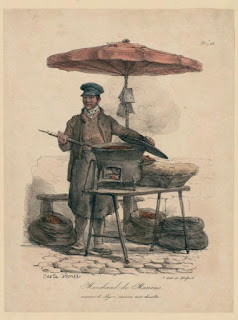
This year, not as many Christmas markets are running in Germany as before Covid. For many centuries, Germany and other German-speaking countries have held Christmas markets in town squares that are filled with wooden stalls and sparkling lights, mulled wine and celebrating people.Weihnachtsmarkts sell holiday greens, ornaments, gingerbread, and a variety of roasted nuts--straight-up smoky smelling roasted chestnuts, as well as sugared, cinnamon almonds--either way, the nuts come wrapped in twists of newspaper. I remember going mad for the almonds and lead Christmas tree ornaments at the Recklinghausen Weihnachtsmarkt during a late 1980s holiday visit to Germany with my mother and sisters. 


The other nutty tradition that gets me reminiscing isn’t tied to any holidays. Roasted nuts--especially peanuts--are part of the everyday street food scene in India. Walking through Mumbai, I’ve often passed vendors shaking peanuts in a giant steel bowl set over an open fire. What aromas! And just like the practical Germans so far away, these vendors shake the nuts into newspaper cones and hand them over.


Despite my overseas romances with various forms of roasted nuts, I only began roasting nuts at home in the early 1990s.I was inspired by a set of recipes for home-made spiced nuts by Julie Sahni. Such nut seemed less perishable and safer to mail to my relatives than cookies—though I’m not going to lie, I make a lot of cookies in December, too. But nuts are the best: not only can you eat them out of hand, but you can add them to salads, cakes, ice cream, oatmeal, and pancakes. Add some chopped dried fruit and you have a trail mix extraordinaire. My family has come to expect these nuts to arrive every year. And it seems symbolic that our bicultural identity comes together in these nuts, which marry the sweet of Germany with the spicy heat of India.


As time marches on, many of us are reducing our sugar intake. Last year, I adjusted the venerable spicy nuts recipe with coconut sugar instead of ordinary white sugar. The coconut sugar didn't make as nice a syrup with water as refined white sugar did. It was eerie, but the healthified nuts still tasted very sweet. My own threshold for what tastes sweet has lowered.


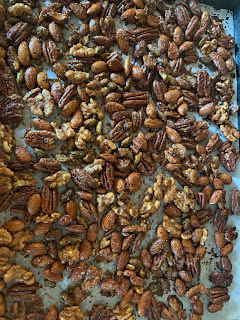
This year, I decided to make extra batches of nuts using a few different sweeteners and to bake them in a regular oven. Because I couldn’t locate a recipe for such that called on Indian spices,   I realized this was a chance to make my own recipe. I counseled myself to be prepared for imperfect results, knowing that food professionals often test upwards of a dozen times before a winner is found.  


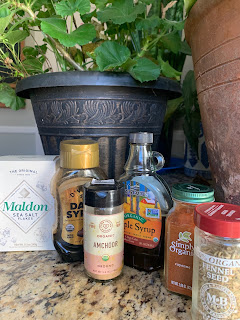
The seasonings


Driving the mission was a change in sweetening from dry sugar mixed with water to an already usable syrup. The sweetener I was most hopeful about was date syrup, originally known as dibis in Iraq and other parts of the Middle East. Typical uses for dibis are drizzled over hummus, mixed into drinks, and within desserts. I would never have known about it if I hadn’t kept coming across it in healthy baking recipes this past year. 


One tablespoon of date syrup has a glycemic index of 47. Putting it in context with other options, maple syrup and coconut sugar have a glycemic index of 54, honey has 58, and sugar 60. (Agave syrup is very low—just 19 on the glycemic index—but I think it tastes weird). According to nutritionists, dates are loaded with amino acids, vitamins and minerals, and antioxidants. because of the protein within nuts, my holiday guilty pleasure could turn into a life-saving holiday hero.


Step into my kitchen. Here's what happened.


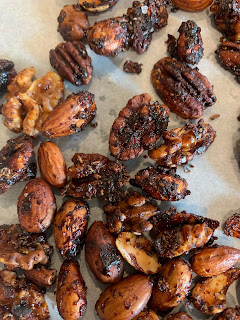
20 minutes was too long for half these nuts!


The first batch I made was three cups of nuts tossed with my usual spices and one-third cup of date syrup. I quickly found that date syrup tended to caramelize faster than expected—resulted in blackened nuts that weren’t very pretty and tasted slightly burned. I also noted (belatedly) that whole almonds are double the size of the walnut and pecan halves, so a shorter cooking time for walnuts and pecans would further protect the nuts. 


For Attempt Number Two, I cut the oven time from twenty minutes to twelve minutes. I also did the extra step of splitting up the nuts on two baking sheets, with the fat almonds on one sheet, and the skinny walnuts and pecans on the other. That way, it was easier to take the faster baking nuts out when they were crying for mercy, and let the almonds linger a few more minutes.  


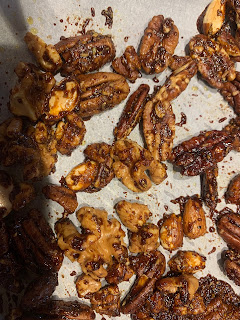
Walnuts and pecans and pistachios done right


So far, so good.


I found myself curious about the road still not taken—another syrup that was a candidate for sweetening.What would the nuts taste like roasted with maple syrup? Would this lighter, higher glycemic index syrup be even better? 


For Attempt Number Three, I took the one-third measuring cup I’d used for previous recipes. I filled half of it with date syrup from my waning bottle and then poured maple syrup to the top. After roasting, the nuts were soft and didn’t taste like much. Impatiently, I waited for them to cool to crispness before tasting. 


Maple-Date nut mix


Hmmm. The odd thing was that although the maple-date laced nuts were lighter in color and dried to a nice crispness, the taste wasn’t as deep and hauntingly flavorful. There was an umami in the date syrup and a nicely chewy caramelization that was no longer there. And being able to taste between the various batches made me decide that date syrup alone was the best. The ultimate nuts that I'm sharing with you. Recipe is also in print below.

Voila!


Spicy Christmas Nuts


Makes 3 and 1/3 cups


Ingredients:

1 cup unroasted, unsalted unblanched whole almonds (often sold as ‘natural’ in the grocery store)

1 cup unroasted, unsalted walnut halves

1 cup unroasted, unsalted pecan halves

1/3 cup unroasted, unsalted pistachios


¾ teaspoon roughly ground or pounded fennel seeds

1 tablespoon ground cumin

1 teaspoon amchoor spice, available at Asian grocery stores ( you can substitute 2 teaspoons lemon juice at end of recipe, if you can’t get amchoor)

½ to 2 teaspoons ground cayenne pepper (I use 1 teaspoon)

1-2 teaspoons fine salt, divided (I use Maldon Sea Salt that I pound fine. but pound it fine)


1/3 cup date syrup

2 tablespoons olive oil.


Preheat oven to 350 degrees. 

1.     Line two rimmed baking sheets with ungreased parchment paper.

2.     Put all the almonds in one bowl.

3.     Put the walnuts halves, pecan halves and pistachios in a second bowl.

4.     Stir all the spices (including 1 teaspoon of the salt) together in a cup and set aside. Be prepared to divide this mix later between two bowls of nuts.

5.     Mix the date syrup and olive oil in another cup. Be prepared to split it between two bowls of nuts.

6.     Cover the nuts in each bowl firstly with the syrup-oil mixture, and secondly with the spices. Don’t be afraid to use your clean hands!

7.     Put the sticky spiced almonds on one baking sheet, and the rest of the nuts on the other sheet. Wash your hands!

8.     Set a timer for 5 minutes and put both baking sheets in the oven. When your timer rings, use a spatula to stir around the nuts on each baking sheet and rotate the sheets back to front, and higher rack to bottom rack. This promotes even cooking. 

9.     Set timer once again for 5 more minutes. When the timer rings, take out the walnuts, pecans and pistachios and set them on their parchment lined pan on a kitchen counter or table. If you are using lemon juice INSTEAD of amchoor, now is the time to toss the nuts with the lemon juice, remembering that you’ll divide the two tablespoons of lemon juice between both sheets of nuts. Taste to see if you want to add any more of the reserved salt.

10.  Allow the almonds to roast two to three more minutes longer than the walnuts-pecans-pistachios--or until many of the nuts show some signs of caramelization. Then you should remove the baking sheet to cool on the counter.

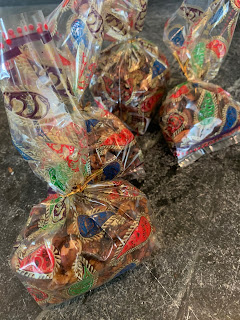
11.  The nuts will probably be cool enough to handle and taste in fifteen minutes. Let them cool to room temperature before packing in tins or git bags. They’ll stay fresh in their wrappings for up to a month, and they can be frozen as well. Eat out of hand and also use as a topping for cereal, oatmeal, cake, ice cream, pancakes, and any other place you think they will spark joy.


Which special traditions do you enjoy that you would never change? And what have you tweaked for the better? 


Wednesday, August 28, 2024

The Sweetness of Figs

 Sujata Massey


Fall is almost here, but nature is having a last hurrah. In Maryland and the states nearby, farmstands are loaded with corn and tomatoes. Peaches are ripe and a second harvest of raspberries looms. For me, the fruit that’s calling out the loudest is the simple brown fig.


Figs are said to originated in Asia Minor, an area in Turkey’s north: a meeting place for European and Asian travelers. The fruit can be grown from a cut twig—so it was easy to propagate and spread worldwide. In Baltimore, Maryland, many Italian and Greek immigrants planted fig trees on the small patches of land outside their rowhouses and cottages. As their trees grew, they shared branches with neighbors.


This practice even continues today. On Deepdene Avenue, a small street filled with small Victorian cottages, my neighbors Prem and Anand admired a robust fig tree across the street. Their neighbor gave them a cutting. Ten years later, their own handsome fig tree towers over the roses and vegetables growing in their back yard. Hundreds of figs are produced each year: more than enough for them and the local birds. This meant that yesterday, Prem and Anand walked Deepdene with bags of figs that they dropped to ten households. They’ve made me and other friends feel welcome to come and pick figs when I want. 


The average fig tree takes three to five years to start bearing fruit; and some can live as long as 200 years. In the novel by Eli Shafak, The Island of Missing Trees a beautifully sheltering fig tree is one of the story's narrators. She is a cutting transported from Cyprus to England, where she is planted and tended by an immigrant family who holds pain of the past. 


Very likely the brown Turkey fig came to India via traders or during the Mughal Empire, because you can find sweets and chutneys made from the fruit in India. However, South Asia has its own indigenous fig tree: the mighty and mystical banyan. A bright red-pink variety of figs grows in thick clusters on banyan trees (Ficus Benghalensus) that are enjoyed by birds, not humans. 


The fig tree that’s now native to my neighborhood is the aforementioned brown Turkey fig, a fruit that does not require wasp pollination. Thus, these are considered “vegetarian” figs as opposed to “carnivorous” figs like Smyrna and San Pedro that have the remnants of dead wasps inside. But don't be frightened! The insects have been almost absorbed by enzymes and are both invisible and don't affect taste.


What to do with an over-abundance of figs? Prem freezes her figs in plastic bags and uses later for baking. Here we are together, and a closeup of Prem's famous fig cake.


In the past I’ve frozen several small fig-almond meal cakes, and they’ve defrosted nicely.  This year, I decided I wanted to make fig chutneys. It’s simple enough to wash the figs and chuck them into a pot with a small amount of onion, ginger, sugar, vinegar and spices. What emerged tasted a lot like a classic sweet mango chutney. 


Two days later, Prem had more figs for me.  I altered the recipe slightly to be more like hers: including half of a tart Granny Smith apple. The result was a different texture and the sweetness was cut very slightly. Either chutney is delicious on a cheese sandwich or a charcuterie board, if you’re not using it alongside grilled meat or on a plate alongside curries, rice and dal. Small amounts of chutney can be used in marinades, glazes, and dishes like chicken salad. Chutney freezes well and makes a meal taste like early Fall sweetness, no matter the time of year.


Fig Chutney (makes approximately 2 cups)


1 ½ tablespoons neutral oil such as avocado, sunflower or canola

½ tsp cumin seeds

¼ tsp fennel seeds

¼ tsp mustard seeds (yellow or brown)

½ cup finely chopped red onion or shallots

1 tablespoon grated or finely chopped gingerroot

Approximately 25 figs, washed, stemmed and cut in half

½ teaspoon garam masala powder (homemade is great, and I like the brands Frontier and Spicewalla)

¼-1/2 teaspoon red chili flakes*

¾ teaspoon fine salt

3 tablespoons brown sugar (I use coconut sugar or jaggery, Indian unrefined cane sugar)

½ tablespoon vinegar (apple cider, sherry or wine vinegar, or plain all work fine)

½ cup water


  1. Heat a stainless steel or ceramic-interior medium sized cooking pot or Dutch oven to medium heat. When warm, add the oil, followed by the seeds. T
  2. When the mustard seeds start to pop, add the chopped onion and ginger. Sautee until soft (but not browned).
  3. Add the figs and all the spices, sugar and vinegar and the ½ cup of water. Sautee uncovered, stirring occasionally, on a low flame. Toward the 20-minute mark, you'll notice the chutney becoming dry. Add a few tablespoons of water to avoid burning and break up the fig halves with your wooden spoon. Cook approximately 25 minutes or until the hot mixture resembles a thick chutney. Turn off heat, cool, and put in a clean jar. Refrigerate and eat within the next 3 weeks. Freeze chutney in plastic containers or bag for later use.


*Chili flakes can be omitted entirely or substituted with other items you may have on hand. Try a chopped fresh red chili, a whole dried red chili, chili crisp, or cayenne powder. In every case, start with a small amount and taste the chutney in the last 5 minutes of cooking time to see if you want to add more of a kick.


Fig-Apple Chutney Variation: To the recipe listed above, add one half-cup of small-diced Granny Smith apple, or another tart cooking apple. You can cut the figs to 20—or even less. Do as you like, because chutney is most forgiving.  


Here are pictures of the chutney as it starts out in the pot, followed by chutney that is ready for bottling.


Wednesday, June 12, 2024

Eating With My Eyes

 Sujata Massey


When life is stressful, resting my eyes on clear surfaces and straight lines helps me take a deep breath. Getting through the last pages of an edit is always a tough time--I'm housebound and frustrated. So during one of my stomps around the house, I caught sight of some overcrowded bookshelves and became obsessed with purging them. I expected this book cleanse would be easier work than my semi-annual clean-outs of the towering shelves in our dining room. This was a simple matter of tending to the walnut and maple-joined bookcases my husband built in our butler’s pantry twelve years ago. He's tremendously creative, and it its a sturdy, six-foot long, granite-topped set of two sturdy shelves that can hold almost two hundred cookbooks.  


I find it difficult to retire a cookbook. This is no matter whether it’s been used a lot in the past and has become threadbare or is pristine because of minimal use. I probably struggle also because I have strong feelings about cookbook authors. These writers often have professional cooking backgrounds. They test their recipes multiple times, they use science and history, and they are usually involved in the food styling and photography. My very favorite cookbook writers are also charming storytellers who mix personal tales along with teaspoons. This contingent is headed by the dearly departed MFK Fisher, Laurie Colwin and Elizabeth David. Still living, and writing wonderful stories along with their recipes, are Molly Wizenberg, Amanda Hesser, Dorie Greenspan, Hannah Che, and Priya Krishna. 


Until now, I hadn’t realized that so many food writing favorites are women. Is focusing on writing because of women’s exclusion from chef jobs for so many years? Or is it because cookbooks are a subgenre of "women's books?" What about the madness of dessert cookbook reading--does reading them hit the same brain receptors as a kiss?


There still are male authors on the shelves, of course. The most favored one is the late Craig Claiborne, who was restaurant critic and food editor at The New York Times from 1957 to 1986. Claiborne doesn't make time for stories, but he writes luscious recipes, never mind the vast amounts of butter and cream in most of them. Claiborne is known for multiple books, but our family favorite was THE NEW YORK TIMES INTERNATIONAL COOKBOOK,  published in 1971, the time my parents were setting up house in Minnesota. I can still picture the thick, dogeared hardcover taking up a big part of a small shelf in the tiny hall just off the kitchen. Whenever my parents wanted to make something exotic like Greek pastitsio or Hungarian goulash, they cooked from this book. The three children in our family had the chore of cooking supper once a week; the good news was it could be anything we wished. I tended to use the cookbook’s French section, because I was enthralled with the poetic names of the soups and entrees. My sisters favored the Italian section and became adept with spaghetti and meatballs, spaghetti carbonara, and even pizza. Yes—in the 1970s, in our family, nobody ever phoned out for pizza delivery--it was made from scratch! My parents and I sometimes had a conversation about what we would cook for Mr. Claiborne if he ever came to dinner. I wanted to make Chicken Chasseur, but my parents said Indian. They were firm in their belief that this was one area of cooking in which they were accomplished, and he was an amateur. 


After I went away to college in Baltimore, I was thrilled to find a first edition of THE NEW YORK TIMES INTERNATIONAL COOKBOOK in a used bookshop. I used it to cook for roommates and friends. The first meal I ever cooked for my future husband, during our college days, was his French section’s Chicken with Cream and Tomatoes. I was nervous about Tony having to wait too long, so I cooked very fast—and part of the interior of the chicken breasts was a vivid pink.


The following summer, I had a New York romance and was exposed to sophisticated cooking of the moment. I became enchanted with a cookbook that may have defined the 1980s: THE SILVER PALETTE COOKBOOK, written by Julee Rosso and Sheila Lukins. I learned about the luscious recipes paging through the book while visiting my boyfriend's mother's dream kitchen--and yes, she cooked from it--and did it well.  My romance fizzled, but the fabulous mother generously gave me my own copy of the cookbook. I left New York without a boyfriend, but I now had a mastery of pesto and dark chocolate cake.  


After college I went to the Baltimore Evening Sun as a general assignment features reporter, and cookbooks fell into my life at a rapid pace. It all started because I offered my reviewing services to a food editor overwhelmed by dozens of books sent by publishers each week. I tried out at least one recipe from each book and wrote reviews, getting letters of thanks—and sometimes anger—from the book’s authors. In the process I filled my Ikea Billy bookcases with that spanned such topics Thanksgiving dishes, biscuits and scones, and Indian microwave cooking. 


I gave away about a third cookbook collection before I got married and moved to Japan. At the Japanese bookstore Kinokuniya, I bought several beautifully photographed Japanese cookbooks—not quite admitting to myself that the dishes were more time-consuming than I could manage. But I still ate through those books with my eyes. 


It’s the same for me now that I’m back in the United States: I have an insatiable hunger for cookbooks that is only amplified by cookbook author interviews on podcasts and cooking videos on YouTube and Instagram. Because of the plethora of food bloggers, it’s easy to find recipes for free on the internet; however, the likelihood of these recipes failing is far greater than recipes by an experienced food writer tested and cleared for publication in a book. Because of the rise of googling for recipes, I fear for the economic wellbeing of cookbook writers; and this is another reason why I rationalize my cookbook buying.  


 Passing the milestone of forty, health became a powerful reason to invest in new cookbooks. I find myself going through phases of various eating styles with great enthusiasm. My vegetarian period involved several books on Indian vegetarianism by Madhur Jaffrey, and American books like Mark Bittman’s 996-page doorstopper, HOW TO COOK EVERYTHING VEGETARIAN. Mark Bittman also helped me through a pescetarian phase with his seminal book, FISH. During the years my kids were young, food sensitivities flew by the wayside. In the interest of time management, I turned to slow cooker books and anything that had the word “Quick” on the cover. 


Late at night is still my quiet time and the perfect opportunity to turn to rereading my favorite food memoirs. My love for literary food writing began when I accidentally discovered a few MFK Fisher classics that described her years living and dining in France—from glorious carefree days to severe food shortages during World War II. I devoured it all. The example of brilliant MFK Fisher led me to think I could make the best of leaving the newspaper to be a trailing spouse—if it were overseas. As a newlywed—just like MFK!—I would settle abroad in an unfamiliar, stimulating location where I would gamely take up a life of eating at restaurants, shopping at exotic markets, and learning to cook another cuisine. 


And reading these books brings me back to that honeymoon period with Tony in Japan. Throughout our time living in Hayama, a small town an hour south of Tokyo, we explored every type of cafĆ© and home dining experience. This translated to rotary sushi bars, tea ceremonies, tofu-making classes, and old-fashioned US Navy dinners where a Campbells Soup-based casserole might be served with fanfare. But instead of writing a food memoir about this period, I found myself drawn writing a mystery that included food. For instance, there’s a horse sashimi appetizer in THE SALARYMAN’S WIFE that is taken straight from my memory of a tense New Year’s Eve dinner in the Japanese Alps. Another book, THE PEARL DIVER, delves into the backstage world of a Japanese fusion restaurant. Years later, I can’t imagine writing a book without the help of restaurant experiences or cookbooks. I often turn to regional Indian cookbooks to set the tables in scenes within the Perveen Mistry series. THE WIDOWS OF MALABAR HILL’s paperback edition contains an easy menu of dinner recipes meant for book-club potluck meals. 


So now that I’ve kissed a few cookbooks goodbye, I have good news. My brain calmed, and I finished my book edit. And I predict the eleven books I’ve left at various Little Free Libraries around the city will soon find themselves in new homes, inspiring people—whether they make a meal or not. 


Sujata recently had the good news of a Macavity nomination! Specifically, it’s a best historical novel nomination for her 203 novel, THE MISTRESS OF BHATIA HOUSE—which  describes in detail Gujarati teatime food. Multiple recipes from all her books and past blogposts can be found at her website.