Showing posts with label Easter. Show all posts

Saturday, April 19, 2025

Sunday is Easter...For All.


Saturday––Jeff
 

Over the years I’ve written about the traditions of Greek Easter many times.  This year the Julian calendar (followed by the Greeks and others of the Eastern Orthodox faith) and the Gregorian calendar (followed by Protestants and Catholics) have Easter falling on the same date, April 20th. I decided that makes this Easter an appropriate time to recap Greece's historic Easter Week celebrations. 

For that I turn again to the explanation found on the Facebook page of the oldest Greek Bakery in Queens--located in the NYC heart of America’s best-known Greek neighborhood, Astoria.  Here’s what the Victory Sweet Shop has to say:


For Greeks worldwide, Easter [April 20th] is the biggest religious holiday of the year.

HOLY WEEK is the week just before Easter that extends from Palm Sunday until Holy Saturday and marks the last week of Lent. It is full of symbolic events, festivities, and traditions followed by Greeks all over the world.


On THURSDAY, Greek Easter bread called Tsoureki is baked and the traditional red Easter eggs are dyed. This sweet bread is usually braided with three pieces of dough, which represent the Holy Trinity. The tsoureki symbolizes the Resurrection of Christ and rebirth as the flour is molded into shape and rises and takes on life as it transforms into its final shape. The red-dyed egg which is placed on top of the braid symbolizes the blood of Jesus. Nowadays, most people can easily buy the Easter Tsoureki at a Greek bakery.


On GOOD FRIDAY you’ll hear the church bells ring for the funeral of Christ. After the church service, the symbolic body of Christ, fashioned out of bundled sheets, is taken down from a cross and placed in a makeshift tomb called the Epitaphios, which is draped with an ornate tapestry and adorned with many flowers. The Epitaphios is then carried outside the church and paraded through the neighborhood before returning to the church for a closing ceremony. 


SATURDAY is the last day of lent and it is filled with preparations for the midnight meal, including a traditional lamb offal soup called “Magiritsa” and a red egg cracking tradition called “Tsougrisma”. Just before midnight on Saturday everyone gathers at church with their Easter candles (Lambathes). The liturgy on Holy Saturday night is a truly unique experience. The churches are usually packed, and you will often see people spilling onto the church’s streets with white candles, which will be lit later with the Holy Light brought all the way from Jerusalem.


The Resurrection of Christ is celebrated at midnight sharp; the priest proclaims “Christos Anesti” (Christ has risen) with bells ringing and fireworks lighting up the sky outside. People greet each other with a “Christos Anesti” (Christ is Risen) and its reply “Alithos Anesti” (He has truly risen), lighting their candles along the way. Each person carefully carries their lit candle home in order to bless their home by drawing a cross with the flame on the doorway. Afterwards, they enjoy the Magiritsa soup and play the Tsougrisma tradition.


On EASTER SUNDAY, family and friends gather for a big Easter meal, which typically includes lambs roasting on a spit, loads of mezedakia, Greek salads, music & dancing. The Easter meal is truly special and a feast of joy and happiness.


Kali Anastasi!!! Καλή Ανάσταση!!!

Happy Easter!!! Καλό Πάσχα!!!

Thank you, Victory Sweet Shop

––Jeff
 

Jeff’s Events (still in formation)

2025

All Live Events


Wednesday, April 2, 6:00 p.m. ET
Mysterious Bookshop
Author Speaking and Signing
New York, NY


Sunday, April 6, 2:00 p.m. PT
Book Carnival
Author Speaking and Signing
Orange, CA


Sunday, April 13, 2:00 p.m. MT
The Poisoned Pen Bookstore
Author Speaking and Signing
Scottsdale, AZ


Friday, April 25, 7:00 p.m.
Mystery Lovers Bookshop
Author Speaking and Signing
Pittsburgh, PA


Sunday, May 4, 2:00 p.m. ET
Sparta Public Library
Author Speaking and Signing
Sparta, NJ


Thursday, May 15, 2:40 p.m.
CrimeFest

Mercure Bristol Grand Hotel

Panelist, Murder is Everywhere: Evil Crimes in Foreign Climes, with  Heidi Amsinck, Michael Ridpath, Ovidia Yu, and Stanley Trollip (moderator)
Bristol, UK


Saturday, May 17, 1:40 p.m.
CrimeFest

Mercure Bristol Grand Hotel

Moderator, Not All 999: Police Procedurals Across Time and Place, with panelists Tara Collins, Mark Ellis, Solveig Palsdottir and Stanley Trollip of Michael Stanley.
Bristol, UK


Wednesday, September 3 – Sunday, September 7
Bouchercon
Author Panels yet to be assigned
New Orleans, LA


Monday, April 1, 2024

Instead of a Blog

Annamaria on the Monday After Easter


Can you guess what's in those carry bags in the picture above? If you look closely, you will make out what looks like a pie in one of them.

It is Easter Sunday as I write this, and those totes are ready to be transported to my brother's house in New Jersey.  Easter is one of the few days of the year that my family gathers all together. This year's celebration is one we are hoping to make very special.

As Americans of Italian descent, we have traditions we follow pretty closely. As the matriarch, I am the chief guardian of those traditions when it comes to food.

Here's what inside those bags  

  1. Appetizer: Pizza Rustica, a Easter-time only treat of ham, two cheeses, a cured salami called soppressata, and lots of eggs, baked into a pie crust.  
  2. Wine
  3. A main course offering of roasted leg of lamb, and the makings of mint gravy.
  4. Desserts: Torta di ricotta, made according a recipe passed down to me through four generations. And a spectacular chocolate layer cake. 

It has been my duty and my pleasure over the past few days to gather the ingredients and produce by best version of these goodies that I could manage.  Now, at nearly noon on Sunday, I will be packing them into an Uber car and transporting them to my beloved family members.  I'll be too tired this evening to say more here, so for now I wish you a Happy Springtime, if you are in the Northern Hemisphere.  And a pleasant winter to my dear ones at the Equator and below.  And to jokesters the world over: Lots of fun on April fool's day. 

Saturday, March 30, 2024

Why's It So Hard to Keep Track of Easter?


Jeff––Saturday

No disrespect intended.  It’s a serious question. 

I  think most of us are aware that Easter is celebrated by Western Christianity and by Orthodox Christianity more often than not on different days. Last year they were celebrated a week apart, this year they're separated by the entire month of April.  Having no fixed date, that's why Easter is called a moveable feast, unlike Christmas…at least for most.

So, why is there such uncertainty over determining the date of this seminal holiday so significant to so much of the world? There are two answers–one easy, one not. The simple answer is that Greeks and others of the Orthodox faith calculate their Easter based upon the Julian calendar, while Western Christianity uses the modern Gregorian Calendar. If you want to know precisely how the date is determined, the explanation begins to sound strangely reminiscent of one attempting to explain how algorithms work.
 

First Council of Nicaea (325)

Officially, I understand the First Ecumenical Synod ruled in 325 that Easter Sunday should fall on the Sunday that follows the first full moon after the vernal equinox (the point at which the ecliptic intersects the celestial equator, the sun having a northerly motion) and the invariable date of the vernal equinox is March 21.  If the full moon happens to fall on a Sunday, Easter is observed the following Sunday.

Before the year 325 the determination of the date for Easter (or Pascha) seemed relatively easy.  Just ask the Jews in your community when they celebrated Passover according to the lunar-based Hebrew Calendar (now into its 5784th year), because the Jewish Holiday of Passover (or Pesach) was the occasion for the Last Supper.  The only dispute appeared to be over whether Easter should be celebrated on the Hebrew calendar’s date of Nisan 14 or the following Sunday.

Original mural by Leonardo Da Vinci between 1495-1498

The First Ecumenical Synod changed all that by calculating the exact date of Easter from the more modern cycles of the sun-based Julian calendar.  And even though some in the Church did not agree with that determination, it became Christianity’s generally accepted method for calculating the date of Easter and continued to be so for more than five hundred years after the Great Schism of 1052 separated the Church of the West to Rome and the Church of the East to Constantinople (Istanbul).

Pope Gregory XIII (1502-1585)
But in 1582 Pope Gregory XIII introduced what is known as the Gregorian calendar for the express purpose of correctly calculating Easter, something the Julian calendar was not believed to have achieved.  Today, the Gregorian calendar is the world’s officially accepted civil calendar (except in Greece’s 1500 year-old monastic community of Mount Athos—see Prey on Patmos), but there still is not agreement among the Christian world over whether it correctly fixes the date of Easter.

Indeed, as recently as 1997 the World Council of Churches proposed a method of using modern scientific knowledge for precisely calculating Easter and replacing divergent practices.  It was not adopted.

All of which means that (based upon our everyday calendar), Easter for Western Christianity always falls on a Sunday between March 22 and April 25, and for most of Eastern Orthodoxy on a Sunday between April 4 and May 8—at least during the 21st Century.

As for how Passover fits into all this, Julian calendar Easter always falls on a Sunday after the first day of the eight-day Passover holiday (and generally within those eight days), but Gregorian calendar observers who might think of tempting their Jewish friends with offers of treasured chocolate bunnies forbidden to their friends during that observant period should keep in mind that on the Gregorian calendar Passover will at times fall after Easter.  My buddies in the old neighborhood learned that lesson the hard way.

But no matter what calendar you follow, with all my heart I wish you a Happy Easter for tomorrow, a Zissen Pesach for April 22nd, and Kalo Paska for May 5th--plus as a bonus to my baby brother born on Cinco de Mayo, HAPPY BIRTHDAY BIG AL. 


––Jeff

Tuesday, March 26, 2024

Fasting for Renewal, Caterpillars & Renovation Update

Ovidia--every other Tuesday

Right now in Singapore we're in a 'fasting' period leading up to two big festivals:

For Christians we are in Lent, leading up to Easter. This is the time between Jesus' entry into Jerusalem and his life, death and resurrection. Lent is a time of prayer, fasting and charity and a reminder that when things seem darkest, things are yet working to bring about greater good than we can imagine.

For Muslims, we are in Ramadan, the period of fasting leading to Hari Raya Aidilfitri. Ramadan marks the time when Prophet Mohammed received the first verses of the Qu'ran. 
Fasting during the daylight hours is a private act of worship that brings about spiritual discipline and empathy with the less fortunate.

In both cases, the joy and celebration of Easter and Hari Raya Aidilfitri are preceded by periods of fasting and reflection, reconstruction and renewal. Almost as though we need to pause and prepare ourselves before we can move on.

It's a pattern that also shows up in nature as well as in our our own lives, I believe. 

This is the chrysalis phase of metamorphosis. An uncomfortable time for the encased caterpillar who isn't able to eat or even move as its body tissue breaks down and the very cells of its muscles and organs dissolve... and the imaginal discs (undifferentiated till now) develop into the wings, legs or antennae they were destined to be from the start.

The emerging butterfly or moth leaves behind in its chrysalis the gooey waste from its previous incarnation. And maybe to keep evolving towards our full potential we need to do the same?

I would really like to think so!
Because right now we are still in a state of upheaval in our current state of evolution/ metamorphois: 

Though the insides are definitely looking better!


At least we can see where the fixtures are going to go!


All the fixtures are supposed to be arriving this week, after much discussion between contractor,  suppliers and workmen on existing plumbing and the relative merits of S- traps (easier to install in existing structure) and P- traps (the latest thing in toilet technology, apparently!)

But it's all still a bit chaotic on the outside... I'm most sorry for the neighbours whose lives we've been discombobulating, but so far everyone has been very sweet and supportive and curious--at least two are interested in getting our contractor to do some work for them... after they've seen the results here. I hope we're a good advertisement for him!


I've run away from it all for now. This is where I've ensconced myself during the day-- the view from the front of the library...


This being Singapore, construction and reconstruction are going on everywhere. We know that behind the protective facade furious work is going on.

And in the library itself all is calm, air-conditioned quiet...


My current chrysalis/ cocoon. This has become my favourite spot in the library! It's quiet with a view of the sky and palm trees, there are chargers for my MacBook and phone, I can spread my stuff on the window ledge... and it's only a short walk (2 bookshelves) to the loo and a little further to the water cooler!


Tuesday, April 11, 2023

The Empty Tomb @ 38 Oxley Road

 Ovidia--every other Tuesday


I was thinking about the coming together of Easter, Passover and Ramadan this year--but other people have written and will write about that better than I ever could. I'd like to talk about something else the image of the empty tomb brought to mind, especially after the 'Day of No Hope' or the Saturday between Good Friday and Easter Sunday.

But how/ where/ why does 38 Oxley Road, Singapore 238629 come into this?

Oxley Road was named after Dr Thomas Oxley, who owned a nutmeg plantation in the area in the 1840s. Built in the late 19th century, Number 38 was originally named 'Castor'. It was occupied by a European merchant family till the war, when it was taken over by the Japanese.

But more significantly, 38 Oxley Road is where Singapore's first Prime Minister Lee Kuan Yew lived in the years when Singapore's Independence was plotted and executed, and throughout his tenure as PM.

It's where the fledgeling PAP's 'underground' meetings were held. 'Underground' because political meetings were illegal under British rule and because their meetings were held in the basement dining room (see below).


This was also where our current Prime Minister Lee Hsien Loong grew up. That's the porch where he had Chinese tuition and Malay tuition in addition to regular school work.


But the reason 38 Oxley Road came to public attention was the very public family discussion over what should become of it after Lee Kuan Yew's death.

When he stepped down as Minister Mentor in 2011, Lee Kuan Yew said he wanted the house demolished. He was against being turned into a cult figure and wanted no permanent commemoration.

However, when the Cabinet wanted to preserve the house for its historic significance, Lee Kuan Yew amended two subsequent versions of his will to remove a previous demolition clause. In his seventh and final will made in December 2013, Lee Kuan Yew willed the house to his eldest son, Lee Hsien Loong.

This upset his siblings who felt he'd gone against their father's wishes, triggering family rancour that was only made a big deal of because of who they are.

Is it more important to follow your father's once stated wishes--or do what the government he established decrees? Which facet of a multifaceted man takes precedence?

But contradictions don't mean someone is mistaken or lying.

Look at the four gospel accounts of who was at the empty tomb: 

1. Matthew says Mary Magdalene and the other Mary went to look at the grave (Matt 28:1) 

2. Mark said it was Mary Magdalene, Mary the mother of James and Salome who brought spices to the tomb to anoint him. (Mark 16:1)

3. Luke says only that some women were at the empty tomb at dawn (Luke 24:1) only adding later that Mary Magdalene, Joanna, Mary the mother of James and some other women were telling things to the apostles (24:10). 

4. And John says Mary Magdalene went to the tomb, early (John 20:1). 

As any reader or writer of crime fiction knows, if two witnesses give identical testimonies it's likely someone has been coached-- because each of us, given our unique perspective, will see things differently. It's what adds dimension to the whole picture.

I don't see a contradiction here--more that each writer named the women he knew or noticed. John mentioned only the woman who talked to Simon Peter. If he didn't notice the others it doesn't mean they weren't there. 

It's the only thing a writer can do--we write down what we see. 

Which is why it's important to remember that what we see is always filtered by who, what and where we are. That we don't know the whole story doesn't mean we can't tell our part of it--we should. And we should also make sure we take in other people's stories too.

Because it's in going out into the world to live and write new stories that counts, not weeping in the empty tomb or outside the empty house. 


Saturday, April 8, 2023

An Historical Perspective on Passover, Easter, and Paska


y


Jeff––Saturday
 
Last Wednesday night was the first Passover Seder.  Tomorrow is Easter in Western Christianity,  and next Sunday is Orthodox (Greek) Easter. I thought it might be helpful to review how these most serious of holidays, linked together as they are through history, manage to jump around as much as they do from year to year.
 

Passover or Pesach always takes place around the same time as Easter or Paska because the holiday of Passover, commemorating God’s liberation of the Jewish People from slavery in Egypt, was the occasion for the Last Supper.  In fact, before the year 325 Easter was calculated upon the lunar-based Hebrew calendar and all one had to do to determine the date for Easter was to “ask a Jew in your community” when Passover was celebrated.


All that changed in 325 when the First Ecumenical Synod calculated the exact date of Easter from the more modern cycles of the sun-based Julian calendar.  That became Christianity’s generally accepted method for calculating the date of Easter and continued to be so for more than five hundred years after the Great Schism of 1052 separated the Church of the West to Rome and the Church of the East to Constantinople (Istanbul).

Then, in 1582, Pope Gregory XIII introduced what is known as the Gregorian calendar for the express purpose of correctly calculating Easter, something the Julian calendar was not believed to have achieved.  Today, the Gregorian calendar is the world’s officially accepted civil calendar (except in Greece’s 1500 year-old monastic community of Mount Athos—see Prey on Patmos), but there still is not agreement among the Christian world over whether it correctly fixes the date of Easter. 

Indeed, as recently as 1997 the World Council of Churches proposed a method of using modern scientific knowledge for precisely calculating Easter and replacing divergent practices.  It was not adopted.

As for how Passover fits into all this, Julian calendar Easter always falls on a Sunday after the first day of the eight-day Passover holiday and generally within those eight days (but not in 2023), though at times more than a month later.  Western Easter, relying on the Gregorian calendar, also generally falls within Passover’s eight days, though three times in every nineteen-year period it falls a month before Passover.


Yes, that’s why Easter is considered a moveable feast, as opposed to Christmas that always occurs on the same date.


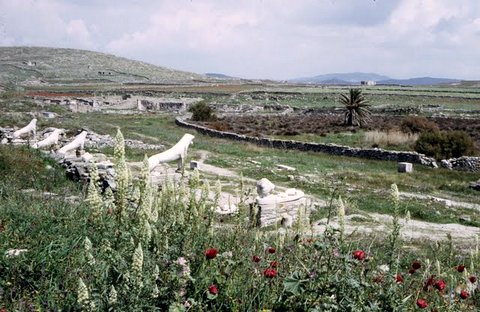
Having gone back 1700 years or so, to reminisce on the influence of past events upon the present, I thought I'd conclude this post with a redux presentation of photographs of what Eastertime looked like on Mykonos and its companion island of Delos some dozen years ago.  The photographs are from the files of the master collector of all things visual Mykonian, Dimitris Koutsoukas.  Enjoy.
 
 
Mykonos:


Delos:


And a Happy Easter, Kalo Paska, and Zissen Pesach to all. 


—Jeff