Showing posts with label Gregorian calendar. Show all posts

Saturday, March 30, 2024

Why's It So Hard to Keep Track of Easter?


Jeff––Saturday

No disrespect intended.  It’s a serious question. 

I  think most of us are aware that Easter is celebrated by Western Christianity and by Orthodox Christianity more often than not on different days. Last year they were celebrated a week apart, this year they're separated by the entire month of April.  Having no fixed date, that's why Easter is called a moveable feast, unlike Christmas…at least for most.

So, why is there such uncertainty over determining the date of this seminal holiday so significant to so much of the world? There are two answers–one easy, one not. The simple answer is that Greeks and others of the Orthodox faith calculate their Easter based upon the Julian calendar, while Western Christianity uses the modern Gregorian Calendar. If you want to know precisely how the date is determined, the explanation begins to sound strangely reminiscent of one attempting to explain how algorithms work.
 

First Council of Nicaea (325)

Officially, I understand the First Ecumenical Synod ruled in 325 that Easter Sunday should fall on the Sunday that follows the first full moon after the vernal equinox (the point at which the ecliptic intersects the celestial equator, the sun having a northerly motion) and the invariable date of the vernal equinox is March 21.  If the full moon happens to fall on a Sunday, Easter is observed the following Sunday.

Before the year 325 the determination of the date for Easter (or Pascha) seemed relatively easy.  Just ask the Jews in your community when they celebrated Passover according to the lunar-based Hebrew Calendar (now into its 5784th year), because the Jewish Holiday of Passover (or Pesach) was the occasion for the Last Supper.  The only dispute appeared to be over whether Easter should be celebrated on the Hebrew calendar’s date of Nisan 14 or the following Sunday.

Original mural by Leonardo Da Vinci between 1495-1498

The First Ecumenical Synod changed all that by calculating the exact date of Easter from the more modern cycles of the sun-based Julian calendar.  And even though some in the Church did not agree with that determination, it became Christianity’s generally accepted method for calculating the date of Easter and continued to be so for more than five hundred years after the Great Schism of 1052 separated the Church of the West to Rome and the Church of the East to Constantinople (Istanbul).

Pope Gregory XIII (1502-1585)
But in 1582 Pope Gregory XIII introduced what is known as the Gregorian calendar for the express purpose of correctly calculating Easter, something the Julian calendar was not believed to have achieved.  Today, the Gregorian calendar is the world’s officially accepted civil calendar (except in Greece’s 1500 year-old monastic community of Mount Athos—see Prey on Patmos), but there still is not agreement among the Christian world over whether it correctly fixes the date of Easter.

Indeed, as recently as 1997 the World Council of Churches proposed a method of using modern scientific knowledge for precisely calculating Easter and replacing divergent practices.  It was not adopted.

All of which means that (based upon our everyday calendar), Easter for Western Christianity always falls on a Sunday between March 22 and April 25, and for most of Eastern Orthodoxy on a Sunday between April 4 and May 8—at least during the 21st Century.

As for how Passover fits into all this, Julian calendar Easter always falls on a Sunday after the first day of the eight-day Passover holiday (and generally within those eight days), but Gregorian calendar observers who might think of tempting their Jewish friends with offers of treasured chocolate bunnies forbidden to their friends during that observant period should keep in mind that on the Gregorian calendar Passover will at times fall after Easter.  My buddies in the old neighborhood learned that lesson the hard way.

But no matter what calendar you follow, with all my heart I wish you a Happy Easter for tomorrow, a Zissen Pesach for April 22nd, and Kalo Paska for May 5th--plus as a bonus to my baby brother born on Cinco de Mayo, HAPPY BIRTHDAY BIG AL. 


––Jeff

Saturday, April 8, 2023

An Historical Perspective on Passover, Easter, and Paska


y


Jeff––Saturday
 
Last Wednesday night was the first Passover Seder.  Tomorrow is Easter in Western Christianity,  and next Sunday is Orthodox (Greek) Easter. I thought it might be helpful to review how these most serious of holidays, linked together as they are through history, manage to jump around as much as they do from year to year.
 

Passover or Pesach always takes place around the same time as Easter or Paska because the holiday of Passover, commemorating God’s liberation of the Jewish People from slavery in Egypt, was the occasion for the Last Supper.  In fact, before the year 325 Easter was calculated upon the lunar-based Hebrew calendar and all one had to do to determine the date for Easter was to “ask a Jew in your community” when Passover was celebrated.


All that changed in 325 when the First Ecumenical Synod calculated the exact date of Easter from the more modern cycles of the sun-based Julian calendar.  That became Christianity’s generally accepted method for calculating the date of Easter and continued to be so for more than five hundred years after the Great Schism of 1052 separated the Church of the West to Rome and the Church of the East to Constantinople (Istanbul).

Then, in 1582, Pope Gregory XIII introduced what is known as the Gregorian calendar for the express purpose of correctly calculating Easter, something the Julian calendar was not believed to have achieved.  Today, the Gregorian calendar is the world’s officially accepted civil calendar (except in Greece’s 1500 year-old monastic community of Mount Athos—see Prey on Patmos), but there still is not agreement among the Christian world over whether it correctly fixes the date of Easter. 

Indeed, as recently as 1997 the World Council of Churches proposed a method of using modern scientific knowledge for precisely calculating Easter and replacing divergent practices.  It was not adopted.

As for how Passover fits into all this, Julian calendar Easter always falls on a Sunday after the first day of the eight-day Passover holiday and generally within those eight days (but not in 2023), though at times more than a month later.  Western Easter, relying on the Gregorian calendar, also generally falls within Passover’s eight days, though three times in every nineteen-year period it falls a month before Passover.


Yes, that’s why Easter is considered a moveable feast, as opposed to Christmas that always occurs on the same date.


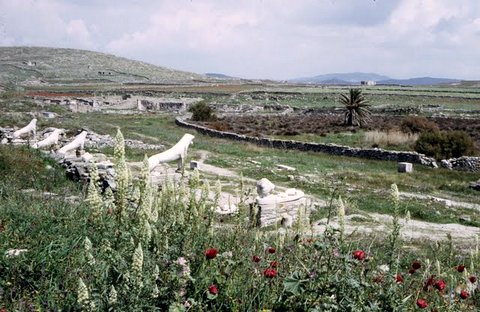
Having gone back 1700 years or so, to reminisce on the influence of past events upon the present, I thought I'd conclude this post with a redux presentation of photographs of what Eastertime looked like on Mykonos and its companion island of Delos some dozen years ago.  The photographs are from the files of the master collector of all things visual Mykonian, Dimitris Koutsoukas.  Enjoy.
 
 
Mykonos:


Delos:


And a Happy Easter, Kalo Paska, and Zissen Pesach to all. 


—Jeff

Saturday, February 16, 2013

Easter Comes But Once a Year...Uhh, Uhh.


For some reason I’ve been asked several times over the past couple weeks why this year Greek Easter falls so much later than “western” Easter.  Catholics, Protestants, and Anglicans will celebrate Easter on March 31st, Greeks and other Eastern Orthodox observers on May 5th.  My simple answer was that Greeks and others of the Eastern Orthodox faith calculated their Easter based upon the Julian calendar while Western Christianity used the (relatively) modern Gregorian calendar. 

Blank stares followed, accompanied by, “But why is this year so different from other years?” 

I couldn’t help but wonder why were they asking that question of the father of a rabbi. 

First Ecumenical Synod
Perhaps they knew that before the First Ecumenical Synod (First Council of Nicaea) in 325 the generally accepted method for determining the date for Easter (or Pascha) was to ask a Jew in the community when he celebrated Passover.  That’s because, according to the lunar-based Hebrew Calendar (now into its 5773rd year), the Jewish Holiday of Passover (or Pesach) was the occasion for the Last Supper, and the only dispute appeared to be over whether Easter should be celebrated on the Hebrew calendar’s date of Nisan 14 or the following Sunday.

The First Ecumenical Synod changed all that by calculating the exact date of Easter based upon the then modern Julian calendar and ruling that Easter Sunday should fall on the Sunday that followed the first full moon after the vernal equinox, with the invariable date of the vernal equinox being March 21.  If the full moon happened to fall on a Sunday, Easter was observed the following Sunday.

Even though some in the Church did not agree with that determination, it became Christianity’s generally accepted method for calculating the date of Easter and continued to be so for more than five hundred years after the Great Schism of 1052 separated the Church of the West to Rome and the Church of the East to Constantinople (Istanbul).

But in 1582 Pope Gregory XIII introduced what is known as the Gregorian calendar for the express purpose of correctly calculating Easter, something the Julian calendar was not believed to have achieved.  Today, the Gregorian calendar is the world’s officially accepted civil calendar. 

Calendar men Julius Caesar and Pope Gregory XIII
And though the date of Easter remained the same as set in 325—the Sunday following the first full moon after March 21—it was now based upon the Gregorian calendar’s March 21, one different from March 21 on the Julian calendar.  Add to that an “it’s-all-Greek-to-me” series of ecclesiastical moon, paschal full moon, astronomical equinox and fixed equinox calculations and you have a precise explanation for why there are often differing dates for Easter.

Did you get that?

The simple answer to the question I was asked about Easter 2013 is that, this year, the first full moon after March 21 on the Gregorian calendar falls before the Julian calendar’s March 21, and therefore the Greeks must wait until after the next full moon to celebrate their Easter.

And for those still reading, a bonus bit of information.  Based upon our everyday, Gregorian calendar, Easter for Western Christianity always falls on a Sunday between March 22 and April 25, and for most of Eastern Orthodoxy on a Sunday between April 4 and May 8—at least during the 21st Century.  And Easter always falls after Passover. 

This year Passover is observed between March 25 and April 2.  But don’t ask me why.  Ask my son.

Jeff—Saturday

Saturday, April 23, 2011

Are You Sure Easter Is Tomorrow?

No disrespect intended.  It’s a serious question.  I was so anxious for the Easter Bunny to arrive this year that I wrote an Easter piece a few weeks back and realized in the course of writing it just how divergent were the views on the process of the calculation.  This year Christians in the West and the East celebrate it together on the same date, but that is not always the case.  And each year’s date is different from the last, which is why it’s called a moveable feast, unlike Christmas…at least for most.

So, why is there such uncertainty over determining the date of this seminal holiday so significant to so much of the world?

First Council of Nicaea (325)

I understand that officially the First Ecumenical Synod ruled in 325 that Easter Sunday should fall on the Sunday that follows the first full moon after the vernal equinox (the point at which the ecliptic intersects the celestial equator, the sun having a northerly motion) and the invariable date of the vernal equinox is March 21.  If the full moon happens to fall on a Sunday, Easter is observed the following Sunday.

Before the year 325 the determination of the date for Easter (or Pascha) seemed relatively easy.  Just ask the Jews in your community when they celebrated Passover according to the lunar-based Hebrew Calendar (now into its 5771st year), because the Jewish Holiday of Passover (or Pesach) was the occasion for the Last Supper.  The only dispute appeared to be over whether Easter should be celebrated on the Hebrew calendar’s date of Nisan 14 or the following Sunday.

Original mural by Leonardo Da Vinci between 1495-1498

The First Ecumenical Synod changed all that by calculating the exact date of Easter from the more modern, cycles of the sun-based Julian calendar.  And even though some in the Church did not agree with that determination, it became Christianity’s generally accepted method for calculating the date of Easter and continued to be so for more than five hundred years after the Great Schism of 1052 separated the Church of the West to Rome and the Church of the East to Constantinople (Istanbul).

Pope Gregory XIII (1502-1585)
But in 1582 Pope Gregory XIII introduced what is known as the Gregorian calendar for the express purpose of correctly calculating Easter, something the Julian calendar was not believed to have achieved.  Today, the Gregorian calendar is the world’s officially accepted civil calendar (except in Greece’s 1500 year-old monastic community of Mount Athos—see Prey on Patmos), but there still is not agreement among the Christian world over whether it correctly fixes the date of Easter.

Indeed, as recently as 1997 the World Council of Churches proposed a method of using modern scientific knowledge for precisely calculating Easter and replacing divergent practices.  It was not adopted.

All of which means that (based upon our everyday calendar), Easter for Western Christianity always falls on a Sunday between March 22 and April 25, and for most of Eastern Orthodoxy on a Sunday between April 4 and May 8—at least during the 21st Century.

A White House Passover Seder
As for how Passover fits into all this, Julian calendar Easter always falls on a Sunday after the first day of the eight-day Passover holiday (and generally within those eight days), but Gregorian calendar observers who might think of tempting their Jewish friends with offers of treasured chocolate bunnies forbidden to their friends during that observant period should keep in mind that on the Gregorian calendar Passover will fall around a month after Easter three times in every nineteen year period.  My buddies in the old neighborhood learned that lesson the hard way.

But no matter what calendar you follow, with all my heart I wish you Happy Easter, Kalo Paska, and Zissen Pesach.  And a special message of love to my grandson, who turns four today.

Jeff—Saturday