Showing posts with label Delos. Show all posts

Saturday, April 27, 2024

Apollo and Artemis, the Sun and Moon God Twins.


Jeff—Saturday

Perhaps my favorite place on all of Mykonos for watching sunset is by a waning crescent moon beach that was once the island’s most famous beach, Megali Ammos–before new roads made dozens of other beaches readily accessible and development played its inevitable role. 

Yet, for me, there’s still no more beautiful a spot for sunset than there.  The sea shimmers in combinations of gun-metal blue, silver, and gold against a backdrop of vermilion skies and shadowy forms of distant islands.  But for a lone white church with a blood red roof on the tiny island of Baou at the entrance to the bay, nothing in view suggests that the hand of man played a part in any of this––unless of course you look sharply to the left or right.  But no one comes here to do that.  This is a place for remembering simpler times and watching a glowing orange ball fade below the horizon.


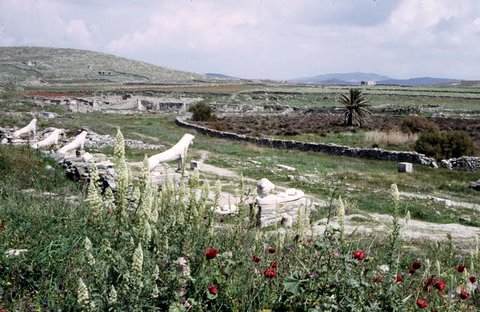
On a clear day (as most are) you can see Tinos to the right, Syros dead ahead, and a bit of Rhenia (or big Delos, as the locals call it) off to the left.  Delos is out there too, around a bend to the left and less than a mile away.  I wrote about Delos in my very first Murder is Everywhere post.


It’s hard not to think of Delos as you watch the sunset.  After all, Delos is where Apollo, god of the sun, and his twin-sister, Artemis, the original divine personification of the moon were born to their mother, Leto, out of her assignation with Zeus.  Delos wasn’t Leto’s first choice for a delivery room, because back then it was little more than a rock bouncing around the Aegean Sea.  But she had little choice because Zeus’ wife (and sister—more about that here), Hera, had the world fearing her jealous wrath, and only tiny Delos saw nothing to lose in making a “You take care of me, I’ll take care of you bargain” with Zeus.

Birth of Artemis and Apollo to Leto

From the moment of Apollo’s birth, when golden light flooded down upon Delos, the island prospered, so much so that it rose to emerge as one of antiquity’s bastions of commerce and religiosity.


But Apollo didn’t stick around his birthplace very long.  Jealous Hera drove Leto away from her children forcing Apollo to grow up quickly—in a matter of hours to be precise (on a diet of nectar and ambrosia)—and begin a pilgrimage that launched his myth, one of the oldest of all Greek myths and one of the few of entirely Greek creation (as opposed to foreign influences).


Although Apollo’s exploits gave rise to his being known by many different names and titles—Karneios, Hyakinthios, Pythios, Thargelios, Nomios, Delphinios, Ismenios, Hebdomeios, Lykios, Musagetes, etcetera—they all in one way or another derived from his link to the eternal operation of the sun and all that the ancients attributed to it.


In much the same way Apollo’s sister, Artemis, found that the qualities attributed to the moon—bringing fertility to the earth through cool, dew filled nights and casting light into the dark night offering protection to flocks and hunters—had her identified with those traits (fertility, hunting) and called by names and titles linked to those perceived powers of the moon: Agrotora, Kalliste, Diktynna, Britomartis, Eleuthro, Orthia, Limnaia, Potamia, Munychia, Brauronia, Amarynthia, etcetera.

Adonis and Artemis

As a duet, Apollo and Artemis might be best known for a bloody, Bonnie and Clyde-style episode brought on by an affront to their mother (and them) by the daughter of a king who boasted that her own children were “more beautiful” than Leto’s.  Talk about perturbing the wrong folk.  Artemis and Apollo promptly punished the prideful mother (Niobe) by slaying all of her children, Artemis by arrows the daughters, and Adonis by arrows the sons.  In her anguish the mother turned to stone.

On the off chance I’ve written something that a buddy of those Delosian twins might find offensive, please don’t come looking for me.  You’ll want to talk to Alexander S. Murray who wrote Who’s Who in Mythology.  It’s his book that’s responsible for driving this post…so help me gods.

–Jeff


Jeff's Upcoming Events

CrimeFest, Bristol UK

Panel THURSDAY, MAY 9, 2024 @ 17:00
"Overstepping the Mark: Abuses of Privilege and Power" with Ajay Chowdhury, Alex North, Kate Ellis, Jeffrey Siger, Sam Holland (Moderator)

Panel FRIDAY, MAY 10, 2024 @17:10
"What a Thrill: Page-Turners and Cliff Hangers" with Chris Curran, Antony Dunford, Charles Harris, Christine Poulson, Jeffrey Siger (Moderator)


Saturday, February 24, 2024

Murder à la grecque redux


February 5th was the 14th anniversary of my first post on Murder is Everywhere. It was a guest post opportunity extended by the late, great inimitable Leighton Gage. That post led to another guest post, and ultimately to an invitation to be a permanent member of the MIE writing family.  Agreeing to write that first post turned out to be one of the best decisions of my mystery writing life, for it's led me to more friendships, opportunities, and rich experiences than I'd ever imagined.

That same guest opportunity is now available on Sundays to other authors. I can assure you that you'll be well served on taking up that invitation.  For one never knows where it can lead as we hit the six million views mark.

 Here's what Leighton had to say in his blush-inducing generous introduction of my first post:


Saturday is the day that we reserve for guest authors. Today it's the turn of the estimable Jeffrey Siger. 

Jeff was born and raised in Pittsburgh. He practiced law at a major Wall Street law firm before establishing his own New York City law firm and continuing as one of its name partners until giving it all up to write full-time among the people, life, and politics of his beloved Mykonos, his adopted home of twenty-five years.  When he’s not in Greece, his other home is a farm outside New York City.  Murder in Mykonos (Poisoned Pen Press 2009), the first in his Chief Inspector Andreas Kaldis series, was the #1 best selling English-language novel in Greece, and the Greek version of his just published second novel in the series, Assassins of Athens (Poisoned Pen Press, 2010), instantly became one of Greece’s top ten best sellers.
 
Here's Jeff in his own words and pictures:

 
I live within the cradle of European civilization, less than a mile from the birthplace of the god of light, amidst a circle of islands that once hosted the crossroads of trade for the ancient world.  But it’s eons since the birth of Apollo, two and a half millennia beyond its glory days of commerce, and 2000 years since the island heart of this Cycladic chain was obliterated from the face of the earth and its 20,000 residents slaughtered or sold into slavery in retribution for backing the wrong protector. 

Over the ensuing centuries a succession of plunderers, foreign and domestic, made off with its treasures and the small, razed island came to serve as little more than a source of building materials and hunting grounds for surrounding islanders.  In 1872 things began to change. The French School of Archeology started excavations and today it represents the most varied collection of ruins in all of Greece, conveying to visitors a sense of eternal spirituality that no doubt was what made it second only to Delphi in sacred importance to the ancients.

But that’s Delos.  I don’t live there.  No one does.  No one is allowed to, or for that matter to be born or die there.  The Athenians decided in 425 BC to purify Apollo’s birthplace, and removed all graves to the nearby island of Rhenia.  I don’t live there either, only a handful do, but the spear fishing off its shores is about as good as it gets in that part of the world.
 
My home is on another neighbor island, and though larger than Delos (one and a half times the size of Manhattan) it barely received much notice in Delos’ heyday.  Yes, it was known for agriculture and highly desirable clay deposits used to create that era’s equivalents of tuna fish cans, pickle jars, and cereal boxes, but it definitely was not the main show.  Not even an opening act. 
It was an island of granite, forced to endure centuries of foreign occupiers, one after another from the Middle Ages through the middle of the 20th Century.  Those years generated a lot of history, filled with daring pirates, dashing heroes (male and female), bittersweet realities, and many tales, but there’s no time to tell those stories now. 

Besides, times have changed, the focus of visitors today is on the present and I doubt a time traveler from just fifty—certainly seventy—years ago would recognize my island home today.  It is a new sort of international cross roads, one of dazzling beaches, mega-yachts, private jets, and 24/7 lifestyles.  It is Europe’s most popular tourist island, the sexy Aegean island of Mykonos.

Assuming you’ve never experienced my island’s incredible light, the unmatched beauty of its sea, and omnipresent energy that would do the gods of Delos proud, the thought of my choosing to live in such a “tourist paradise”­ might lead you to question my sanity or at least my taste.  Believe me, there are a lifetime of reasons for asking that question, but my decision to make Mykonos my home is not one of them; and for a very simple reason: Mykonos is not Disneyland, it is a real place filled with remarkable people. 
 
Mykonians are a warm and hospitable breed, raising families in keeping with deeply held traditions, and yet they are among the most accepting people on earth.  I’m continually amazed at how tourists intrude with cameras upon the most personal of public events, such as a funeral, and not one local objects.  I once thought that was because Mykonians considered tourist season some sort of annual tsunami that rushed in upon their island for three months leaving them no choice but acceptance until it receded in September.  But I’ve come to think differently.  Mykonians overlook behavior from visitors that they would never tolerate from one of their own because they know no offense or ill will is intended.  They accept that behavior for what it is: foreign.
 
There is an additional reason I live there.  I write mystery thrillers that just happen to explore serious societal issues confronting modern Greece while touching upon the country’s ancient roots.  During tourist season, many visitors from the mainland and beyond willingly share their private thoughts and confidences in relaxed beachside chats or pre-dawn whispered conversations in a club or bar.  The world comes to party on Mykonos, and I sit with pen and (inconspicuous) pad in hand gathering in all the material they’re willing to share.  Yes, I’ve learned to surf the tsunami.  Fish it, too.  Hard work, but alas, we must suffer for our art.

You can, and we here at Murder is Everywhere hope you will, visit Jeff at his website:
He's a great guy, and a fine writer! 
––Leighton
 
––Jeff 
 
Jeff's Upcoming In Person Events
 

Thursday, February 29, 7:00 p.m. PT
Vroman’s Bookstore
Author Speaking and Signing
Pasadena, CA

Saturday, March 9, 3:00 p.m. CT
Murder By The Book
Author Speaking and Signing
Houston, TX


Saturday, April 8, 2023

An Historical Perspective on Passover, Easter, and Paska


y


Jeff––Saturday
 
Last Wednesday night was the first Passover Seder.  Tomorrow is Easter in Western Christianity,  and next Sunday is Orthodox (Greek) Easter. I thought it might be helpful to review how these most serious of holidays, linked together as they are through history, manage to jump around as much as they do from year to year.
 

Passover or Pesach always takes place around the same time as Easter or Paska because the holiday of Passover, commemorating God’s liberation of the Jewish People from slavery in Egypt, was the occasion for the Last Supper.  In fact, before the year 325 Easter was calculated upon the lunar-based Hebrew calendar and all one had to do to determine the date for Easter was to “ask a Jew in your community” when Passover was celebrated.


All that changed in 325 when the First Ecumenical Synod calculated the exact date of Easter from the more modern cycles of the sun-based Julian calendar.  That became Christianity’s generally accepted method for calculating the date of Easter and continued to be so for more than five hundred years after the Great Schism of 1052 separated the Church of the West to Rome and the Church of the East to Constantinople (Istanbul).

Then, in 1582, Pope Gregory XIII introduced what is known as the Gregorian calendar for the express purpose of correctly calculating Easter, something the Julian calendar was not believed to have achieved.  Today, the Gregorian calendar is the world’s officially accepted civil calendar (except in Greece’s 1500 year-old monastic community of Mount Athos—see Prey on Patmos), but there still is not agreement among the Christian world over whether it correctly fixes the date of Easter. 

Indeed, as recently as 1997 the World Council of Churches proposed a method of using modern scientific knowledge for precisely calculating Easter and replacing divergent practices.  It was not adopted.

As for how Passover fits into all this, Julian calendar Easter always falls on a Sunday after the first day of the eight-day Passover holiday and generally within those eight days (but not in 2023), though at times more than a month later.  Western Easter, relying on the Gregorian calendar, also generally falls within Passover’s eight days, though three times in every nineteen-year period it falls a month before Passover.


Yes, that’s why Easter is considered a moveable feast, as opposed to Christmas that always occurs on the same date.


Having gone back 1700 years or so, to reminisce on the influence of past events upon the present, I thought I'd conclude this post with a redux presentation of photographs of what Eastertime looked like on Mykonos and its companion island of Delos some dozen years ago.  The photographs are from the files of the master collector of all things visual Mykonian, Dimitris Koutsoukas.  Enjoy.
 
 
Mykonos:


Delos:


And a Happy Easter, Kalo Paska, and Zissen Pesach to all. 


—Jeff

Saturday, June 4, 2022

A Magical Welcome Home to the Beauty of Greece


Jeff–Saturday


On Tuesday, I left New York for my return home to the Greek island of Mykonos. But this post isn’t about Mykonos. It’s about a much smaller island less than a mile from Mykonos that served as the birthplace of the god of light and remains at the core of a circle of islands that once hosted the crossroads of trade for the ancient world. 


But it’s eons since the birth of Apollo, two and a half millennia beyond its glory days of commerce, and 2000 years since the island heart of this Cycladic chain was obliterated from the face of the earth and its 20,000 residents slaughtered or sold into slavery in retribution for backing the wrong protector.  


Over the ensuing centuries a succession of plunderers, foreign and domestic, made off with its treasures and the small, razed island came to serve as little more than a source of building materials and hunting grounds for surrounding islanders.  In 1872 things began to change. The French School of Archeology started excavations and today it represents the most varied collection of ruins in all of Greece, conveying to visitors a sense of eternal spirituality that no doubt was what made it second only to Delphi in sacred importance to the ancients.


That island is Delos.  I don’t live there.  No one is allowed to live there (except to protect it), or for that matter to be born or die there.  The Athenians decided in 425 BC to purify Apollo’s birthplace and removed all graves to the nearby island of Rhenia, which as of today remains virtually uninhabited and inexorably linked to Delos in the hearts of Mykonians.


To me, Delos represents the essence of the region’s incredible light, the unmatched beauty of its sea, and an omnipresent energy that does its ancient gods proud.


I am far from alone in this deep fascination with the inescapable spirituality of Delos.  For decades efforts to preserve and utilize its magical presence have brought the arts to its shores. On May 30th, the day before I left for Greece, Delos served as the stunning open-air backdrop for a very special performance of Vivaldi’s Four Seasons by the European Union Youth Orchestra, violinist Diana Tischenko, and Greek lyre virtuoso Sokratis Sinopoulos.


But rather than describe it, allow me to offer you this live streamed YouTube beauty of a concert sponsored by ARTE, a European Public Service channel dedicated to culture.


Trust me, it’s worth it. Enjoy.


     https://www.youtube.com/watch?v=VMBR9kenFrI


–Jeff

Saturday, May 4, 2019

My Very First Murder is Everywhere Post


Jeff--Saturday, [originally posted February 5, 2010]

It has been a grueling seven weeks on the road, and I'm coming into the final weekend of book events before heading back to NYC for a day to pack and run off to Bristol, UK for CrimeFest and then to Mykonos.  All of which is my way of apologizing for reposting an old blog. But that said, this is a special blog, for it's the very first one I ever put up on Murder is Everywhere (sans the gracious introduction by our founder, Leighton Gage).  It was very interesting to me to see how I described Mykonos back then...and how time has influenced my opinions...not to mention what it's done to the person represented in the photo below.  Anyway, from nine years ago, hereeeee's Jeffrey....

I live within the cradle of European civilization, less than a mile from the birthplace of the god of light, amidst a circle of islands that once hosted the crossroads of trade for the ancient world.  But it’s eons since the birth of Apollo, two and a half millennia beyond its glory days of commerce, and 2000 years since the island heart of this Cycladic chain was obliterated from the face of the earth and its 20,000 residents slaughtered or sold into slavery in retribution for backing the wrong protector. 

Over the ensuing centuries a succession of plunderers, foreign and domestic, made off with its treasures and the small, razed island came to serve as little more than a source of building materials and hunting grounds for surrounding islanders.  In 1872 things began to change. The French School of Archeology started excavations and today it represents the most varied collection of ruins in all of Greece, conveying to visitors a sense of eternal spirituality that no doubt was what made it second only to Delphi in sacred importance to the ancients.

But that’s Delos.  I don’t live there.  No one does.  No one is allowed to, or for that matter to be born or die there.  The Athenians decided in 425 BC to purify Apollo’s birthplace, and removed all graves to the nearby island of Rhenia.  I don’t live there either, only a handful do, but the spear fishing off its shores is about as good as it gets in that part of the world.

My home is on another neighbor island, and though larger than Delos (one and a half times the size of Manhattan) it barely received much notice in Delos’ heyday.  Yes, it was known for agriculture and highly desirable clay deposits used to create that era’s equivalents of tuna fish cans, pickle jars, and cereal boxes, but it definitely was not the main show.  Not even an opening act. 
It was an island of granite, forced to endure centuries of foreign occupiers, one after another from the Middle Ages through the middle of the 20th Century.  Those years generated a lot of history, filled with daring pirates, dashing heroes (male and female), bittersweet realities, and many tales, but there’s no time to tell those stories now. 

Besides, times have changed, the focus of visitors today is on the present and I doubt a time traveler from just fifty—certainly seventy—years ago would recognize my island home today.  It is a new sort of international cross roads, one of dazzling beaches, mega-yachts, private jets, and 24/7 lifestyles.  It is Europe’s most popular tourist island, the sexy Aegean island of Mykonos.

Assuming you’ve never experienced my island’s incredible light, the unmatched beauty of its sea, and omnipresent energy that would do the gods of Delos proud, the thought of my choosing to live in such a “tourist paradise”­ might lead you to question my sanity or at least my taste.  Believe me, there are a lifetime of reasons for asking that question, but my decision to make Mykonos my home is not one of them; and for a very simple reason: Mykonos is not Disneyland, it is a real place filled with remarkable people.

Mykonians are a warm and hospitable breed, raising families in keeping with deeply held traditions, and yet they are among the most accepting people on earth.  I’m continually amazed at how tourists intrude with cameras upon the most personal of public events, such as a funeral, and not one local objects.  I once thought that was because Mykonians considered tourist season some sort of annual tsunami that rushed in upon their island for three months leaving them no choice but acceptance until it receded in September.  But I’ve come to think differently.  Mykonians overlook behavior from visitors that they would never tolerate from one of their own because they know no offense or ill will is intended.  They accept that behavior for what it is: foreign.

There is an additional reason I live there.  I write mystery thrillers that just happen to explore serious societal issues confronting modern Greece while touching upon the country’s ancient roots.  During tourist season, many visitors from the mainland and beyond willingly share their private thoughts and confidences in relaxed beachside chats or pre-dawn whispered conversations in a club or bar.  The world comes to party on Mykonos, and I sit with pen and (inconspicuous) pad in hand gathering in all the material they’re willing to share.  Yes, I’ve learned to surf the tsunami.  Fish it, too.  Hard work, but alas, we must suffer for our art.

--Jeff

Jeff's Events:


Thursday May 9, 5:00 PM
BRISTOL, UK
CRIMEFEST—Mercure Bristol Grand Hotel
Panelist on “Nobody Would Believe it if You Wrote it: Fake News, Post-Truth and Changing Words,” with Fiona Erskine, William Shaw, Gilly Macmillan, moderated by Paul E. Hardisty

Friday, May 10, 5:10 PM
BRISTOL, UK
CRIMEFEST—Mercure Bristol Grand Hotel
Panelist on “Sunshine Noir,” with Paul Hardisty,  Barbara Nadel, Robert Wilson, moderated by Michael Stanley

October 31-November 3
DALLAS, TX
BOUCHERCON 2019---Hyatt Regency Dallas
Panel Schedule Yet to be Announced