Showing posts with label Dimitris Koutsoukas. Show all posts

Saturday, April 8, 2023

An Historical Perspective on Passover, Easter, and Paska


y


Jeff––Saturday
 
Last Wednesday night was the first Passover Seder.  Tomorrow is Easter in Western Christianity,  and next Sunday is Orthodox (Greek) Easter. I thought it might be helpful to review how these most serious of holidays, linked together as they are through history, manage to jump around as much as they do from year to year.
 

Passover or Pesach always takes place around the same time as Easter or Paska because the holiday of Passover, commemorating God’s liberation of the Jewish People from slavery in Egypt, was the occasion for the Last Supper.  In fact, before the year 325 Easter was calculated upon the lunar-based Hebrew calendar and all one had to do to determine the date for Easter was to “ask a Jew in your community” when Passover was celebrated.


All that changed in 325 when the First Ecumenical Synod calculated the exact date of Easter from the more modern cycles of the sun-based Julian calendar.  That became Christianity’s generally accepted method for calculating the date of Easter and continued to be so for more than five hundred years after the Great Schism of 1052 separated the Church of the West to Rome and the Church of the East to Constantinople (Istanbul).

Then, in 1582, Pope Gregory XIII introduced what is known as the Gregorian calendar for the express purpose of correctly calculating Easter, something the Julian calendar was not believed to have achieved.  Today, the Gregorian calendar is the world’s officially accepted civil calendar (except in Greece’s 1500 year-old monastic community of Mount Athos—see Prey on Patmos), but there still is not agreement among the Christian world over whether it correctly fixes the date of Easter. 

Indeed, as recently as 1997 the World Council of Churches proposed a method of using modern scientific knowledge for precisely calculating Easter and replacing divergent practices.  It was not adopted.

As for how Passover fits into all this, Julian calendar Easter always falls on a Sunday after the first day of the eight-day Passover holiday and generally within those eight days (but not in 2023), though at times more than a month later.  Western Easter, relying on the Gregorian calendar, also generally falls within Passover’s eight days, though three times in every nineteen-year period it falls a month before Passover.


Yes, that’s why Easter is considered a moveable feast, as opposed to Christmas that always occurs on the same date.


Having gone back 1700 years or so, to reminisce on the influence of past events upon the present, I thought I'd conclude this post with a redux presentation of photographs of what Eastertime looked like on Mykonos and its companion island of Delos some dozen years ago.  The photographs are from the files of the master collector of all things visual Mykonian, Dimitris Koutsoukas.  Enjoy.
 
 
Mykonos:


Delos:


And a Happy Easter, Kalo Paska, and Zissen Pesach to all. 


—Jeff

Friday, March 19, 2021

Springtime on Mykonos ain't New Jersey


Saturday––Jeff


Spring officially arrives this weekend at the farm. It’s still wintry here, which means snow at times, but more often we’ll see chill rains working away at washing all but patches of hard-packed icy snow from the pastures. Daffodils are tentatively poking their shoots out from soft sunny spots in otherwise hard ground, and though temperatures bounce between the 30s and 50s (0-10C), hardy March winds knock the feel of the cold down ten degrees from thermometer readings.  Still spring definitely is on its way to pastoral northwestern New Jersey.


I like springtime here, but I’ll particularly miss seeing it this year in Mykonos. Now is when nature goes into full bloom on the island, giving it a blanket of green covered in red, yellow and purple wildflowers.  Most will be gone by the advent of tourist season.  It is a picture of the island few tourists ever get to see.


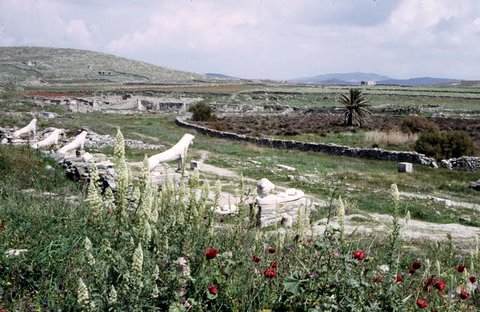
In that mindset, I thought I’d share some of my memories of springtime on Mykonos through this pictorial view of past such times there and on its neighboring island of Delos.  Of course, some things have changed—notably the original Naxian Lions of Delos have moved inside the Museum, replaced by copies to endure the elements.  The photographs are from the files of the master collector of all things visual Mykonian, Dimitris Koutsoukas.  Enjoy.


––Jeff


A DEADLY TWIST, Chief Inspector Andreas Kaldis #11 coming April 6th

“Engrossing…gorgeous”—Library Journal, starred review

“Vivid…travel buffs will be enchanted.”—Publishers Weekly

“Ingenious plot twists…delicious description”—Booklist

 “Like visiting old friends”—Kirkus Reviews

“Great characters, an intriguing story line and a wonderful setting”—Deadly Pleasures Mystery Magazine, A-rating.


Saturday, May 20, 2017

Mykonos of Old


Jeff--Saturday

Tomorrow, I return to Greece where I shall remain until returning in October for Bouchercon in Toronto.

I've been away from Mykonos for far too long, and can't wait to get back. I understand much has changed over the winter on the island.  It's said to have doubled down on solidifying its reputation as the Mediterranean playground for the rich and would like to be famous. But I've already written that book ("Mykonos After Midnight"), so addressing what the island has become will not be the subject of my new work. I'll spend the five months on something else.

And speaking of something else, six years ago I started off a blog on the eve of my departure to Mykonos with this sentence..."Mykonos wasn’t always like this."

That opening line is even more pertinent today, so I thought I'd reminisce a bit by rerunning that post on the eve of this departure. I can use the reminder of times past, in preparation for the present.  So here goes...

Mykonos wasn't always like this.  There were hard times, make that very hard times.  The island once was among Greece’s most impoverished places.  Mykonians literally starved to death during World War II.  Then came the Greek Civil War.

Monday I’ll be back on Mykonos and promise to share with you as much as good taste will allow of present day life on that international jet set summer destination.  But how did it came to pass that a community still guided by centuries-old church traditions and deeply held family values so effortlessly coexists amid the unstructured, freewheeling lifestyle of visiting summer hedonists?


I think the simplest way of telling the story of that transition is out of the archives of Dimitris Koutsoukos.  As I described an earlier piece, Dimitri is a native Mykonian who has amassed a fascinating collection of photographs capturing the essence of the island, many of which are posted to music on YouTube videos available through this link.  http://www.youtube.com/results?search_query=dimitris+koutsoukos&aq=0
Dimitris Koutsoukos amid the old and the new.

Dimitri, the photographs please…

These were the days that set the island’s modern day roots, when all Mykonians had was each other.  It was the turn of the 20th Century.


Naturally, many lived off the sea and learned their skills from childhood.


Others survived as farmers.


Some depended on both.


Then came regular boat service linking the island to the mainland.


And with that tourists looking to experience traditional island life.


But one day a very famous visitor stepped ashore and forever changed the image of Mykonos.

International celebrity Petros the Pelican arrives with friend.

And glitz began to flock there.


Turning fishermen into guides.

Bringing energy to quiet beaches.


And, of course, making nice with the locals.

In the process each learned much from other.

Tourists how to dance...


...locals how to dress.

And they became friends.

It is a life to which I long to return.
Mykonians tolerating tourists
And for a musical understanding of the draw of Greece, check out this YouTube Video.

Jeff—Saturday