Sunday, August 6, 2017

The Mystical Wolves of Mount Mitake

-- Susan, every other Sunday

Mountains have always been fertile grounds for gods and legends. Sasquatch and Coyote roam the American West, while basilisks and ghost dogs haunt the peaks of Europe.

In Japan, the mountain slopes are home to a wide variety of kami, ghosts, and legendary creatures, some of whom live on long after their natural counterparts have gone extinct.

Inari Wolf on Mount Mitake

Although the short-legged Japanese wolf was declared extinct in the first years of the 20th century (the last confirmed sightings occurred in 1905), the legend of Mount Mitake's wolves remains alive and well.

Mount Mitake rises 929 meters (3,048 feet) above sea level in Chichibu Tama Kai National Park, about an hour's train ride northwest of central Tokyo. Upon arrival, visitors either hike the 2.5-hour trail to the top or, more commonly ride the Mitake Tozan Cable Car and hike the last 45 minutes to Musashi-Mitake Jinja (Shrine) which sits on the mountain's summit.

The entrance to Musashi-Mitake Jinja ... still a 20 minute stair-climb from the summit.

Like many Shintō shrines, Musashi-Mitake Jinja has both a primary hondo, or worship hall, and numerous sub-shrines, including one dedicated to Inari, the god of rice, sake, and fertility.

One of the only Inari shrines in Japan that doesn't have foxes as guardian statues.

Guardian statues near the shrines serve as spiritual protectors, but unlike most other Shintō shrines, whose guardians are lion-dogs, kirin, or--in the case of Inari shrines--foxes, the guardians at Musashi-Mitake shrine are wolves.

Inari wolf on Mount Mitake


Wherein lies a tale.

Guardian wolf, Musashi-Mitake Shrine

According to legend, Prince Yamato Takeru--the son of Japan's 12th emperor--got lost in the forests of Mount Mitake after a demon transformed itself into a stag and led the prince astray. Lost and cold, the prince wandered on the mountain until a giant white wolf appeared and led him to safety. Thereafter, the prince proclaimed the wolf a deity, and it became the official guardian and protector of the mountain.

Protecting Mount Mitake for over 1000 years.

In Japanese folklore, wolves are often portrayed as messengers of the kami (deities or gods); in other legends, wolves are considered divine in their own right.

Numerous places in Japan have local legends involving okuriōkami  or "escort wolves" that rescue people lost on mountains or follow travelers through the forest at night to ensure they reach home safely. Whether these legends predate or follow Yamato Takeru's encounter on Mount Mitake, they demonstrate that wolves in Japan are not the Big Bad Beasties of Western lore.

The ferocious scowls on the statues that cover Mount Mitake may strike terror into the hearts of evildoers, but little girls on the path to grandma's house have nothing to fear.

He's only fierce if you are.

Regrettably, there are no more live wolves in Japan, but if you believe the legends, the spirit wolves are still watching and waiting, ready to come to your aid in a time of need.

Saturday, August 5, 2017

An Italian Tale of the Piano Bar


Jeff—Saturday


Every year at this time my friends, Jody Duncan and Nikos Hristodulakis get wound up enough to read aloud a tale they first publically shared here on MIE five years ago today.  It’s one of their unique stories about life behind the bar at the La Cage aux Folles-style cabaret they own together on the Aegean Greek island of Mykonos.  For thirty-five years they’ve run Montparnasse Piano Bar, and this is tale that serves as testament to their business acumen. Staying afloat in the bar business is tough, especially when you go out of your way to treat everyone as family.  Here’s a Jody Duncan Business School example of how to deal with party-minded customers who do not return the respect for your business that you show to them. 

It was 1985, as I recall.  August, of course, and Mykonos was rapidly filling with Italians on their summer holidays.


At the Piano Bar life was normal, with one exception: We were seeing groups of Italian tourists arriving at the bar to spend the evening listening to the show, but only a small percentage of each group ordered anything at all.  The others would simply say, “niente”— nothing.  What we learned was that groups of friends would go out for the evening prepared to pay for only one drink per person per night. 

To achieve that they’d take turns ordering drinks, so that the group could go to three or four bars and still have only one drink per person over the course of the evening.  So, in the ordering process, I was hearing from a group of eight,  “Coca-cola, niente, niente, oranjiatta (orange juice), niente, niente, niente, vino bianco.”  A thirty-six percent rate of sales, not even enough to cover expenses, sadly.

What made things even more difficult was that no one in these groups seemed to understand the business end of our operation, or perhaps they just didn't care.

After a couple of days of this ritual, and faced with another night of  “Niente, niente, coca-cola, niente, hot water with lemon, vino bianco, niente, niente, niente,” I was at the end of my rope and my patience had run out.


I went behind the bar, found some white paper the size of a business card, and began to write:

NIENTE
Our special cocktail for the month of August

A champagne cocktail, featuring vodka, cherry brandy, creme de cassis, and grapefruit juice, generously topped with champagne

700 drachmas

I pinned the cards to the inside of the drink menus and waited for the next group to arrive. I didn't have to wait long.  A group of six arrived. I greeted them, handed each guest a menu, and left them to peruse the cocktail list.  Upon returning a couple of minutes later I asked if they were ready to order.  Yes, they said, and began their “Oranjiatta, niente, niente, coca-cola, niente, niente” routine.

I thanked them, took the menus and went to prepare the drinks.  When I returned to their table with a tray of drinks, an amazed, bewildered look came over their faces.  I handed the first member of the group his cocktail and he said, “I didn't order anything.”

“You certainly did,” I said.  “You ordered a ‘Niente,’ which is our special cocktail for August, and that's exactly what I’ve brought you.  And I have three more for your other friends who also ordered ‘Niente.’  Enjoy your drinks!”


Needless to say, our sales improved, and we still get a laugh out of the memory.


And what other cocktail could properly accompany this tale but the infamous “Niente,” currently listed on the Montparnasse drink menu as a Pink Russian:

In a champagne flute, add ½ ounce vodka, ½ ounce cherry brandy, ½ ounce creme de cassis, 1 ounce grapefruit juice, top with chilled champagne (or prosecco), and serve. Salut!!!

Thanks, Jody, but I’m frightened now to ask you for water.


—Jeff

Friday, August 4, 2017

Update - that magnificent man in his flying machine.

On Friday, August 2, 2013 I posted the following blog about a chap called Howard Squires and his Spitfire.


The blog followed the story of my patient 'Bob' and his old Latin teacher, the aforementioned Mr Squires. Well 'Bob' came in for treatment today for his neck pain, after he had driven 400 miles to see the Spitfire ( see story of Spitfire rescue below), 'Bob' is still in his disability  motorscooter, so he drove around the Aeronautical Section of the Imperial War Museum with a copy of this blog in his hand and asked a few of the attendants where the Spitfire was now. And not any old Spitfire, THAT much loved and adored Spitfire.

Nobody seemed to know much about anything until he waved the blog about, and somebody asked somebody who went off to find somebody ... and an engineer appeared and said...'Please wheel yourself this way.'

And there it was, Howard Squire's Spitfire, with a new coat of paint and a different number painted on its... fuselage (?... side bit anyway..), which Bob, being a very observant fellow, pointed out immediately.

The mechanic grinned, and stroked the Spitfire lovingly as these types do, then opened the tiny door to the cockpit, and there, scribbled on a small scrap of paper was Howard's signature and squadron number.

So why the paint job? Why the new number?  The plane has a starring role in the film Dunkirk. Right at the end there is a scene of a Spitfire flying low over the beach at Dunkirk - and that's this plane! Pushed into a river in the 1940's, recovered in the drought of 76, rebuilt by a load of fanatics who adored these rare flying machines, reunited  around 2010 with Mr Squires and now a film star.
More comebacks than Sinatra!

The Spitfire is owned by an American millionaire who pays an engineer full time to look after it and keep it flying. It is on permanent  loan to the Imperial War Museum on one condition - that it keeps flying.

What a story!

If you see the film,  give it a wave- nobody will notice.

By the way, the Spitfire is  parked next to the Flying Fortress that starred in the film Memphis Belle. 'Is that a B52?' I asked 'Bob, looking at the photograph.  'It's a B17,' he corrected me, and gave me a look that said I should go back and stick to crime writing. 

However, the blog, the pics, Bob's story and  a still from the film are all going into a journal for the archive at the war museum.  A might fine job I say.

Chocks away, chappies!

Rodger and out.

Caro Ramsay 04 08 2017


One Magnificent Man and his flying machine..

I have reshuffled my blogs as I thought ( and don't ask me why ! ) that this one was more appropriate at this time - a story of good men doing good things rather than Victorian poisonings. I get the feeling that  if I had told Leighton this story, standing at the bar, with a nice glass of red wine, he would have appreciated it and had a wee chortle.

The story is a simple one. I am basically blogging about something that I know nothing about  so forgive any errors but the 'as told to me story' is 100 % true. So here goes....

Imagine if you will a busy  clinic. I am running around, steth in hand, patient's notes are lost, the receptionist is sitting on the photocopier trying to persuade it to work, the shop that does the good latte is closed for a Monday holiday and the waiting room is very busy.

I call my patient through. He is an older gent (70 +), very well spoken 'a Pimms and LeCarre' type of gentleman. He wears a white straw hat to do his garden in the hot weather, he also wears flannels. He is English of course and might still wear a cravat if he lived down south but dare not up here as that is a hanging offence.  He did do the sensible thing and married a Scots lassie. For the purposes of this, I shall call him 'Bob.'
                                                      
                                               Spitfire X4650! On the road to recovery.


While I was waggling his limbs around to find the most painful bit and hurt it even more, I was telling him I saw a Spitfire plane on the back of a lorry on the motorway. It was at the point of the English Scottish border, going north. He is a aeroplane buff, so he  knew all about this.  Oh yes!!  He then went on to say that he had been at the very air show where the Spitfire had been.  He was very pleased as his son had rented him a disability buggy so he could spend all day mooching around the hangers and not having to worry about his bad leg or falling over - either due to his leg or too many Pimms.

Then Bob said it was just as well as he would have fallen over with surprise if he had not been sitting down.... and he then told me  a great story....
                                                       

                                                 The Wee plane doing its stuff!             

As a youngster he had rheumatic fever. He was off school for so long his form master used to come in to the house and help him with his homework, his Latin vocab etc. School boy Bob grew very close to the form master, a man called  Mr Squire. He told me, with a huge smile on his face that he had never forgotten Mr Squire and his extremely blue eyes, the fact that he was a quiet spoken man, a ex Spitfire pilot. The young boys were intrigued by this of course but much to their disappointment, Mr Squire said he had never been shot down, he had never been brave, no great stories of daring do and aerobatic heroics. He did regale them with the story of when he flew into the back of the squadron leader's plane while on a training exercise. He ducked in his cockpit as the tail of the plane in front skimmed the top of his, taking off the top of his Spitfire like a can opener on a sardine tin. He had to bale out, so did the squadron leader. Both pilots  parachuted to safety. What the squadron leader said to young Squire  is not recorded but we can imagine...
                                                   
                                                                Mr Squire

So back to the present day and Bob has just driven his little buggy in to the spitfire hanger at the air show.... to be confronted by a large photograph of his old form master Mr Squire in his late twenties. And his spitfire!  Bob then told me the story that after the  infamous incident, the spitfire seemingly landed  itself on a riverbank. The villagers came out and pushed it into the  river, where it stayed  until the drought of  1976 when it reappeared, was dragged out rebuilt and  now flies again. Mr Squire and his spitfire where reunited in 2010, Mr Squire passed away in 2012 and Bob was a bit upset that  if he had made that air show  two years earlier, they might have crossed paths once again.

I thought it was a great story but  time can allow stories to grow tall and I just wondered.... so I got home and did a bit of googling.


                                                         Cade's famous portrait of Al Deere 

Up popped a telegraph headline from 2012  ' Forgotten Spitfire will fly again after major restoration' "A project to create the most authentic flying Mark I Spitfire will be completed later this year when aircraft X4650 takes to the skies 70 years after the Battle of Britain"" The painstaking reconstruction  of aircraft X4650 .... also shines a spotlight on the extraordinary story of young pilot Howard Squire who was flying the plane on a training mission led by RAF legend 'Al' Deere when the pair collided over North Yorkshire."

"Sgt Squire, now 89, has visited the restoration project and hopes to see the finished aircraft fly over the south coast of England later this year."

"Those involved in the project believe X4650 will be the most accurately-rebuilt Mark I Spitfire in the skies and will contain the highest number of original parts.
                                                        

                                                 Deere where he loved to be, in the cockpit.

The wreckage was only discovered in the long, hot summer of 1976 when low river levels exposed the metal embedded in a clay riverbank on farmland near Kirklevington, Cleveland."

Also while googling around I found  some very  interesting facts, stuff you really could not make up! The very famous and decorated  pilot Al Deere was the squadron leader!!!!
Reading on - the plane had been in the river  since 28 Dec 1940.  A 'Sgt Squire' had collided with Deere, Flight Commander of 54 Squadron at RAF Catterick. Deere was giving the sergeant a lesson in how to keep close to enemy aircraft.   Squire got a bit too close and there was a collision at 12000 feet. Squire is reported as stating that Derre was 'very good about it'!
So now we know!


And it seems that Sgt Squire himself was a bit of a hero, he was eventually shot  down over France on February 26, 1941, and became a prisoner of war.

And the bit about the plane landing itself? Also true..... Squire had set the aircraft for a slow, steady  decent  so it would suffer less damage than in a high impact landing. He loved his spitfire and wanted no harm to come to it. He lived to know that  it cost hundreds of thousands of pounds to repair , but now flying, it is worth over two million.
                                                  

                                                  Rebuilt, flying again.
                                    

Both Squire and Deere were exceptionally brave men. Squire went back to life as a teacher, looking after his charges, teaching them their Latin vocabulary when they were too ill to attend school.  In his valour, there was absolute discretion.
                                                       

                                               Mr Squire and X 4650 reunited. 

I really liked that story, Bob  had a wee tear in his eye when I told him the back ground of it all and printed out the photo that shows Mr Squire still had his twinkling blue eyes.
You really couldn't make that up could you?
                                         
                                                       Picture from the Daily Mail
Caro GB 02 08 2013

Thursday, August 3, 2017

The Internet of Things

Michael - Thursday

The IT world seems to buzz with the invention of new names and acronyms. (Like IT = Information Technology.) One of the recent terms to gain currency is the internet of things (IoT). And unlike some of the others, this one is a big deal. So what’s in a name? Well, this one is quite apposite. We're used to the idea of the internet being about humans using computers to communicate—sometimes with other websites and databases and sometimes with other humans. IoT is about computer systems incarnated in devices, machines, or whatever communicating with each other.

The idea has been around for a while. In 1982 a modified Coke machine at Carnegie Mellon University became the first Internet-connected appliance, able to report its inventory and whether newly loaded drinks were cold. In 2013, the Global Standards Initiative on Internet of Things defined the IoT as "a global infrastructure for the information society, enabling advanced services by interconnecting (physical and virtual) things based on existing and evolving interoperable information and communication technologies," and for these purposes a "thing" is "an object of the physical world (physical things) or the information world (virtual things), which is capable of being identified and integrated into communication networks". No wonder no one took much notice. No one could understand it for a start.


So let’s take the vending machine example. It senses the amount and age of its stock and the physical status of the machine itself—temperature, state of moving parts, amount of cash on board and change available, health and safety issue. This information is transmitted over the internet to a computer somewhere—usually in the cloud, but that’s another story—that does various things. It schedules maintenance for the machine, it may move up the next delivery, even disable the machine if there's a serious problem. It will also integrate the data over all its machines and see if orders should be increased or decreased across its network. It will inform its supplier's computer (probably just some other part of the cloud) which would deal with the factory supply, ordering more (or less) materials and maybe scheduling an extra shift at the bakery.


This is not humans communicating with humans using computers. What the humans discover is an instruction to move up the maintenance of the vending machine (chosen not to add too much time cost to their current route, of course), and to stay on for an extra shift at the bakery. For now. In the not too distant future the cloud will tell an automated electric van with a suitable repair robot to head straight to the vending machine, while just briefly stepping up production at the automatic bakery…

There’s a huge wealth of advantages and efficiencies that will be generated by IoT. It's not how far will it go, but rather if it will stop. Elon Musk (apparently a bit bored with conquering space, revolutionizing the automobile industry, and changing the nature of energy supply) has a new project. Nothing less than deciphering the waves generated by the human brain, amplifying them and transmitting them, so that we can communicate that way. So the person you're 'talking' to will know what you really want and really mean. And of course, thanks to the IoT, the person you’re 'telepathically' communicating with can be anywhere at all in the world, or may even not be human at all.

Another part of the cloud will be monitoring your pace maker, your blood pressure, your diet… 

Here’s a piece a friend sent to me that sort of sparked this blog:

“Hello! Gordon's Pizza?”
“No sir, it's Google's Pizza.”
“Must be a wrong number.”
“No sir, Google bought the pizza shop.”
“OK. Here’s my order...”
“No problem sir, I suppose you want the usual?”
“The usual? How would you know? You’re under new management.”
“According to our caller ID, on the last 12 occasions you ordered pizza with cheese, sausage and thick crust.”
“Right…”
“…May I suggest this time you have ricotta, aragula and dried tomato?”
“No, I hate vegetables.”
“But what about your high cholesterol?”
“My high cholesterol? How would you know?”
“Through the Subscribers’ Guide. We have the results of your blood tests for the last 7 years.”
“I don’t care, I already take medicine. Give me my usual.”
“But you haven’t been taking your medicine. You last purchased a box of 30 and that was 4 months ago at Drugsale Network.”
“I bought more from another drugstore.”
“It's not showing on your credit card.”
“I paid in cash.”
“But you didn’t withdraw enough cash according to your bank statement.”
“I have another source of cash.”
“It’s not showing on your last Tax Return, unless you got it from an undeclared income source…”
“Get lost! No more Google, Facebook, Twitter, WhatsApp! I'm going to a deserted island with no internet, no cell phones and no one to spy on me!”
“I understand sir. But you will need to renew your passport, your old one expired 5 weeks ago.”

Not to be taken too seriously. For now. IoT is happening with all its advantages, but there are downsides. WIRED in an editorial summed it up: "What you're about to lose is your privacy. Actually, it's worse than that. You aren't just going to lose your privacy, you're going to have to watch the very concept of privacy be rewritten under your nose.”  And The American Civil Liberties Union wrote that "There's simply no way to forecast how these immense powers – disproportionately accumulating in the hands of corporations seeking financial advantage and governments craving ever more control – will be used. Chances are big data and the Internet of Things will make it harder for us to control our own lives, as we grow increasingly transparent to powerful corporations and government institutions that are becoming more opaque to us."

And now hacker attacks can become physical attacks as well as attacks on your data. No matter how much security you build into a computer system, someone can break in. Hackers have already demonstrated that they can hijack parts of the IoT. So far most of these attacks have been tests. Cameras have been switched on and off without the owners realizing, driverless cars ‘hijacked,’ and pacemakers switched on and off. (A new murder weapon for mystery writers!) I would guess that the Russians are spending a LOT of money on this issue and they have enormous talent for this sort of stuff. So does the USA. With all the good that can come of the IoT, we also may be witnessing the development of a new weapon on mass destruction.
____________________________________________

Murder Is Everywhere
Author Recognitions and Events

CARA BLACK

Murder in Saint Germain, Aimée Leduc’s next investigation, launched June 6.

SUSAN SPANN

My next Hiro Hattori mystery, Betrayal at Iga, launched on July 11 from Seventh Street Books. 

MICHAEL STANLEY
         
The next Detective Kubu mystery, Dying to Live, launched this week in the UK from Orenda books.

Wednesday, August 2, 2017

Indian Chutney for an American Summer

Sujata Massey


In the height of summer, a heap of imperfectly gorgeous tomatoes rest on my kitchen island. They beseech me to touch them and make something great. The obvious thing would be to make a lush sauce—but it’s 90 degrees outside, and I’m not in the mood for cozy Italian pasta.

No. These tomatoes are calling out their wish to become a chutney.

“Chatni” is a classic accompaniment to a South Asian meal containing rice, meat and vegetable dishes, and breads. In a typical chatni, fruits and vegetables such as tomato or mango are slow-cooked with spices and ginger, various forms of chilies and the solid brown sugar called jaggery. Jaggery comes from palm sap or sugar cane and is sold in Asian grocery stores. Sometimes garlic and onion are part of the mix. Before the British, mustard and other oils were used to help keep the chutneys from spoiling. The ingredient of vinegar in chutneys comes from Britain, but is now part of some Indian chutney recipes.


Yogurt-based sauces also are known as chutneys; most famously the coriander-mint chutney served at almost every Indian restaurant, and the creamy, sweet and spicy coconut chutney essential to South Indian dosa.


When the British tasted chatni, they loved it. They anglicized the spelling to ‘chutney’ and found ways, after they went back to Britain, to make new chutneys with fruits like apples, plums and rhubarb and the preservative vinegar. A few months ago, I had a great experience making rhubarb chutney. They also created “Major Grey’s Mango Chutney,” a style of sweet and sticky chutney containing raisins, vinegar and a bit of tamarind that is an ingredient in many an American chicken salad. In my family, it is the standard slather over a cheddar cheese sandwich--or grilled cheese.


Sweet mango chutney is the starter chutney for children who are cautious about foreign tastes. Growing up, I had a big spoonful of sweet mango chutney with almost every home cooked Indian meal. I can’t imagine eating biryani without some mango chutney mixed in. These days, Indian food companies such as Patak’s make these Anglo-style mango chutneys with chilies included, if you like.


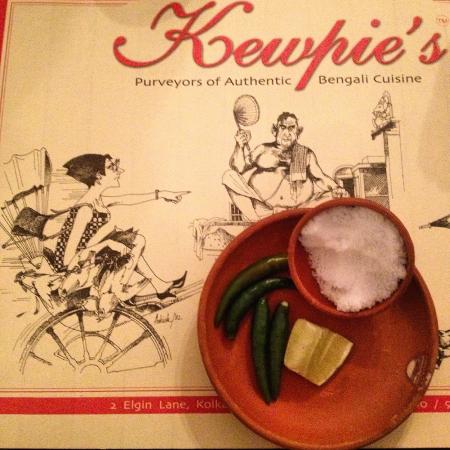
Back to the homemade tomato chutney. My recipe is inspired by a traditional one found in The Calcutta-Cookbook, A Treasury of Recipes from Pavement to Palace by Minakshie “Kewpie” Das Gupta, Bunny Gupta and Jaya Chaliha. Kewpie was a legendary Bengali home cook and cookbook writer. After Kewpie's passing, her family opened a jewelbox of a café in her honor within their historic home at 2 Elgin Road. Kewpie's is a must for lunch, if you are visiting South Kolkata. And the cookbook details how to make "Colonel's Sweet and Hot Mango Chutney," which is surely more delicious than the commercial version. 


Kewpie's placemats have charming vintage-inspired drawings of Calcutta life


During my frequent lunches at Kewpie’s in the late 1990s, I enjoyed food served on banana leaves and old-fashioned terra cotta plates. There would always be several extraordinary fresh chutneys served. Not to mention spicy pickles--but vegetable pickle is a story for another column!


My tomato chutney, which does not include raisins or too much chili firepower, is great on sandwiches, burgers, alongside grilled meat and fish. You can mix in 1/3 cup of it with eggplant that’s been roasted and mashed. You wind up with something very much like the famous dish Baigan Bharta, but with 75% less work.


Chutney's jammy consistency, when it's ready


The farmer’s market sells larger bunches of herbs than can be eaten in a week—so again, the answer is chutney. I make my cilantro-mint chutney with Greek yogurt for extra protein. It’s a natural with crispy treats like samosas, pakoras or with grilled fish. This green chutney is a great marinade for chicken pieces to be baked or grilled.

Here are my tomato, cilantro-mint and rhubarb chutney recipes. Please note that these chutneys are designed to be refrigerated in glass jars or bowls with lids. They are not shelf-stable.

I'm winding up my culinary adventures to return to my real work: writing a novel. It strikes me, though, that concocting a chutney is a bit like writing a mystery. There are so many interchangeable small parts: fruits and vegetables, spices, and preserving vinegars or oils. When I write, I pull together many pieces: characters, plots and sub-plots, settings, conflicts, motivations. I contemplate when I've got too much of one thing or am missing an important element. My book's components are adjusted as it grows toward a finished state.


But while it takes a year for me to write a book, a chutney rarely simmers more than thirty minutes.  This makes it a small but gratifying accomplishment.


Tuesday, August 1, 2017

So sorry to hear of AnnaMaria's loss.
 We lost another great person today, Jeanne Moreau, the French actress. Of the many who praised her I like this quote, 'Her charisma, intelligence, sexuality and star quality created a new space in postwar cinema'.  She played in the New Wave but she wasn't defined by it or any genre of performance. She was her own person.


In her own words:
When you live under the power of terror and segregation, you can't ever start a work of art.
Age does not protect you from love. But love, to some extent, protects you from age.
As long as you don't make waves, ripples, life seems easy. But that's condemning yourself to impotence and death before you are dead.

Miss you Jeanne