As an adult, I learned to cook for my kids – workmanlike, weekday meals such as chicken parmesan, stir-fry, and risotto – with recipes, and with guidance from my husband, who grew up in a family that Cooked with a capital C. (That capital C should be in a font twice that size, italicized, and in bold. Just saying.) Thanksgiving was a three-day cooking extravaganza complete with hand-torn loaves of stale bread for stuffing and an enormous turkey, mashed potatoes and gravy, succotash, homemade cranberry relish (two kinds), and five kinds of pie. His mother filled an entire wall with pots and pans, each particular to a use, on a cork-board along the staircase down to the basement, in addition to the cookware in the kitchen cupboards. My husband still does all the holiday cooking – it’s he who makes French onion soup from scratch and the Beef Wellington in phyllo dough for Thanksgiving every year. (Guests welcome!)
Thursday, October 30, 2025
Happiness is under 30 minutes: Scones
As an adult, I learned to cook for my kids – workmanlike, weekday meals such as chicken parmesan, stir-fry, and risotto – with recipes, and with guidance from my husband, who grew up in a family that Cooked with a capital C. (That capital C should be in a font twice that size, italicized, and in bold. Just saying.) Thanksgiving was a three-day cooking extravaganza complete with hand-torn loaves of stale bread for stuffing and an enormous turkey, mashed potatoes and gravy, succotash, homemade cranberry relish (two kinds), and five kinds of pie. His mother filled an entire wall with pots and pans, each particular to a use, on a cork-board along the staircase down to the basement, in addition to the cookware in the kitchen cupboards. My husband still does all the holiday cooking – it’s he who makes French onion soup from scratch and the Beef Wellington in phyllo dough for Thanksgiving every year. (Guests welcome!)
Tuesday, June 20, 2023
Popiah Lessons
Ovidia--every other Tuesday
We had popiah for lunch at Coronation Plaza; the first time in a long time for both Coronation Plaza and popiah.
Coronation Plaza used to be a regular haunt when I was growing up. Like Katong Shopping Centre or Beauty World, Coronation Shopping Plaza was built during the “boom” that Singapore enjoyed in the 1970s and 1980s as we emerged as a "newly industrialised society".
They seemed so new and exciting back then, but feel like ageing suburban malls now. Like I'm an ageing suburban "aunty" to the store keepers who in the old days eyed askance our school uniforms (it was a stop off point between school and swimming practice).
Anyway, the popiah stall we went to has been in the same corner of the Coronation Shopping Plaza since 1988. Mr Leong, who runs it, is a nephew of the famous (in Singapore at least) late Peranakan author Leong Yee Soo.
And the popiah was great, but what struck me is that my late mother had a copy of that cookbook and I suspect the popiah she used to make for special occasions came out of there. She didn't like to cook. But she produced popiah that more than satisfied most special occasions.
The best thing about popiah is, once you've got the ingredients prepared, the serving is a DIY business.
First you take your popiah skin,
'Poh piah' means thin flatbread, and the perfect popiah skin is very thin, elastic, and chewy.
It's made by rubbing lumps of viscous, wet wheat flour dough in rounds against a very hot steel plate. The thin layer of dough that sticks and starts to cook is peeled off while still white and untoasted.
Fortunately most popiah skins are bought and kept moist under a damp cloth till needed!
Then come the sauces and seasonings:
After that, everything on the table can be piled on as you like. There's always crushed roasted peanuts, lettuce and bean sprouts, and fried tau kua (bean curd) and omelette cut into strips, and often chinese sausage, roasted Pork belly minced into small little cubes as well as shrimp and crab meat.
So if you are vegan (as long as you've pre-warned the cook not to use meat stock in the braise) you can eat alongside everyone else.
The main hot filling is stewed bangkuang or Chinese turnip and carrots. This is usually the only hot part of the meal. Since popiah was traditionally eaten after visiting the ancestral graves during the QingMing Festival, all the side dishes were prepared early and left cold, with only the bangkuang kept on the kitchen coals.
That's what goes on last:
When my mother and aunts made popiah, they would reminisce how, during the war years, they would have popiah with only vegetables. Thanks to the jungle 'garden' there were always beansprouts, kangkong and green papaya, which made them among the lucky ones.
They talked about how, back in the war years, they would pretend they were rolling up pork and eggs and shrimp into their popiah skins--all the rich foods they stuffed us with years later, to try to make up for the hunger their childhood selves had gone through.
To roll up your popiah, you tuck in the short ends first, to keep the filling in place. Then fold over the top flap and roll it over the centre, keep on rolling till you have a smooth tube.
Then either cut it into rings to be eaten with chopsticks or eat them whole like we did, with your fingers.
But as a result of their stories, when we well fed, pampered children ate our popiahs, we liked to fold them with just bean sprouts and Chinese turnip and pretend we were trying to survive the war.
Maybe it's the pretending that we're all looking for. Or the novelty of other lives and possibilities. Because who can tell what delectable mysteries (or over spiced disasters) you've wrapped inside the discreet skin of your popiah? Or in the skin of a day or just of the next hour?
Since no one knows but you, you can roll up whatever you like in there. And I’m only now coming to realize that what I choose to wrap in the thin elastic skins of these precious moments doesn’t have to be limited by what's put on the table in front of me.
Wednesday, December 15, 2021
Get Your Roasted Nuts Here!
Throughout December, almonds, walnuts, pistachios, and pecans are always in my shopping cart. I first wrote about this peculiar passion three years ago, yet I couldn’t resist returning to the topic this year. And the nuts made me contemplate whether traditions can shift a bit and still feel comforting.
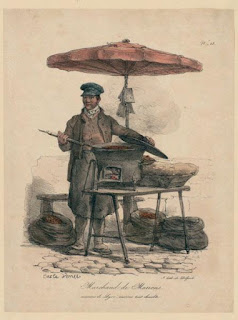
This year, not as many Christmas markets are running in Germany as before Covid. For many centuries, Germany and other German-speaking countries have held Christmas markets in town squares that are filled with wooden stalls and sparkling lights, mulled wine and celebrating people.Weihnachtsmarkts sell holiday greens, ornaments, gingerbread, and a variety of roasted nuts--straight-up smoky smelling roasted chestnuts, as well as sugared, cinnamon almonds--either way, the nuts come wrapped in twists of newspaper. I remember going mad for the almonds and lead Christmas tree ornaments at the Recklinghausen Weihnachtsmarkt during a late 1980s holiday visit to Germany with my mother and sisters.
The other nutty tradition that gets me reminiscing isn’t tied to any holidays. Roasted nuts--especially peanuts--are part of the everyday street food scene in India. Walking through Mumbai, I’ve often passed vendors shaking peanuts in a giant steel bowl set over an open fire. What aromas! And just like the practical Germans so far away, these vendors shake the nuts into newspaper cones and hand them over.
Despite my overseas romances with various forms of roasted nuts, I only began roasting nuts at home in the early 1990s.I was inspired by a set of recipes for home-made spiced nuts by Julie Sahni. Such nut seemed less perishable and safer to mail to my relatives than cookies—though I’m not going to lie, I make a lot of cookies in December, too. But nuts are the best: not only can you eat them out of hand, but you can add them to salads, cakes, ice cream, oatmeal, and pancakes. Add some chopped dried fruit and you have a trail mix extraordinaire. My family has come to expect these nuts to arrive every year. And it seems symbolic that our bicultural identity comes together in these nuts, which marry the sweet of Germany with the spicy heat of India.
As time marches on, many of us are reducing our sugar intake. Last year, I adjusted the venerable spicy nuts recipe with coconut sugar instead of ordinary white sugar. The coconut sugar didn't make as nice a syrup with water as refined white sugar did. It was eerie, but the healthified nuts still tasted very sweet. My own threshold for enjoying sweetness had lowered.
This year, I decided to make extra batches of nuts using a few different sweeteners and to bake them in a regular oven. Because I couldn’t locate a recipe for such that called on Indian spices, I realized this was a chance to make my own recipe. I counseled myself to be prepared for imperfect results, knowing that food professionals often test upwards of a dozen times before a winner is found.
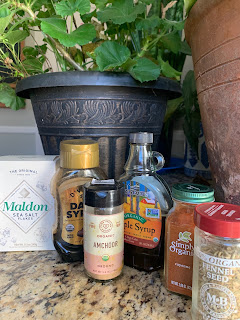
| The seasonings |
Driving the mission was a change in sweetening from dry sugar mixed with water to an already usable syrup. The sweetener I was most hopeful about was date syrup, originally known as dibis in Iraq and other parts of the Middle East. Typical uses for dibis are drizzled over hummus, mixed into drinks, and within desserts. I would never have known about it if I hadn’t kept coming across it in healthy baking recipes this past year.
One tablespoon of date syrup has a glycemic index of 47. Putting it in context with other options, maple syrup and coconut sugar have a glycemic index of 54, honey has 58, and sugar 60. (Agave syrup is very low—just 19 on the glycemic index—but I think it tastes weird). According to nutritionists, dates are loaded with amino acids, vitamins and minerals, and antioxidants. because of the protein within nuts, my holiday guilty pleasure could turn into a life-saving holiday hero.
Step into my kitchen. Here's what happened.
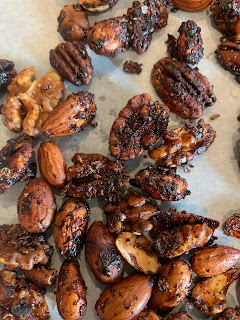
| 20 minutes was too long for half these nuts! |
The first batch I made was three cups of nuts tossed with my usual spices and one-third cup of date syrup. I quickly found that date syrup tended to caramelize faster than expected—resulted in blackened nuts that weren’t very pretty and tasted slightly burned. I also noted (belatedly) that whole almonds are double the size of the walnut and pecan halves, so a shorter cooking time for walnuts and pecans would further protect the nuts.
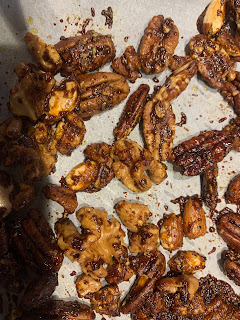
For Attempt Number Two, I cut the oven time from twenty minutes to twelve minutes. I also did the extra step of splitting up the nuts on two baking sheets, with the fat almonds on one sheet, and the skinny walnuts and pecans on the other. That way, it was easier to take the faster baking nuts out when they were crying for mercy, and let the almonds linger a few more minutes.
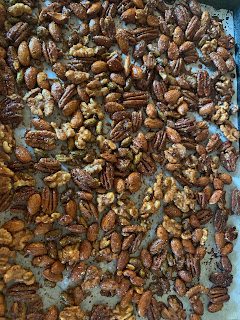
| Walnuts and pecans and pistachios done right |
So far, so good.
I found myself curious about the road still not taken—another syrup that was a candidate for sweetening.What would the nuts taste like roasted with maple syrup? Would this lighter, higher glycemic index syrup be even better?
For Attempt Number Three, I took the one-third measuring cup I’d used for previous recipes. I filled half of it with date syrup from my waning bottle and then poured maple syrup to the top. After roasting, the nuts were soft and didn’t taste like much. Impatiently, I waited for them to cool to crispness before tasting.
| Maple-Date nut mix |
Hmmm. The odd thing was that although the maple-date laced nuts were lighter in color and dried to a nice crispness, the taste wasn’t as deep and hauntingly flavorful. There was an umami in the date syrup and a nicely chewy caramelization that was no longer there. And being able to taste between the various batches made me decide that date syrup alone was the best. The ultimate nuts that I'm sharing with you. Recipe is also in print below.
Voila!
Spicy Christmas Nuts
Makes 3 and 1/3 cups
Ingredients:
1 cup unroasted, unsalted unblanched whole almonds (often sold as ‘natural’ in the grocery store)
1 cup unroasted, unsalted walnut halves
1 cup unroasted, unsalted pecan halves
1/3 cup unroasted, unsalted pistachios
¾ teaspoon roughly ground or pounded fennel seeds
1 tablespoon ground cumin
1 teaspoon amchoor spice, available at Asian grocery stores ( you can substitute 2 teaspoons lemon juice at end of recipe, if you can’t get amchoor)
½ to 2 teaspoons ground cayenne pepper (I use 1 teaspoon)
1-2 teaspoons fine salt, divided (I use Maldon Sea Salt that I pound fine. but pound it fine)
1/3 cup date syrup
2 tablespoons olive oil.
Preheat oven to 350 degrees.
1. Line two rimmed baking sheets with ungreased parchment paper.
2. Put all the almonds in one bowl.
3. Put the walnuts halves, pecan halves and pistachios in a second bowl.
4. Stir all the spices (including 1 teaspoon of the salt) together in a cup and set aside. Be prepared to divide this mix later between two bowls of nuts.
5. Mix the date syrup and olive oil in another cup. Be prepared to split it between two bowls of nuts.
6. Cover the nuts in each bowl firstly with the syrup-oil mixture, and secondly with the spices. Don’t be afraid to use your clean hands!
7. Put the sticky spiced almonds on one baking sheet, and the rest of the nuts on the other sheet. Wash your hands!
8. Set a timer for 5 minutes and put both baking sheets in the oven. When your timer rings, use a spatula to stir around the nuts on each baking sheet and rotate the sheets back to front, and higher rack to bottom rack. This promotes even cooking.
9. Set timer once again for 5 more minutes. When the timer rings, take out the walnuts, pecans and pistachios and set them on their parchment lined pan on a kitchen counter or table. If you are using lemon juice INSTEAD of amchoor, now is the time to toss the nuts with the lemon juice, remembering that you’ll divide the two tablespoons of lemon juice between both sheets of nuts. Taste to see if you want to add any more of the reserved salt.
10. Allow the almonds to roast two to three more minutes longer than the walnuts-pecans-pistachios--or until many of the nuts show some signs of caramelization. Then you should remove the baking sheet to cool on the counter.
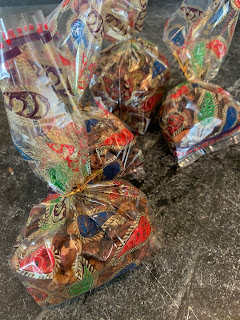
11. The nuts will probably be cool enough to handle and taste in fifteen minutes. Let them cool to room temperature before packing in tins or git bags. They’ll stay fresh in their wrappings for up to a month, and they can be frozen as well. Eat out of hand and also use as a topping for cereal, oatmeal, cake, ice cream, pancakes, and any other place you think they will spark joy.
Which special traditions do you enjoy that you would never change? And what have you tweaked for the better?
Wednesday, August 2, 2017
Indian Chutney for an American Summer
Yogurt-based sauces also are known as chutneys; most famously the coriander-mint chutney served at almost every Indian restaurant, and the creamy, sweet and spicy coconut chutney essential to South Indian dosa.
Sweet mango chutney is the starter chutney for children who are cautious about foreign tastes. Growing up, I had a big spoonful of sweet mango chutney with almost every home cooked Indian meal. I can’t imagine eating biryani without some mango chutney mixed in. These days, Indian food companies such as Patak’s make these Anglo-style mango chutneys with chilies included, if you like.
![]() |
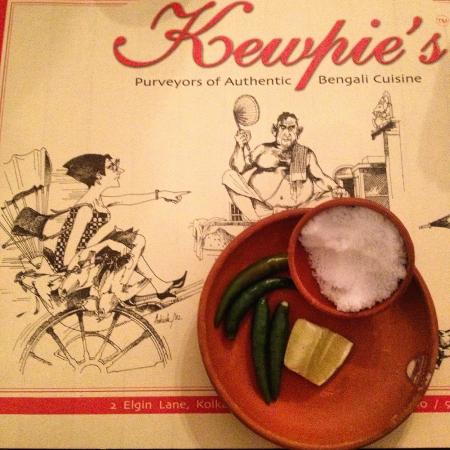
| Kewpie's placemats have charming vintage-inspired drawings of Calcutta life |
![]() |
| Chutney's jammy consistency, when it's ready |
Here are my tomato, cilantro-mint and rhubarb chutney recipes. Please note that these chutneys are designed to be refrigerated in glass jars or bowls with lids. They are not shelf-stable.