Showing posts with label Kolkata. Show all posts

Wednesday, December 16, 2020

When the Muse is Named Corona

 Sujata Massey

"Love in the Age of Covid," Bhaskar Chitrakar, 2020


Once the pandemic is a memory, what image will you remember? The tired mask on a hook by the door, or it a dear friend's face trapped behind an oxygen mask--a sight you're only privy to because the shot was beamed into Facebook?


Coronavirus pictures have been dismal until the last week or so, when media published proof of health care workers in England getting vaccinations, and now Americans as well. As gratifying as these pictures of jubilant workers are, they are digital images with limited visibility. The next day, something else fills up the center spot on the newspaper's home page. 


And we must never forget. 


The museums that recently re-opened have closed because the virus is surging. But art never sleeps; I suspect many of its makers are contemplating the coronavirus. And I'm certain that  what these artists can eventually show us is different from mass perceptions.  


Bhaskar Chitrakar with one of his creations


Bhaskar Chitrakar is a Kolkata artist in his early 40s who works in the Kalighat painting tradition that’s been identified with his city since the early 1800s.  The painter’s surname, Chitrakar, literally means “illustrator,” and he’s the last descendent in a clan of painters who have trained father to son and grandson for generations. 


The type of painting that this family and others made is an endangered art called Kalighat Patachitra. These small paintings, bought as souvenirs, were created inside a Kolkata neighborhood called Kalighat in honor of its temple celebrating the goddess Kali. The art form started with small-scale religious paintings were sold at low cost to ordinary people. As British dominance in Bengal increased, people chafed at the foreigners' oppression and the pretentiousness of the expanding Bengali upper class who eagerly took jobs as English-speaking clerks and officials. Babu, the honorific suffix these gentlemen favored for themselves, became slang meaning a silly gentleman. Babus were mocked for wearing western men's pumps in conjunction with the Indian dhoti, and for smoking hookahs, and making a nuisance of themselves. Babus, artists, and wealthy women became recurring protagonists in Kalighat pachitra work.


19th century Kalighat art at the Victoria and Albert Museum


More of the V&A's historic Kalighat Patachitra


Bhaskar Chitrakar was six when his father started to teach him painting. By thirteen, he was working full-time. While remaining respectful of the exquisitely detailed painting form, Bhaskar experimented with his own social commentary: strong women, jazz-loving cats, cell phones and taxis. To suit his his own sensibility, he continued to clothe his men and women in traditional 19th century garb—the sherwani jackets, draped dhotis, and flowing saris that light up up his paintings. 


"Dance of the Coronavirus," Bhaskar Chitrakar


Bhaskar Chitrakar’s art entered my life in the most quotidian way: a marketing email. The Khazana Gallery, a Minneapolis, Minnesota venue representing South Asian artists, created an online event called Tree of Life last July. This was an art sale designed to offer extra support to Khazana's artists living isolated and unable to sell their work because of India’s long and strict national quarantine. The gallery decided not to charge its usual commission in order to give all the money raised from the art sale to the folk artists. 


Feeling curious, I clicked into the gallery of available images. Not all of Chitrakar's watercolors had a coronavirus theme, but I smiled the most at ones that did.  “Love in the Time of Coronavirus” shows an elegant couple toasting each other from a six-foot distance, and “Have No Fear, I am Here” shows a smug, rounded corona molecule awaiting a syringe held by a flamboyant babu. 


"Have No Fear, I am Here," Bhaskar Chitrakar


I drew my husband Tony into the digital window shopping. When we choose a painting to admire or even buy, we usually see eye-to-eye.


"Leave Me Alone!" Bhaskar Chitrakar


This time was harder than usual, but we eventually chose the painting pictured above. A musician is wielding a musical instrument called a tanbura, all the while deftly balancing a cat on top of it and defiantly regarding the burning corona sun. He's like all of us, balancing everything despite the difficulty of the situation. The man's handsome coat is patterned with tiny corona images, and the coat's tassel trim repeats the corona motif.  I loved the grace of the musician’s movement, and the irony of his modern surgical mask against his fine clothing. Those masks made all of us look ridiculous. The picture is rounded out by a dog howling at the sun and a tiny crow. The three animals make me think of working parents with children underfoot.


After I'd placed my online order, the gallery emailed to alert me the picture we'd selected had already sold; yet Bhaskar was willing to recreate the same picture (he paints about eight works a month). I agreed, feeling glad that artists painting in a historic tradition are generous enough to recreate their visions by hand.  


“Leave Me Alone!” departed India in early August and arrived in my home before that month’s end. I took it out straight away and admired it—along with six other works by different Indian artists. Art fever had infected me. 


Yet despite my excitement over these purchases, I dragged my feet when it came to getting them framed. I didn’t feel especially safe going into the big box store where I usually got framing done. Working with a consultant to select the right frames and mats would take ages, and how many customers would be waiting ahead of me or breathing on the back of my neck? 


In November, Covid-19 rates were rising, so I knew I had to get a move on before stores might close. I decided to try a small, socially distanced artist supply store inTowson, MD. I was the only customer at the framing desk, where a massive plexiglass shield protected staff and customers from each other. The process took about an hour, and I was glad that for three things: the framing consultant also liked the pictures, nobody got in line behind me, and I was putting some money into the pocket of a small business. 


I collected my framed paintings today--just 24 hours after the first Pfizer vaccinations went into the arms of health care workers in my country. I had a place in mind on the living room wall, and when I hung the painting, it looked like it was home.


From where I sit, I can keep one eye on a blazing fire and the other on a mythical battle with an unnerving disease.  In the distant future, I imagine a world that is healthier in some ways, and sicker in others. 


In my imagination, a cute young child is running roughshod through my living room and clambers to stand up on an upholstered chair to better inspect "Leave Me Alone!" And then it's time for me to answer: 


Why is that funny guy's mouth and nose covered up?


Khazana has revived its Tree of Life fundraising sale for the month of December, 2020. You can shop for available work from Bhaskar Chitrakar and four other folk artists working in India.

Wednesday, August 2, 2017

Indian Chutney for an American Summer

Sujata Massey


In the height of summer, a heap of imperfectly gorgeous tomatoes rest on my kitchen island. They beseech me to touch them and make something great. The obvious thing would be to make a lush sauce—but it’s 90 degrees outside, and I’m not in the mood for cozy Italian pasta.

No. These tomatoes are calling out their wish to become a chutney.

“Chatni” is a classic accompaniment to a South Asian meal containing rice, meat and vegetable dishes, and breads. In a typical chatni, fruits and vegetables such as tomato or mango are slow-cooked with spices and ginger, various forms of chilies and the solid brown sugar called jaggery. Jaggery comes from palm sap or sugar cane and is sold in Asian grocery stores. Sometimes garlic and onion are part of the mix. Before the British, mustard and other oils were used to help keep the chutneys from spoiling. The ingredient of vinegar in chutneys comes from Britain, but is now part of some Indian chutney recipes.


Yogurt-based sauces also are known as chutneys; most famously the coriander-mint chutney served at almost every Indian restaurant, and the creamy, sweet and spicy coconut chutney essential to South Indian dosa.


When the British tasted chatni, they loved it. They anglicized the spelling to ‘chutney’ and found ways, after they went back to Britain, to make new chutneys with fruits like apples, plums and rhubarb and the preservative vinegar. A few months ago, I had a great experience making rhubarb chutney. They also created “Major Grey’s Mango Chutney,” a style of sweet and sticky chutney containing raisins, vinegar and a bit of tamarind that is an ingredient in many an American chicken salad. In my family, it is the standard slather over a cheddar cheese sandwich--or grilled cheese.


Sweet mango chutney is the starter chutney for children who are cautious about foreign tastes. Growing up, I had a big spoonful of sweet mango chutney with almost every home cooked Indian meal. I can’t imagine eating biryani without some mango chutney mixed in. These days, Indian food companies such as Patak’s make these Anglo-style mango chutneys with chilies included, if you like.


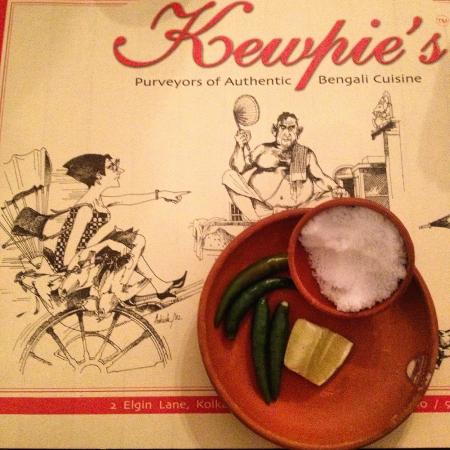
Back to the homemade tomato chutney. My recipe is inspired by a traditional one found in The Calcutta-Cookbook, A Treasury of Recipes from Pavement to Palace by Minakshie “Kewpie” Das Gupta, Bunny Gupta and Jaya Chaliha. Kewpie was a legendary Bengali home cook and cookbook writer. After Kewpie's passing, her family opened a jewelbox of a café in her honor within their historic home at 2 Elgin Road. Kewpie's is a must for lunch, if you are visiting South Kolkata. And the cookbook details how to make "Colonel's Sweet and Hot Mango Chutney," which is surely more delicious than the commercial version. 


Kewpie's placemats have charming vintage-inspired drawings of Calcutta life


During my frequent lunches at Kewpie’s in the late 1990s, I enjoyed food served on banana leaves and old-fashioned terra cotta plates. There would always be several extraordinary fresh chutneys served. Not to mention spicy pickles--but vegetable pickle is a story for another column!


My tomato chutney, which does not include raisins or too much chili firepower, is great on sandwiches, burgers, alongside grilled meat and fish. You can mix in 1/3 cup of it with eggplant that’s been roasted and mashed. You wind up with something very much like the famous dish Baigan Bharta, but with 75% less work.


Chutney's jammy consistency, when it's ready


The farmer’s market sells larger bunches of herbs than can be eaten in a week—so again, the answer is chutney. I make my cilantro-mint chutney with Greek yogurt for extra protein. It’s a natural with crispy treats like samosas, pakoras or with grilled fish. This green chutney is a great marinade for chicken pieces to be baked or grilled.

Here are my tomato, cilantro-mint and rhubarb chutney recipes. Please note that these chutneys are designed to be refrigerated in glass jars or bowls with lids. They are not shelf-stable.

I'm winding up my culinary adventures to return to my real work: writing a novel. It strikes me, though, that concocting a chutney is a bit like writing a mystery. There are so many interchangeable small parts: fruits and vegetables, spices, and preserving vinegars or oils. When I write, I pull together many pieces: characters, plots and sub-plots, settings, conflicts, motivations. I contemplate when I've got too much of one thing or am missing an important element. My book's components are adjusted as it grows toward a finished state.


But while it takes a year for me to write a book, a chutney rarely simmers more than thirty minutes.  This makes it a small but gratifying accomplishment.


Wednesday, April 20, 2016

Booking India

Sujata Massey


Chiki Sarkar, co-founder of Juggernaut Publishing/photo by Vogue India


This post is a tribute to a young democracy that has brought the world great writers--and a fantastical amount of readers.

India's population of 1.2 billion boasts a literacy rate of 86% in cities and 71% in rural areas.
Inside India, twenty major languages are spoken and read, and a few hundred more languages are used in rural communities. About 125 million Indians speak and read English, making it the second largest English-speaking country in the world.

Indian kids selling pirated books to car passengers
Yet despite the vast numbers of Indians educated in  schools, book sales are paltry--out of proportion for a nation with the largest middle class in the world and a plethora of talented writers in those twenty-plus languages. Why is this?

Many urban people are exposed to pirated books every day. An estimated 25% of books sold in India are proferred by slum dwellers who work under the supervision of gang bosses who distribute reprinted versions of Indian bestsellers on paper thin as tissue. During recent travels in Kolkata and Mumbai, I kept running into kids selling pirated Slumdog Millionare books...such an irony! If you got stuck on a street for a half-hour every day, and the same friendly youth offered you a bestseller for less than half of its cover cost, why wouldn't you buy--especially if you thought it would help the child?


College Street bookseller/photo by Rishi Bandopadhyay


Another blow against literary commerce are  time-honored, used-book stalls in all cities. Used book shopping at book corners loaded with thousands of traded-in books is one of the joys of visiting Kolkata's College Street. However, these places don't earn a rupee for the author or publisher.


The efforts of India's biggest publishers tosell e-books haven't helped. I have a novel published in India, City of Palaces. The beautifully designed trade paperback has a list price of 499 rupees, but the reality is that the trade paperback is sold at Amazon for 310 rupees, while the ebook is 299. We are talking about $4.68 US versus $4.51. Many Indians buy e-reader devices are sucked into the free ebook and get so much content loaded up they have no interest in adding books that aren't free.


A young woman publisher, Chiki Sarkar, is trying to change that. (Full disclosure: Chiki bought and published my book, City of Palaces, during her time at Penguin). I was stunned that shortly after her promotion to becoming publisher for the newly joined PenguinIndia/Random House, she departed to create her own start-up venture. Juggernaut launched this month with an amazing author list.

In several articles I've read, Chiki has mentioned that publishers can't expect distributors to pay them on time, and there aren't a lot of great independent and chain bookstores in India investing in new authors. She joined hands with with Durga Raghunath, a tech entrepreneur. They are launching Juggernaut, a publishing house unlike anything India's ever experienced.

Jagannath celebration in Puri

 Juggernaut is a very old, yet modern-sounding word. British administrators during the colonial era were stunned by the energy of the Rath Yatra Hindu festival held in Puri, Orissa every year in honor of the god Jagganath. To them, the Jagannath gathering was a wild melee of people and massive, heavy carts--the 18th-century precursor of rush hour traffic. Frequently, religious pilgrims were crushed in the throngs of Jagannath--yet the carts and people pressed on. The British colonials began using the term "Juggernaut" to describe  a powerful force or institution that cannot be halted.

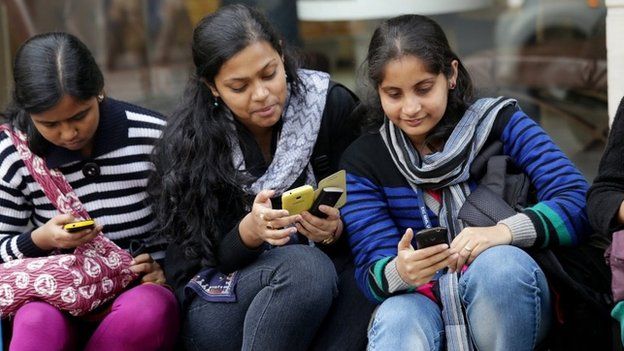
 Juggernaut Publishing's push is embracing the shift of reading on mobiles phone. The publisher plans to release more books as digital exclusives, although about 50  books per year will also be released in paper. The lynchpin of the publisher's debut will be the memoir of Rajat Gupta, a business scion who was convicted of insider trading and jailed. More details are here in some interviews Chiki Sarkar did at the recent  London Book Fair and with Vogue India.


Mobile users in India/photo by BBC


Many people worldwide read novels on our phones and tablets, using apps from Amazon and Apple. I do it to keep myself busy when I'm waiting somewhere. I own a Nook e-reader and a Kindle Fire, but I confess both need to be charged, because I use them only on the treadmill or when traveling.

Here's the other side of the story. Remember how I mentioned people speaking so many languages in India?

Penguin/Random House has decided to go big guns and  translate quality regional language fiction into English. One example of this new pubs is one of the most powerful thrillers I'd ever read, Hangwoman, by KR Meera and translated by J. Devika.


I would not have ever known about this haunting novel, originally written in Malayalam, if it hadn't been for this publishing risk taken. The past and the future, interwoven. That's why I love India.