Showing posts with label Edo. Show all posts

Sunday, January 17, 2021

Remembering the Great Gyonin-zaka Fire

 --Susan, every other Sunday


Hello again from Tokyo! This week, I'd like to share a hidden historical gem that's close to home (for me at least): Daienji, a Tendai Buddhist temple not far from my home in Tokyo's Meguro Ward.


The main gate at Daienji

I visited the temple last weekend, as part of a walking pilgrimage to visit the shichifukujin, or "Seven Gods of Good Fortune"--a New Year tradition in Japan. The Seven Lucky Gods pilgrimage near my home in Meguro is the oldest one in Tokyo, and unusual in that each of the lucky gods is enshrined in a Buddhist Temple, rather than a Shinto shrine. 

Daienji, which sits about a five minute walk from Meguro station on a steep hill called Gyonin-Zaka, is the fourth of six temples on the pilgrimage (the previous temple, Myoenji, enshrines two of the gods of god fortune). The temple was founded in 1624 as a center of Tendai teaching and worship. The principal image is that of Dainichi Nyorai, the central deity of esoteric Buddhism.


An obelisk outside the temple gate

A secondary shrine within the temple grounds enshrines the deity Daikoku--the patron of wealth, farmers, and the kitchen. This is where people pray on the seven lucky gods pilgrimage, although most visitors pay respects to Dainichi Nyorai also.


One of the few purification fountains still running---but please don't use it at the moment.

The dragon-headed purification fountain pictured above sits just to the left of the main gate, at the temple entrance. Most of Japan's purification fountains currently are not in operation (many are dry for the first time in memory), and even those still running, like this one, have signs nearby asking people to forego the customary ritual cleansing of hands and mouths, to prevent the spread of COVID-19.


Main worship hall (hondo) of Daienji

The main temple yard contains not only the hondo (worship hall) but also the secondary shrine dedicated to the god of good fortune. To the right of the worship hall, you can see a seated Buddha partially covered in gold leaf. The statue represents Yakushi Nyorai, the god of healing, and for 500 yen (about $5 USD) you can purchase sheets of gold leaf to place on the Buddha's body. Apparently, if you lay the gold on the place that hurts, the Buddha will take your pain away. I wasn't hurting last weekend, so I can't tell you whether or not this works, but I'll keep it in mind the next time my ankle acts up.


The Seven Lucky Gods

Statues on the temple grounds represent the seven gods of good fortune.

Shaka Nyorai and the Arhats (also a surprisingly good band name)

In 1772, a massive fire swept through Edo (now Tokyo), destroying much of the city. The fire, now known as the Great Gyonin-Zaka Fire, is believed to have begun on the grounds of Daienji (although the precise cause is unknown). After the fire, the statues in the next few pictures were constructed and placed on the temple grounds as a memorial to the people who perished in the fire. 

The large seated figure above is Shaka Nyorai, the historical Buddha (Prince Siddhartha, Gautama Buddha). The small statues in the background are 491 arhats, or disciples of the Buddha, each of which has a different face, position, and expression.


More of the Arhats

Collections of 500 arhats can be seen across Japan; they represent various disciples of the Buddha and have been installed on mountainsides, and at various Buddhist temples. These were created as an act of worship, over a period of years. The oldest arhats bear inscriptions stating they were created in 1763, but most of the figures were made and installed after 1781. The Buddhas in the foreground were added after the temple was rebuilt in 1848.

As a native Californian transplanted to and living in Japan, it's a humbling experience to visit a local temple--just a 40-minute walk from my apartment--and to realize that it has stood here longer than the country of my birth (to say nothing of my native state) has even existed. 

It's also a good reminder that history isn't only something we read about in books. It lives, and breathes, down every street and in every paving stone. Sometimes you have to look for it, but the search is well worthwhile when it unearths a hidden treasure like Daienji. 

Sunday, July 23, 2017

Back in Time--and Potty Humor--at the Edo-Tokyo Museum

-- Susan, every other Sunday

During last month's trip to Japan, I spent a day at the Edo-Tokyo Museum researching an upcoming Hiro Hattori mystery and learning oodles of fascinating facts about Japan's modern capital during the Edo period.

The massive Edo-Tokyo Museum

For those who don't know, Tokyo was formerly known as Edo--and Japanese historians use the term "Edo Period" to refer to the period between 1603 and 1868 (the start of the Meiji Period) when Edo was the capital of Japan and ruled by the Tokugawa shogunate.

The Edo-Tokyo museum is split in two: one side deals with the city's history during the Edo Period, the other with the more modern Meiji period. Regrettably, I spent all day on the Edo side this trip--though that means I'll get to explore the Meiji half of the museum another trip.

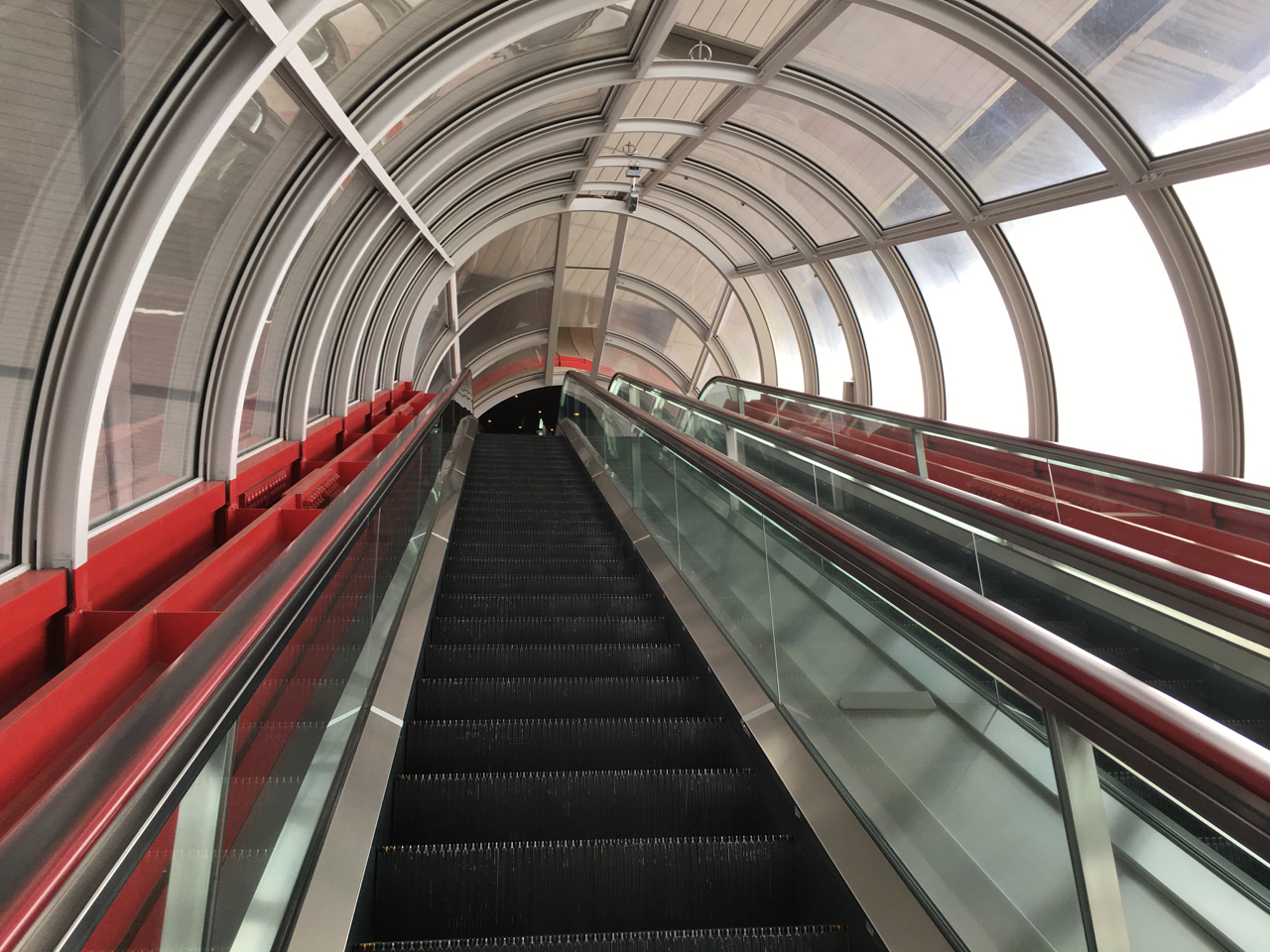
Visitors enter the museum through a series of escalators that take you to the building's sixth floor - where the exhibits start.
Up and up and up to enter ... and then you walk down through the exhibits.

You emerge on the upper level of a cavernous room near a full-sized replica of the Nihonbashi Bridge

Medieval Japanese bridges were built for traffic.

The bridge was once the primary entrance into Edo--and visitors walk across it to access the museum's other exhibits.

Not for those who fear heights.


On one side of the bridge, visitors look down on a full-sized replica of a seventeenth century Kabuki theater:

Nakamura-Za Kabuki Theater

On the other, a reconstructed building from Meiji-era Tokyo:

Sadly, I didn't get to this half of the museum this trip.

The opposite side of the bridge holds a treasure trove of engaging and interactive exhibits, including dioramas showing life in Edo Period Japan.

Detail of a diorama showing the Nihonbashi Bridge 

Many of the exhibits are interactive, allowing visitors to experience life in "old Edo."

This palanquin was used by samurai who could not or chose not to ride horses.
Nightsoil buckets - visitors can lift the yoke and experience the weight - though not the smell.

For a writer, the blend of original artifacts and reconstructed buildings was a gold mine--though anyone with an interest in history (or Japan) would find it equally fascinating.

Original Edo-era coins, on display.

I particularly liked the exhibits that reconstructed one of the connected row houses (munewari nagaya) where Edo's commoners lived during the 16th and 17th centuries.

Carpenter's one-room home in an Edo row house.

The houses consisted of multiple, connected one-room dwellings, each of which was home to a single family. The landlord who owned the building usually lived elsewhere (in a larger, multi-room home) so the people who shared the tenements were not necessarily (and often, not) related.

Nagaya did not have indoor plumbing, so the residents used a common well, garbage bin, and latrine placed at the rear of the block.

Replica of the communal well at a nagaya.

As a writer, I photograph everything--and I was particularly interested in documenting the nagaya display for my books, including the latrine, which was the first full-sized model of a Japanese city latrine that I'd seen.

Japanese potty - the stalls are squat toilets. The open space on the end contains a urinal.

Medieval Japanese urinal. That's a thing you know about now.

(Full disclosure: My friends and I have a running joke that I must be a six year-old boy at heart, because every book I write ends up with a latrine in it somewhere. Six or forty-six, I admit to an odd fascination with potties of every type and era.)

While I was photographing the latrine, an elderly Japanese man walked up next to me and started laughing. When I lowered my camera, he pointed and said (quite loudly) in English: "YOU LIKE TOILET!"

"I am an American novelist," I responded (in Japanese), "I am writing a book--"

"About Edo toilet!" He finished, in English, with a giant grin and two thumbs up.

"And ninjas!" I added.

He found this absolutely hilarious.

I can't say that I blame him.

Given that I was the only non-Japanese person I saw in the museum all day, my fascination with the toilet probably gave him all kinds of only partially-inaccurate opinions of Americans, women, and novelists.

I have no regrets. In fact, it put a perfect capper (or should I say, crapper) on the day.