Showing posts with label Deadly Harvest. Show all posts

Thursday, August 28, 2025

The minds of murderers

 Michael –Alternate Tuesdays

Guess who...

The crime reading and writing community obviously has a deep interest in what goes on in the minds of murderers – what are their motives, is the crime opportunistic or carefully planned, do they have favorite locations, weapons, approaches?

In most real cases, the killing is on the spur of the moment, motivated by anger or possibly by mental and physical abuse where the victim finally snaps. Those cases don’t make interesting police procedurals. The connection between the victim and the killer is usually apparent or quickly discovered. Once the motive is established, and remembering that the attack was unplanned, it’s easy to identify the prime suspect and join the dots. However, premeditated murder (at least in fiction) is usually planned quite carefully. The motive may be more obscure – money, love, hate, revenge, silence. The murderer will take trouble to avoid discovery and, perhaps, try to engineer an alibi. He or she will choose the time and place. They will know what sort of things the police will look for and try to avoid those using information from CSI and all the other true crime series flooding the streaming services. Now the detective has a challenge worth reading about.

The writer’s job is to make the villain believable, and to do that one needs to understand what’s going on in their mind. What is the real motive? How do they react to it? How do they think about it? How do they plan? What will they do when they’re caught? In a sense one needs to profile the character. If that’s not done well enough, the reader will exclaim, “He’d never do that!”, and the fictional dream will be lost.

So how does one approach that? Well, it’s actually reverse profiling. Create and understand the bad guy’s psyche, then deduce the behavior that would follow from it. It’s hard work to do that first step. One has to get into the mind of the murderer. One may even have scenes in the book from his point of view. And sometimes those may be unpleasant for the reader (and the writer) even if they are necessary for the story and character development.

It even looks human...
But what about when the mind of the murderer is really far away from anything the writer can conceive? I’m not talking about aliens in science fiction. (With a few exceptions, the aliens are either horrors or their minds work similarly to human minds. Otherwise, how do we relate to them as characters?) I’m thinking of psychopaths who perform grotesque murders apparently almost at random. How do you get into the mind of a murderer so removed from anything your own mind can understand? How believable would be a scene from such a character’s point of view?


John Douglas at the time of the book
Probably most readers of this blog will know the story of how the FBI started profiling serial killers by interviewing them in prison. John Douglas and Mark Olshaker told the story in their book Mindhunter. Douglas faced the same sort of questions, albeit with much higher stakes. Could one develop a good enough picture –physical and psychological – of the killer to be able to predict his behavior (it is almost always a “he”) and what physical and family attributes such a killer probably had. The book was dramatized in a Netflix series of the same name. The most fascinating parts of the series are the selection of interviews with serial killers based on the transcripts of Douglas’s actual interviews with them in prison. Despite stomach-churning crimes, these men are convincing in a way that few purely fictional characters are. The experiences that Douglas had with them enabled him to develop the art of criminal profiling and spread it through seminars to law enforcement. 

Kemper at the time of his arrest
The scenes with Edmund Kemper are particularly intriguing and he seems to be accurately portrayed in the Mindhunter series. A sociopathic killer who was known as “the coed killer” shot his grandparents as a boy, murdered and dismembered six young girls, and battered his mother to death with a claw hammer. He towers six foot nine inches with a weight to match. Yet if you knew nothing about him and met him in the street, you would describe him as well-spoken, intelligent and friendly.

Their technique consisted of sitting down with the convicted killer and asking questions about his background and his crimes. Kemper, in particular, loved to talk about himself and what had motivated him. As he told the story, his motive became believable if not understandable. If you have a psychopathic character, maybe pretend he's been caught, sit him down in prison and interview him the way Douglas did. If he can't convince you of the sense his actions make to him, it's unlikely the reader will be convinced either.

Although we’ve had quite a few pretty nasty bad guys in our books, we’ve never had a chapter from the point of view of a psychopathic serial killer. The closest we’ve come to a serial killer is the witch doctor in Deadly Harvest who kills, or orders killed, people for the black-magic potions that he sells at high prices to rich clients. But like “ordinary” serial killers, power is his real motivation. There is no section of the book from his point of view. He is hidden, unknown, we see his effects on other people, but not from the man himself. Some further evidence of how his mind twisted is revealed at the end, but not by him. In this case, less is more.

He is much like a serial killer. Apart from some clues to the sorts of people he chooses, there is no connection between him and his victims for the police to follow. Also, his clients are rich and powerful people, possibly even within the police. No case could be more daunting to a detective. Unless that detective has his or her own axe to grind as is the case in Deadly Harvest.

We agonized over that witch doctor. Had we managed to create a believable villain? Would people outside Africa be able to relate to the fear that even well-educated local people might hold for such a person? Apparently, we did a good enough job to impress the reviewers and even bag a place on the shortlist for an ITW thriller award for the year.

In our new book we have a different sort of bad guy. He may not have started life as a sociopath, but he’ll get there by the time we’re finished!

Thursday, September 15, 2022

Murder Most Foul

Michael - Thursday

While we were writing our first book, A Carrion Death, we managed to spend an afternoon with the then director of the Botswana Criminal Investigation Department in Gaborone. We had a great time and I think he enjoyed our interest in his country and his department. At one point he asked us what our book was about, and we described it to him. He nodded and made a few comments, and then told us what he thought we should be writing about, describing the brutal abduction and murder of a young girl, Segametsi Mogomotsi in 1994. Parts of her body were used for muti – potions for black magic. He finished with the statement that following angry riots motivated by the lack of resolution of the case, the Botswana government had called in Scotland Yard to review the local police’s investigation. The UK team had reported to the government, but that report was never released to the public. The girl’s stepfather was arrested at one point and confessed to some involvement, but later withdrew his confession, which he said was coerced. When the director told us the story, no one had been convicted of the murder. That’s still the case twenty years later.

The story of Segametsi stuck in our minds, but we wrote three books before we thought about basing something on that case. We were ambivalent. In the first place, basing a novel, even loosely, on a real case can be hurtful to people involved. However, twenty years had passed, and the furor caused by the case in Botswana had died away. Secondly, a book about the ritual murder and dismemberment of children was much darker than our previous books, and finally, did we even want to deal with a subject that might well upset some of our readers?

Muti murders weren’t new in fiction. It had already been addressed by Unity Dow, a campaigner for women’s rights in Botswana, a high court judge, and subsequently minister of education, who also wrote fiction (and other works). Her book The Screaming of the Innocent is an excellent, if deeply disturbing, novel.

In the end, we wrote Deadly Harvest as sensitively as we could, trying to explore the factors that led to the beliefs as well as the motives and the impact on the families. Belief in black magic and its trappings is a horrific feature of much of sub-Saharan Africa—yes, even the Africa of skyscrapers and modern economies and technology. The belief hasn’t gone away, and these cases are hard for the police. They remain reticent to take on witch doctors and the rich and powerful people who employ them, and it's hard to trace the connection between the victim and the murderers. But technology has moved on.

Lobatse in southern Botswana

Six year old Tlotso Karema disappeared from his home in Lobatse this March. When his remains were discovered recently, forensic pathology confirmed them using DNA, and established that certain body parts were missing. The police assessed the case as a ritual murder and addressed it in that context. Here is an extract from Botswana news site The Voice:

“A distressing and dramatic three months after Karema’s disappearance, the boy’ stepfather, Lovemore Sithole has been arrested and detained in connection with his kidnapping. Sithole, a 37-year old father of three has allegedly confessed to the police that he sold Tlotso for P200 000" (about US$15,000).

‘Those bones discovered two weeks ago belonged to Tlotso. Some members of his family are implicated in his kidnapping. Some prominent figures too, but it’s too early to reveal names,’ a source close to the family has alleged."

According to a neighbor, what led to Sithole’s arrest was a discussion between Sithole and a possible partner in crime that the boy’s mother overheard when Sithole was in the (outdoor) toilet.

‘Kesego followed him to the toilet and overheard Sithole talking to someone on the other end about Tlotso. When she confronted him, he grabbed her phone and threw it, together with his in the toilet because she had claimed to have recorded the entire conversation on her phone,' said the neighbour.”

Arrest of Lovemore Sithole

The police were left with the job of dredging the toilet.

The Botswana Police Service had little comment, but Kgosi Ngakaayagae (described as a “celebrity lawyer”) summed it up rather clearly:

“The ultimate beneficiary of a ritual murder is usually some privileged guy removed from the scene. … The principal criminals in ritual murders are usually; some Chief, some Politician, some businessman, some traditional doctor who prescribes the evil, some sick person who has been told by a traditional doctor they 'need' a human sacrifice to heal,” he explained. “Their DNA is never at the scene of crime. It’s the runners (catchers, if you will), that get arrested and that ultimately hang...

“My point is that the big criminals, including the traditional doctors who prescribe (muti) always get away, with murder. The small guy pays for them all, with his life. So, Lovemore's guilt (if true), would only be 10% of the puzzle. He’d at best be a lead. The crime would be far from solved. I trust the police to do a thorough, job.”

Well, perhaps they did. Last month the Member of Parliament for Lobatse, Dr Thapelo Matsheka, was arrested and held in connection with the murder. Was he then Kgosi Ngakaayagae’s “ultimate beneficiary”? How had they traced him? Through the sodden cell phones?

Arrest of Dr Matsheka

Despite Kgosi Ngakaayagae’s description, Matsheka seems an unlikely "ultimate beneficiary". He has a successful financial consulting business. He has a PhD in economics from the University of Kent and an MPhil from the University of Glasgow. He has a safe seat in Lobatse for the government and was minister of finance until recently.

But “recently” was when he challenged the party hierarchy and President Masisi at a political level and was suddenly replaced. So was he the “ultimate beneficiary” of a horrible muti murder, or could it be that powerful political opponents have spotted a way to neatly settle a few scores?

UPCOMING EVENTS in September:

Saturday 17, 1:00 pm 

Nokomis Library event

5100 S 34th Ave, Minneapolis, MN 55417 Phone: 612-543-6800


Wednesday 21, 6:00 pm 

Thomas St. Angelo Public Library of Cumberland event

1305 2nd Ave, Cumberland, WI 54829. Phone: 715-822-2767


Thursday 22, 6:30 pm 

Spooner Library event

421 High St, Spooner, WI 54801 Phone. 715-635-2792


Saturday 24, 1200

The Bookstore at Fitger’s

600 East Superior Street, Duluth MN 55802


Tuesday, 27, 6:00 pm (In person and virtual)

Official launch of A Deadly Covenant at Once Upon A Crime

604 W. 26th Street, Minneapolis, MN 5540 Phone: 612.870.3785 

Email: onceuponacrimebooks@gmail.com

With Mary Ann Grossman


Thursday, June 2, 2016

The accidental protagonist and other serendipities


This book-writing business has been a lark from beginning to end.  It happened by mistake and remains serendipitous.

If Michael and I hadn’t seen, in Botswana’s Chobe National Park, a pack of hyenas hunt, kill, and consume a wildebeest in four hours—all of the wildebeest, flesh and bones—we probably would never have thought about writing a mystery. 


Licking the plate after all was gone!
Nothing left for her
Then, it took us more than fifteen years to start writing A CARRION DEATH (which is regarded as borderline impatient in our academic circles), but at least we knew how it was going to start, which saved a few years.  However, we had no idea how it was going to proceed, so we took another three years to finish it, probably throwing away as many words as we kept, because we had no clue what we were doing.  Neither of us had written fiction before—at least not since we were very young.

We were told to write what we knew.  Sounded good, so it was a professor who stumbled across a hyena that had not quite finished dining on a human body.  The professor was smart, in a cool field (ecology), and stood out in comparison to his companion, a game ranger.  He figured out what was going on very quickly, and we were delighted we’d created such a good protagonist.  However, we realised that he couldn’t do everything himself, that we would have to bring a detective from Gaborone to the middle of the Kalahari to do the official  investigation – after all it was a murder.

The only detective who was free that day was Assistant Superintendent David Bengu, sporting what some thought was a rude nickname—Kubu, or hippopotamus in the Setswana language.  And yes, he was big and ponderous.   And dangerous.

Photo: Aron Frankental
So this secondary character jumped into his Land Rover, with sandwiches, something to drink, and various tapes he could sing along with.  Opera tapes.  And the Land Rover was his only stage—and then only when alone—because he was the only person on the planet who thought he had a decent voice.
Kubu faced dangerous animals on the road through the Kalahari.
And as he drove along the sands of the Kalahari, singing lustily, he taught us a lesson we’d never forget.

We thought, as the authors of the book, that we’d be in charge, in control of what happened, and of who did what to whom.

Not so, it turned out.

By the time Kubu had arrived at the camp near where the body had been found, he’d taken over as our main character.  We can just see him, as he was driving, saying to himself: “A professor as protagonist?  Eish!!  No way.  It’s going to me.”

And so it came to pass.  We capitulated immediately, relegating the professor to the background, and Kubu became our accidental protagonist.  To be fair, as Michael always says, we did give him a consolation prize, marrying him off to Kubu’s sister-in-law in a later book.

While writing A CARRION DEATH, we realised we knew nothing about the police or their procedures, at least from the inside, and even less about the Botswana police.  So we started emailing and phoning the Director of the Botswana Criminal Investigation Department (CID) – Director Mulale.  He ignored us.  And continued to ignore us as we continued trying to contact him.  Even his assistant director ignored us.  We felt most put out.  

Eventually we went to Gaborone, Botswana’s capital, to research locations for the book.  When we arrived there one Friday evening, we continued to hound the Director – somehow we’d managed to get hold of his mobile phone.  Eventually, in sheer exasperation, he capitulated, saying “ You’ve worn me out!”  We agreed to meet at noon on the Saturday at our hotel.

Gaborone market outside our hotel
Director Mulale arrived, as tall as Stanley, in jeans, cowboy boots, and a Stetson, and then more than made up for his reticence.  He spent the next six hours driving us all over the area, showing us where various crimes had taken place, where the best drugs were sold, where the police were trained, and where the bad guys were imprisoned. 

Police Training College
Three things stand out about that afternoon.  

First, Director Mulale's friendliness and willingness to share what he knew despite our earlier obnoxious persistence.  

Second, as we drove around, Director Mulale’s mobile kept ringing about a gang of armed South African bank robbers who were in the town of Lobatse, south of Gaborone.  Mulale kept telling his assistant the he was busy with some writers from South Africa and that he, the assistant, should take care of the bad guys.  

And third, during the afternoon, Director Mulale told us that if we wanted to write about something really important, we should write about muti murders – and he told us about the true story of Segametsi Mogamotsi, a young girl who had been abducted, murdered, and various body parts taken for muti or magic potions.  It was on this story that we eventually based DEADLY HARVEST.  He was clearly frustrated by the inability and unwillingness of the police to bring closure to muti-murder cases.

Just released UK edition by Orenda Books
Finally, even though we’d written A CARRION DEATH as a lark—to see whether we could actually write a mystery—we liked it enough to try and get it published.  I was in the States at the time and started sending out query letters to various agents.  Lots of query letters.  Some agents said no; some didn't reply; a few asked us to send more, then said no.  We despaired as all our efforts appeared to be of no avail.

Then, to our great excitement, an agent said she would like to represent us and sent us her contract.  We were very puzzled by it —we didn’t understand it.  There were sections that contradicted each other, sentences that made no sense.  We offered to rewrite the contract, an offer that wasn't well received.  

However, as new authors, we were also VERY keen to get published and were about to sign despite having no idea what the contract meant, when I had dinner with some neighbours.  I told them the saga of the contract, and serendipity intervened once again.  One of the guests said they knew an author I should contact.  To cut a long story short, we soon signed with the writer's agent, who, within a few weeks phoned us to tell us she had a contract with HarperCollins.

HARPERCOLLINS!

“I assume you’re writing a series,” our agent asked.  “Of course,” we replied, never having had the slightest intention of writing a second Kubu book.

“Please email me the synopsis, asap.  Harper's only interested in a series,” she said.  “Of course,” we replied, not having such a thing.

So we scrambled mightily and came up with a synopsis that appeared to satisfy our soon-to-be editor.

Then we signed A TWO-BOOK contract.  Gadzooks!  AND, they were going to give us money up front!  Real money! 


And since then we’ve been part of a mysterious world, filled with contradictions, sometimes frustrations, as well as a great deal of enjoyment. 

And perhaps the most serendipitous outcome of watching those hyenas is that we now hang out with the nicest and most supporting people you will ever meet.  Thank you!


Thursday, May 26, 2016

Crimefest 2016

Michael and Stanley - Thursday


Several of our co-bloggers have asked about our experiences at Crimefest.  I’d like to give the scintillating definitive report here today, but having landed in Johannesburg a few hours ago after a packed overnight flight from London in sardine class, scintillating isn’t my word of the day.

As always it was great fun.  Being based in South Africa, it’s always a great treat when one has the opportunity to meet old friends at writing conventions and to make new ones.  And Crimefest really is one of the friendliest and most enjoyable of the bunch.  It’s in the hundreds of participants rather than in the thousands, and even though it now has three parallel panels on the Saturday instead of the usual two, almost all the panels are full and there are plenty of readers buying books.

Caroline Todd with Michael

Almost all the Orenda Books mystery authors were there and we had a great dinner together on the opening Thursday night.  I think they’ve all had their arms twisted to write a guest blog for us here, so you’ll be hearing more about them then.

Kati Hiekkapelto
Not really a big drinker...


Bill and Toby Gottfried
Loyal to Kubu as always!
Apart from the general camaraderie and good cheer (usually of the alcoholic variety), there were a variety of highlights. Featured author interviews with great writers (and speakers) Ian Rankin, Peter James, and Norway’s Anne Holt. An excellent panel around real and fictional spying where James Naughtie talked about his fact-based fiction and Adam Sisman talked about his recent biography of John Le CarrĆ©. 

A highlight for us was meeting ‘Karen Perry,’ a successful thriller writing partnership from Dublin consisting of Karen Gillece and Paul Perry.
Paul Perry and Karen Gillece
 
The four of us made up a panel chaired by Jake Kerridge.  I hope the audience enjoyed it as much as we did.  It was amazing (or perhaps not) how closely the two teams felt about most issues. I’m looking forward to reading their books.

Probably if you care about these things, you already know all about the various Crime Writers Association Dagger shortlists.  Hearty congratulations to Jorn Horst on his nomination for THE CAVE MAN for the International Dagger. He’s written about it before here.  I’ve read it and it’s a very fine book.  He’s head to head with South African thriller master Deon Meyer (up for the award for the second or third time) for his latest book ICARUS. (You can read my interview with Deon about this excellent book here.)

Our farewell dinner
Michael with Peter Rozovsky
 while Adrian Muller has a well earned meal.


Stan with Alex Shaw
The Icelanders Cometh
Ragnar Jonasson and Yrsa Sigurdardottir (with grandson)
Of course the most important highlight for us was the release of DEADLY HARVEST for the first time in the UK. We really love that cover! 

Thursday, November 20, 2014

BOUCHERCON HIATUS: UNITY DOW

Last time I wrote about the Botswana elections and Unity Dow's election to the National Assembly. The piece below, which appeared four years ago, explains why we think that's a really good thing!

Michael - Thursday


Unity Dow is an extraordinary woman by any standards, but even more so by the standards of male-oriented Botswana. Born in 1959, she became a lawyer and immediately took up the cause of women’s rights in Botswana. In a landmark case, she challenged the constitutionality of a law which excluded her children from citizenship because her husband is a citizen of the United states. She won this, solidifying the equal gender rights promised by the constitution. Later she became a High Court judge – the first woman member – and served for 11 years. During that time she was one of the justices involved in the High Court challenge that gave the San (Bushman) peoples the right to return to their traditional lifestyle in the Kalahari. She later served on a commission redrawing the Kenyan constitution. And now she has been appointed to the legislature.

She is also a talented writer. She has written four novels reflecting deep issues in contemporary Botswana: the struggle between traditional and Western values, the AIDS pandemic (Botswana and South Africa compete for the world’s highest infection rates), and ritual murder.

The Screaming of the Innocent is a powerful and disturbing book. A young girl vanishes; the police guess that she has been eaten by a lion, but the reader knows that she has been ritually murdered for body parts reputed to bestow great power. Years later a female student doing national service in the community comes across a box of clothing which seems to belong to the missing girl. But after she draws attention to it, the box vanishes. She seeks out a friend – now a lawyer – and the two young women pursue the matter together.

The book is good not only because of the intriguing characters and plot, but because the reader finds the premise completely believable because the perspective is purely African. To westerners, witchcraft has become almost flippant superstition – like avoiding a black cat. But in many African cultures it is not only respected and feared, but deeply believed. It is this that Dow manages to capture so well in her novel. She makes no bones about the influence of male dominance being connected with these issues. When her evil characters are plotting the murder, they look for “a man with a hard heart, a heart of stone, a heart of a real man”. And, of course, they find such a man. The heroine follows the twists and turns and seems to be taking us to a successful resolution. But Africa is often not like that.

The book was first published in 2002 by Spinifex Press – a boutique publisher in Australia specialising in books focussing on women’s issues – and subsequently published in South Africa. Fortunately, it is widely available. It is a harrowing book, but one well worth reading.

It is tempting to see the premise of the story as an ingenious (if ghoulish) invention, but it is probably based on a real case which would have been well known to Dow. In 1994 a 14-year-old girl named Segametsi and her friend Monnye decided to sell oranges in Mochudi (a small town where they lived) to raise money for a church trip to Francistown. The girls separated near the house of a man called Mokgalo. Segametsi was never seen alive again. Her body was found with fatal chest wounds and with a variety of body parts removed, possibly while she was still alive. Clearly she had been murdered to harvest these organs for Dipheko, “medicine” made from human flesh.

Nothing about the case was obvious. Circumstantial evidence pointed to Mokgalo and he was held briefly, perhaps for his own safety. Soon he was released. Monnye then came up with a story that Mokgalo previously had made advances to Segametsi. Mokgalo wa held again. And in an almost unbelievable turn of events the murdered girl’s father made a confession that he had accepted a promise of 1,200 pula (about $200) to help with the girl’s abduction. Mokgalo was held for two months. During that time the police became suspicious of the stories they had been told. The father was sent for mental examination. Both the father and the Monnye eventually withdrew their stories, and the suspects were released. This led to rioting in Mochudi and nearby Gaborone and the focus moved from the murder to public order. The police and soldiers reacted violently and many people were injured. One was deliberately killed by a policeman.

The government was under continuing pressure and eventually was obliged to ask Scotland Yard to send a team to independently investigate the murder and the police conduct of the case. This lack of trust in the police and people in authority is all reflected in Dow’s novel.

The policeman who killed the suspected rioter was sentenced for manslaughter and the government paid his family about $100,000 in compensation. Mokgalo won a case for wrongful arrest, but describes himself as a broken man who is still treated with suspicion. The Scotland Yard report has never been made public. No one has been arrested for the murder of Segametsi.

When we met the then director of the CID and he heard we were mystery writers, he said there was much to write about in Botswana, and mentioned the Segametsi case. I have always wondered why the director of the investigating department would want this brought up. Also, he must have known about Unity Dow’s novel. What was there to add? It took us eight years to discover our answer in DEADLY HARVEST.

The belief in the power of evil medicines and witches has another somewhat unexpected and damaging consequence. Since witchcraft is used to ensure success in financial and other ventures, it can be dangerous to appear too successful. If you have risen faster and farther than others, is it not possible that you too may have dabbled with Dipheko? This perception may be very dangerous for you indeed. It is safer to be mediocre…


Thursday, September 5, 2013

A Walk in the Hills


Botswana is full of beautiful wilderness areas and places of historical and cultural interest.   It’s the wildlife areas of Chobe, Moremi, and Savuti and the incomparable Okavango Delta which draw the tourists, but there’s an incredible diversity of interesting places.  The Kalahari sprawls across most of the country coating it in deep, pink sand.  If deserts appeal to you – as they do to me – you will find many beautiful stark scenes in the Central Kalahari Game Reserve.  There are also cultural sites as interesting as any in the world.  We have written before about the treasure trove of Bushman (San) art at the Tsodilo Hills.  Believed by the Bushmen to be the birthplace of mankind, human habitation there goes back tens of thousands of years.

Michael, Mompati and Sheldon
I’ve just returned from a trip to Botswana and this time I was lucky enough to have a friend with me who is a serious photographer.  The trip had two main focuses: a launch of DEADLY HARVEST at Exclusive Books in Gaborone, and a visit to Shoshong, a village of great historical interest going back to David Livingstone’s era.  This was our first proper launch of a Detective Kubu novel in Botswana, so I was really looking forward to it.  I persuaded Professor Sheldon Weeks - book reviewer for the weekly Botswana national paper Mmegi - to lead the discussion of our books.  It wasn’t a big crowd, but it was an enthusiastic one and a good time was had by all thanks to the store’s manager, Mompati Seditse, and our South African publisher, Jonathan Ball.


The next day we set off along the old road north.  This was an important trade route in the nineteenth century and only lost prominence when Cecil Rhodes built his “Cape to Cairo” railroad much further to the east.  From the old road, one comes into Shoshong from the west side and on the way you pass a sign announcing: Pitsane Hill 2Km.  Here was a place I’d never visited.  So we pulled onto a donkey cart track and muddled our way till we found a cow path heading into the hills.  There we stopped and walked up Pitsane Hill.


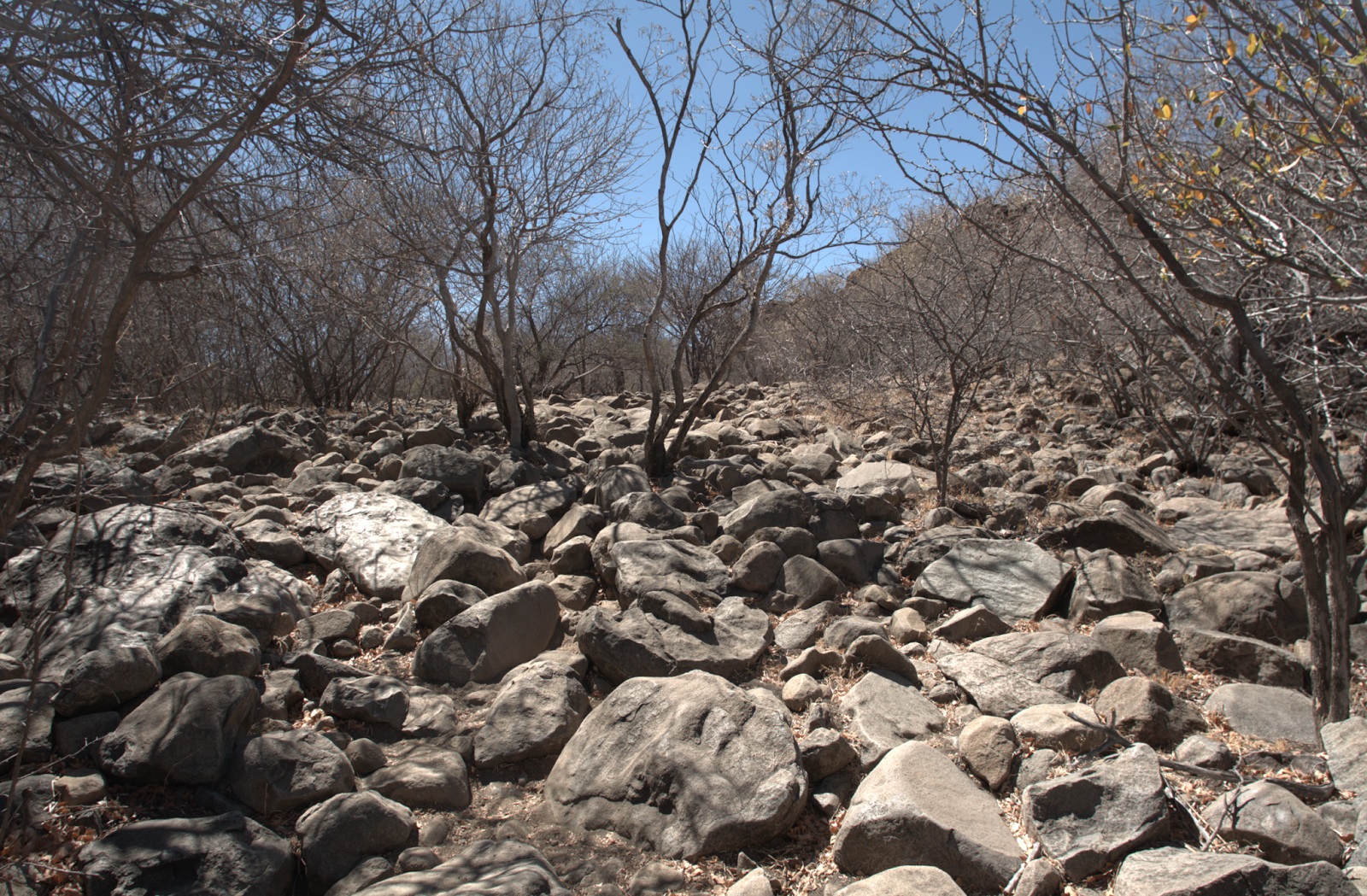
The hills forms a saddle and you can walk through it down to a river – dry, of course – which we realized was the same one that was once responsible for Shoshong’s prominence.  In this area of the hill, there was an iron age settlement over 1000 years ago.  The Botswana National Museum tells us that these people worked metal for tools, kept cattle, and grew crops in the area.  The relics are at the museum and not much remains to be seen of the Pitsane Hill settlements today, but the walk is wonderful.  You climb the hills – sharing the route only with cows, who seem to know where they're going although there is really nowhere to go.  There are wonderful views of the surrounding plains.  You descend through a gorge into the riverbed, surrounded by the fascinating Dolerite boulders and screes of the hills that protected Shoshong from hostile tribes to the north.  But the most fascinating part is to be surrounded by the amazing Paperbark Corkwood trees (Commiphora Marlothii).  Our timing was perfect.  The trees were developing new green spring bark, sloughing off the old in rice-paper like fragments.  As you walked, the wind made them whisper and rustle like animate things.


The launch was great, but it’s the walk in the hills of Pitsane that I’ll never forget.


Oh.  I was supposed to tell you about Shoshong.  Well, another time.

Michael – Thursday.

Photographs by Jonathan Everitt.

Thursday, April 25, 2013

Deadly Harvest


Next week (April 30th) sees the release of the new Detective Kubu mystery DEADLY HARVEST.  Naturally we wanted to tell you about it, but we decided to let Kubu himself talk about it instead.  

We were in Botswana at the beginning of the month so we lured him away from the Criminal Investigation Department of the Botswana police by offering him lunch at one of his favorite restaurants – the Caravela, a great Portuguese restaurant in Gaborone with an interesting background.  (We reported on it in an earlier blog.)

Once we had settled down and Kubu had regretfully passed on the wine because he was on duty, we chatted.  Of course we are old friends so we used his nickname “Kubu”, which means hippopotamus in the Setswana language.  Kubu doesn’t mind.  It is part of his persona and has been with him since his school days at the Maru a Pula school.

Michael asked him about being a detective in Botswana.

Kubu laughed.  “I thought you’d want to talk about food and recipes!  You know there’s a cook book out now as an e-book with my favorite African dishes?  Sometimes I think I’m better known as a gourmet than a detective.  But don’t ask me to be the cook!  By the way shall we order?  Joy says I should have a salad for lunch.  It’s part of my diet.  So I’ll start with the avocado salad.  It’s excellent.  Then I’ll have the peri-peri whole chicken.  I really recommend that.  We can wait till after the main course before we order the desserts.”


While we were wondering about the salad ‘diet’ and whether we’d brought enough pula to pay for all these courses, Kubu returned to the subject of police work.

“Michael, you have to understand that Botswana is a very big country.  The size of France.  Less than two million people though.  We have about twenty main police centers, but they all have a lot of area to cover and lots of places for criminals to hide.  And the countryside is very diverse.  We’ve got the huge Kalahari desert with very low population – mainly Bushmen.  There’s the lush northern area along the Chobe and Linyanti rivers, with all that spectacular wildlife.  But, at Kazangula, Botswana has a joint border with three other countries – Zimbabwe, Zambia, and Namibia.  Think of the smuggling possibilities that offers.  Then there are the cities like Gaborone and Francistown, nothing like Johannesburg, but they have their share of crime.”

We’re very interested in the situation with the Bushman peoples of Botswana, so Stan asked about it.  Kubu sighed.

“It’s such a difficult issue.  Some of the Bushmen want to live a nomadic life in the Kalahari like their ancestors, but most want the comforts of modern life, education for their children, health care, and so on.  The government is bound by the constitution to supply those things, but they can’t do it if people are in a different place every day.  One needs a consensus from the people involved – particularly the Bushmen - as to how to move forward, and that didn’t happen.  It ended up in the High Court, and Judge Unity Dow gave a judgment in the Bushmen’s favor.  But it will take time for the Bushmen to find their role in modern Botswana.”

Courtyard at the Caravela. Photo: J Everitt
We really wanted to know about muti murders: people – especially children – being murdered so that witch doctors can use their body parts for black magic.  It’s a scary practice becoming more, rather than less, prevalent in sub-Saharan Africa, and it provides the backstory of DEADLY HARVEST.  Michael asked Kubu how these cases were handled in Botswana.

Witch Doctor
Photo courtesy A Zaloumis
He hesitated, then said: “You must understand that most witch doctors do good.  They have a variety of herbal remedies, usually supplied with a dash of good advice or a prayer.  My father is a herbalist, although recently…  Well, that’s another story.  Now a few witch doctors might add animal parts – like the heart of a lion to give the client strength.  But a very few – reputed to be the most powerful – use human body parts.  Children are abducted.  It’s horrible.  And the culprits are very hard to find because the victims aren’t related in any way to their abductors.  Worse, everyone is too scared of the witch doctors to give information.  Even some policemen are nervous.  Not me, of course.”

Shangaan fetishes Photo courtesy Alex Zaloumis
We said we found it hard to credit that modern educated people still believed in these types of potions, but Kubu shook his head.  “It’s supposed to give the evil witch doctors tremendous power, shape changing, invisibility.  The witch doctor I had to deal with in the Deadly Harvest case was thought to be invisible. As you can imagine, it was a very hard case to solve.  Fortunately the CID has a new detective – a woman believe it or not – who really pushed us to make progress.  We got to the bottom of it all together.”  He paused.  “These cases really shake things up.  There is the infamous case of a young girl, Segametsi Mogomotsi, which occurred in Mochudi in 1994.  She and her friend were selling oranges and became separated.  Segametsi disappeared and her mutilated body was found weeks later.  Segametsi’s murder caused the community to come out in violent protests because they believed the police were protecting the witch doctors’ powerful clients.  One person was shot and killed by a policeman.  The government eventually felt it necessary to conduct an independent enquiry, so it called in Scotland Yard from the United Kingdom.”
\
From The Star newspaper. Courtesy Alex Zaloumis
We nodded.  We had heard about that awful case at our first meeting with the previous director of the CID, Tabathu Mulale.  The Scotland Yard report was never released and the case remains unsolved.  To lighten the rather somber mood, Stan asked: “Have you ever met Precious Ramotswe?  You’re sort of in the same line of work.”

Kubu laughed.  “No, not really.  She’s that lady private investigator?  She solves people’s problems, but I’m after murderers.  She’s very resourceful, but our cases don’t overlap much.  Maybe I’ll bump into her one day.”

At that point the food arrived, and that was all we could get out of Assistant Superintendent David “Kubu” Bengu.
