Showing posts with label Jonathan Everitt. Show all posts

Thursday, June 23, 2016

Olifants River Game Reserve Revisited

Michael and Jonathan - Thursday


A river runs through it
After a busy time with Crimefest and our launch in the UK of Deadly Harvest, I got back to a stack of exam papers to mark.  I couldn't see any reason to sit in chilly Johannesburg doing that, so I headed up to the bungalow I share in the Olifants River Game Reserve with my friend Jonathan Everitt who is a keen photographer.  The trip was motivated as a quiet place to mark, and a research trip to discover more about the rhino poaching industry.  You don't want to hear about the former and there will be more about the latter in a future blog.  In the meanwhile, I invite you just to enjoy our trip with us. Jonathan took all the pictures.

It's a bit crowded out here

The focus of  the African bushveld in winter is water and in a drought year even more so.

The view from our deck across the river - I did have a few distractions from work... 

Waterbuck
Elephants join the parade
Impala at the water
As the river dries, a few plants claim the last moisture

Away from the river, it's the waterholes that are the focus of life.

Male kudu
He's been digging in the mud with his horns

Terrapin  (freshwater turtle) just out of the muddy pool
White rhino
Red billed oxpecker. Oh, yes, there's a female kudu underneath it
Juvenile bataleur eagle
Red crested korhaan.
A beautiful bird and amazingly well camouflaged!
Lilac breasted roller
Brown hooded kingfisher

Pretty dry out here

The cactus-like Nabooms were in flower and attracted some smaller game.


And it was full moon as a bonus

White backed night heron in the moonlight

Thursday, September 5, 2013

A Walk in the Hills


Botswana is full of beautiful wilderness areas and places of historical and cultural interest.   It’s the wildlife areas of Chobe, Moremi, and Savuti and the incomparable Okavango Delta which draw the tourists, but there’s an incredible diversity of interesting places.  The Kalahari sprawls across most of the country coating it in deep, pink sand.  If deserts appeal to you – as they do to me – you will find many beautiful stark scenes in the Central Kalahari Game Reserve.  There are also cultural sites as interesting as any in the world.  We have written before about the treasure trove of Bushman (San) art at the Tsodilo Hills.  Believed by the Bushmen to be the birthplace of mankind, human habitation there goes back tens of thousands of years.

Michael, Mompati and Sheldon
I’ve just returned from a trip to Botswana and this time I was lucky enough to have a friend with me who is a serious photographer.  The trip had two main focuses: a launch of DEADLY HARVEST at Exclusive Books in Gaborone, and a visit to Shoshong, a village of great historical interest going back to David Livingstone’s era.  This was our first proper launch of a Detective Kubu novel in Botswana, so I was really looking forward to it.  I persuaded Professor Sheldon Weeks - book reviewer for the weekly Botswana national paper Mmegi - to lead the discussion of our books.  It wasn’t a big crowd, but it was an enthusiastic one and a good time was had by all thanks to the store’s manager, Mompati Seditse, and our South African publisher, Jonathan Ball.


The next day we set off along the old road north.  This was an important trade route in the nineteenth century and only lost prominence when Cecil Rhodes built his “Cape to Cairo” railroad much further to the east.  From the old road, one comes into Shoshong from the west side and on the way you pass a sign announcing: Pitsane Hill 2Km.  Here was a place I’d never visited.  So we pulled onto a donkey cart track and muddled our way till we found a cow path heading into the hills.  There we stopped and walked up Pitsane Hill.


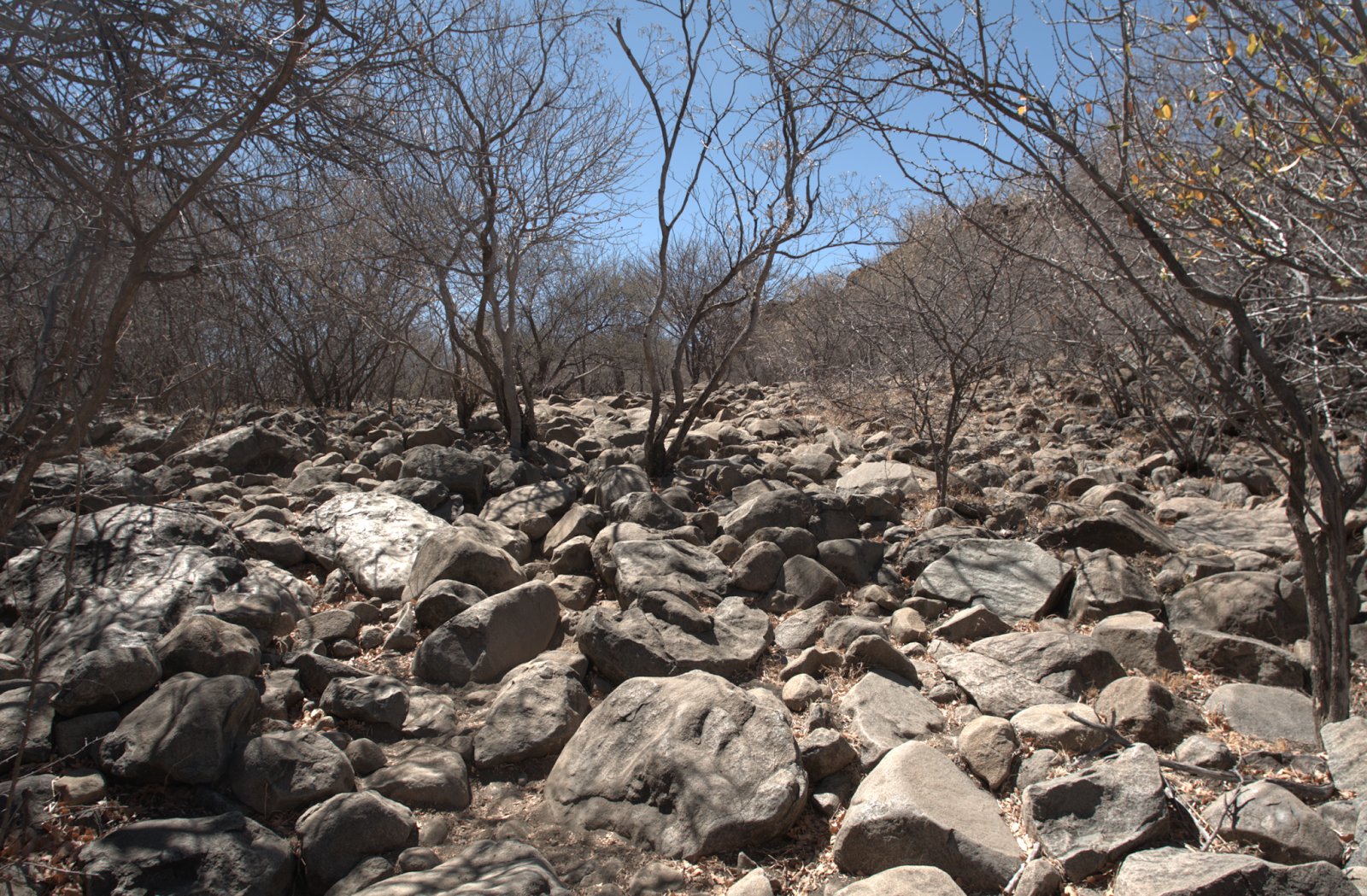
The hills forms a saddle and you can walk through it down to a river – dry, of course – which we realized was the same one that was once responsible for Shoshong’s prominence.  In this area of the hill, there was an iron age settlement over 1000 years ago.  The Botswana National Museum tells us that these people worked metal for tools, kept cattle, and grew crops in the area.  The relics are at the museum and not much remains to be seen of the Pitsane Hill settlements today, but the walk is wonderful.  You climb the hills – sharing the route only with cows, who seem to know where they're going although there is really nowhere to go.  There are wonderful views of the surrounding plains.  You descend through a gorge into the riverbed, surrounded by the fascinating Dolerite boulders and screes of the hills that protected Shoshong from hostile tribes to the north.  But the most fascinating part is to be surrounded by the amazing Paperbark Corkwood trees (Commiphora Marlothii).  Our timing was perfect.  The trees were developing new green spring bark, sloughing off the old in rice-paper like fragments.  As you walked, the wind made them whisper and rustle like animate things.


The launch was great, but it’s the walk in the hills of Pitsane that I’ll never forget.


Oh.  I was supposed to tell you about Shoshong.  Well, another time.

Michael – Thursday.

Photographs by Jonathan Everitt.

Thursday, July 19, 2012

Caravela

I'm sure Leighton knows all about the Caravela - the small, fleet, sailing ship developed by the Portuguese in the fifteenth century mainly to explore the coast of west Africa.  Detective Kubu knows all about the Caravela too, but for a different reason.  It is the name of far and away the best restaurant in Gaborone, and, for special occasions - or indeed whenever he can find an excuse - Kubu will make his way there and enjoy food which is Portuguese in character but with a subtle African fusion.  At the end of the next Detective Kubu novel, he and Mabaku sit under the trees in the courtyard, toast their successes, and lick their wounds.
My friend Jonathan Everitt is a photographer, IT specialist, and occasional (like this is the first occasion) restaurant reviewer.  I thought it would be interesting to see his take on the past, present, and future of the Caravela on his first visit to Botswana last month.  
Over to Jonathan:


On the 21 June 2012, I found myself in Botswana rendering IT support to one of our branch offices in the Kgale district of Gaborone. I was probably a stone's throw from the Criminal Investigation Department offices, and might have looked up Kubu, but I didn't know that at the time.  Botswana feels quite different to South Africa. For one thing, I felt slightly alien as there were very few white people in the city, a different feel but certainly not threatening in any way, rather the opposite. On Michael's recommendation, after work that evening I took the opportunity to visit the famous Caravela Restaurant, renowned for its Portuguese fare. The restaurant is situated inside a residential area, and, from outside the property, one can see the large trees providing shelter to the courtyard tables. 


The restaurant officially opens its gates at 6pm, so I spent some time waiting outside and taking photographs until the new managers, James and Sue, arrived. I was welcomed in and told to make myself at home as they prepared for the evening. I chose a two-seater table in a corner, and made my way around the restaurant with camera in hand.  I familiarized myself with the bar, and menu as the waitresses busily prepared tables and cleaned up. I went outside and took some photographs of the courtyard section, empty given the cool weather.  Still, I could visualize the lunchtime bustle as customers enjoyed the shade provided by the large trees, the wall allowing one to forget the neighboring suburbs. By this time, Tony, the owner of the Caravela, arrived, and was kind enough to spend time with me, giving me some background on how the restaurant began.

Originally from Mozambique and then Rhodesia, Tony arrived in South Africa in 1982 where he began a catering business. He remarked how different the people were when he first arrived in South Africa, and although welcoming, he found them quite reticent in developing the easy friendships he was used to from his Rhodesia days.  In 1996 he and his wife, Lou, left South Africa and settled in Botswana where they started the Caravela, following the dream they both shared of owning and operating a distinctive establishment that offered Portuguese food in an intimate and comfortable setting, without a pretentious air about it. My impression was that the restaurant was to be regarded as a special place, as though one was visiting a friend's home. Certainly that was how they made me feel. Tony brought James and Sue on board to operate the restaurant as he wanted more time to relax and enjoy his life with his family. My observations of the four together during the evening were of a close-knit family working in synchronicity- a refreshing change from the majority of Johannesburg restaurants.


From the starter menu I chose the prawn cakes (4 in a serving), which were delicious, while I enjoyed the house red. For my main course, I chose the Bife a Portuguese, grilled fillet steak with wine and garlic sauce, topped with bacon and fried egg and served with rice or chips.The steak was a sizeable portion, but the flavor was what made it. It was prepared as I always prefer, medium-rare. At the risk of being boring, I would choose the same meal again.  Given the satisfaction I got from that dish, why choose anything else?  But fish lovers  can select from seafood kebab (Espetada De Peixe), two styles of southern Africa's delicious local Kingklip, Sole, Calamari, Cod fish, and finally Portuguese sardines. Then there are meat and chicken specialties which all looked excellent.

At times the electricity went out (Tuesdays and Thursday are the days that this happens apparently), but in a couple of seconds a generator somewhere at the back of the restaurant started up and everything resumed once more. No one expressed a murmur of discontent when the electricity failed - indicating that the diners were regulars, used to this. 

During the course of the evening, the atmosphere was warm, and the conversation levels kept low, befitting the intimate atmosphere of the candlelight, especially when the power was off. The tables were well spaced for privacy and the service was attentive, but not intrusive. 

The conclusion to this evening was that, funds permitting, I would fly to Gaborone just for supper at Caravela!

Thanks, Jonathan!  I can't wait to get back to the Caravela.  And everyone thought Stan and I go to Botswana for the wildlife when, as you see, it's all for research...

Michael - Thursday.