Showing posts with label A Carrion Death. Show all posts

Wednesday, January 26, 2022

Where do ideas come from?

 Stanley - Thursday

Every writer of mysteries has been asked where they get their ideas. I normally respond that there is no shortage of ideas. The real issue is whether the idea has enough meat to sustain a book-length story. I also say that Michael and I usually start with a backstory we're interested in, then brainstorm possible stories that can float on top of it.

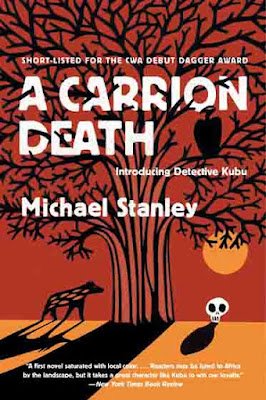
However, that wasn't how our first book worked! We had a terrific premise - if you leave a body out for hyenas to consume, it would be nigh impossible for the police to have a case, because those wonderful animals eat both the flesh and the bones. As we often say "No body, no case." So we had to build a story, a plot, around that terrific idea. And A Carrion Death emerged.


Our second book, The Second Death of Goodluck Tinubu, started with the backstory of the Rhodesian Civil War, on which we built the story of two people who fought on opposite sides being at the same tourist camp in Botswana. The third book, Death of the Mantis, started with our interest in the demise of the Bushmen in Southern Africa, and became the story of a desparate quest to preserve a most sacred Bushman site.

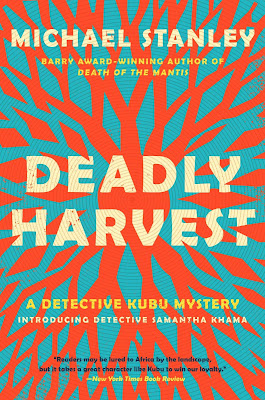
Deadly Harvest, our fourth book, was very different. When we were researching the series, before the first book was finished, we spent an afternoon with the Director of the Criminal Investigation Department of the Botswana Police Service. He drove us all over town, telling us stories, answering urgent calls from his staff, and so on. He suggested very strongly that we use the brutal practice of muti murders for one of our books. A muti murder is when a witchdoctor uses human body parts for concocting a powerful medicine (called muti locally). He told us of the infamous case of Segametsi Mogomotsi, a fourteen-year-old girl who was murdered for body parts, a case that had never been solved. We researched it and used it specifically as the backstory of our tale.


Books five, six, and seven (
A Death in the Family, Dying to Live, and Facts of Death) had contemporary issues as backstories: the increasing presence of Chinese in Africa; biopiracy; and the enormous importance of diamonds to Botswana's economy and politics.

We'll tell you more about the Detective Kubu book we have just finished sometime soon. It's called A Deadly Covenant. 

Switching to our thriller, Shoot the Bastards, featuring investigative reporter, Crystal Nguyen, we had the whole shocking story of rhino poaching and rhino-horn smuggling to work with as a backstory. Even so, we struggled with the writing, several times grinding to a halt at about 20,000 words. Eventually I suggested to Michael that I write a few chapters, a few stories, about what Crystal did in her job in Duluth, Minnesota. I did that and ended up with about 60,000 words, which, during COVID, I reworked into my first solo book, Wolfman.


An unsettling part of Wolfman is the fact that Crystal, an ambitious investigative reporter, creates news stories that she later reports on. I've been asked a number of times where that idea came from. It actually came from a blog I wrote many years ago here on Murder is Everywhere. Here's that blog.
______________________________

Most countries have criminals or criminal events that capture the public’s imagination, sometimes positively, but usually negatively.  Some that come to mind are Bonnie and Clyde, Al Capone, Ted Bundy, Jeffrey Dahmer, Charles Manson, Ronald Briggs and the Great Train Robbery, Jack the Ripper, and so on.  We all have heard of these people and the crimes they perpetrated.

In South Africa, it was what the media called the Stander Gang that caused newspaper sales to soar.  The public couldn’t get enough information (or speculation) about the gang and its exploits, and even today there are many South Africans who wish that the gang had got away with its daring exploits.  In fact, at one stage in the spree of bank robberies, it became a badge of distinction to have been robbed by the gang.

The gang was named after its leader, André Stander, son of a senior officer in the Correctional Services, Major-General Frans Stander.  After failing high school, the Major-General suggested (!) that André join the police.

In a surprising turnabout, André was selected as the Best Recruit in 1964.  After graduating he rose through the ranks and was promoted to captain in 1977 and headed the Criminal Investigation Department at the Johannesburg suburb of Kempton Park, near Johannesburg’s international airport.

Apparently his success in the police force didn’t meet all his needs, probably both emotional and financial.  So he took up robbing banks as a hobby.  On his days off from his police job, he would fly to Durban, don a disguise, rent or steal a car at the airport, and go and rob a bank or building society.  When he finished he would drive back to the airport, fly back to Johannesburg, and become a policeman again.

He did this for three years, leaving his colleagues in the police force bewildered, with no clues as to who was pulling off the audacious jobs.  As is so often the case, he became overconfident and boasted to one of his close friends about what he was doing.  The friend worked for the Bureau of State Security (BOSS) – one of the draconian arms of the apartheid government.  The friend reported the comments, and the police set up surveillance. 

Sure enough, after flying into Johannesburg from a heist in Durban, he was apprehended with money, disguises, and a firearm in his luggage.  He was found guilty on 15 of 28 charges of bank robbery and sentenced to an effective 17 years in a maximum-security prison.

At this stage in his career, he enjoyed only minor celebrity status, which included rumours that he would rob a bank during his lunch hour, then return to it later to investigate the crime.

 However, it’s what happened next that catapulted him to the spotlight and fame.

While in prison, Stander met and befriended two other bank robbers, Patrick Lee McCall and Allan Heyl.  In August 1983, Stander and McCall, with several other prisoners, were scheduled to meet with a physiotherapist.  While in the waiting room, Stander and McCall overpowered their guards and the poor physiotherapist and escaped.

About two moths later, Stander and McCall returned to the prison and sprung Heyl from the maximum-security facility.  Then the fun began.  

Over the next three months, what became called the Stander Gang, robbed at will.  They raided a gun shop and took an arsenal of weapons.  Stander took a yellow Porsche Targa for a test drive at a dealership and left the salesman gawping as the Porsche sped into the distance.  Far from coy, Stander used the Porsche to go to nightclubs and to transport girls from an escort agency to and from the gang’s three safe house in the affluent suburb of Houghton.

In the two months from mid-November 1983 to mid-January 1984, the gang robbed twenty banks, sometimes four in a day.  Each time they robbed a bank, the newspapers splashed their deeds all over the front page, and the public cheered.  They saw Stander as a modern day Robin Hood, a gentleman robber – although there is no evidence he did anything charitable with his money, and in fact the police were pretty sure he was a rapist.  The more the gang robbed, the more support the gang garnered from the public. 

Again over-confidence took hold.  Stander robbed a bank, in disguise, but without his sun glasses.  A camera caught him in action, and the police at last had a clear image of his face – which they gave to every newspaper in the country, as well as to TV.  Stander realized that time was running short and arranged to buy a yacht in Cape Town in which the three could sail to the United States.  Stander flew to the States on a false passport  to finalize details.

The day after he left, apparently based on information offered by some of the escort agency girls, the police surrounded one of the safe houses.  After a mighty gun battle, McCall was killed.  Heyl, who was elsewhere that evening, then fled the country and went to ground in Greece, on the island of Hydra.

Mugshots of Stander by Florida police
Stander meanwhile assumed the guise of an Australian writer in the Fort Lauderdale area of Florida.  He bought an old Ford Mustang, but was stopped by the police shortly afterwards for driving an unregistered vehicle.  They photographed and fingerprinted Stander (or Peter Harris, as he was known) and impounded the car.  Undaunted, Stander broke into the police impound lot and stole his car back.  Then he did something that boggles the mind – something that if any of us tried to use in one of our books, the editor would delete it immediately, rolling her eyes, thinking how stupid some writers can be.  Stander took the Mustang back to the second-hand dealer from whom he had bought it and asked for it to be sprayed a different color.

As luck would have it, the dealer had read in the local newspaper about the Stander Gang and recognised Stander when he walked in.  He called the police.  That evening the police surrounded Stander’s apartment, and when he showed up around 10:30 PM, they confronted him.  He tried to wrestle with one of the policemen, whose shotgun went off, fatally wounding Stander.

As for Allan Heyl, he left Hydra for England, where he pulled a small heist.  Eventually a confidence trickster he had befriended, turned him into the police.  He was arrested at a house in Surrey.  In May 1985, he was sentenced to nine years in prison.  When he was released, he was extradited to South Africa where he received an additional sentence from which he was paroled in 2005.  And guess what?  He is now a motivational speaker!

__________________________________

I so loved the idea of a policeman robbing banks, then returning a day or two later to investigate the robbery, that for a number of years I had toyed with ways I could use it. So, when I started writing about Crystal Nguyen, investigative reporter, it occurred to me that the same principle could be used. News reporter creates a newsworthy event, then later returns to report on it. Unethical? Certainly! But what's an ambitious, young, female reporter going do when she's sidelined on the news desk? 

Of course, the whole idea comes back to bite her, and her life's in jeopardy, as it was for Stander. Fortunately for me, Crystal is still alive.

Do you have an idea for a new adventure for Crystal? If so, please let me know! Then I won't have to look around for ideas, because they'll come from you.

Thursday, January 9, 2020

Why we went backwards

Stanley - Thursday

Two days ago, our seventh Detective Kubu mystery hit the bookshelves in North America. It is called Facets of Death. What sets it apart from the other six is that it is a prequel.

The first Kubu novel was A Carrion Death which was set contemporaneously with its publication in 2008. Each successive book followed the same pattern. After our detour to the stand-alone thriller Dead of Night outside North America (Shoot the Bastards in North America), we wanted to return to Kubu and decided to return to his professional roots.


When we started writing A Carrion Death, we didn’t plan that Kubu would be the protagonist. As novice novelists, we heeded the the advice of the experts, who said we should write about what we knew. So, as academics ourselves, we planned that a brilliant young ecologist would discover a body that had been left in the desert for hyenas to devour and go on to solve the mystery. 


However, it was obvious to our young professor that it was no accident that the body was lying naked on the Kalahari sands. It was a case of murder, so the police had to be called in. So, with much amusement, we sent a detective, David Bengu, from the CID headquarters in Gaborone into the Kalahari in his Land Rover. Let's make him big, we said. Very big! So David Bengu became David 'Kubu' Bengu. His nickname means hippopotamus in the Setswana language. Ho ho ho, we laughed and had another glass of wine.

It's a long drive in unfavourable condition from Gaborone to where the body had been found in the middle of the Kalahari Desert, so we had to find things for Kubu to do.

First, he provisioned himself with sandwiches and something to drink (non-alcoholic because he was driving and on duty). After all, big people have to eat a lot. Then, he brought along some cassette tapes of some of his favourite operas. Ho ho ho! A Botswana detective who loves opera! Giggle! And then he sang along with them - in his only-sing-along-when-no-one-is-around baritone. Clink! Another toast.


We were really enjoying this character we were developing.

He also had time to muse about how a Bushman school friend had shown him how to see clues of things hidden in the desert, such as the stone-like Lithops plants and the trapdoor spiders. Aha, we said. That was the spark that made Kubu want to become a detective. He would train himself to look beyond the obvious.

It can be really difficult to find Lithops.
Trapdoor spiders build their homes in the ground.
Trapdoor spider
 By the time this larger-than-life character had visited the scene of the crime and interviewed the men who had found the body, he made it clear to us that he had to be the main character. That came as a complete surprise. We thought we were in charge of the story.

Fortunately for us, it turned out that Kubu was a major attraction for readers. Marilyn Stasio in the New York Times summed up the matter succinctly in her review of the book: “Readers may be lured to Africa by the landscape, but it takes a great character like Kubu to win our loyalty.” 

We were delighted that Kubu won readers’ loyalty, but the fact remained that he was unplanned. 

How well did we actually know him? 

He was smart and good at solving problems. Unlike many detectives in police procedurals, he was happily married and sober almost all of the time. Of course, during the series his character developed, his relationships with his wife, parents, and colleagues deepened, and he became more solid, more three-dimensional. There were clues about his childhood in the books—things that had come up as we went along. 

We knew he had loving, traditional, but Christian parents, and that their minister had arranged a scholarship for him at an excellent private school in Gaborone. We knew of his Bushman friend. We knew he loved to do puzzles with his father. We knew where he’d met his wife. But there was nothing that explained how he’d gone from school to being the star detective in the Botswana Criminal Investigation Department. It was not just a hole in his background, but, in a way, a gap in his character.

Diamonds have always been one of Botswana’s most important exports and allowed the newly independent country to flourish. The two richest diamond mines in the world are there, owned by a joint venture between the government and the diamond giant De Beers. The fact that the country was almost totally reliant on diamonds for its success made us wonder about the impact of a massive heist. Could it shake the country’s financial foundation?

Second largest uncut diamond ever was found in Botswana a few years ago.
It is 1109 carats and named Lesedi La Rona (Our Light). 
 We decided to address both the issue of Kubu’s early role in the CID and a robbery at the height of the diamond boom by writing a prequel to the series—a Kubu mystery that starts the day he joins the CID as a new detective straight out of university without ever having to be a constable on the beat. 

Immediately things started to take shape. Kubu’s first case is a minor matter concerning a few suitcases going missing at Gaborone airport. Yet it’s a challenging puzzle, and he loves it. However, the other detectives, who have come up in the CID the hard way, have no time for him. He has to struggle to find a place for himself. Sometimes his new boss, Assistant Superintendent Mabaku (who will later become director of the CID), seems disappointed in him. Then, a massive diamond robbery takes place and suddenly everything changes. Everyone is thrown into the case, even the raw detective in his first week on the job.

As we wrote the prequel, we were delighted to watch Kubu develop, having insights, but also making the mistakes that only experience can avoid. He earns respect, but also opprobrium. And as Mabaku comes to appreciate his talents, Kubu becomes more and more central to the case. Eventually, they deduce who the mastermind behind the robbery actually is, but they have no strong evidence. Now they have to find some way to catch him, and Kubu and Mabaku both find their careers on the line—in Kubu’s case, before his career has even begun. 

By the end of the book, Kubu has learned a lot about being in the CID and how to interact with his colleagues and his superiors. He has also fallen in love with a wonderful women, and sees some hope that his feelings are reciprocated. 


Writing Facets of Death was a journey of exploration for us. We learnt a lot about how Kubu became the CID’s best detective and about who he is as a person. We know him better now. 

It was fifteen years between putting fingers to keys for A Carrion Death and for Facets of Death. We enjoyed writing the prequel just as much as the debut - perhaps with just a little less wine. We hope readers will enjoy the young Kubu’s journey also.

Thursday, June 2, 2016

The accidental protagonist and other serendipities


This book-writing business has been a lark from beginning to end.  It happened by mistake and remains serendipitous.

If Michael and I hadn’t seen, in Botswana’s Chobe National Park, a pack of hyenas hunt, kill, and consume a wildebeest in four hours—all of the wildebeest, flesh and bones—we probably would never have thought about writing a mystery. 


Licking the plate after all was gone!
Nothing left for her
Then, it took us more than fifteen years to start writing A CARRION DEATH (which is regarded as borderline impatient in our academic circles), but at least we knew how it was going to start, which saved a few years.  However, we had no idea how it was going to proceed, so we took another three years to finish it, probably throwing away as many words as we kept, because we had no clue what we were doing.  Neither of us had written fiction before—at least not since we were very young.

We were told to write what we knew.  Sounded good, so it was a professor who stumbled across a hyena that had not quite finished dining on a human body.  The professor was smart, in a cool field (ecology), and stood out in comparison to his companion, a game ranger.  He figured out what was going on very quickly, and we were delighted we’d created such a good protagonist.  However, we realised that he couldn’t do everything himself, that we would have to bring a detective from Gaborone to the middle of the Kalahari to do the official  investigation – after all it was a murder.

The only detective who was free that day was Assistant Superintendent David Bengu, sporting what some thought was a rude nickname—Kubu, or hippopotamus in the Setswana language.  And yes, he was big and ponderous.   And dangerous.

Photo: Aron Frankental
So this secondary character jumped into his Land Rover, with sandwiches, something to drink, and various tapes he could sing along with.  Opera tapes.  And the Land Rover was his only stage—and then only when alone—because he was the only person on the planet who thought he had a decent voice.
Kubu faced dangerous animals on the road through the Kalahari.
And as he drove along the sands of the Kalahari, singing lustily, he taught us a lesson we’d never forget.

We thought, as the authors of the book, that we’d be in charge, in control of what happened, and of who did what to whom.

Not so, it turned out.

By the time Kubu had arrived at the camp near where the body had been found, he’d taken over as our main character.  We can just see him, as he was driving, saying to himself: “A professor as protagonist?  Eish!!  No way.  It’s going to me.”

And so it came to pass.  We capitulated immediately, relegating the professor to the background, and Kubu became our accidental protagonist.  To be fair, as Michael always says, we did give him a consolation prize, marrying him off to Kubu’s sister-in-law in a later book.

While writing A CARRION DEATH, we realised we knew nothing about the police or their procedures, at least from the inside, and even less about the Botswana police.  So we started emailing and phoning the Director of the Botswana Criminal Investigation Department (CID) – Director Mulale.  He ignored us.  And continued to ignore us as we continued trying to contact him.  Even his assistant director ignored us.  We felt most put out.  

Eventually we went to Gaborone, Botswana’s capital, to research locations for the book.  When we arrived there one Friday evening, we continued to hound the Director – somehow we’d managed to get hold of his mobile phone.  Eventually, in sheer exasperation, he capitulated, saying “ You’ve worn me out!”  We agreed to meet at noon on the Saturday at our hotel.

Gaborone market outside our hotel
Director Mulale arrived, as tall as Stanley, in jeans, cowboy boots, and a Stetson, and then more than made up for his reticence.  He spent the next six hours driving us all over the area, showing us where various crimes had taken place, where the best drugs were sold, where the police were trained, and where the bad guys were imprisoned. 

Police Training College
Three things stand out about that afternoon.  

First, Director Mulale's friendliness and willingness to share what he knew despite our earlier obnoxious persistence.  

Second, as we drove around, Director Mulale’s mobile kept ringing about a gang of armed South African bank robbers who were in the town of Lobatse, south of Gaborone.  Mulale kept telling his assistant the he was busy with some writers from South Africa and that he, the assistant, should take care of the bad guys.  

And third, during the afternoon, Director Mulale told us that if we wanted to write about something really important, we should write about muti murders – and he told us about the true story of Segametsi Mogamotsi, a young girl who had been abducted, murdered, and various body parts taken for muti or magic potions.  It was on this story that we eventually based DEADLY HARVEST.  He was clearly frustrated by the inability and unwillingness of the police to bring closure to muti-murder cases.

Just released UK edition by Orenda Books
Finally, even though we’d written A CARRION DEATH as a lark—to see whether we could actually write a mystery—we liked it enough to try and get it published.  I was in the States at the time and started sending out query letters to various agents.  Lots of query letters.  Some agents said no; some didn't reply; a few asked us to send more, then said no.  We despaired as all our efforts appeared to be of no avail.

Then, to our great excitement, an agent said she would like to represent us and sent us her contract.  We were very puzzled by it —we didn’t understand it.  There were sections that contradicted each other, sentences that made no sense.  We offered to rewrite the contract, an offer that wasn't well received.  

However, as new authors, we were also VERY keen to get published and were about to sign despite having no idea what the contract meant, when I had dinner with some neighbours.  I told them the saga of the contract, and serendipity intervened once again.  One of the guests said they knew an author I should contact.  To cut a long story short, we soon signed with the writer's agent, who, within a few weeks phoned us to tell us she had a contract with HarperCollins.

HARPERCOLLINS!

“I assume you’re writing a series,” our agent asked.  “Of course,” we replied, never having had the slightest intention of writing a second Kubu book.

“Please email me the synopsis, asap.  Harper's only interested in a series,” she said.  “Of course,” we replied, not having such a thing.

So we scrambled mightily and came up with a synopsis that appeared to satisfy our soon-to-be editor.

Then we signed A TWO-BOOK contract.  Gadzooks!  AND, they were going to give us money up front!  Real money! 


And since then we’ve been part of a mysterious world, filled with contradictions, sometimes frustrations, as well as a great deal of enjoyment. 

And perhaps the most serendipitous outcome of watching those hyenas is that we now hang out with the nicest and most supporting people you will ever meet.  Thank you!


Thursday, July 17, 2014

The Instant Experts

Last week Stan wrote a summary of how we started writing together (indeed, how we started writing fiction at all), where it went, and where – hopefully – it’s going.  Apart from getting published in the first place, three things really surprised us when our first book was published.  Here we were, two academics, neither of us in the arts let alone experts in creative writing, who had somehow put together a book that some people seemed to enjoy and find worth reading, and even pay for.

The first surprise was that we were suddenly instant experts.  Clearly we had discovered the secret of writing successful fiction, getting big advances from publishers, and gathering award nominations.  A few prospective writers felt it would be reasonable for us to share this secret so that they too could become successful scribes.  Yet the only advice I felt I could offer with any confidence was “You have to be really lucky" and "Don’t give up your day job.”  This wasn’t what they wanted to hear, and many drifted off with the attitude that we were meanly keeping our secrets to ourselves.

The second surprise was the reaction we had from other mystery writers.  Surely people who had been writing for twenty years, learning the trade, and hammering out rejected manuscripts as they honed their skills, would hardly welcome two Johnny-come-latelies who admitted that their formal training in writing was obtained from a few books recommended by writer friends.  Instead, we found positive interest and generous support.  The established writers were keen to help, supporting us and our books, making introductions, offering blog spots.  We’ve been told that not every genre behaves that way, but in the mystery circle the attitude almost universally seems to be one that the whole is bigger than the sum of the parts i.e. that one more successful mystery book or successful mystery writer improves the chances for everyone. This is how one would like the world to work, but, in practice, it seldom does.

The third surprise was that our mystery writer colleagues also came from diverse backgrounds and seemed to have been drawn to mystery writing by the love of storytelling and the genre rather than by any academic route.  That’s not to say that they hadn’t worked their way up, learning the ropes, earning their stripes.  Quite the contrary.  Most had done exactly that, but few had followed an academic route.  (Take a look at the backgrounds of the other writers on this blog and you’ll get the point.)  They worked to improve what they did anyway – write fiction.  The issue was to write it better.  It’s almost a tautology to say that the best way of learning something is to do it.  I can’t think of any area where this is not true to some extent – usually a large extent.  I often do presentations to my classes in image processing and watch the students making notes and – not infrequently – drifting off.  I don’t care as long as they go to the computer labs afterwards and see how it all fits together.  Then they will go back to the notes and study what they can find to help them with what they want to do.

Stan and I didn’t know anything about writing fiction when we started.  A CARRION DEATH took us three years to write mainly because of that.  Most of what we wrote was thrown away.  Most of it was just learning not writing.  Hopefully what was left was worth something.  We had no idea.  We didn’t even know enough about writing fiction to know that the conventional wisdom was that two people shouldn’t do it together.  Most of our writing colleagues are amazed that we do just that and that it works for us.  When we learned a lot more, we discovered that there are quite a few successful fiction writing teams, but that most of them write – like us – under a single name.  Another thing we believed was that our rather random development of the plot from a premise, a few ideas, and some characters was another symptom of our lack of knowledge and experience.  We were smugly pleased that our second book, THE SECOND DEATH OF GOODLUCK TINUBU, was planned and plotted and followed the synopsis.  More or less when we finished it, we discovered that more often than not, mystery writers use a premise, a few ideas, and some characters and let them drive the story – pantsing not plotting.  So much for the instant experts!

Still, we are teachers.  There we do have experience although teaching at college level involves about as much formal training as we have in writing fiction.  So last year we found ourselves giving a couple of sessions at a mystery writing workshop in Minneapolis.  The topics were collaborative writing, and dialog in foreign cultures.  Maybe we’ve learned something about these areas.  Certainly we enjoyed the workshop and Kent Krueger’s plenary talk gave us the kernel of an idea which led to our new Kubu novel.  We were happy to join the gang, try to help aspiring writers as others have helped us.  We met a great group of people and enjoyed their ideas, their questions, their thoughts.  One of them – Dr. Tom Combs - let us give him input on his first novel, NERVE DAMAGE – a tight medical thriller with a really original premise and some great characters.  In return, he’s helped us with medical issues related to our books.

It’s a great community of people – the writers, readers, editors, developing writers.  We’re grateful to be a part of it.


Michael – Thursday.

Thursday, June 21, 2012

Two Heads

Greg and Lisa
When Stan and I started writing A CARRION DEATH, we didn’t give too much thought to the concept of two people writing fiction together.  We were used to working collaboratively in our academic careers, and it seemed natural to take on a novel as a joint project.  Later we realized that it was quite unusual for fiction to be written jointly, and still later we discovered that, in fact, there were several successful writing partnership in the mystery and thriller genre – Nicki French, Charles Todd, PJ Tracy, Roslund&Hellström are excellent examples.  And it seems to be becoming more common, even in South Africa.  Recently a husband and wife team, who live in Cape Town, published a dark, psychologically driven thriller - WHEN IN BROAD DAYLIGHT I OPEN MY EYES - to critical acclaim. Greg Fried and Lisa Lazarus write under the name Greg Lazarus.  Greg is a philosopher at the University of Cape Town, Lisa is a psychologist and freelance writer.  You can read more about Greg and Lisa and their writing at: www.greglazarus.com
Unfortunately their book is currently only available in South Africa but, after reading it, I’m sure that’s going to change. 
Of course, Stan and I were very curious about how this new South African writing duo operates, and how their style compares to ours.  So we got together (electronically) and compared notes.
When you write - at least, your first draft - do you divide the work by characters, scenes or in some other way? Do you plot the whole book before you begin?
Greg & Lisa: For WHEN IN BROAD DAYLIGHT I OPEN MY EYES, we began with a very simple idea. There would be two main characters: a female psychologist, and a man with bad intentions. Every scene was to be written from the perspective of either the psychologist or the menacing figure. We each took charge of one character, and assigned the scenes accordingly.
That first draft was a mess. However, once we had finished it, we had definitely gained more insight into our characters, plot and setting. We then went back to the beginning and rewrote everything scene by scene. This time we collaborated closely: we bounced the chapters between each other many times, deleting scenes, adding new ones. Then we worked through the book again, and again...  We kept revising the novel until the people, action, tone and other features felt right.
Now we’re working on a book that we’re trying to plot carefully before we start writing. We’re interested to see whether it’s any easier, and how the preparation might influence the result.
Michael & Stanley:  We don’t divide the draft by characters, we do it by scenes.  Sometimes it’s a matter of knowing something about the context – for example Stan is a pilot and Michael worked in the diamond mining industry – but sometimes it’s just who has an idea or “sees” the scene in his head.  That’s the first draft.  Then we swap the scene back and forth until we’re both happy with it.  That could take more than 20 iterations!
As far as plotting is concerned, A CARRION DEATH grew like topsy and went through many changes of plot.  A DEADLY TRADE was planned out carefully and that worked well, but DEATH OF THE MANTIS was somewhere in between, and so is our new book.  There doesn’t seem to be a perfect strategy – at least not for us.
As writers, do you have different temperaments, notice different things, write in different ways?  What about the gender mix?
Michael and Stanley:  Well, it would be interesting to have a female perspective on things, and perhaps it would be easier to draw female characters.  We are sometimes asked about how we can write a black character from a different culture.  We think the cross culture thing may be harder than the cross gender thing.
Greg and Lisa:  Maybe Greg is terser and more implicit in his style, and Lisa more explicit and expansive. Also, perhaps Greg is more interested in abstract ideas, and Lisa in the dynamics of a relationship.
We used these differences in the first draft, where each of us began to establish a voice for one of the main characters. But in subsequent drafts, where we both worked on everything, we were each careful to write in a way that would be natural to whichever character whose scene it was. By now, neither of us can say of any sentence in the book, ‘That’s mine.’
Do you find that writing as a duo helps you to write a rich novel, or does co-writing make it harder to keep it all coherent? (Both found the other’s book seamless.)
Greg and Lisa:  We write better when we write together. The risk of incoherence is higher than it is for a lone writer, maybe, but the reward feels greater.
We’ve found that people are often surprised that fiction can be created collaboratively. But of course, other writing projects – for instance, scriptwriting for TV – are often collaborative too, and that doesn’t amaze anyone. Maybe the idea is that literature is, or should be, the product of a single mind, a communication from one author to the reader. We wouldn’t accept that, though we do agree that it’s crucial to produce a coherent work.
Michael and Stanley:  We think we gain a lot from brainstorming and working through scenarios together before we write them and discover that they don’t work!  On the whole, we both keep track of where we are and keep the unity of the book in mind.
Do you think that crime and thriller writing is especially suited to co-writing, in comparison with other genres?
Michael and Stanley:  We hadn’t thought about this before, but we think the answer is probably yes.  All fiction is driven by story and characters, but the plot is a very important component in crime novels.  We think the brainstorming aspect is very helpful in that context.  We have certainly found it so.

Greg and Lisa:  We’re not sure. Maybe any genre is well-suited to the pooled ideas and writing skills of co-authors. Of course, almost every book already has more than one person working on it in some way: there are editors and proof-readers too.
Does working collaboratively mean that productivity is higher?
Michael and Stanley:  When we are asked about productivity, we sometimes joke that we work twenty-four hours a day (when Stan is in Minneapolis eight hours behind Michael in Johannesburg).  Actually, we don’t think that being two people means we write the book faster.
Greg and Lisa:  On the one hand, we felt that revisions were more efficient with two people. On the other hand, co-authorship seemed to make the need for revisions greater! So perhaps these factors balance each other.

 One task that took a long time was to inhabit the same imaginary world. The first draft felt as if two quite disparate worlds had been welded clumsily together. By the last few months of revisions, we were living, so to speak, in the same place; we had the same ideas about what our characters and our imaginary Cape Town were like.

We finished up by asking each other a couple of specific questions about the books:

Greg and Lisa:  As far as we can gather, neither of you live in Botswana. What made you choose that country as the setting for A CARRION DEATH? What has been the international response to setting your book there?

Michael and Stanley:  There are really several reasons.  We wanted to set the book in a location where the idea of leaving a body to be destroyed by scavengers made sense.  We didn’t feel that would work well in South Africa.  We also wanted to explore an African culture that was stable and not working through the aftermath of Apartheid, yet still had intrinsic problems.  Finally, we’ve both spent a lot of time in Botswana and love the diversity of the country - both the environment and the people. 

The main issue with overseas reaction was the McCall Smith issue.  Where we trying to ride on his coat-tails?  Actually we didn’t know about McCall Smith’s work when we started the book, and our novels are very different from his in any case.  Other than that, reaction has been very good.  Several reviewers have described Botswana as a character in its own right in our books.

Michael and Stanley:  Your two main characters in WHEN IN BROAD DAYLIGHT I OPEN MY EYES are an academic philosopher and a psychologist.  We’re sure their characters are very different from your own, but there’s an obvious parallel.  Was this a case of “writing what you know”?  Presumably this novel is a “stand alone”.  What’s the strategy for the next book?

Greg and Lisa:  Our lives are much less thrilling than those of our main characters! But yes, we thought we might convey a little of what it’s like to be a psychologist, or a philosopher, though we did reshape these experiences so as to support the ominous, gothic atmosphere we were  hoping to achieve. 

We found our professions useful in other ways. Psychologists are trained to look for complexity in people: their contradictory desires, for example, and their mixture of goodness and malice. That’s helpful for creating characters. And philosophers attend to fundamental questions, such as how a person’s worldview influences her life; we were interested in this as one of the themes of our book.

 We hope our next book will be thrilling, tense, and alert to the intricacy of people. How it’ll turn out, though, we don’t know!

Michael (with Stanley, Greg, and Lisa) – Thursday.

Thursday, March 15, 2012

Baobabs


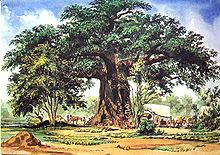
Baobabs are wonderful trees.  I love them!  They store water, the leaves are nutritious for people and animals, they are the source of cream of tartar, and...well, they look as though they come from another planet.  David Livingstone apparently said they looked like "a carrot planted upside down".  I don't quite get that comparison, but in the winter - as in the specimen above - they certainly do look as though the roots are in the air.  They're sometimes called upside-down trees.

The Bushmen have a number of legends about them.  Great story tellers, it is hardly surprising that the baobab would intrigue and entertain them.  One story is that in the beginning the gods distributed the seeds of all the plants to the animals to cultivate.  The hyena was the last to receive his seed and it was a baobab.  He was so disgusted to be last that he planted it upside down.  An even more intriguing story is that baobabs don't grow at all.  They are dropped from heaven fully grown, and being top heavy they land upside down with a loud thud still sometimes heard today... 

The second legend may come from the fact that the trees are very slow growing indeed and the young ones look very different from the adults.  Some of the adults are thousands of years old.  They've seen a thing or two. Like ones with cannon balls embedded in their trunks from battles long past. 

Women's prison tree with new police station.

The largest may grow to 150 feet in circumference, and they can be used as shelters. Baobabs are not very common in Botswana - preferring the tropics - but in the north you see them from time to time.  In Kasane, on the border with Zimbabwe, they were even once used as prisons - one for men and one for women.  When the new police station was built, it was designed so that the trees and their history could be preserved.


Prison trees seemed to be an idea whose time had come.  This one in Australia was used for a similar purpose.

This one does service as a pub.


Here's one on Kubu Island growing from the rocks.  There aren't hippos on that dry pan despite the name!


Baines' Baobabs.


A Baines painting.

This group in the northern Kalahari is known as 'the sleeping sisters', here in full leaf after unusually wonderful rains.  The group is also named after Thomas Baines, naturalist, explorer and painter who seemed to have an affinity for these trees.  He travelled with Livingstone, and also explored in Australia.  Perhaps he was after the baobab species there.  There the name is shortened (as with many names in Australia) to baobs.


Madagascar

The family name is Adansonia and there are only eight species in the world.  One is widely spread over Africa and Asia, one occurs in north-west Australia and the other six are in Madagascar.  It's one of the many reasons that I'd love to visit there one day and see the forests of these amazing trees.  The Madagascar species look quite different to ours; they have a sort of fantasy shape that makes you think they may have walked out of middle earth.

They catch the eyes of editors too.  Two of our books have them on the cover amid the African reds and oranges: A DEADLY TRADE (the UK edition of The Second Death of Goodluck Tinubu) and IL DETECTIVE KUBU (the Italian version of A Carrion Death).  We love the menace of those eyes on the Italian book!  (Cat eyes rather than hyena eyes, but then the baobabs are one of the species  from Madagascar.  No, we don't get to approve the covers!) 

Michael - Thursday