Showing posts with label Kubu. Show all posts

Wednesday, November 19, 2025

The big six revisited

 Michael - Alternate Thursdays

I'm currently travelling up to my favorite bush area in South Africa - Olifants River Game Reserve. I hope to have some interesting things to say about it once I get there, but in the meanwhile here's a relook at one of my favorite animals (and detectives for that matter).

Kubu

The Big Five are elephant, lion, leopard, buffalo, and  rhino.  Certainly these are great contenders for the top animals list, but I do feel one animal has been very short-changed and it’s an animal very close to our hearts (i.e. Stan’s heart and my heart).  That is the hippo.  I’m sure readers of this blog know that kubu is the Setswana word for hippo, and that our detective has that as his nickname.  I think the hippo has every right to be included in the top rank with those other five.  Not only are the animals very large – the males weigh in over 4,000 lbs, coming in third to elephants and rhinos in terms of size, but they are also fierce and can be quite aggressive in some circumstances – they account for more human deaths in Africa than any other mammal.  And they are fascinating creatures and interesting to watch, edging out the rhino for second place of the three ultra-large herbivores in my opinion.  No river in Africa is complete without their cheerful grunting carrying across the water.

From a physiological point of view, the hippo is amazing.  How about an animal that spends its days in the water, but is too dense to float?  That can hold its breath for up to five minutes.  (Don’t try that one at home!)  That has nostrils designed to close under water, and a reflex that allows it to sleep under the water and rise for breathing without waking up.  That has built in goggles (transparent membranes that close over the eyes under water).  And that has built in sunscreen (the hippo secretes an oily brownish substance which protects its bare skin from the sun).  Pretty impressive design, I’d say.  And no rude comments about it being porcine.  (Kubu would be particularly offended.)  The hippo’s closest relations are the dolphins and whales; it separated off from them about fifty million years ago.

Most of the day they spend fully submerged or comfortably beached on a sandbar warming in the sun (having applied sunscreen, of course.)  In the evenings they come out of the water and spend the nights browsing and grazing along the river banks or quite far inland if the feeding conditions are poor as they tend to be in the winter.  At this time they are busy with the important issue of building up that 4,000 lbs of bulk, and you really don’t want to interfere with them.  In particular, you don’t want to give them the idea that you are trying to cut them off from the haven of the river.  That usually leads to aggressive behavior and possibly one of those human deaths.


I’ve had my own close encounter, mostly my own fault.  It was my first time in a canoe on the Zambesi river in Zimbabwe.  I was with a friend who was a bit more expert as a canoeist than I was, but not much.  He was at the back.  At a certain point the guide who was ahead of us in another canoe signaled us to move out into the center of the river; he’d spotted a pod of hippos near the shore.  What he didn’t know was that the hippos had spotted him, and submerged and politely moved to the center of the river to let us pass.  My friend and I paddled out into the river, proud of our calm expertise.  Moments later a huge jaw opened a short distance in front of us; we had not reciprocated the hippos polite behavior.  We immediately put the canoe into what we thought was reverse.  Unfortunately our expertise did not run to reverse against the current.  What we did do was cause the canoe to rotate as the current took us towards that enormous mouth.  At the crucial moment the hippo sank under the water and we passed over it.  I think I know why it didn’t convert our canoe into splinters and us into mincemeat.  It was laughing too hard.


Hippo behavior is complex.  The males have water territories, but will tolerate other bulls as long as they behave in a submissive way.  I've seen an interesting example at one of the dams at Olifants River Game Reserve.  The dam is large and a family of five hippos, one male and two females with youngsters, had taken up residence.  They were a charming group, and most days we would pop in to see how they were getting on.  On this particular evening, we arrived at the dam to discover that it now contained six hippos.  Apparently another male had decided the dam was a nice spot to spend the day.  The altercation between the males seemed to involve bursts of rivalry where they would rise from the water bellowing and threatening each other by matching their enormous mouths.  Then all would go quiet for a while and one would rest its head on the other’s back.  Maybe that’s submissive behavior?  Unfortunately it became too dark and rainy to see what happened in the end, but I’d guess that all six went off feeding and that the interloper would have found a more peaceful dam or river stretch for his day nap.


So from all points of view, I believe that the hippopotamus fully deserve a place up there with the other big five.  I propose that in future we have the Big Six.


Thursday, October 10, 2024

A series in search of a setting

 Michael - Alternate Thursdays

Bushman hunter
Two weeks ago Sujata wrote about how setting makes a series and how she chose her settings. It made me think about how setting drives our Botswana mysteries in almost every way. Deserts are fascinating in their own right and most of the country is the arid Kalahari, but in the north Botswana borders on the Chobe and Zimbabwe rivers and suddenly becomes lush with riverine vegetation and abundant animal and bird life. The people, too, are varied. The largest group is the various Setswana speaking peoples, but there are other cultures as well including the San or Bushman peoples of the Kalahari. The constitution of Botswana guarantees equal rights to all citizens, but that doesn’t mean that there is no discrimination or that people don’t sometimes have to fight for those rights. The Bushman feature in several of our stories, and their struggle is the pivot of Death of the Mantis.

Ever since independence, the country has been a democracy that holds regular elections. It’s true that Seretse Khama’s Botswana Democratic Party has never lost an election, but there have been no serious challenges to the validity of the elections. Probably it’s fair to say that most people are fairly satisfied with the arc of their lives in the sixty-five-year-old nation. Part of that is due to the fact that the local kgosi (chief) and kgotla (assembly) run most aspects of local life as they have done for generations. So while much changed at the time of the British Protectorate and subsequently with the creation of the nation of Botswana, much also stayed the same. The continuity of those aspects of life smoothed the rougher transitions. So did the diamond wealth of the new nation. Both of those are threads in our stories.

Large meeting at the kgotla

Since Stanley and I both know Botswana well from many visits and work experiences, and we both love and respect the country, it doesn't seem unreasonable that we would choose to set our mystery series there even though we are South Africans. But, in fact, it wasn’t like that at all. In the first place, it was never our intention to write a series. We had an idea for what we thought would be an intriguing premise for a mystery and played with that idea for a long time before we set fingers to keyboards, only to discover that writing requires a lot of hard work and a lot of craft (that we had to learn largely from scratch).

Those hyenas again...
Yes, they'll chase off lions if they have the numbers

Many readers of Murder Is Everywhere will know that our premise was that a pack of hyenas would completely consume a body, including the bones, leaving nothing that a detective could track or identify. (We know this is true because we saw a pack of hyenas do exactly that to an adult Wildebeest they’d killed.) Our book would open with a game ranger and an ecologist discovering a hyena eating a human body and the story would flow from there. (Of course, we discovered rather quickly that that is the premise for a chapter not for a novel. I said we were beginners. We soon came to the more interesting question of why the murderer was so keen that the body would disappear without trace. That was the premise for a novel.)

Our intention was to set the book in a wedge of South Africa that forms part of the Kgalagadi Transfrontier Park, a large area jointly managed by South Africa and Botswana. We needed an open wildlife area where it would not be unlikely to find helpful hyenas to get on with eliminating the body. However, we soon started to worry about the difficulty of taking a body into a national park with its control gates and personnel checking vehicles. We decided to move our venue to a much less controlled game reserve in Botswana.

Oddly, one of the most important features of Botswana as a setting for us turned out to be that it is not South Africa. That frees us to explore a variety of backstories that are relevant to southern Africa in general but not nailed down by the legacy of apartheid and the internal dynamics of South Africa. The Bushman stories are one example. Murders for witchcraft, the growing Chinese influence in the region, and biopiracy are others that have featured in our books.

By the way, when we chose Botswana, it was by no means virgin territory for mystery writers. Apart from Unity Dow’s horrifying Screaming of the Innocents, there was Alexander McCall Smith with his wildly popular Mma Ramotswe’s No 1 Ladies’ Detective Agency series. When the start of our first book, A Carrion Death, was shortlisted for the UK Crime Writers Association Debut Dagger award, and we hopefully attended the awards dinner (we didn’t win), one of the judges kindly congratulated us on our work, but then asked why we’d dared to set the book in Botswana. “McCall Smith owns Botswana,” she informed us. It’s one of the minor regrets of my life that I only thought of the obvious riposte much later. I should have said, “Well, probably half the writers here set their books in London. Doesn’t Conan Doyle own London?” Botswana is a country the size of France albeit with only a few million people, but it’s big enough and diverse enough to have many stories and host many writers.


So Kubu found his home in Botswana, and almost everything about him reflects the culture of his people and the nature of his country. That it was the home for a series happened a bit later when our agent brought us a contract from Harper Collins for A Carrion Death. We were stunned and delighted.

“You are writing a series, aren’t you?” she asked. “They want a series. It’s a two book contract.”

Still in shock, we assured her that we would write a series, even suggesting that we were already planning the sequel.

“Good,” she responded. “They want a synopsis for the second book by next week.”

We had a busy weekend, but we had our series and it had its setting.


Wednesday, January 17, 2024

Do you love your protagonist?

 Michael –Alternate Thursdays

What makes a great character readers are willing to follow through multiple books? No one knows the answer, and probably there isn’t any one answer anyway. The examples are as diverse as Hercule Poirot and Jack Reacher. Poirot is a brilliant detective. Reacher is smart, but he’s not into obscure deductions. On the other hand, Reacher is a man of action. No one would accuse Poirot of that. 

Last week Caro mentioned the issue of how authors feel about their protagonists. My theory is that, before anything else, the author must be truly fond of the character—maybe even love the character. That doesn’t mean that she or he would necessarily even like the person in real life. It’s more about enjoying time with the protagonist, offering challenges, watching the character grow. Caring about them. After all, if the author doesn’t feel that way, why on earth should the reader?

There are apparent counter examples. Arthur Conan Doyle deliberately killed off Sherlock Holmes so that he could move on to other things. Perhaps Holmes’ popularity came to outshine his own to such an extent that a certain amount of jealousy was involved? Still, nothing else he wrote had anything like the same impact and, of course, he eventually resurrected Holmes. We'll never know if he missed the taciturn detective or if he just gave way to public pressure.

Certainly, there are a variety of classes of successful protagonists in crime and thriller fiction. One extreme is probably the “action” protagonists, who usually have enough weaknesses to make them real and slightly vulnerable. Reacher has no home and no real life beyond his adventures. One feels sorry for him. He makes connections, but soon they are broken and he travels on.

At the other extreme are the “cozy” protagonists. They’re not necessarily all that happy. Take Sally Andrew’s Tannie Maria who hides her emotional damage from an abusive ex-husband behind her love of food and cooking. The murders that she ropes herself into investigating are seldom cozy. But her life is rather that way. A similar case could be made for Alexander McCall Smith’s wildly popular Mma Ramotswe series set in Botswana. Sometimes, her cases are challenging but hardly life and death. (But in her first outing she needed to prevent a muti murder. That’s as dark as it gets.)

There are a host of classes in between. The “damaged” protagonist has typically lost his (mostly it is a he) family, and abuses alcohol or drugs, but somehow manages to turn the tables on the bad guys and stagger on to the next case. Deon Meyer's Bennie Griesel is an example. The personal trials can be more tense than the criminal ones. We desperately want to know if he will eventually make it through to the other side of his temptations. Roll on the next book.

Our character, Kubu, doesn’t really fit any of these molds. He’s certainly very smart, and his family life has problems, but he isn’t an alcoholic or divorced. Perhaps his attraction is that he's in many ways an ordinary family man whose talent happens to be solving puzzles—detective puzzles in this case. Physically, he's large and overweight motivating his Hippo nickname. Perhaps readers like him because he’s comfortable to be with. He’s been described as “a sort of Hercule Poirot of the desert”, and as “the African Columbo”. Maybe this should be called the class of the “comfortable” protagonists.

Do we love Kubu? I think so. In the long run, we wouldn’t want anything bad to happen to him or his family, although they all have to put up with plenty of short term threats and problems. 

Some of you will know that Kubu was never intended to be the protagonist of A Carrion Death. Instead, we had in mind a smart US-trained ecologist who would solve the case while the police were rather inept about it. Still, one has to have a police detective investigate a murder. Kubu left the CID, climbed into his Land Rover with suitable provisions for the trip and headed off. Along the way he thought about what had made him become a detective, and what might lie ahead in the Kalarahi desert where the body had been found. He certainly wasn’t inept. He was smart and thoughtful and cared about his job. I guess we fell for him rather hard. Eventually, the ecologist had to settle for Kubu’s sister-in-law as a consolation prize. 

If you’re a series author, do you love your protagonist? If you're a reader, what makes you long for the next book featuring a protagonist you follow?

Wednesday, August 31, 2022

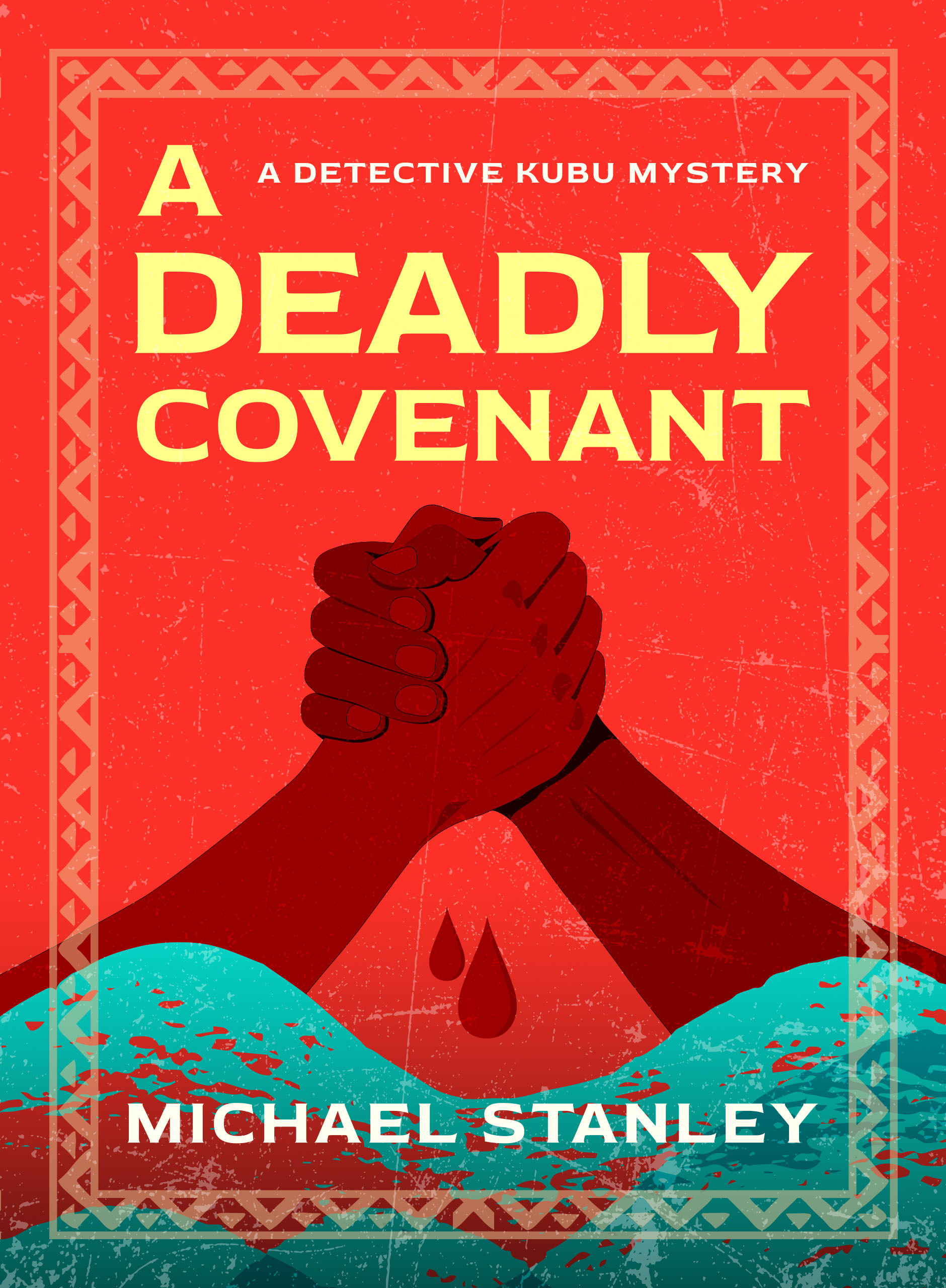
Launch of A Deadly Covenant

 Michael & Stanley - Thursday

Finally, we’ve reached September 1. Today, A Deadly Covenant is out in the world!


There’s quite a story behind this one. Stan had the idea of a Bushman skeleton being unearthed (by accident) and Kubu investigating, and more skeletons turning up, not necessarily Bushman skeletons. It seemed an intriguing premise.

Drotsky's cabins near Shakawe
where Kubu and Ian stay during the investigation

In terms of location, we’d been keen for a long time to set something in northwest Botswana. Shakawe is the town where the Kavango River from Angola flows from Namibia into Botswana. We experienced “bird overload” there once—so many water birds crowding the drying pools to get the trapped fish that we didn’t know where to look first. 

After that the river makes its way deeper into the Kalahari and then floods the Okavango Delta, creating one of the most amazing wildlife areas of the world. But the Okavango needs those annual floods. What would happen, we wondered, if it was an irrigation project that unearthed the first skeleton, perhaps a pipeline trench to take water from the river? A host of political and corruption issues presented themselves.


That was about what we knew when we started writing the book. We’ve always been “pantsers”— writing by the seats of our pants and wondering (sometimes with fear, occasionally with terror) where it was all going to go.

So Kubu, still a new detective in the Botswana CID, but with the success of solving the diamond heist case of Facets of Death under his belt, was sent out to Shakawe to help the pathologist, Ian Macgregor, get to the bottom of the mysterious skeleton. They get more than they bargained for. Eventually Ian finds nine skeletons, all of Bushmen, some of women and children, and all have been murdered—shot or bludgeoned to death. A Bushman massacre. And no one they ask in Shakawe is willing to admit to any knowledge of what happened.


At that point Selelo, a Bushman, appears from nowhere at the site of the massacre, dances to his ancestors in the sky, and then collapses. The next day he disappears. Next, an elderly man is murdered at his home. The local police think it’s a robbery gone wrong and blame the mysterious Bushman, but Kubu thinks otherwise. So does a strange woman who believes that a powerful river spirit, Mami Wata, is angry about the water project designed to “steal” her water.

Mami Wata

As his time away from Gaborone drags on, Kubu is missing Joy and agonizing over where their relationship is going. We love this quote from Lavender Magazine about A Deadly Covenant that encapsulates how the young Kubu feels:

Kubu, despite personal insecurities concerning love and social skills, sets his keen mind to work, absorbs, solves – gains confidence in handling police procedure, single-malt whiskey, and love.

Kubu’s boss, Assistant Superintendent Jacob Mabaku is sent to join Kubu and Ian amid rumors of corruption around the water project and the build-up of international anger over the Bushman killings.  Then another death occurs…


At that point we knew more or less what was happening and had a pile of cut scenes to show where the dead ends had occurred. But the conclusion itself seemed out of our grasp. What would happen to Selelo? How was the village chief, Kgosi Rantao, involved if he was involved? Who was lying and who (if anyone) was telling the truth? And how were Kubu, Ian, and Mabaku going to make head or tail of all this?

Well, eventually they did. We breathed a sigh of relief.

We hope you enjoy A Deadly Covenant and that, if you can, you’ll come to one of the events to hear more about the book and about Bushman culture.

Here's the September schedule:

Wednesday, 7. 4:30 – 5:30 pm 

Totally Criminal Cocktail Hour at Valley Bookstore

The Zephyr Theatre, 601 N Main St, StillwaterMN 55082

Call 651.430.3385 for reservations.


If you're attending Bouchercon, don't miss Stan's dream panel with Alexander McCall Smith, Jo Nesbo, and Caro Ramsay!


Friday, 9, 1:45 – 2:30 pm

BOUCHERCON Panel:

The Mystery of Multiple Points of View and Multiple Timelines (Writers use dual perspectives/multiple narrators and alternating timelines to tell their stories.)

Marty Ambrose; Mary R. Davidsaver; B.A. Shapiro; Julie Carrick Dalton; Stanley Trollip (Moderator)

Saturday, 10, 11:30 -12:15 pm 

BOUCHERCON Panel:

Under the Sun or Below Zero (You’ve heard of “setting as a character.” Well … what about the weather?  These authors’ works represent a dichotomy of climates where rising temps or bone-chilling cold are just as effective as any villain.)

Alexander McCall Smith; Stan Trollip (Michael Stanley); Catriona McPherson; Jo NesbĆø ; Matthew Goldman (Moderator); Caro Ramsay

If you're attending the International Agatha Christie Festival, join us for Agatha in Africa.


Thursday, 15, 12:30 – 1:00 pm (UK time) 

Virtual event at the International Agatha Christie Festival

Agatha in Africa

Michael, Stanley and Zimbabwe author Bryony Rheam discuss Agatha Christie’s trip to South Africa and Southern Rhodesia and its connection with her mystery thriller The Man in the Brown Suit.


Saturday 17, 1:00 pm 

Nokomis Library event

5100 S 34th Ave, Minneapolis, MN 55417 Phone: 612-543-6800


Wednesday 21, 6:00 pm 

Thomas St. Angelo Public Library of Cumberland event

1305 2nd Ave, Cumberland, WI 54829. Phone: 715-822-2767


Thursday 22, 6:30 pm 

Spooner Library event

421 High St, Spooner, WI 54801 Phone. 715-635-2792


Saturday 24, 1200

The Bookstore at Fitger’s

600 East Superior Street, Duluth MN 55802


Tuesday, 27, 6:00 pm (In person and virtual)

Official launch of A Deadly Covenant at Once Upon A Crime

604 W. 26th Street, MinneapolisMN 5540 Phone: 612.870.3785 

Email: onceuponacrimebooks@gmail.com

With Mary Ann Grossman

Thursday, March 22, 2018

We are what we drink


Michael-Thursday

Last week, Stanley mentioned that we were in the last throes of writing our stand-alone, Dead of Night. I'm pleased to report that on Tuesday we added the final full stop to the last sentence, and sent it off to our agents and our editor in the UK. Stanley pointed out that the book was already available for advance purchase in the UK on Amazon. Who knew Amazon sold books that hadn’t even been written yet?

If anyone is concerned that we have shelved Kubu in favor of our new protagonist, Crystal Nguyen, don’t worry. Kubu will be back next year. We’ve just accepted a two Kubu book deal with Orenda, and at least the first will feature a younger Kubu trying to find his feet in the CID, working under Assistant Superintendent Jacob Mabaku. And he’ll be back in the US, too—we’ve just signed a deal with Poisoned Pen Press and we are absolutely delighted to be joining them!

All this is by way of introduction to the fact that my mind is now quite blank—emptied of Crystal and not yet reloaded with Kubu. (Some may say that that is its usual state anyway. Thought I’d get in with that one first.) So that is how I sat down to write this blog.

Usually something has happened in the news during the week that intrigues me, but the last week was totally swamped with the news of Cambridge Analytica. I don’t think anyone wants to hear more about that.

There was one thing though. Genetically modifed beer. A research student at UC Berkeley thought of it. Students think a lot about beer anyway (probably second only to that business that takes two of them), so why not? His idea was to splice mint and basil genes into yeast in order to cut out the hops. Hops are expensive, hard to grow, and drink gallons of water. The idea is to replace the bitterness/yeastiness introduced by the hop flowers by adding it directly in the yeast. The London Times took a somewhat tongue in cheek approach with a headline: Abandon all hops.  After insulting the Royal Family or criticizing Football, it’s hard to imagine anything that would get the English more upset than messing around with their beer.

However, in a blind taste test, a panel was convinced—the new yeast made decent beer that matched the hop flavors. Interesting, because the genes spliced were from mint and basil. Sounds more like something you might meet in the southern states than in California. But even the researchers are a bit dubious about the commercial viability of their discovery; brewers are very conservative people apparently.

Most drinks seem to be going the other way—organic wines, handmade craft beers, niche spirits. People have strong feelings about what is best, the right way to do things, and so on. Some of this goes almost to the occult with biodynamic wine making involving buried cows heads and harvesting at full moon.


From my rather limited experience, I can say two things about these types of wines. One, they are usually expensive, and two, they are often very good. The expense clearly comes from all the extra overheads. You start off with insects eating the vines, progress through people having to wake at midnight at full moon (overtime), and end up with the wild yeasts spoiling multiple barrels. The fact that it’s often better may be a result of all these things, but it will be the result of all the extra care and commitment that the vineyard manager and wine maker put into the process.

And organic means different things in different places and different industries. Even quality control regulations vary from place to place. In Burgundy you can chaptalize wine (add sugar). That would be anathema in South Africa (mainly because our problem is too much ripening and so too much sugar). In Burgundy you can’t irrigate vines. (Why would you? Have you been there in winter?) Here it’s completely standard.


All this, of course, interests people at the top end of the market. The vast majority of wine sales go to people who want just three things (1) alcohol, (2) something that isn’t repulsive to drink or produce an instant migraine, and (3) alcohol.

So how about GM beer? In my opinion, all it needs is a catchy name and an appealing label. Suggestions can be sent care of UC Berkeley.

At the end of this stream of subconsciousness, I realize that I still haven’t got anything to write about this week. Well, maybe in a fortnight…

Thursday, January 30, 2014

Big Five Plus One


Last year Stan took us through the Big Five – elephant, lion, leopard, buffalo, and  rhino.  I’ve been in the bush for the past few weeks and lucky enough to have wonderful sightings of all of these.  But I do feel one animal has been very short-changed and it’s an animal very close to our hearts (i.e. Stan’s heart and my heart).  That is the hippo.  I’m sure readers of this blog know that kubu is the Setswana word for hippo, and that our detective has that as his nickname.  I think the hippo has every right to be included in the top rank with those other five.  Not only are the animals very large – the males weigh in over 4,000 lbs, coming in third to elephants and rhinos in terms of size, but they are also fierce and can be quite aggressive in some circumstances – they account for more human deaths in Africa than any other mammal.  And they are fascinating creatures and interesting to watch, edging out the rhino for second place of the three ultra-large herbivores in my opinion.  No river in Africa is complete without their cheerful grunting carrying across the water.

From a physiological point of view, the hippo is amazing.  How about an animal that spends its days in the water, but is too dense to float?  That can hold its breath for up to five minutes.  (Don’t try that one at home!)  That has nostrils designed to close under water, and a reflex that allows it to sleep under the water and rise for breathing without waking up.  That has built in goggles (transparent membranes that close over the eyes under water).  And that has built in sunscreen (the hippo secretes an oily brownish substance which protects its bare skin from the sun).  Pretty impressive design, I’d say.  And no rude comments about it being porcine.  (Kubu would be particularly offended.)  The hippo’s closest relations are the dolphins and whales; it separated off from them about fifty million years ago.

Most of the day they spend fully submerged or comfortably beached on a sandbar warming in the sun (having applied sunscreen, of course.)  In the evenings they come out of the water and spend the nights browsing and grazing along the river banks or quite far inland if the feeding conditions are poor as they tend to be in the winter.  At this time they are busy with the important issue of building up that 4,000 lbs of bulk, and you really don’t want to interfere with them.  In particular, you don’t want to give them the idea that you are trying to cut them off from the haven of the river.  That usually leads to aggressive behavior and possibly one of those human deaths.


I’ve had my own close encounter, mostly my own fault.  It was my first time in a canoe on the Zambesi river in Zimbabwe.  I was with a friend who was a bit more expert as a canoeist than I was, but not much.  He was at the back.  At a certain point the guide who was ahead of us in another canoe signaled us to move out into the center of the river; he’d spotted a pod of hippos near the shore.  What he didn’t know was that the hippos had spotted him, and submerged and politely moved to the center of the river to let us pass.  My friend and I paddled out into the river, proud of our calm expertise.  Moments later a huge jaw opened a short distance in front of us; we had not reciprocated the hippos polite behavior.  We immediately put the canoe into what we thought was reverse.  Unfortunately our expertise did not run to reverse against the current.  What we did do was cause the canoe to rotate as the current took us towards that enormous mouth.  At the crucial moment the hippo sank under the water and we passed over it.  I think I know why it didn’t convert our canoe into splinters and us into mincemeat.  It was laughing too much.


Hippo behavior is complex.  The males have water territories, but will tolerate other bulls as long as they behave in a submissive way.  Last week we saw an interesting example at one of the dams at the game reserve where we were staying.  The dam is large and a family of five hippos, one male and two females with youngsters, has taken up residence.  They’re a charming group, and most days we would pop in to see how they were getting on.  As I mentioned last time, on one occasion they had a stand-off with nine lions and eventually the hippos got right of way.  On our last evening, we arrived at the dam to discover that it now contained six hippos.  Apparently another male had decided the dam was a nice spot to spend the day.  The altercation between the males seemed to involve bursts of rivalry where they would rise from the water bellowing and threatening each other by matching their enormous mouths.  Then all would go quiet for a while and one would rest its head on the other’s back.  Maybe that’s submissive behavior?  Unfortunately it became too dark and rainy to see what happened in the end, but I’d guess that all six went off feeding and that the interloper would have found a more peaceful dam or river stretch for his day nap.


So from all points of view, I believe that the hippopotamus fully deserve a place up there with the other big five.  I propose that in future we have the Big Six.


Michael – Thursday.

Thursday, August 29, 2013

Is it any wonder why Africa is called the Dark Continent?

I want to start off today with a little quiz.  Nobody is going to see your answers, except yourself, so you can cheat.  Seriously, take a few minutes to write down your answers.

First, the difficult ones:

1.  How many countries are in Africa?

2.  What are they?  Which is the biggest; which is the smallest?

3.  What is the population of Africa?

4.  What is the predominant religion in Africa?

5.  Which country in Africa has a biggest industrial output?

Now some easy ones:

6.  If the southern tip of Africa has a latitude of X degrees south, what city on the west coast of north America (Mexico, USA, Canada) would be X degrees north?  What city in Europe is X degrees north?

7.  What city in south America is about X degrees south?

8.  How many miles (kms) is it from southern most point in Africa to the northern most point?

9.  How many miles (kms) is it from the western most point in Africa to the eastern most point?

And two interesting ones:

10.  What percentage of Africa is covered by desert?

11.  What animal kills the most people in Africa?

12.  Other than Wilbur Smith and Nelson Mandela, name 5 black African authors and 5 non-black African authors.

Of course I thought of giving you the answers next week, but I won’t.  Where appropriate, they are given below the photos from Africa.

Pyramids at Giza

Tutenkhamen

Temple of Karnak

100-tonne obelisk at Karnak

Sankore Mosque in Timbuktu

Ruins of the Greater Zimbabwe in Zimbabwe
Kilimanjaro


The Smoke that Thunders - Victoria Falls

Mozambique beach

Table Mountain - soon to be my backyard

African rainforest

Lanzerac Wine Estate near Cape Town
Wildebeest migration in Serengeti

Mongoose Lemur
Ring-tailed Lemur (National Geographic)


Baby Cheetah (Stan Trollip)

Giraffe (Stan Trollip)

Zebra  (Stan Trollip)

A Kubu  (Aron Frankental)

Another Kubu (Aron Frankental)

African Fish Eagle  (Stan Trollip)

Lilac Breasted Roller  (Stan Trollip)

Lion resting after sex  (Stan Trollip)

Leopard on Impala kill (Stan Trollip)

I'm keeping my eye on you
Elephant in Chobe National Park, Botswana (Stan Trollip)

So here are the answers:

1.  There are 54 independent countries in Africa.

2.  It is easier for you to go to the following URL to see what the countries are: http://en.wikipedia.org/wiki/List_of_sovereign_states_and_dependent_territories_in_Africa.  The biggest is Algeria (barely beating out The Democratic Republic of the Congo) at 2,381,740 sq. kms.  The smallest are the island countries of the Seychelles at 451 sq. kms and the Democratic Republic of SĆ£o TomĆ© and PrĆ­ncipe at 964 sq. kms.  The smallest country on the mainland of Africa is The Gambia at a little over 10,000 sq. kms. 

Note 1: 1 sq. mile = 2.6 sq. kms.

Note 2:  The USA is about 9,827,000 sq. kms.

3.  1.03 billion people live in Africa (2011)

4.  Islam is the largest religion with 47% of Africa’s population being believers.  Christianity is second.

5.  I couldn’t find convincing data as to which country has a biggest industrial output, but I think it is South Africa.

6.  Los Angeles is as far north as Cape Town is south ( 34 degrees).  The only European country that is 34 degrees north is Greece, and then only just.  The Island of Crete is about that far north, so Heraklion would have to be the answer.

7.  Buenos Aires is about 34 degrees south.  The tip of south America is about 55 degrees south, or about 1,500 miles (about 2,500 kms) south of the southern tip of Africa.

8.  Africa as about 5,000 miles (8,000 kms) north to south.

9. Africa is about 4,600 miles (7,400 kms) east to west.

10.  About a third of Africa is desert.  The Sahara is about the size of the USA.

11.  The mosquito is the most dangerous animal in Africa.  The hippo is the most dangerous mammal.  But be careful of the Nile crocodile.

12.  I am going to leave it to you to explore Africa’s rich literary talent.

Most westerners have little knowledge of Africa.  I hope this helped to lighten the Dark Continent a bit. 

Of course, I think that Africa is seen as dark because westerners try to look at it with their eyes shut.


Stan - Thursday