Showing posts with label Shoshong. Show all posts

Thursday, August 18, 2022

Shoshong and A Death in the Family - Special Offer


Buttress over the river

This week I want to return to one of the most interesting places in Botswana, Shoshong. Shoshong has a long and complex history (and prehistory) in southern Africa. It is also the setting for the Detective Kubu mystery A Death in the Family, which was chosen as the theme for a cultural festival held in Shoshong. (Another reason why it's one of my favorite places!) 

To celebrate all these things about Shoshong, and the upcoming launch of our new Kubu book A Deadly Covenant (set in another of my favorite places in Botswana, but more about that next week), we are offering A Death in the Family ebook for 99c in the US and Canada until the end of Bouchercon, (September 11). This applies to all formats for the ebook. If you've already read the book and enjoyed it, please let your friends know about this special offer. After all, they only have 99c to lose...

Angry scene from the book reenacted at the
Bollapela Cultural Festival

So back to Shoshong.


View from the air

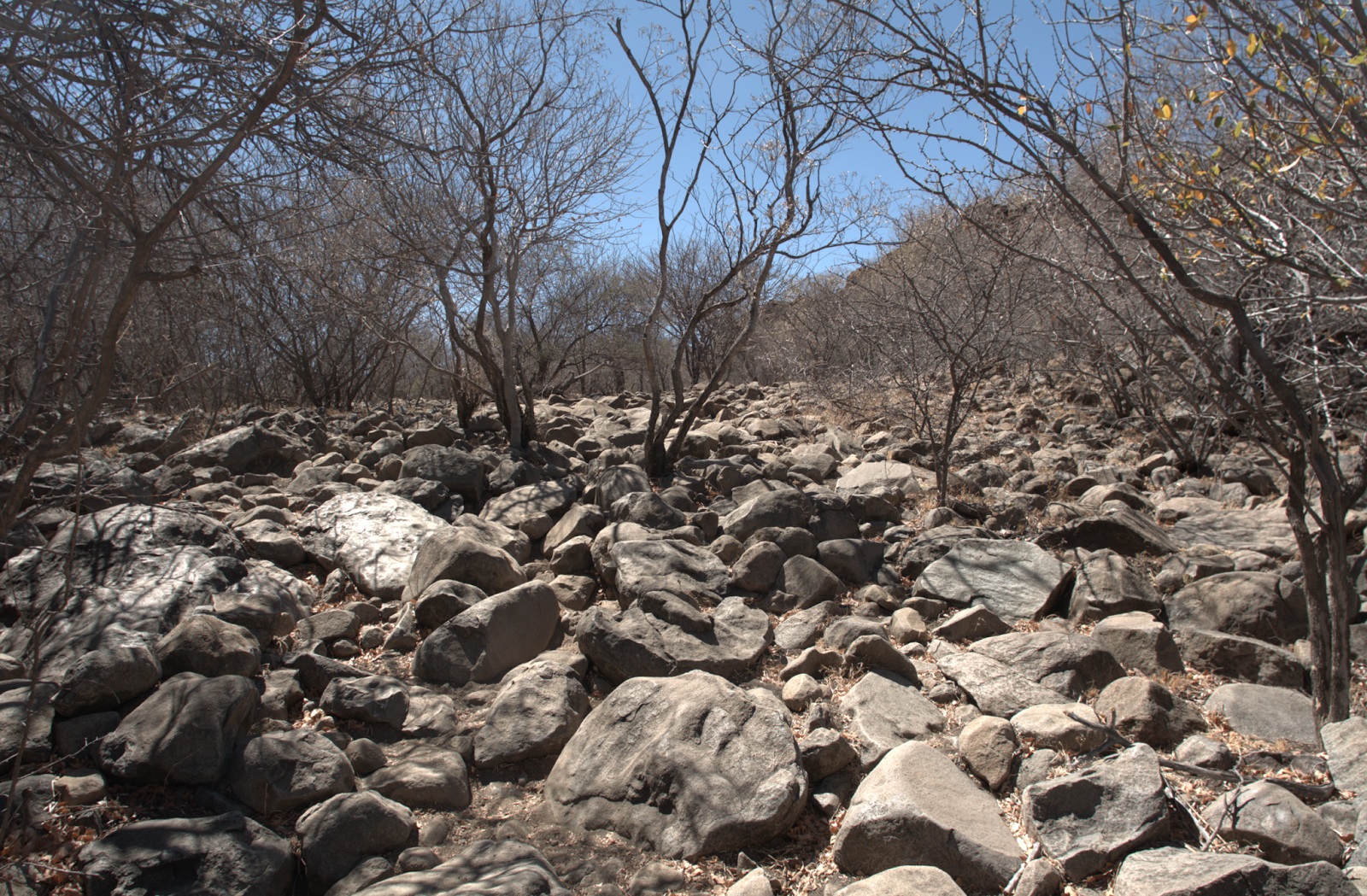
Few people outside Botswana have heard of Shoshong, yet in its day it was a very important town in southern Africa – much more so than the current capital of Gaborone (which hardly existed at that time) and many South African towns that are now regarded as significant (such as Johnnesburg).  Founded in the mid nineteenth century, it was chosen for two critical reasons – it is protected on the north by a horseshoe of hills which are difficult to climb because of screes of dolorite boulders, and it had comparatively plentiful water from the Bonwapitse river which flows into the town through a gorge in the hills.  In fact, the hills were home to stone age people long before the Tswana people.  The leader of the Bangwato people, Sekgoma I, made it his capital when he conquered the Bakaa people in 1849.  
Since the Matabele to the north were pretty unfriendly neighbors at the time, the hills formed a welcome shield. Sekgoma's son, Khama III, consolidated and built Shoshong into a strategic center of around 30,000 people.

Across Shoshong to the hills

The town thrived because it was strategically placed on the main road north between what is now southern Botswana and Zimbabwe.  It became an important trading center and was host to hunters, missionaries, and famous explorers - including David Livingstone, who passed through.  Some Europeans settled there and traces of their tin-roofed rectangular houses and artifacts have been found in the area.  Christianity was introduced by John Mackenzie in 1868 when he built the Moffat Institution for the London Missionary Society there.  A church bell was found in the area – the only surviving evidence of the church.  It seemed Shoshong was here to stay.


Paper-bark tree in the hills

But Shashong’s Achilles’ heel was the very reason for its existence – the river.  A prolonged drought and the settlement’s stress on the environment left the town almost dry and surrounded by semi-desert.  By 1889 the town was described as “a filthy place with only one trickling well.”  Khama III told his people to pack up and move, which they did, leaving behind a ghost town. 


Little remains to be seen of Old Shoshong, only the remains of the stone walls and the graves both old and new that are filling the space between the Kgotla (meeting place) at the north of the new town and the gorge.  Even though the town was resettled and is quite a thriving little place these days, it never regained its importance. However, it lies in one of Botswana's mining provinces, and in A Death in he Family, we postulate a Chinese-owned mine in the area. The increasing influence of China in southern Africa (and indeed in Africa as a whole) and the relationship that Chinese immigrants have to the local people is the backdrop to the story, which begins with the murder of Kubu's father in Mochudi. There's a CIA connection too, and Kubu makes a visit to New York...


Lots of events coming up for the release of A Deadly Covenant. Here's the September schedule:

Wednesday, 7. 4:30 – 5:30 pm 

Totally Criminal Cocktail Hour at Valley Bookstore

The Zephyr Theatre, 601 N Main St, Stillwater, MN 55082

Find out more about the event HERE.


Friday, 9, 1:45 – 2:30 pm 

BOUCHERCON Panel:

The Mystery of Multiple Points of View and Multiple Timelines (Writers use dual perspectives/multiple narrators and alternating timelines to tell their stories.)

Marty Ambrose; William Boyle; Mary R. Davidsaver; B.A. Shapiro; Julie Carrick Dalton; Stanley Trollip (Moderator)

Saturday, 10, 11:30 -12:15 pm 

BOUCHERCON Panel:

Under the Sun or Below Zero (You’ve heard of “setting as a character.” Well … what about the weather?  These authors’ works represent a dichotomy of climates where rising temps or bone-chilling cold are just as effective as any villain.)

Alexander McCall Smith; Stan Trollip (Michael Stanley); Catriona McPherson; Jo Nesbø ; Matthew Goldman (Moderator); Caro Ramsay

Thursday, 15, 12:30 – 1:00 pm (UK time) 

Virtual event at the International Agatha Christie Festival

Agatha in Africa

Michael, Stanley and Zimbabwe author Bryony Rheam discuss Agatha Christie’s trip to South Africa and Southern Rhodesia and its connection with her mystery thriller The Man in the Brown Suit.


Monday 19, 6:00 pm 

Nokomis Library event

5100 S 34th Ave, Minneapolis, MN 55417 Phone: 612-543-6800


Wednesday 21, 6:00 pm 

Thomas St. Angelo Public Library of Cumberland event

1305 2nd Ave, Cumberland, WI 54829. Phone: 715-822-2767


Thursday 22, 6:30 pm 

Spooner Library event

421 High St, Spooner, WI 54801 Phone. 715-635-2792


Saturday 24, 1200

The Bookstore at Fitger’s

600 East Superior Street, Duluth MN 55802


Tuesday, 27, 6:00 pm 

Launch of A Deadly Covenant at Once Upon A Crime

604 W. 26th Street, Minneapolis, MN 5540 Phone: 612.870.3785 Email: onceuponacrimebooks@gmail.com

With Mary Ann Grossman

Thursday, April 28, 2016

BOLLAPELA CULTURAL FESTIVAL

Michael - Thursday - talking to Angela Seiphetlheng


 We’re often asked whether our books are sold and well received in Botswana – a natural question since that’s where they’re set.  Botswana has a small population, and an even smaller group who read fiction, but all our books are always on sale in Gaborone.  Still, you can imagine how thrilled we were when we met Nyane Angela Seiphetlheng, she was enthusiastic about the books, and decided to choose A DEATH IN THE FAMILY as the centerpiece for one of Botswana’s major arts and culture festivals that she organizes in the Shoshong area.

It’s a great honor, and I’m going to be at the festival to enjoy every minute of it.  Anyone planning a trip in southern Africa, please join us!

I wanted to find out more about the festival and about Angela – who is one of Botswana’s amazing go-getters.  She is one of those people who does the hard things at once, and takes a little longer to do the impossible!  So I asked her about the festival and invite you to share the discussion.

Would you tell us a little about the Festival and why it takes place in Shoshong?
Nyane Events, will host a cultural activity on the 4th June 2016.  The cultural event in Shoshong will have a special feature to it based on a novel launched in August 2015, Botswana- Gaborone, by its authors Michael Sears and Stanley Trollip called, A DEATH IN THE FAMILY. This is a detective crime series novel with part of its setting covering Shoshong, Tobela, Mochudi and Gaborone.

After a study carried out in 2010 around the Shoshong constituency, it emerged with areas for potential investment being Agriculture, Tourism; Eco-tourism, Mining, Solar Energy, Waste Management; Biofuel, Potential opportunities presented by the B112 road linking major villages of Molepolole, Shoshong and Serowe, to be marketed as a gateway to major tourist sites of Maun, Chobe, Okavango and Victoria Falls, to list a few. I am a member of a village development committee (Shoshong Your Investment Destination committee) and as its Vice chairperson, I am tasked with the mandate of taking the message to the world about this gem area of Shoshong constituency and it’s potential.

The Shoshong Hills in late afternoon
Shoshong area has:

       Colonial Heritage includes buildings, and missionary heritage sites.
      Historical Heritage- Shoshong is the first village of Baphaleng, Bakaa, Bangwato, Bakgalagadi and other early Tswana Communities.
       Archaeological Heritage includes pottery remains, burials and monuments.
      Natural Heritage include Hills that have historical storylines associated with them as well as rocks that are associated with the village identity such as Lesoso, bollapela, majwe-maswaana to list a few.
     Cultural Heritage Sites: Marele Engraves ( referred to as Ntswe le tswa batho) in the Kodibeleng area; Marele Hill (Kodibeleng); Old Shoshong site where we find the church bell and Ironstones outcrops; Mareletsane Gorge, visible from tarred road from Mahalapye, Sunyaneng Gorge found in the Shoshong Hills; Pitsane Hilltop found in Shoshong Hills;  
      The historic routes: There are also routes that link up Shoshong and Kalamare, passing through the Old Shoshong hill site, passing by the magnificent view of Sogwang. This route is less than 20km. There is also a breath taking route to Mmutlane that can take less than 15minutes going on top of the hill from Shoshong. When you are in destination Mmutlane at the hill top, there is flat land. This route has been used for years and is still being used to date.

View of Shoshong from the Hills
It is against this background that the Bollapela Cultural festival will try to promote tourism, culture and arts in the form of dramatization of certain parts of the novel, drawing or painting as well as sculptures of scenes or characters from the novel. This will form a great part of the celebrations of the cultural day activities of traditional games, music, ancestors worship, folklores and stories of Shoshong area.

The event will be held under the theme:
CELEBRATING CULTURE AND ARTS IN PROMOTING TOURISM IN THE SHOSHONG RICH HISTORIC AREA.  

What persuaded you to have Detective Kubu as the centerpiece of this year’s festival?
I read the first Michael Stanley novel- A CARRION DEATH - and got hooked from the day I opened the first page in 2015. As I got to follow them as I was also researching on Shoshong and its surrounding areas to promote, I came across information that their fifth novel was to be out by August same year and its partly based on Shoshong and Tobela. I couldn’t wait to see what the big, opera and wine loving Kubu would be doing in my village Shoshong.

The novel not only embraces a great place in Botswana with a rich historic background but also promotes the area internationally as a potential tourist destination. Detective Kubu had to be celebrated in Shoshong and the 2016 cultural event had to embrace him for his services in Shoshong.

And on a personal note, I love the work of Detective Kubu because I grew up watching my father, the Late Kgakgamatso Seiphetlheng who was a famous Crime Detective Investigator in Botswana from a small village in the middle of a horse shoe of hills- Shoshong. Admired by a lot of his peers in the police department, having worked in areas of Maun, Lobatse, Palapye, Francistown busting crimes and catching thieves. Well-known as Silverfox by women, children and criminals. He was also called as part of the investigation team for the ritual murder case of the young girl Segametsi Mogomotsi at Mochudi. I am also excited that Michael Stanley wrote DEADLY HARVEST novel based on this incidence. I so wish my dad was around to appreciate this art.

That’s fascinating Angela. We were told about the Mogomotsi case by a previous director of the CID, Rra Mulale.  We knew that one day we would have to write a book based on it.  I wish we had met your father.  Maybe our detective would be called Silverback instead of Kubu if we had!

What attracted you to A DEATH IN THE FAMILY in particular?
I found the novel to be God sent, a novel that touched on issues of culture, effects of developments on culture, youth, the elderly and change, mining in the area of Shoshong- Tobela, the rich history found in the Shoshong area and the huge potential it has on tourism.  It also talks of corruption that comes about with globalization, invasion of the Chinese into Africa, particularly Botswana and the Americans. All these aspects are covered in a creative manner, by great authors, passionate about Botswana and they packaged the Shoshong area in an artistic way that would attract both the young and elderly to take a moment and look at Shoshong and Tobela.

I’m really looking forward to seeing how the groups interpret the issues that we raise in the book! Has there been a lot of interest in the theme?
The part that will be dramatized are the ones where activities happen at the Kgotla. The theme derived of the novel is- How the Kgotla setup can enhance the development of rural communities through fruitful deliberations from both the youth and the elderly.

There has been lots of excitement around this theme from the village leadership being Chiefs. The Chairpeson of House of Chiefs- Kgosi Gaborone is aware of this project, the Shoshong chiefs have been made aware and will be launching the Kgotla that will be built at the events venue. Not only will this Kgotla be used for drama but the Chief would like to do all official opening of event and welcoming of Chief Oscar Mosielele of Moshupa- the guest speaker at that Kgotla to embrace our culture. Kgosi Mosielele already has a copy of A DEATH IN THE FAMILY.

The Shoshong youth drama group (Black Tswana Drama Group) who have been struggling with exposure and having a career with what they love most being drama have read the novel and excited to be given this platform. It’s the passion they have to try and wow the world about their skill and a great novel. Regardless of the financial challenges they are facing now to meet since they travel from Shoshong to Kalamare to meet up with other team members, it’s the passion in their eyes created by this novel that melts me. Most of them are unemployed.

One of the unemployed young ladies in her twenties from Shoshong heard me making a presentation about the event and asked to read the novel. She completed the novel in 3 days saying she couldn’t put it down. She has since produced a song about Detective Kubu.

Would you tell us a little about the food that will be available at the event.
Setswana variety of foods will be at the event. Bogobe jwa mabele (sorghum meal), bogobe jwa lerotse, seswaa (pounded meat), mokoro, nama ya tlhogo, serobe (tripe stew) sebete (liver stew), morogo wa dinawa (beans leaves), phane worms.
There will be game meat, game biltong and sausages.
As a way of appreciating the international features of the novel, we will be having Chinese and American foods stalls, to embrace the different cultures that determine the diet of people of Botswana and Shoshong now.

Do you feel the Detective Kubu novels realistically reflect life in modern Botswana? I know you will be absolutely honest!
YES, YES, YES, Ohhhhh YES. That’s why I easily related to it. I visualized the areas and activities of the novel that I can’t wait for someone to do movies of series for Detective Kubu. I guess that why I wanted to see how people could translate it in drama, paintings or drawing of scenes they visualize as they read the novel.

Angela, thanks so much! I’m really looking forward to being at the festival.  It will be a highlight of the year!

Wednesday, November 11, 2015

The Road to Botswana I

Michael - Thursday

The history of Botswana is an interesting one.  Most people assume that – like Zimbabwe and Zambia for example – it was carved out on geographic lines as a British colony and eventually became independent, like so many countries in Africa as “the winds of change” swept the colonialists away.  But that’s not the case.

Engraving of Shoshong in the nineteenth century
The people of Botswana are called Batswana—a term that is applied interchangeably to a member of the Tswana group of peoples and now also to citizens of Botswana.  The Tswana peoples don’t have a written history of their early origins, instead it was passed down the generations in tales and legends.  Probably they originated in the area around what is now Rustenburg in South Africa and spread from there.  Although not nomadic in the traditional sense, the tribal groups could not afford to stay in one place for too long because the land was arid and unable to sustain significant settlements and water use for any length of time. Tribal groups split, coalesced, explored, shared resources or fought over them. There were feuds, kings (or dikosi) made alliances by marriage and agreement. Their plots and feuds would do justice to the classical Greeks at their best.

Church building and ox-wagons

In the eighteenth century, Kgosi Malope led the Bakwena tribe into what is now southern Botswana. He had three sons who eventually broke away from him and went off on their own.  They quarreled among each other as well; one split apparently was sparked by a lost cow, and led to attacks on the villages of each other’s followers!

Aerial photo of Shoshong
The period from 1700 to 1850 was a bad time for the Tswana peoples.  Not only were they fighting each other, but the Zulus and Matebele threatened them. In 1770 Kgosi Mathiba split from the Bakwena and made his way to the area of Shoshong and established a stronghold there.  The spot was attractive because of the protection offered by the hills in the event of an attack, and caves in which to take refuge if the odds became too great.  Also, there was a reliable source of water from the river that flowed through a gorge in the hills. One of his sons was the first Khama. This story relates what it was like for him as a boy:

“We were more like game then men in those days, for though I tell you where we lived the fact is that we were always changing. We settled down somewhere and then someone attacked us; and then we moved off somewhere else. And so it went on.”
“Khama says the whole of the Bakaa hid in a single cave, and the Matebele could not kill a single one of them. Khama still remembers the cave in which he hid with his mother, though he does not think he could find it again. And he has not forgot how they rushed their goats into caves at sound of warning leaving them to be herded together by older hands while they fled to the caves where their mothers were. Of course there were always spies about watching for the Matebele night and day.”

Khama III and his wife

Khama III, who was born around 1837, was to be the strong leader who started the foundations of the Botswana nation.  From 1850 the area was opened up to trading and hunting by explorers and missionaries like David Livingstone.  Khama embraced Christianity and exploited the opportunities that commerce offered. As a young man, he was active in the new trade, owning guns, horses and ox-wagons. He spoke fluent Dutch. But relations with his father were strained and feuds between the two men led to him leaving Shoshong.  His father tried to have him killed, they reconciled, fought again, and eventually Khama defeated his father in a month-long armed conflict between their followers.  Despite this inauspicious start, Khama III was a fine leader and sometimes referred to as Khama the Good.

Kgotla (meeting) to discuss the protectorate

But when he finally became Kgosi in 1875, Khama was beset on all sides.  Drought was threatening Shoshong, the Ndebele in the north were making incursions into his lands, the Dutch Voortrekkers where at his door in the south, and German colonists were moving in from the west.  Cecil Rhodes also had his eye on the region - he wanted it for his Cape to Cairo railway and as part of his overall plan of British dominion in Africa. Against this backdrop, Khama took a very unusual step.  Along with two other chiefs, he set sail for England and asked Queen Victoria for protection.  It was a brilliant and courageous move.  Despite strong opposition from Rhodes, the British government agreed, and declared Bechuanaland a protectorate.  Thus, it was never a colony and retained much of its own locally-based governing structures that survive to this day.  The Bechuanaland Protectorate was administered by the British from Mafeking – a town in South Africa!  
The chiefs in London

On hearing of the decision of the British government, Khama declared:
“I,.Khama, chief of the Bamangwato, with my younger brothers, heads of my town, express my gratitude at the coming of the messenger of the Queen of England, and for the announcement to me of the Protectorate, which has been established by the desire of the Queen, and which has come to help the land of the Bamangwato also. I give thanks for the word of the Queen … and I accept the friendship and protection of the Government of England within the Bamangwato country…”

Statue commemorating the three chiefs

In 1966, Khama III's grandson became the president of a new united country called Botswana. A story for another occasion.

Photographs courtesy of the Botswana National Archives


Monday, October 26, 2015

A Death in the Family

Michael and Stanley - Thursday


Tuesday saw the release of the new Detective Kubu mystery, A DEATH IN THE FAMILY.  We were delighted to have the launch once again at the wonderful Once Upon a Crime bookshop in Minneapolis and are grateful to Pat and Gary and all the friends and readers who came to support us.

Signing

Backlist! With request to support wonderful Books for Africa!

Awaiting purchase!

More signing!

Standing-room only!

Michael talking
The idea for the story originated during a trip Stanley made through northern Namibia and Botswana.  In Namibia, even in the smallest towns, he noticed a proliferation of Chinese-owned shops.  He also saw several instances of local Namibians joking with the Chinese, who appeared not to want to join in the fun.

When Stanley was driving between Katchikau and Goma Bridge in north-west Botswana – a road we’ve both driven several times before – he found the road now paved, with no economic reason justifying the upgrade.  Then he saw a new, small village next to the road – a Chinese village – surrounded by a barbed-wire fence.

The metropolis of Katchikau
Subsequent research showed that many infrastructure projects were being done by Chinese companies that imported Chinese labor, ignoring the locals. So there was a situation where locals were being side-lined by the Chinese; the Chinese were making no attempts at integrating with the locals and were isolating themselves; and the natural friendliness of the locals was being rebuffed by the Chinese.
What a good backdrop for a murder mystery!

And we discovered a lot more as we dug deeper.  Chinese companies were using the muscle of their government to undercut other contractors, and often offering barter deals for raw materials in the poorer countries.  And sometimes they also combined low quality with low prices.  The new airport in Gaborone was years overdue when the Botswana government eventually fired the Chinese contractor; the new power station has yet to reach better than fifty percent capacity without failure.

The new airport -
 after it had been finished by a German company.

Chinese-run infrastructure project
For the story, we wanted to do two things.  First, we wanted to take both Kubu and ourselves out of our comfort zones.  Second, we wanted the backstory to paint the picture of what we saw with respect to the Chinese in Africa.

To accomplish the first goal - taking Kubu and ourselves into places we hadn't been - the story has Kubu's beloved father murdered at the beginning of he book.  To make things worse, Kubu is sidelined from the investigation for fear that his presence would contaminate any prosecution.  Can Kubu stay out of the investigation?  Of course not!  Each time he tries to do something, his boss Mabaku gets angrier, eventually banishing Kubu to New York to deliver a speech to Interpol in his place.  Kubu's frustration is so great that he actually stops eating!

For the backstory, we situated a Chinese-owned mine near Shoshong—a historic town a few hours drive from Gaborone.  The mine wants to expand and promises jobs in an area far from the diamond riches; however, the elders want to preserve the culture and history of their village.


Modern Shoshong from the hills
As an aside, few people outside Botswana have heard of Shoshong, yet in its day it was the most important inland town in southern Africa – much more so than the current capital of Gaborone (which hardly existed at that time). 

The town thrived because it was strategically placed on the main road between Zimbabwe and southern Botswana.  It became an important trading centre and was host to hunters, missionaries, and famous explorers - including David Livingstone.  Some Europeans settled there, and traces of their tin-roofed rectangular houses and artefacts have been found in the area. 
However, the river dried up, and a prolonged drought caused the town to be abandoned in 1889.

The river today
Today, little is left of old Shoshong - only the remains of a few stone walls and the graveyard, and the memories of the elders of good times past.

Kubu's frustrations are somewhat mollified by having to investigate the apparent suicide of a government official. The threads lead him to the US embassy and to the Chinese owners of the Shoshong mine.  And eventually to the reason for his father’s murder.

For the past week or so, we've been gnawing on our fingernails waiting for reactions to our newest baby.  Every writer knows what that's about.  Fortunately, the initial reviews of A Death in the Family have been positive!  So forgive this annual BSP (Blatant Self Promotion) blog and allow us to quote a few:

The fifth rip-roaring mystery in the Detective Kubu series…exceptional police procedural plot…—South African Sunday Times

 Kubu returns with a vengeance – but what is prowling in the darkness of Botswana is more dangerous than the four-legged predators.  Then there are the Chinese who just may be the most dangerous of all … I love it!
—Charles Todd (New York Times best-selling author)

Engrossing fifth mystery…as always, Stanley (the writing team of Michael Sears and Stanley Trollip) brings to life a Botswana different from the one familiar to Alexander McCall Smith readers.
—Publishers Weekly

Like all the Kubu books, this one weaves societal and cultural problems into the plot. In this case, it's the generational divide between young people in the village of Shoshong who want the mine to expand because they need jobs, and the elders, who remember when promises of new houses and other goodies were made and not fulfilled. The way the young people speak to the elders is shocking to many older people who fear Botswana's traditions of respect are eroding. When there is a riot in the village during an elders' meeting, Kubu figures someone instigated it.
But was it the Chinese or one of his countrymen?
Sears and Trollip, both retired professors, have been in and out of Botswana much of their adult lives and their writing reflects their love for the landscape and the people. Kubu is an endearing character, even when he's angry, and you feel the people of Botswana are safe when this big man is on the job.
—Mary Ann Grossmann in The Pioneer Press.


This latest Detective Kubu Mystery is a gem, although the Botswana assistant superintendent of its CID is one frustrated detective throughout most of the novel.

—Ted Feit

We'd love to see you at one of our events.  Please visit www.detectivekubu.com or www.facebook.com/MichaelStanleyBooks for details.

Thursday, October 3, 2013

The Rise and Fall of Shoshong

New Shoshong from the hills

Few people outside Botswana have heard of Shoshong, yet in its day it was a very important town in southern Africa – much more so than the current capital of Gaborone (which hardly existed at that time) and many South African towns that are now regarded as significant.  Founded in the mid nineteenth century, it was chosen for two critical reasons – it is protected on the north by a horseshoe of hills which are difficult to climb because of screes of dolomite boulders, and it had comparatively plentiful water from the Bonwapitse river which flows into the town through a gorge in the hills.  Since the Matabele to the north were pretty unfriendly neighbors at the time, the hills were a welcome shield.  The leader of the Bangwato people, Sekgoma I, made it his capital when he conquered the Bakaa people in 1849.  His son, Khama III, consolidated and built Shoshong into a strategic center which peaked at around 30,000 people. 

Shoshong hills

The town thrived because it was strategically placed on the main road north between what is now southern Botswana and what is now Zimbabwe.  It became an important trading center and was host to hunters, missionaries, and famous explorers - including David Livingstone - who passed through.  Some Europeans settled there and traces of their tin-roofed rectangular houses and artifacts have been found in the area.  Christianity was introduced by John Mackenzie in 1868 when he built the Moffat Institution for the London Missionary Society there.  (A church bell was found in the area – the only surviving evidence of the church.) You could be forgiven for assuming that Shoshong was there to stay.

Buttress over the gorge
But Shashong’s Achilles’ heel was the very reason for its existence – the river.  A prolonged drought and the population’s stress on the environment left the town almost dry and surrounded by semi-desert.  By 1889 the town was described as “a filthy place with only one trickling well.”  Khama III told his people to pack up and move, which they did, leaving behind a ghost town which was soon reclaimed by the wind. 

Graves old and new

Little remains to be seen of Old Shoshong, only the remains of the stone walls and the graves both old and new that are filling the space between the Kgotla (meeting place at the north of the new town) and the gorge. 

Old walls
The town was resettled and is quite a thriving little place these days.

Learning to drive in New Shoshong

But it never regained its importance.  When Cecil Rhodes planned his Cape to Cairo railway, he sited it well to the east of Shoshong and the trade route moved with it. Sic transit gloria mundi. 

Michael - Thursday
Pictures by Jonathan Everitt

PS Kubu hasn't yet been to Shoshong, but we're working on that.
And for those of you who like to read ebooks and who haven't yet met Detective Kubu, our first book and our latest book are currently available on Amazon for only $1.99 each.
M&S.

Thursday, September 5, 2013

A Walk in the Hills


Botswana is full of beautiful wilderness areas and places of historical and cultural interest.   It’s the wildlife areas of Chobe, Moremi, and Savuti and the incomparable Okavango Delta which draw the tourists, but there’s an incredible diversity of interesting places.  The Kalahari sprawls across most of the country coating it in deep, pink sand.  If deserts appeal to you – as they do to me – you will find many beautiful stark scenes in the Central Kalahari Game Reserve.  There are also cultural sites as interesting as any in the world.  We have written before about the treasure trove of Bushman (San) art at the Tsodilo Hills.  Believed by the Bushmen to be the birthplace of mankind, human habitation there goes back tens of thousands of years.

Michael, Mompati and Sheldon
I’ve just returned from a trip to Botswana and this time I was lucky enough to have a friend with me who is a serious photographer.  The trip had two main focuses: a launch of DEADLY HARVEST at Exclusive Books in Gaborone, and a visit to Shoshong, a village of great historical interest going back to David Livingstone’s era.  This was our first proper launch of a Detective Kubu novel in Botswana, so I was really looking forward to it.  I persuaded Professor Sheldon Weeks - book reviewer for the weekly Botswana national paper Mmegi - to lead the discussion of our books.  It wasn’t a big crowd, but it was an enthusiastic one and a good time was had by all thanks to the store’s manager, Mompati Seditse, and our South African publisher, Jonathan Ball.


The next day we set off along the old road north.  This was an important trade route in the nineteenth century and only lost prominence when Cecil Rhodes built his “Cape to Cairo” railroad much further to the east.  From the old road, one comes into Shoshong from the west side and on the way you pass a sign announcing: Pitsane Hill 2Km.  Here was a place I’d never visited.  So we pulled onto a donkey cart track and muddled our way till we found a cow path heading into the hills.  There we stopped and walked up Pitsane Hill.


The hills forms a saddle and you can walk through it down to a river – dry, of course – which we realized was the same one that was once responsible for Shoshong’s prominence.  In this area of the hill, there was an iron age settlement over 1000 years ago.  The Botswana National Museum tells us that these people worked metal for tools, kept cattle, and grew crops in the area.  The relics are at the museum and not much remains to be seen of the Pitsane Hill settlements today, but the walk is wonderful.  You climb the hills – sharing the route only with cows, who seem to know where they're going although there is really nowhere to go.  There are wonderful views of the surrounding plains.  You descend through a gorge into the riverbed, surrounded by the fascinating Dolerite boulders and screes of the hills that protected Shoshong from hostile tribes to the north.  But the most fascinating part is to be surrounded by the amazing Paperbark Corkwood trees (Commiphora Marlothii).  Our timing was perfect.  The trees were developing new green spring bark, sloughing off the old in rice-paper like fragments.  As you walked, the wind made them whisper and rustle like animate things.


The launch was great, but it’s the walk in the hills of Pitsane that I’ll never forget.


Oh.  I was supposed to tell you about Shoshong.  Well, another time.

Michael – Thursday.

Photographs by Jonathan Everitt.
