Stanley - Thursday
Every writer of mysteries has been asked where they get their ideas. I normally respond that there is no shortage of ideas. The real issue is whether the idea has enough meat to sustain a book-length story. I also say that Michael and I usually start with a backstory we're interested in, then brainstorm possible stories that can float on top of it.
However, that wasn't how our first book worked! We had a terrific premise - if you leave a body out for hyenas to consume, it would be nigh impossible for the police to have a case, because those wonderful animals eat both the flesh and the bones. As we often say "No body, no case." So we had to build a story, a plot, around that terrific idea. And A Carrion Death emerged.
Our second book, The Second Death of Goodluck Tinubu, started with the backstory of the Rhodesian Civil War, on which we built the story of two people who fought on opposite sides being at the same tourist camp in Botswana. The third book, Death of the Mantis, started with our interest in the demise of the Bushmen in Southern Africa, and became the story of a desparate quest to preserve a most sacred Bushman site.
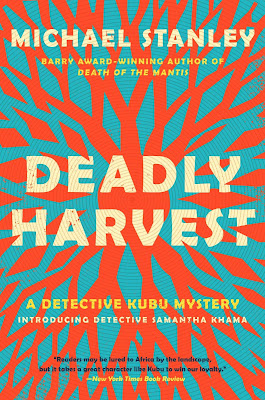
Deadly Harvest, our fourth book, was very different. When we were researching the series, before the first book was finished, we spent an afternoon with the Director of the Criminal Investigation Department of the Botswana Police Service. He drove us all over town, telling us stories, answering urgent calls from his staff, and so on. He suggested very strongly that we use the brutal practice of muti murders for one of our books. A muti murder is when a witchdoctor uses human body parts for concocting a powerful medicine (called muti locally). He told us of the infamous case of Segametsi Mogomotsi, a fourteen-year-old girl who was murdered for body parts, a case that had never been solved. We researched it and used it specifically as the backstory of our tale.
Books five, six, and seven (A Death in the Family, Dying to Live, and Facts of Death) had contemporary issues as backstories: the increasing presence of Chinese in Africa; biopiracy; and the enormous importance of diamonds to Botswana's economy and politics.We'll tell you more about the Detective Kubu book we have just finished sometime soon. It's called A Deadly Covenant.
Switching to our thriller, Shoot the Bastards, featuring investigative reporter, Crystal Nguyen, we had the whole shocking story of rhino poaching and rhino-horn smuggling to work with as a backstory. Even so, we struggled with the writing, several times grinding to a halt at about 20,000 words. Eventually I suggested to Michael that I write a few chapters, a few stories, about what Crystal did in her job in Duluth, Minnesota. I did that and ended up with about 60,000 words, which, during COVID, I reworked into my first solo book, Wolfman.
An unsettling part of Wolfman is the fact that Crystal, an ambitious investigative reporter, creates news stories that she later reports on. I've been asked a number of times where that idea came from. It actually came from a blog I wrote many years ago here on Murder is Everywhere. Here's that blog.
______________________________
Most countries have criminals or criminal events that capture the public’s imagination, sometimes positively, but usually negatively. Some that come to mind are Bonnie and Clyde, Al Capone, Ted Bundy, Jeffrey Dahmer, Charles Manson, Ronald Briggs and the Great Train Robbery, Jack the Ripper, and so on. We all have heard of these people and the crimes they perpetrated.
In South Africa, it was what the media called the Stander Gang that caused newspaper sales to soar. The public couldn’t get enough information (or speculation) about the gang and its exploits, and even today there are many South Africans who wish that the gang had got away with its daring exploits. In fact, at one stage in the spree of bank robberies, it became a badge of distinction to have been robbed by the gang.
The gang was named after its leader, André Stander, son of a senior officer in the Correctional Services, Major-General Frans Stander. After failing high school, the Major-General suggested (!) that André join the police.
In a surprising turnabout, André was selected as the Best Recruit in 1964. After graduating he rose through the ranks and was promoted to captain in 1977 and headed the Criminal Investigation Department at the Johannesburg suburb of Kempton Park, near Johannesburg’s international airport.
Apparently his success in the police force didn’t meet all his needs, probably both emotional and financial. So he took up robbing banks as a hobby. On his days off from his police job, he would fly to Durban, don a disguise, rent or steal a car at the airport, and go and rob a bank or building society. When he finished he would drive back to the airport, fly back to Johannesburg, and become a policeman again.
 He did this for three years, leaving his colleagues in the police force bewildered, with no clues as to who was pulling off the audacious jobs. As is so often the case, he became overconfident and boasted to one of his close friends about what he was doing. The friend worked for the Bureau of State Security (BOSS) – one of the draconian arms of the apartheid government. The friend reported the comments, and the police set up surveillance.
Sure enough, after flying into Johannesburg from a heist in Durban, he was apprehended with money, disguises, and a firearm in his luggage. He was found guilty on 15 of 28 charges of bank robbery and sentenced to an effective 17 years in a maximum-security prison.
At this stage in his career, he enjoyed only minor celebrity status, which included rumours that he would rob a bank during his lunch hour, then return to it later to investigate the crime.
 However, it’s what happened next that catapulted him to the spotlight and fame.
While in prison, Stander met and befriended two other bank robbers, Patrick Lee McCall and Allan Heyl. In August 1983, Stander and McCall, with several other prisoners, were scheduled to meet with a physiotherapist. While in the waiting room, Stander and McCall overpowered their guards and the poor physiotherapist and escaped.
About two moths later, Stander and McCall returned to the prison and sprung Heyl from the maximum-security facility. Then the fun began.
 Over the next three months, what became called the Stander Gang, robbed at will. They raided a gun shop and took an arsenal of weapons. Stander took a yellow Porsche Targa for a test drive at a dealership and left the salesman gawping as the Porsche sped into the distance. Far from coy, Stander used the Porsche to go to nightclubs and to transport girls from an escort agency to and from the gang’s three safe house in the affluent suburb of Houghton.
In the two months from mid-November 1983 to mid-January 1984, the gang robbed twenty banks, sometimes four in a day. Each time they robbed a bank, the newspapers splashed their deeds all over the front page, and the public cheered. They saw Stander as a modern day Robin Hood, a gentleman robber – although there is no evidence he did anything charitable with his money, and in fact the police were pretty sure he was a rapist. The more the gang robbed, the more support the gang garnered from the public.
 Again over-confidence took hold. Stander robbed a bank, in disguise, but without his sun glasses. A camera caught him in action, and the police at last had a clear image of his face – which they gave to every newspaper in the country, as well as to TV. Stander realized that time was running short and arranged to buy a yacht in Cape Town in which the three could sail to the United States. Stander flew to the States on a false passport to finalize details.
The day after he left, apparently based on information offered by some of the escort agency girls, the police surrounded one of the safe houses. After a mighty gun battle, McCall was killed. Heyl, who was elsewhere that evening, then fled the country and went to ground in Greece, on the island of Hydra.
 |
| Mugshots of Stander by Florida police |
Stander meanwhile assumed the guise of an Australian writer in the Fort Lauderdale area of Florida. He bought an old Ford Mustang, but was stopped by the police shortly afterwards for driving an unregistered vehicle. They photographed and fingerprinted Stander (or Peter Harris, as he was known) and impounded the car. Undaunted, Stander broke into the police impound lot and stole his car back. Then he did something that boggles the mind – something that if any of us tried to use in one of our books, the editor would delete it immediately, rolling her eyes, thinking how stupid some writers can be. Stander took the Mustang back to the second-hand dealer from whom he had bought it and asked for it to be sprayed a different color.
As luck would have it, the dealer had read in the local newspaper about the Stander Gang and recognised Stander when he walked in. He called the police. That evening the police surrounded Stander’s apartment, and when he showed up around 10:30 PM, they confronted him. He tried to wrestle with one of the policemen, whose shotgun went off, fatally wounding Stander.
As for Allan Heyl, he left Hydra for England, where he pulled a small heist. Eventually a confidence trickster he had befriended, turned him into the police. He was arrested at a house in Surrey. In May 1985, he was sentenced to nine years in prison. When he was released, he was extradited to South Africa where he received an additional sentence from which he was paroled in 2005. And guess what? He is now a motivational speaker!
__________________________________
I so loved the idea of a policeman robbing banks, then returning a day or two later to investigate the robbery, that for a number of years I had toyed with ways I could use it. So, when I started writing about Crystal Nguyen, investigative reporter, it occurred to me that the same principle could be used. News reporter creates a newsworthy event, then later returns to report on it. Unethical? Certainly! But what's an ambitious, young, female reporter going do when she's sidelined on the news desk?
Of course, the whole idea comes back to bite her, and her life's in jeopardy, as it was for Stander. Fortunately for me, Crystal is still alive.
Do you have an idea for a new adventure for Crystal? If so, please let me know! Then I won't have to look around for ideas, because they'll come from you.



 He did this for three years, leaving his colleagues in the police force bewildered, with no clues as to who was pulling off the audacious jobs. As is so often the case, he became overconfident and boasted to one of his close friends about what he was doing. The friend worked for the Bureau of State Security (BOSS) – one of the draconian arms of the apartheid government. The friend reported the comments, and the police set up surveillance.
  However, it’s what happened next that catapulted him to the spotlight and fame.
 Over the next three months, what became called the Stander Gang, robbed at will. They raided a gun shop and took an arsenal of weapons. Stander took a yellow Porsche Targa for a test drive at a dealership and left the salesman gawping as the Porsche sped into the distance. Far from coy, Stander used the Porsche to go to nightclubs and to transport girls from an escort agency to and from the gang’s three safe house in the affluent suburb of Houghton.
 Again over-confidence took hold. Stander robbed a bank, in disguise, but without his sun glasses. A camera caught him in action, and the police at last had a clear image of his face – which they gave to every newspaper in the country, as well as to TV. Stander realized that time was running short and arranged to buy a yacht in Cape Town in which the three could sail to the United States. Stander flew to the States on a false passport to finalize details.





