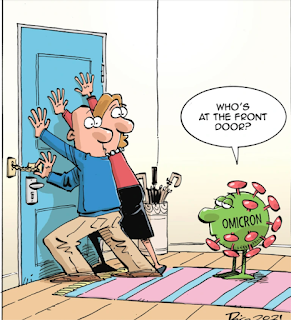
I was going to rant and rave in today's blog about the travel ban on southern African countries because of the omicron variant. Not only because I may not be able to fly to Cape Town when scheduled in a couple of weeks, but more so because it seems so hypocritical, with Europe now having over a hundred confirmed cases and few restrictions, and overall way more infections. The Business Maverick in South Africa had a cartoon which sums up the situation very well. Thank you Rico.

Instead of spewing fire and brimstone at the UK and Europe, I'm going to take a gentler approach and write about trees.
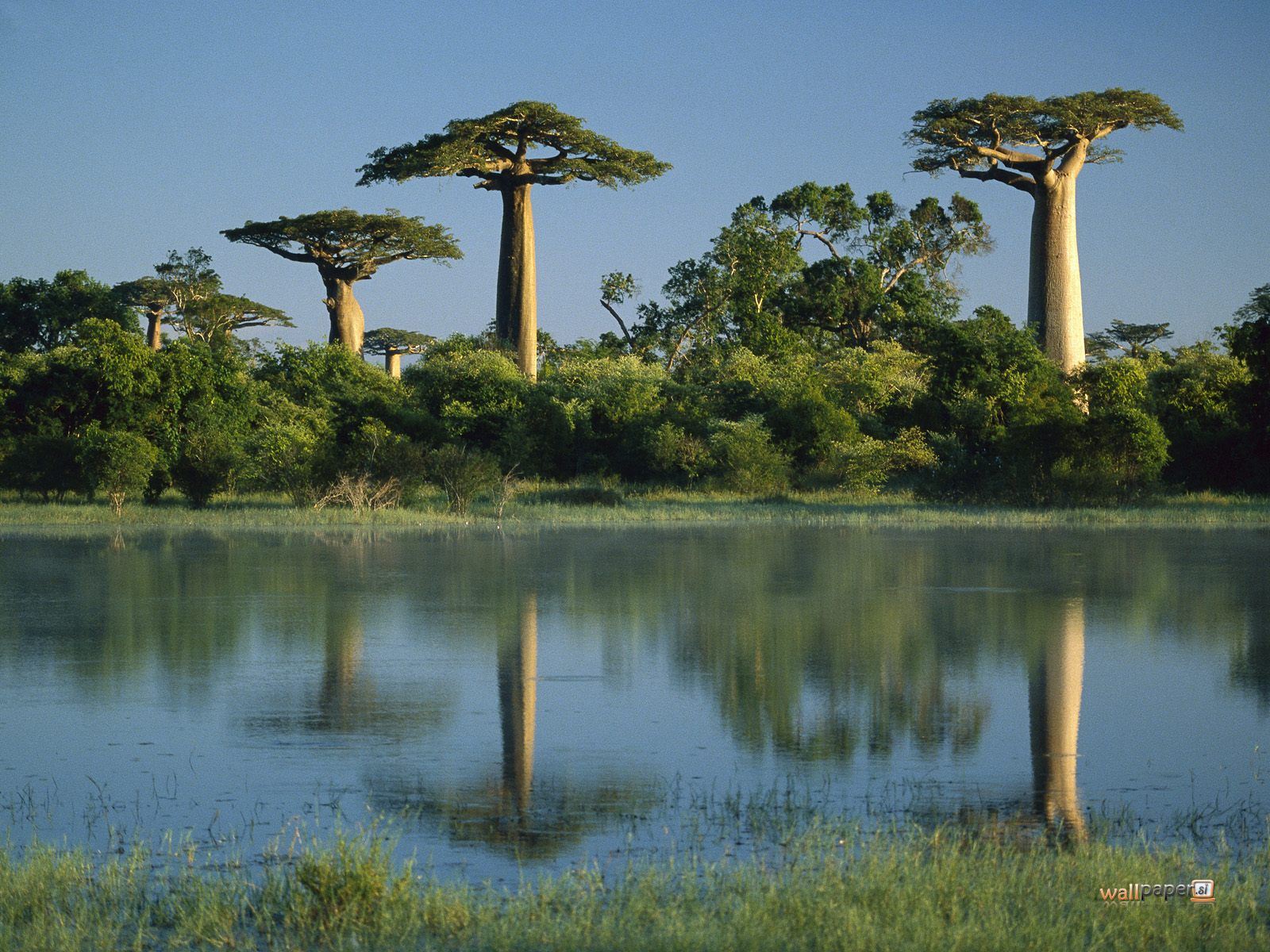
Not any old trees, but a special family that inhabit Africa, Madagascar, and Australia - the baobab.
There are eight species of baobab: one on the African mainland, six on Madagascar, and one in Australia.
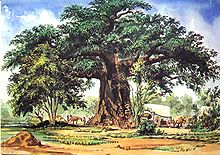
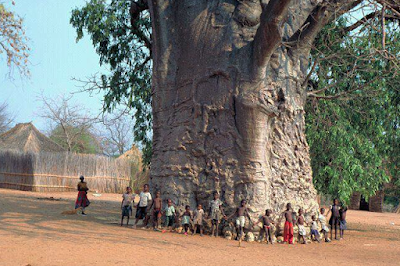
For those of us who grew up in Southern Africa, baobabs are a familiar sight. Specifically, the one African species is Adansonia digitata, named after French naturalist Michel Adanson. Some of them are extremely old and often huge. Some have been dated to be over 2000 years old. The owners of Sunland Farm in Limpopo, South Africa have built a pub called "The Big Baobab Pub" inside the hollow trunk of the 22 metres (72 ft) high tree. The tree is 47 metres (155 ft) in circumference. They claim the tree is over 6000 years old, but that claim may have something to do with the fact that one is told that in a pub.
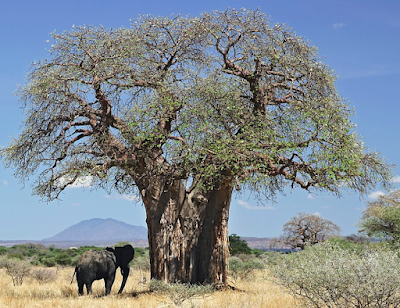
They are very fibrous, and elephants often use their tusks to dig into them for water, leaving unsightly wounds in their trunks - the trunks of the baobab, not the elephant!
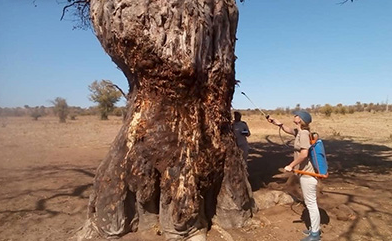 |
| Trying to protect a baobab gashed by elephants |
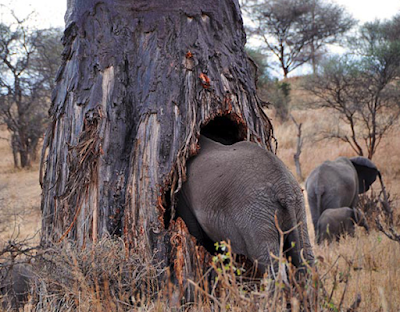 |
| An elephant pub |
Michael and I have had a couple of baobab encounters while writing the Detective Kubu series. The first was in Kasane in northern Botswana. We were visiting the police station there, researching one of our books. The police station itself is modern, and set between two very old baobabs that had been used historically as a mail drop and a prison - one baobab for men, the other for women. We were very impressed that the Botswana Police Service had chosen a new building site that wouldn't mean getting rid of these historical trees.
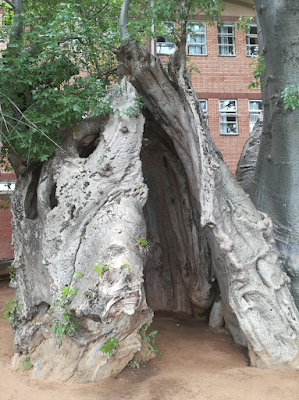 |
| The old jail with the new one in the background |
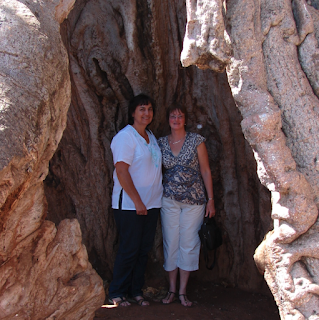 |
| In jail |
When we eventually were seated in front of the station commander, we told him that the country's police commissioner had told us to ask him to show us around to the holding cells and interrogation rooms. He didn't believe us. He pulled out his mobile phone and handed it to me, saying quite aggressively: "Phone the Commissioner and have him tell me."
Fortunately, I had the Commissioner's number, which I dialled and was extremely fortunate to have him answer. I explained the situation and handed the phone back to the station commander. After that we could see whatever we wanted.
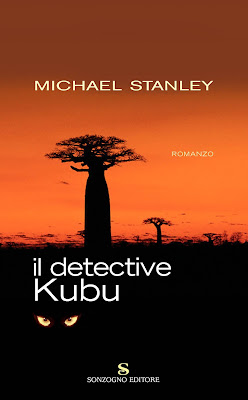
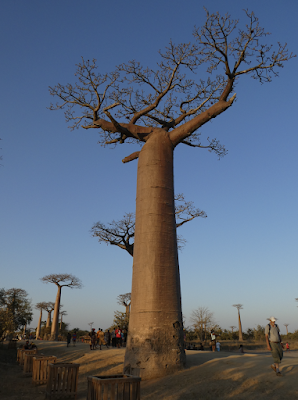
The second baobab story Michael and I have relates to the cover of the Italian edition of A Carrion Death, our story where in Chapter 1 a hyena is found eating what remains of a human. It was titled Il Detective Kubu and had a very dramatic cover, seen below, with a pair of eyes staring out at the reader, with some baobabs on the top half. Of course, when we received the cover from the publisher, it was accompanied by a note that indicated that they thought it was the greatest cover ever. That created somewhat of a quandary for us because the eyes were were those of something in the cat family - none of which makes an appearance in the book, and certainly not hyena eyes. And the baobabs were a species (Adansonia grandidieri) that grow only in Madagascar. We decided not to push out luck and wrote back that while we agreed it was the greatest cover ever, it would probably be good to put an African baobab on the cover. We didn't mention the eyes.
The outcome was as we expected - nothing changed.
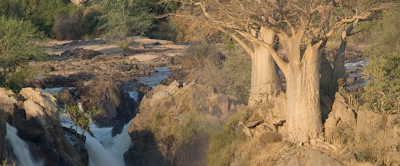
Here are a couple of photographs of Africa's Adansonia digitata.
 |
| A single Adansonia grandidieri |
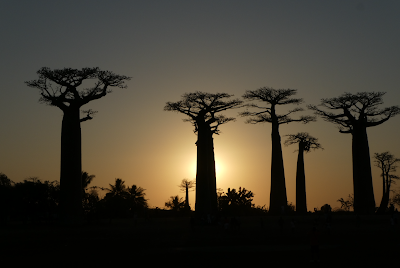 |
| An avenue of Adansonia grandidieri |
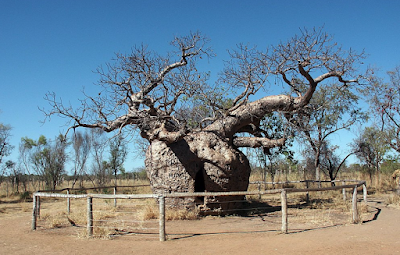 |
| Adansonia Gregorio |
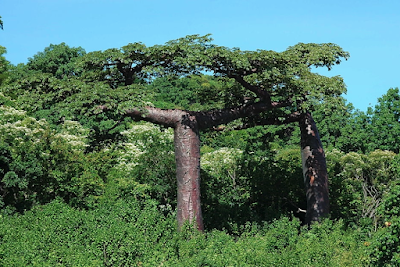 |
| Adansonia suarenzensis |
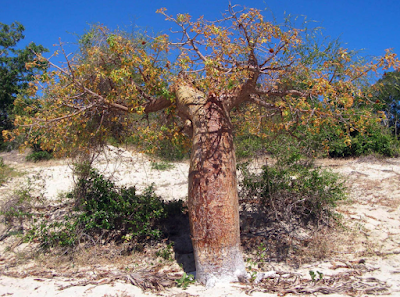 |
| A little Adansonia rubrostipa |
 |
| Adansonia rubrostipa (Photo: Beth Moon from her book Baobab) |
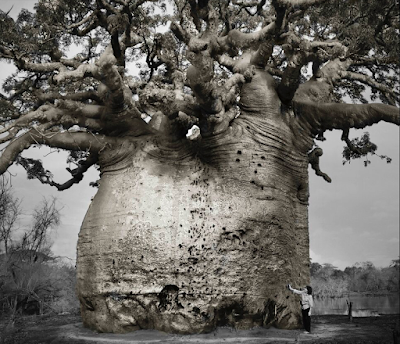 |
| Adansonia rubrostipa (Photo: Beth Moon from her book Baobab) |
In Africa, the baobab is called the tree of life for its water and fruit. A mature baobab can hold up to 100,000 litres of water (about 25,000 gallons), and the leaves are sometimes used as vegetables. The fruit of the baobabs is one of their distinguishing features. It is large, oval to round, and berry-like in most species. It has a dry, hard outer shell of variable thickness. In most species, the shell is indehiscent (a word for Zoë), which means it does not break open easily. The fruit usually dried and the resulting powder used in a variety of foods.
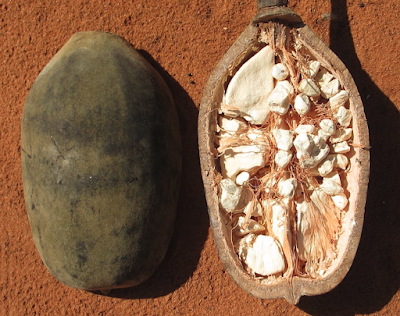 |
| Fruit of Adansonia digitata |