Showing posts with label Madagascar. Show all posts

Wednesday, January 18, 2023

When cultures clash


Michael and Stanley - Thursday


We all know that one of the most important issues to grab the reader's interest is tension. When cultures clash, it generates a fracture point where tensions rise and angry people may commit violent acts. This isn’t always colonists versus indigenous people; it can also be tribal or religious conflict. Some fine crime fiction focuses on these situations to provide an intriguing and believable backdrop for an entertaining murder mystery. To illustrate what we mean, here are a few examples we've enjoyed where culture clash is a central theme. Each of the books mentioned takes on culture clash in a different context and comes up with a different type of story. Each could only work in its particular setting, both in terms of character and plot.

In Abir Mukherjee’s series of historical mysteries set in the British Raj, the clash is between the British rulers and the local Indian population. Ex-Scotland Yard detective Captain Wyndham teams up with Sergeant Banerjee, a local whose relationship with the British rulers makes him unpopular with some of his own people. The combination of the two of them allows us to see the crimes they investigate from different, and sometimes opposing, perspectives. In the first of the series, A Rising Man, a senior British official is murdered. The British assume that the murder has been carried out by some branch of the independence movement, but the detectives need to look at the crime much more deeply to make progress. The complex trail leads them through the fractious relationship between the British and their Indian subjects to a surprising conclusion. Along the way Mukherjee recreates the Calcutta of the 1920s with all its nuances. The book won the prestigious Crime Writers Association Gold Dagger for best mystery of the year.

James McClure wrote during the apartheid era, and his books were banned in South Africa for some time. In fact, he relocated to the UK. His novels are set in apartheid South Africa, and here the clash is pretty obvious—the powerful minority White Afrikaner rulers of the country versus the local Black peoples. McClure illustrates the conflict through all his books, subtly taking on the premises of apartheid through his two policemen—the White Lieutenant Kramer and the Black Detective Sergeant Zondi – a similar stratagem to the one Mukherjee uses. The detectives’ backgrounds are very different, but they make a good team. McClure cocks a snoot at the racism of the era by making Zondi, lower-ranked because of his color, the smarter of the two.

In The Steam Pig, a beautiful music teacher is murdered with a bicycle spoke through the heart. It’s the collaborative work of Kramer and Zondi that eventually breaks the case and illustrates directly why the apartheid system was at such cost to all sides.

The Steam Pig was another CWA Gold Dagger winner.

Madagascar has a mix of peoples who originated from places as diverse as mainland Africa and Indonesia. It was taken over by the French at the start of the twentieth century and became a veritable boiling pot of diverse cultures and races. After the French left, a republic was declared in 1960 that has creaked under the pressures of a variety of corrupt regimes ever since.

Stephen Holgate worked in the US Foreign Service, and his time in Madagascar as a diplomat not only informed him about the island, but also saw him develop an understanding of the peoples, and that comes through powerfully in his novel. Holgate uses the outsider point of view to observe the cultural conflicts. His protagonist, Robert Knott, is a diplomat at the US embassy. He's spent his career abroad, and has finally washed up in Madagascar. 

The local culture and its belief in the ghosts of ancestors is central to the story. Knott understands this, but, of course, doesn’t believe in it. As he says himself: he prefers to keep the island at a distance. It doesn’t work out that way. 

A great example comes from our own Annamaria Alfieri. South America, too, has historical conflict between the locals and the invaders from Spain and Portugal. (Everyone knows the movie The Mission.) City of Silver was her acclaimed debut. It's recently been translated into Spanish.

The silver mines made Potosi in seventeenth century Peru the richest city in the new world. The wealthy and powerful mayor’s daughter dies at a convent there and is believed to have committed suicide. However, the abbess thinks otherwise and sets out to discover the truth.

The Spaniards, the Inquisition, and the local people produce a three way culture clash for an intriguing mystery in a fascinating historical setting.   


Culture clash is not always White versus Black. Our own crime fiction sometimes uses the clash between the Bushman cultures of the Kalahari and that of the Tswana people of Botswana. It's a major theme in the latest book, A Deadly Covenant. A massacre of a Bushman group by a Tswana gang is the flash point. Although many years have elapsed, the tensions and fears generated by the event lead to apparently inexplicable killings in the present. Kubu has his work cut out for him.

These are just a few examples of a broad spectrum of first-rate crime fiction based on the clash of cultures. We haven't touched on North America - Tony Hillerman’s Native American novels are well known, and the modern-day black-white culture clash in the US is powerfully illustrated in SA Cosby’s work.  Europe, too, has plenty of examples. John Banville’s crime fiction set in Ireland has religious as well as political tensions in the background, and what about all the refugee culture (and other) issues?

It's all grist to the mystery writer's mill. Friction, tension, anger. Maybe even murder...


Thursday, December 2, 2021

No rant today!

 Stanley - Thursday

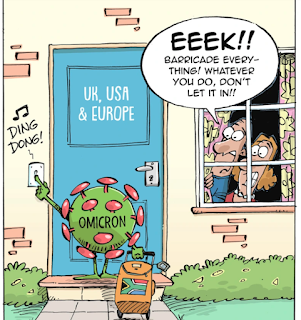
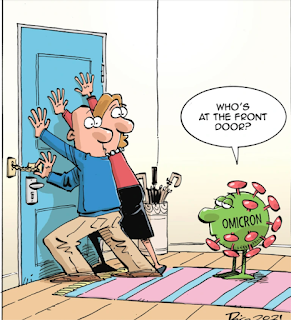
I was going to rant and rave in today's blog about the travel ban on southern African countries because of the omicron variant. Not only because I may not be able to fly to Cape Town when scheduled in a couple of weeks, but more so because it seems so hypocritical, with Europe now having over a hundred confirmed cases and few restrictions, and overall way more infections. The Business Maverick in South Africa had a cartoon which sums up the situation very well. Thank you Rico.


Instead of spewing fire and brimstone at the UK and Europe, I'm going to take a gentler approach and write about trees.

Not any old trees, but a special family that inhabit Africa, Madagascar, and Australia - the baobab.

There are eight species of baobab: one on the African mainland, six on Madagascar, and one in Australia. 

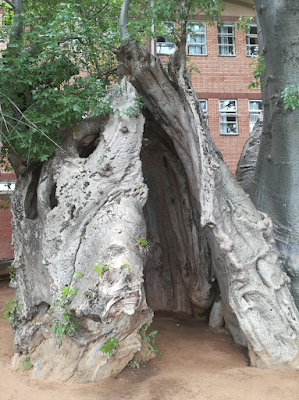
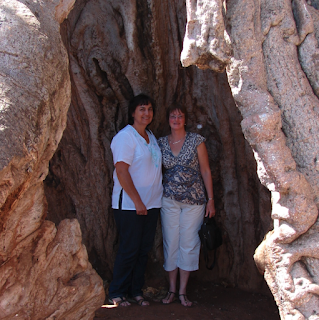
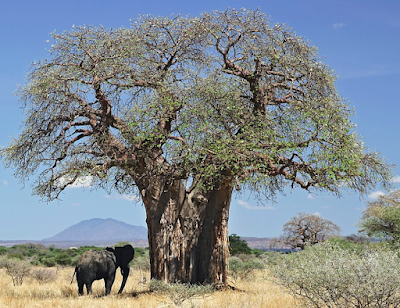
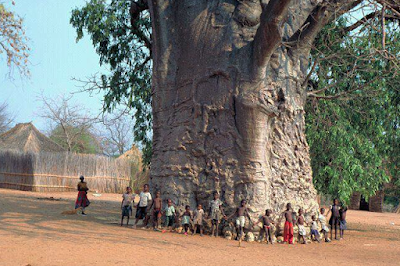
For those of us who grew up in Southern Africa, baobabs are a familiar sight. Specifically, the one African species is Adansonia digitata, named after French naturalist Michel Adanson. Some of them are extremely old and often huge. Some have been dated to be over 2000 years old. The owners of Sunland Farm in Limpopo, South Africa have built a pub called "The Big Baobab Pub" inside the hollow trunk of the 22 metres (72 ft) high tree. The tree is 47 metres (155 ft) in circumference. They claim the tree is over 6000 years old, but that claim may have something to do with the fact that one is told that in a pub.

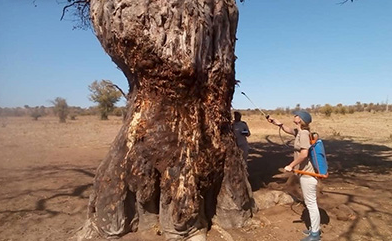
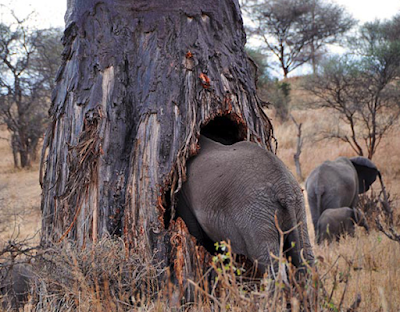
They are very fibrous, and elephants often use their tusks to dig into them for water, leaving unsightly wounds in their trunks - the trunks of the baobab, not the elephant!

Trying to protect a baobab gashed by elephants

An elephant pub

Michael and I have had a couple of baobab encounters while writing the Detective Kubu series. The first was in Kasane in northern Botswana. We were visiting the police station there, researching one of our books. The police station itself is modern, and set between two very old baobabs that had been used historically as a mail drop and a prison - one baobab for men, the other for women. We were very impressed that the Botswana Police Service had chosen a new building site that wouldn't mean getting rid of these historical trees.

The old jail with the new one in the background

In jail 

When we eventually were seated in front of the station commander, we told him that the country's police commissioner had told us to ask him to show us around to the holding cells and interrogation rooms. He didn't believe us. He pulled out his mobile phone and handed it to me, saying quite aggressively: "Phone the Commissioner and have him tell me."

Fortunately, I had the Commissioner's number, which I dialled and was extremely fortunate to have him answer. I explained the situation and handed the phone back to the station commander. After that we could see whatever we wanted.

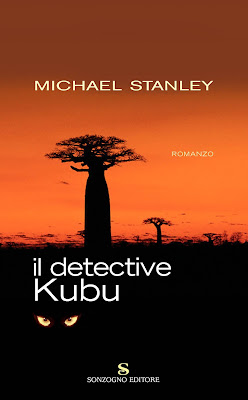
The second baobab story Michael and I have relates to the cover of the Italian edition of A Carrion Death, our story where in Chapter 1 a hyena is found eating what remains of a human. It was titled Il Detective Kubu and had a very dramatic cover, seen below, with a pair of eyes staring out at the reader, with some baobabs on the top half. Of course, when we received the cover from the publisher, it was accompanied by a note that indicated that they thought it was the greatest cover ever. That created somewhat of a quandary for us because the eyes were were those of something in the cat family - none of which makes an appearance in the book, and certainly not hyena eyes. And the baobabs were a species (Adansonia grandidieri) that grow only in Madagascar. We decided not to push out luck and wrote back that while we agreed it was the greatest cover ever, it would probably be good to put an African baobab on the cover. We didn't mention the eyes. 

The outcome was as we expected - nothing changed.


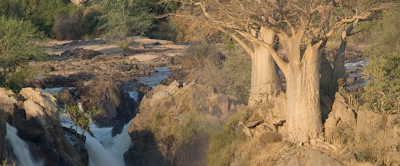
Here are a couple of photographs of Africa's Adansonia digitata.


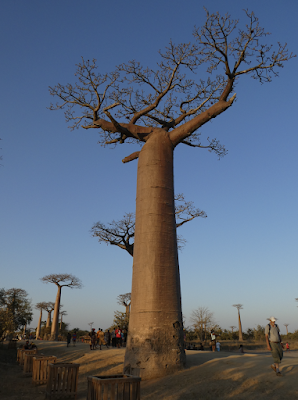
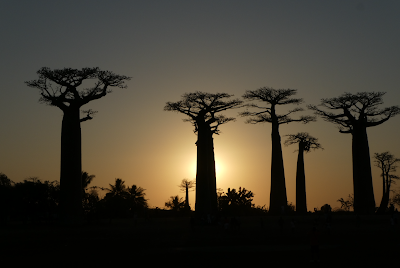
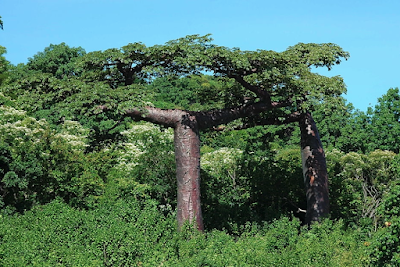
Michael and I and others visited Madagascar four years ago and enjoyed the famed Allée des Baobabs  (Adansonia grandidieri).

A single Adansonia grandidieri

An avenue of Adansonia grandidieri

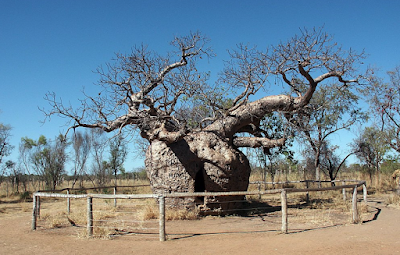
Across the Indian Ocean to the Kimberley District of Australia we find Adansonia Gregorio, another fat stemmed baobab - the baob or Australian baobab.

Adansonia Gregorio

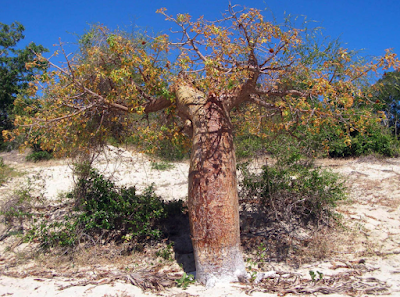
Back to Madagascar, there is Adansonia suarenzensis - very different.

Adansonia suarenzensis

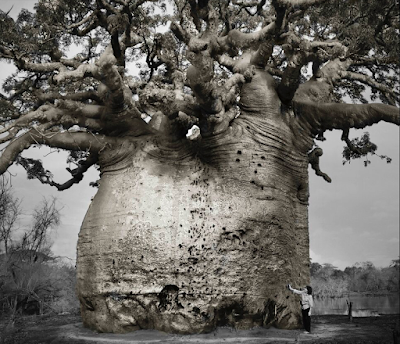
And finally, the strangest of all - the Adansonia rubrostipa, which comes in all shapes and sizes.

A little Adansonia rubrostipa

Adansonia rubrostipa (Photo: Beth Moon from her book Baobab)

Adansonia rubrostipa (Photo: Beth Moon from her book Baobab)

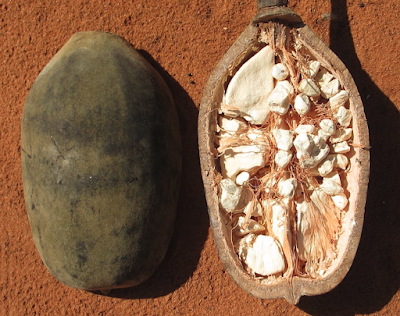
In Africa, the baobab is called the tree of life for its water and fruit. A mature baobab can hold up to 100,000 litres of water (about 25,000 gallons), and the leaves are sometimes used as vegetables. The fruit of the baobabs is one of their distinguishing features. It is large, oval to round, and berry-like in most species. It has a dry, hard outer shell of variable thickness. In most species, the shell is indehiscent (a word for Zoë), which means it does not break open easily. The fruit usually dried and the resulting powder used in a variety of foods.

Fruit of Adansonia digitata

The baobab is also called the upside-down-tree, for obvious reasons. It is worth a trip to Africa and Madagascar just to see these monsters.

Now I can get back to grumbling about the travel ban, particularly now that nine omicron cases were found in Scotland before the virus was identified in South Africa, none of whom had travelled to Southern Africa nor had any links to anyone there. Grrr.

Thursday, September 7, 2017

Madagascar - Part 2: The dream

Stanley - Thursday

Last week I chronicled the disgraceful way our tour operator, Madagascar Natural Tours, handled Michael's birthday trip.

However, even in bad circumstances, in a place like Madagascar there will always be highlights.  So, putting the bad behind, let's take a look at the extraordinary offerings the country has.  The animals one dreams about.


I dream of a sifaka lemur (Photo: Jill Wilson)

First, some facts:

Name: Republic of Madagascar


Flag of Madagascar (it's white on the left)
Size: 587,041 km2 (226,658 sq mi) - nearly the size of France.  Fourth largest island.

Population: 24,400,000

Currency: Malagasy ariary (approximately 3,000 to the dollar.  Paying for things provided ongoing light relief as most places did not take credit cards.  It seemed that whenever we saw an ATM, there was a rush to draw cash.  At 3,000 ariary to the dollar, drawing three-hundred thousand to half-a-million ariary was the norm.  Large wads stuffed in pockets and too-small wallets.

Just over $3.  Biggest denomination is 20,000 ariary.  I never saw one.

Government:  Constitutional democracy

People: 18 sub-groups of African and south-east Asian origins.  The Malagasy people are very attractive, generally small, and look healthy.  I only saw a few fat people and no evidence of malnutrition. 


Languages:  Malagasy and French

Biodiversity: Madagascar is a biodiversity treasure.  Over 90% of its wildlife is found nowhere else, thanks to its isolation from both Africa and India.

Last week's teasers

I asked what you thought this was a photograph of.


When I saw this during a night walk, I immediately thought it was an owl of some sort - an owl with a frown.  But I was wrong.  It is actually two collared nightjars cozying up to each other.   The eye on the left is the left eye of the nightjar on the left; the eye on the right is the right eye of the nightjar on the right.  If you look carefully, you can see their beaks.

This was the second teaser:


Our guide stopped us at a tree and pointed to a length of the trunk, perhaps a metre long. He asked what animal we could see.  Ten of us looked blankly until he used a twig to raise the head of a mossy leaf-tailed gecko.  You can see its head pointed downward.  Here's another picture of this species of gecko, taken from the Mail Online.  Can you find it?  Unbelievable camouflage.


Lemurs - I prefer the French pronunciation - leMOOR, rather than the English LEEmer

The name is thought to originate from the Latin lemures, meaning ghosts.
Lemurs are probably what first comes to mind when Madagascar is mentioned.  There are over 100 species, ranging from the minute mouse lemur (weight 30 grams - just over an ounce) to the large indri, which weighs in at about 8 or 9 kilograms or 20 lbs.  Historically, there were even bigger ones, but they are now extinct.
Lemurs evolved independently from other primates, such as monkeys and baboons.  And it was the diversity of Madagascar's climate that gave rise to the extraordinary diversity among these animals.  Since the different types of lemurs are spread all over the country, one can only hope to see some, rather than all, of them.  I think we ended up seeing about 15 different types.

The experience of looking for lemurs was very different from what I expected.  I thought we would walk through forests, necks craned upward, searching for them.  We certainly did some of that, but generally the guides knew where the lemurs were.  In addition, in some places, the lemurs had become habituated to humans and, not only were comfortable around people, but often jumped on their heads and shoulders,  More like a zoo, in fact.

However we came to see them, the lemurs were wonderful to watch, not only for their looks, but also for their amazing facility in moving through the forest.
Here are some of the lemurs we saw.  I have to admit that I'm unsure that I've identified them all correctly.

Where we say a number of lemurs
The indri is the biggest of the lemurs and is the only one with virtually no tail.  It is called babakoto locally, which can mean ancestor.  It is highly regarded, almost worshiped.  It has a remarkable call that can be heard over great distances.  Click here to hear the call.  It often hangs upside down from a branch.  It is endangered.


Other species

Black lemur (I think)
Baby mouse lemur

Woolly lemur?

Dwarf lemur

Black and white ruffed lemur

Mongoose lemur (?)


Hybrid lemur
Hybrid lemur 

Hybrid and woolly(?) lemurs

Crowned lemur


Mette said she would die if a lemur jumped on her shoulder.  It did,  She didn't.

Sifaka lemur (which one I am not sure.)
Sifaka lemur
Sifaka lemurs are so well adapted for arboreal existence that they struggle on the ground.  To get around on the ground they have to hop, either forward or sideways.  This is amazing to watch.  Click here to see the sifaka moving on the ground.

Aye-aye

Unlike the indri, which is revered, the aye-aye is hated.  It is the sign of bad luck.   If it is seen in a village, it is believed that a villager will soon die.  It is often killed on sight.

It is quite big (1.5 to 2 kg) and body and tail can be a metre long.

It is quite remarkable in how it finds food.  It knocks on the bark of a tree.  If it hears an insect, it gnaws the bark away with its special incisors, then inserts a very long third finger in the hole to get its prey.  (I suspect the long middle finger is why locals don't like it.)

It is also amazingly mobile and can cover several kilometres a night in search of food.

Aye-aye

Aye-aye hand


Chameleons and frogs and other creepy crawlies

Madagascar is home to over half of the world's 200 species of chameleon.  Some are huge and some are tiny.  All are fascinating.

Tiny
Tiny

Medium
Medium

Medium

Big!  Parson's chameleon (Photo: Jill Wilson)

Stick insect
Tiny frog

Predators

Surprisingly, Madagascar has nothing like the predator population of Africa.  Lemurs have two natural enemies, fossa and birds of prey.  I would have thought that lemurs could have taken a page out of the chameleon's book and developed one eye that looked up and one down.

The difficult to photograph fossa

Well, I think that is enough for today.  Next time, I'll take a look at the amazing baobab trees and say a few words about the Malagasy culture.