Sunday, September 3, 2017

An Owling Good Time in Tokyo

-- Susan, every other Sunday

With the world in chaos, and stress levels rising, I face a choice when my Sundays here at MIE roll around: address the world's troubles or try to offer an island of peace. Admittedly, Jeff makes my decision easier - his willingess to dive into the breach on Saturdays allows me to retreat to the fluffier side of blogging.

And it doesn't get much fluffier than the place I'm taking you today.

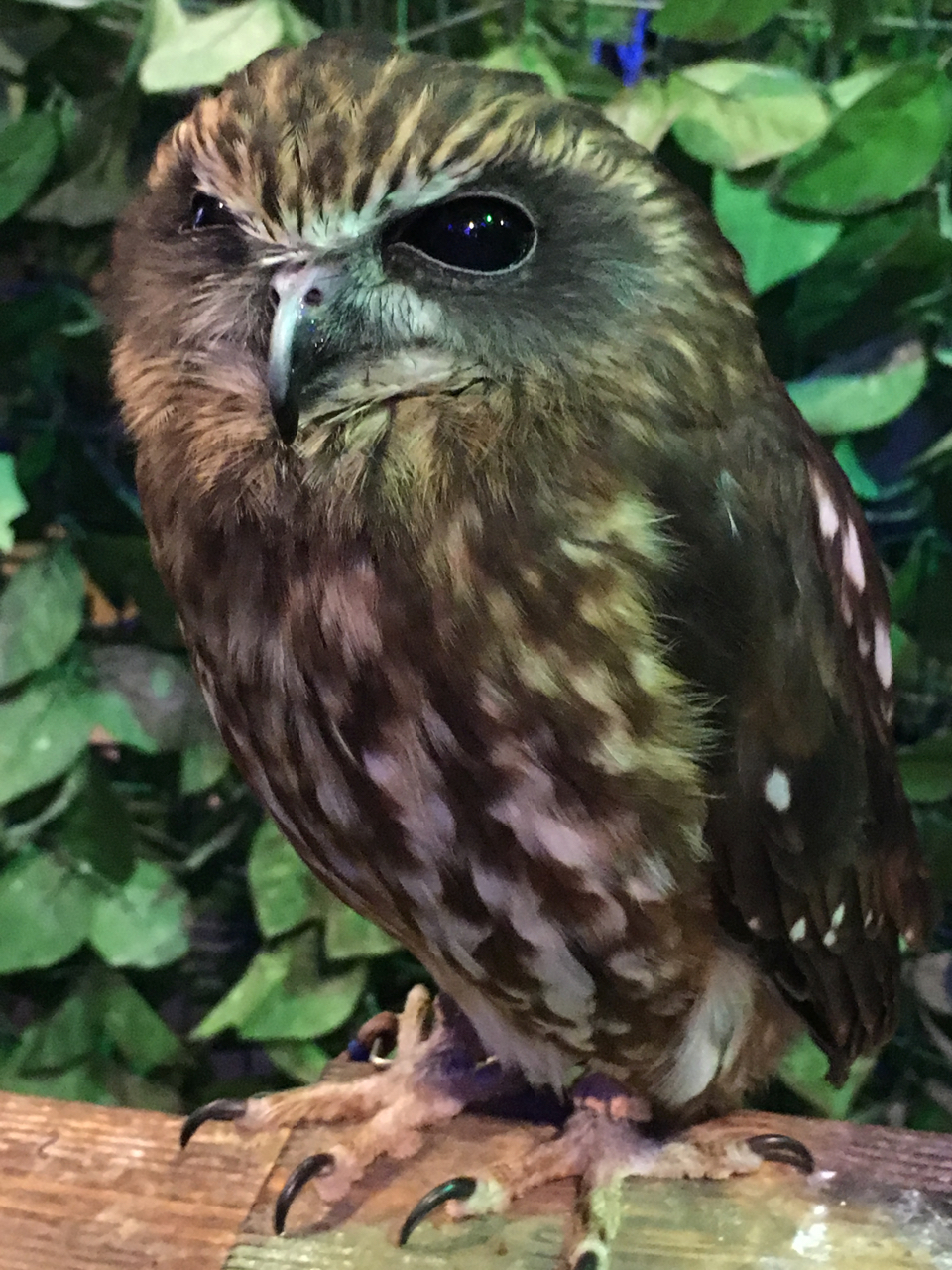
Her name is Holi Moli.

Most people have heard of Cat Cafes - coffee houses where cats roam freely so customers who like animals but can't own one can pet and play with cats while sipping lattes or iced tea.

But this Tokyo phenomenon has now given birth to an even stranger offspring: the OWL CAFE.

As the name suggests, it's a cafe where people go to pet and interact with owls.

Yes, live owls.


Much more fun than the dead kind.

I discovered the existence of Owl Cafes last spring, shortly before my last research trip to Japan, and since I've always wanted to touch a living owl, I hoped to pay one a visit.

As it happened, I stumbled across an owl cafe in Asakusa on the very first day of my trip, while doing research at Sensoji (Tokyo's oldest Buddhist temple, about which I've blogged here before). To escape from the rain, I wandered down a shopping arcade near the temple, and came across the most unusual--and compelling--barker I'd ever seen.

Tell me you wouldn't have gone inside too...


I didn't hesitate. I headed up the stairs, paid the cover charge (about $8.00, which entitles you to a drink and unlimited time with the owls), disinfected my hands (per the entry policy) and headed in.

Visitors are allowed to pet most of the owls -- the ones that don't like being touched have signs that say "Please look, but do not touch me" in both English and Japanese - but instructed to use the back of the hand (most likely to avoid harm to everyone).

Come at me, bro.

There were also other posted warnings.

Everybody poops. Sometimes, above you.


While some owl cafes are set up like standard coffee shops, with tables and wait staff who bring an owl to the customer's table for a time-limited visit, the owl cafe in Asakusa is built to resemble a jungle, with 12-15 owls sitting on perches and others roaming, flying, or wandering about on their own.

Barn owl!!

(Even more owls are in a resting room, away from the public - the owls are only "on" for a couple of hours at a time, and even then most of them can leave the public areas and fly into the rafters if they want to.)

The room is fairly dark - I suspect the owls are "time shifted" to think it's evening during operating hours, because most were alert and interested in the visitors.

Love the mustache.

Before visiting, I wondered whether the owls enjoyed being petted. Based on my experiences, both here and with other types of birds, they do. They leaned into my hand, fluffed up slightly the way birds do when happy, and didn't try to move away.

A happy owl.

For the record: petting an owl feels the way I believed that clouds must feel when I was very young. They're almost too soft to believe, and the amount of airspace beneath their feathers makes petting one feel like it almost disappears beneath your hand.  

I enjoyed my trip so much I went back a second time with my son, who also wanted to experience an owl cafe.

A boy and his owls.

He liked it as much as I did--and for the same reasons. Not only did we get to interact with owls, but the birds were clearly healthy, well-fed, alert, and not being forced to interact with us against their will. While some (the dozen or so that were actively "on duty") were tethered, the tethers were long enough to allow them to move around and to escape from visitors if they chose.

At least a dozen others were completely un-tethered, and most of them were still interacting with visitors. The ones that didn't want to be touched simply walked away or watched us from the parts of the cafe we could not enter.

On display, but not interested in being touched.

I loved it so much that I'll definitely go back, the next time I'm in Tokyo.

I finally found my own photobomber.

In fact, with no apologies . . . my son and I both had an 'owling good time.


Saturday, September 2, 2017

In Praise of American Values


Jeff—Saturday

What a week. I mean WHAT A WEEK.


Houston area rainfall in INCHES

Where to start?  Virtually all US news this week—at least that reaching us over here in Greece on US TV—focused on Southeast Texas flooding, plus of course, tantalizing Presidential touches like pardoning a partisan supporter, banning willing soldiers from serving in the military, and substantially cutting taxes for the yet to be determined. Oh yes, and North Korea.

Sort of makes you think everything is underwater.   


As some of you may know, my son is a chaplain with the Harris County Sheriff’s Department, which includes the city of Houston.  He was on site for the recovery of the six members of a single family (two great grandparents and four of their great grandchildren, ages 6 to 16) who perished when the van they were in was swept off the road into the water.  May God have mercy on their souls, and grant serenity of thought to the many torn apart by what this great storm has wrought.


But for the courage and perseverance of first responders, and an army of volunteers, each one risking his or her own life to save others, the death toll would be far greater.  Let us stop for a moment and look at the faces of these brave saviors.  They’re people of every color, gender, ethnicity, economic strata, religion, and sexual preference working together for a single purpose, to save another person’s life. 


That is not a Houston or Texas phenomenon in times of crisis. It is a tried and true, deeply engrained American trait. We saw the same courage in New Orleans during Katrina, and in New York and New Jersey with Sandy.  In trying times like these we see our true strength and values as a country come to the fore.


It is not a time for politics, polemics, or pettiness.

This is a time for reflecting on what brings us together, not to hammer away at what drives us apart.  Let us find a lesson in how individual Texans are pulling together to battle an unmitigated disaster, let us bring that sense of camaraderie into our hearts, allow it to fill our souls, and pray that it serves as an honest guide to what we all truly share as American values.

Amen.

And for those who wish to donate to American Red Cross Hurricane Harvey Disaster Relief, here is the link.


—Jeff

Friday, September 1, 2017

Confused. Me ?


 I confess to being quite confused now.  I think it might be an age thing.
 I can’t even speak the terminology  any more; it’s all too new to me.
It’s all about labels. And we all need a different label, which to me is divisive  rather than unifying.
So, here’s one thing. As far as I know there are two genders. XX and XY.
Two.
I have been told recently that this is wrong and that there are about 55 genders.
Nope. There are two.
I am told I am intolerant and sexist for saying so.
I might go for three. Occasionally there is  a XXY. They used to be very good at shot putting until we had the technology to find them out but are a genuine twist of nature so really it’s  two; XX and XY.
How you want to express those chromosomes in your private or personal life is no business of mine. It’s your personal stuff and unless I am in your personal circle, not my business. You can be binary, unilobular, tricyclic, quadrophenic, quintessential, hexagonal  I have no interest. As long as they are happy it’s fine.  My two best pals are gay. They have never told me they are gay, they just are what they are. And that’s fine. They do not label themselves as gay and they have never felt the need to.
                                           
                                                       I think this is a man in a skirt. I wouldn't argue
                                                          with him either way...

And now another celebrity has announced they are bringing their child up as non gender specific. Fair enough,  let the kid find it’s own way, I am all for that. But I suspect ‘it/ he/ she/them’ might be appearing in magazines with the parents discussing their/his/hers non gender status  to the ends of the earth as the XX or XY works  their  magic just as nature intended.
So when I get a bit of trouble with an employee for persistent lateness , I have to state to the lawyer if they are gay or not. Now the only answer to that should be, ‘I have no idea, it’s none of my business.’
Lawyer ‘Well you need to find out.’
Me       ‘Why, does being gay give you an inability to get to work on time?’
Lawyer  ‘No but..’
Me       ‘ Well why ask the bloody question then?’
Lawyer   ‘Yes, but they are a minority..’
Me    ‘Well if you look hard enough we are all a minority. I have green eyes, the last green eyed person will die in Finland in 2075 (I read that somewhere). I am so rare I could be persecuted. I am endangered.’

I think it might be my age.
Am I post feminist?  What does that mean? Ladies ( XX) fought very hard for the rights I have enjoyed, the equal rights I have enjoyed. I’ve never felt oppressed by men at work; I have a brain, I can speak and point out something that is unequal, hopefully without causing offence as often offence is not intended.

If a man stands up to let me sit down on the bus. I am not offended, but I’ll smile and say no thanks.
If an older man got on, I’d give them my seat. Same with a pregnant lady… or a pregnant man for that matter.  I’m not offended if a man holds a door open for me. I would also hold a door open for a XY coming through. It’s about people.

And equality. And the right to choose? Absolutely. And that goes both ways.
In my profession, I do believe that patients have a choice. They can see male or female practitioners as they do have to undress a little. Women not wanting to undress in front of men in the clinical sense, fair enough. Men not wanting treatment from a female because woman are not strong enough- well let’s hope they never phone up as an emergency on my shift!
Much more important is the protection of male practitioners from female patients who maybe have a different agenda than getting treatment for a sore back. And these women do exist and know how to work the system.
                                           

It’s about respect.
So I am now told  we are in an age where woman are expressing their sexuality freely. I thought that started in the 60’s but hey ho.  I was at an event recently where the women were dressed in knickers and suspenders, Basques and thigh length boots, in front of a male audience – which to me is right back where we started.
But that’s  err…. Something else.
I know it’s a deeper issue than that. Men paying women to take their clothes off is a win win for women, IF it’s her choice but it rarely is.  It’s normally an abuse of a vulnerable subject, and that abuse is not confined to women.
The event I am talking about so offended me - maybe that’s too strong a word- maybe I was struck by its incongruity and was uncomfortable with it. Any time I have witnessed a female stripper I have gone to the toilet so I don’t need to witness it. Anytime I have witnessed a male stripper I have gone to the toilet so I don’t need to witness that either. I see enough of that at work.
When I got my deal with Penguin, a male friend and writer (unpublished) said to me, ‘Well you would as you are young and blonde.’ I pointed out I was a lot older than him. He remains unpublished. He did not remain my friend.
                                                 
                                  A Scottish woman in art....but she maybe not be either.


And as I have mentioned before, we have a movement called the Women In Arts in Scotland. For the promotion of women in arts. Men are not allowed to join.
So I refused to join.


It  makes me uneasy. Equality is equality. Not just for some. I said that at an event recently and got a spontaneous round of applause so it’s not just me.
And then at work we got a letter from a lawyer, it started Dear Sirs (British polite from one company to another). My PA walked into the back office with our reply and got dogs abuse from a 35 (ish) member of staff. ‘It’s not right to put Dear Sirs, I mean that just means men, that’s demeaning to women. It’s not even legal so you should get that changed… ‘etc. etc., no doubt there was finger wagging. Then I said, loudly, ‘If they Dear Sirs us, we will Dear Sirs them.’
The finger waver scuttled to my door, all pouting and knickers in a twist. ‘We are all strong independent women; you should not be condoning that sort of language.’
‘Well I am the sort of strong independent woman who runs this company and you are the sort of strong independent woman who let her mum wash her socks until she was 33 so think on.’
And that just sums it up.
Just as I was writing this, a diversity survey from the Scottish Book Trust popped into my inbox. It has four questions, they want my age, they want to know how I would identify  myself. The word passport is not an option; male, female, other, prefer not to say.  But you can specify in a special box.. And then a question about my sexual orientation; 8 choices there. A question about disability   and then a question about my  ethnic origin;  11 options there, everyone has the word Scottish in it.
So I guess I am saying I am fed up with labels!
                                        

Caro Ramsay (XX ,Scot, Brit, European, osteopath, heterosexual, unionist, green eyed, vegan, runner, dog lover, cat slave, crime writer, MIE blogger.)

Thursday, August 31, 2017

Madagascar – Part 1: The nightmare


Madagascar – Part 1, the nightmare

Three weeks ago, ten of us descended on Antananarivo (usually called Tana for obvious reasons).  The main reason was to celebrate Michael’s 70th birthday.  Other reasons were to explore the country’s amazing flora and fauna, as well as to taste the Malagasy culture.

And taste it we did, but a lot of the taste was very sour.  Unripe lemons when expecting a mango.

The problems started when eight of the group arrived at Oliver Tambo airport in Johannesburg for their flight to Tana.  Despite their tickets declaring the baggage limit was 23kg and having checked on this online and in person, the eager travellers found the check-in clerk insist it was 20kg.  A frenzy of moving clothes and shoes around helped, but didn’t solve the problem, merely reduced it.  Eventually after paying usurious fees, the journey began.

A wee dram or two on board helped the travellers relax and stoke their anticipation.  What was not to look forward to?  A new country, lemurs, chameleons, baobabs, and a host of potential lifers for the birding-inclined.  And good company.

Except . . .

The tour company we had used to put together our two-week itinerary was not at the airport to meet the flight.  Having worked their way through the typically third-world airport at Tana, which meant going to a counter to have some form filled out, taking it to the next counter to pay a fee.  Then to another counter for the visa to be inserted into the passport, and finally to have someone else check that you and your passport were in sync, before you could go and retrieve your bags.  Or in Michael’s case, a suitcase and several large boxes of carefully protected vintage champagne and other fine wines.

Ivato International at Tana
When the frazzled group emerged from customs and immigration and found no one holding up a sign MADAGASCAR NATURAL TOURS – SEARS, frantic phone calls ensued.  Eventually, someone arrived and the group headed for their hotel.

Except . . .

It wasn’t the hotel that had been booked.  Eventually the harsh truth bubbled up.  The entire trip had been booked using an early itinerary, not the final one.  Consequently everything was a day off.  Hence no hotel.  We were expected the next day. 

So Michael’s carefully planned welcome dinner, with its highlight of vintage Bollinger champagne, went by the board.  Wrong day, wrong place, and no ice to chill the bubbly.

Meanwhile, Mette and I had headed for Tana after spending a few days in Paris – on a circuitous route via Amsterdam and Nairobi.  The flight to Amsterdam was late, causing us to miss our Nairobi connection.  Catching the next day’s flight would have put us a full day behind the rest of the group.  With a little gentle persuasion, we were rerouted, now out of Paris the following morning, direct to Tana.  A much better flight, despite a 0400 wake-up call to catch the first flight back to the City of Lights.  Eventually, we too arrived in Tana, late at night, but at least on the same day as the others.  And we were met and taken to the new hotel.

Next morning, we awoke early, ate a quick breakfast, and prepared to leave for the East coast.

Except . . .

The bus we had been promised did not materialise.  Instead we were squeezed into two SUVs.  Not ten of us, but eleven, because our guide had to come too.  All the bags had to fit too, so you can imagine the stack on top of the vehicles.  And the squash inside.

Our best vehicle, driven by the ever cheerful Mr. Henri
 

Tying them back on. The bags didn't always stay on the roof.

The roads in Madagascar are the worst I have ever experienced.  Narrow, with potholes that doubled as swimming pools, they often went through villages where market stalls came right to the edge of the road, and people, dogs, zebu, pedal- and people-powered tuk-tuks, and wagons covered the street and competed for space with cars, motorcycles, scooters, vans, petroleum tankers, and 16-wheelers.

Potholes everywhere


Potholes


Zebu - a common sight


Zebu wagon
Zebu wagons carried anything and everything.

Typical narrow road - Route Nationale 2

Typical narrow road - Route Nationale 2


Kids filled in potholes, hoping for tips

Click here to see what driving on Route Nationale 2 looks like.

Except . . .

The driving in Madagascar is the best I have ever seen anywhere.  Not only are drivers skilled in handling their vehicles, but they are patient, courteous, and always signalling their intentions.  The hooter (horn) is used to alert anything ahead that you are behind.  A few taps clears out the thronged streets mentioned above.  People slide to the side, let the car pass, then return to claim their spot in the middle of the road.  Cars pull off the road to let you pass, as do large vehicles.  Quite remarkable actually. 

I guess if people weren’t this courteous, they’d all be dead.

To end up this description of the grim arrangements, here are a few other highlights.
One of our vehicles was not 4x4, so when we arrived at an impassable section of the road to the ferry to our hotel, our guide had to hire a 4x4 from a local and transfer passengers and luggage.

Same on the way back.
A particularly difficult section.  4x4 necessary

On our way back from the east coast to the west, the tour operator eventually found a bus for us, and it was ready for a typical 0700 departure.

Except . . .

It wasn't licensed for the province we were going to.  So we left at 1100.  Unfortunately, the bus had been designed for Lilliputians – and the heating couldn’t be turned off.  So we abandoned it at our next stop.

A hotel at our furthest point held us hostage until we paid the bill.  Our tour operator had failed to do so.  How could a hotel do that? you may ask.  Easily, in this case.  It owned the ferries crossing the nearby river.  They wouldn’t take us until we paid.

The next hotel let us go without paying.

The flights back to Tana from the west-coast town of Morondava had either never been booked or the flights cancelled.  Our money wasn’t refunded, of course. 

Again we were up at 0700, and eventually an improved bus showed up to take us back to Tana.

Except . . .

Our tour operator had only paid the 50% deposit, and the driver refused to budge without full payment.  Smart man.

So WE had to hire vehicles to drive us back the whole way to Tana, so we could catch our flights.  At our cost. This meant we lost a whole day in which we should have been enjoying what we came to see.  We left at noon and had to stop halfway at yet another hotel that hadn't been paid for.
The next day we left on time and headed for our final hotel in Tana.

Except . . .

The hotel we should have stayed at wasn’t booked.  An alternate hotel turned out to be seedy in the extreme, so it took time to find an alternative.  Too late to go to the restaurant at which Michael and Pat had arranged a farewell dinner.  Which is too bad, since I was looking forward to seeing Michael’s face when the dancing girls appeared.

We are all back at home or nearly so.  The bad memories of woeful disorganization, of lack of any attempt to rectify the situation, of blatant failure to provide what we had paid for, and of interminable hours on the road will hopefully fade, and all we’ll remember are the amazing things we saw, which will be chronicled next week.

Sadly, Michael's birthday trip was not what we had hoped for, but we managed to celebrate whenever possible.
All was not lost, Michael enjoyed the Bollinger later in the trip.

As a teaser for next week, what is it I photographed in picture A below?

Picture A: Mystery subject

And in this one?

Picture B: Another mystery subject

__________________________

Upcoming events

Saturday, September 2, 1315: Stanley live interview by Monocle Radio, London (https://monocle.com/radio/)


Wednesday, August 30, 2017

Knocked Off Their Pedestals in Baltimore


Sujata Massey

I cannot call myself a native Baltimorean. However, I've spent almost two-thirds of my life in thi so-called "Charm City," so I call myself one by conversion. I love my town.

When I arrived here fresh off the plane for college, I believed I was going to a Southern city--but I quickly reversed my thoughts, as I realized I was 3 hours from New York, 1 hour from Philadelphia and Washington DC, and almost everyone at school was from the Northeast. Yes, there were crabs that came from an amazing microclimate on Maryland's Eastern shore, but the accents were nothing like true Southern accents. But evidence remained. Before the Civil War, Maryland was a slave-holding state--although its proximity to Washington DC put it on the Union side during the Civil War. 65,000 Marylanders fought for the Union while 22,000 joined the Confederate troops.

The Civil War ended with President Lincoln issuing the Emancipation Proclamation freeing all people in the US from slavery. For some, that was a hard pill to swallow. All across the South, efforts were made to keep blacks from living free and dignified lives. Jim Crow laws established boundaries between blacks and whites. In Baltimore in the early through mid-1900s, Confederate organizations raised funds and got permits to put up four monuments to their past on public land.

But statues aren't just placeholders in parks.

Earlier this month, a heavily-armed white supremacist rally gathered to carry torches and shout messages of hate at a Confederate monument in Charlottesville, Virginia, that the city had voted to remove. "Unite the Right" brought together Nazis, the Klan, and new white supremacy groups. And then they turned on the peaceful counter protestors who'd come. One woman died and 33 people were injured during hours of violence where the police stood by. Although President Trump took it in stride, many people in the country were aghast.  And mayors and governors of Southern states realized that the monuments on their streets could very likely bring the supremacists to visit them.

Within days of the Charlottesville rally,  Baltimore's recently-elected mayor Catherine Pugh ordered the monuments removed. Her action was received with relief by many Baltimoreans, including myself.

Supreme Court Chief Justice Roger Taney's statue stood at Mt. Vernon Place


This monument's base has bloody-looking trickles of red paint


To the outside, the action to remove might have looked like a quick reaction, but it was a long time coming. Many activists in recent years have showed up to protest the Confederate sympathizers who chose to gather at the Robert E Lee/Stonewall Jackson monument during Martin Luther King weekend. As my friend who organized a silent vigil there over many years said, it was stressful for her children to see the people come to mourn the loss of slavery. It seemed like a slap in the face to do it during the King holiday, although the Confederates explained to the protestors they were doing it at the time of both Lee and Jackson birthdays.

Some people have suggested that removing the Confederate statues is an act comparable to the what the Taliban or Isis has done when they've conquered places. But these statues were erected many decades after the Civil War. They are not part of the city's slave history. The organizations that erected them were shrewd to place them in the city's most beautiful and prestigious locations, near museums and colleges where visitors to Baltimore would have to see them. The monuments were put up during times that whites were intent on pushing back civil liberties for racial minorities.

Baltimore tried to deal with the statues gently. They experimented with placing plaques next to the statues explaining this provenance--but the statues were still upsetting to people. A commission of Baltimoreans appointed by the previous mayor, Stephanie Rawlings-Blake, studied the issue and recommended removal of two statues, but to leave two in place with plaques of explanation. The two the commission decided to leave were the ones relating to Confederate soldiers who perished--rather than Roger Taney, the former Supreme Court chief justice who affirmed the right of slave owners, and Stonewall Jackson and Robert E. Lee, the Confederacy's most famous generals.

Why shouldn't the statues remain with plaques of explanation? My mind was changed after I heard Baltimore City Councilman Brandon Scott speak. He said that slavery is a 9-11 for African-Americans. Allowing the statues of those who loved slavery is tantamount to putting up statues of the hijackers who hit New York's World Trade Center in 2001. And these statues weren't destroyed. Right now the removed statues are safely covered up and waiting on an undisclosed city lot. They have a future, somewhere.

I drove around last weekend to look at what was left of the monuments. The bases were still standing. Some of them had been hit with red paint that looked like blood, and others with graffiti.


On right, Cellis; to left are members of UXU, the multi-media organization that produces his videos


When I arrived at the site of the former Robert E. Lee-Stonewall Jackson monument, I was intrigued to find a cluster of young men there. Several had cameras out, a boombox was playing, and one man sat atop the statue performing a rap song.

After the song was done, I met  the rapper/songwriter, Cellis, who is a well-known artist activist. Cellis comes from Baltimore and has recorded strong songs about outspoken on police brutality and gay rights. His new song will be a proclamation of resistance to white supremacy.


The Baltimore Sun's photographers have photographed the statues and their sites before and after. See whether you think we suffered a devastating cultural loss. The Baltimore Office of Promotion and Arts is inviting artists to create sculptures to stand where the old monuments were. A beautiful future, which we can't yet imagine.


Tuesday, August 29, 2017

Twenty years ago in Paris

Twenty years ago this week, and it feels like the proverbial yesterday, I bought a Paris MATCH magazine from my local newsagent, Sam. I live in San Francisco and he stocked all the European newspapers, magazines and international as well. He even had the Charlie Hebdo issue after the terrible tragedy. Sadly, Sam closed a few months ago...just too tough for the printed word and glossies these days.
Paris MATCH always has great pictorials and the gossip, too. A guilty pleasure I admit. Towards the rear of the magazine was an article and paparazzi photos of Princess Diana sunning on a yacht deck in the turquoise Mediterranean with her new squeeze a Doti Fayed.
Paris MATCH always had the celebrati, aristo, billionaires etc often caught in flagrant delicate somewhere in the Mediterranean or South of France. So did the Guardian.

Well, Doti was new to me, whoever he was, she looked amazing, relaxed and really hadn't been on the front pages or on the news burner for a while (this was August 1997). Just another royal celeb with a new secret boyfriend caught by the paparazzi.  It stayed in my mind since I felt happy for her.
Diana and Doti flew back to Paris, stayed at the Ritz on August 30 and 31, and you know the story, left the Ritz late that night. I had literally opened the newspaper the day after I'd read Paris MATCH to headlines of Diana's death.


Here's is the Telegraph UK's timeline using CCTV footage and photographic evidence from which they built up an accurate timeline of Princess Diana and Dodi Fayed's final hours.
4.35pm Princess and Mr Fayed enter Ritz by rear door with Trevor Rees-Jones,bodyguard. Take lift to first floor suite.
5.42 Mr Fayed and Mr Rees-Jones drive to jewellery shop, returning seven minutes later. Member of staff later takes two rings to Mr Fayed's room.
6.53 Couple driven to Mr Fayed's apartment near Arc de Triomphe.
7.05 Henri Paul, chauffeur, goes off duty.
9.51 Couple return to hotel via front entrance.
10.08 Henri Paul returns to hotel.
10.20 Mr Fayed talks to night duty manager, who spends six minutes talking to Henri Paul and two Ritz chauffeurs.
10.30 Henri Paul makes first of five trips to Place Vendome in front of hotel, speaking to paparazzi on last three occasions.
11.51 Mercedes and Range Rover sent on "dummy run" to test reaction of the paparazzi.
12.06am Princess and Mr Fayed go to exit at back of hotel. They hold hands and cuddle.
12:12 Henri Paul waves to paparazzi who have gathered at the back of the hotel.
12.17 Mercedes leaves hotel, driven by Henri Paul, with princess and Mr Fayed inside.
12.22 Mercedes crashes in Alma underpass
Here in the Mercedes, Diana, her bodyguard who is also in the de-planning photo, Doti and the chauffeur who has been said was drinking at the Ritz bar.
 These photos were from the paparazzi trailing them leaving the back entrance of the Ritz and then to underground tunnel.

Now I bring this up because whether you dislike the royals, the hoo ha, the massive outpourings of grief or feel the royals changed or became more approachable after the tragedy, it happened in Paris. A French woman told me that when Diana's body left the Hospital on the Left bank, people stood up at the cafe's and Parisians paused on the street in respect as the hearse drove by. She said in some awful way they felt responsible.  You might have followed the story, or not, or were touched by the funeral or followed the investigation. Yet still it was a shock, unexpected, seemingly random that left two young boys without a mother. And the aftermath seemed to go on forever, right? All these theories, a conspiracy of the MI-6 or is MI-5? The Queen's vendetta for an embarrassing Princess, the paparazzi's on motorcycles, the phantom white Fiat Uno that might have engineered the accident?...on and on.
But it happened in Paris and Paris police were in the eye of the storm. All the world was watching. 
The police, like most Parisians, had just returned from the August holiday and were gearing up for la rentrƩe back to school and work and opening up the city again.
In 2007, I met Jean-Claude Mules head of a unit in the Brigade Criminelle, the elite Paris homicide squad, for lunch. I'd known Jean-Claude for three years at this time. He'd agreed to lunch and was late. He apologized in his way saying 'uhh I just got off the Eurostar, what a morning.' I asked if he'd been in the UK and why. He proceeded to tell me he'd had to speak English all morning - so fatiguing - he only spoke French with me- and all these men wore their funny wigs. I pressed him do you mean like judges wearing wigs? Ah yes, such a morning I had to give evidence, yet again, in this final court hearing. But what trial is this I asked since he'd never talked about an English trial. Ah, it's been ten years, you know and this was it we had to settle this case of Doti's father. Then it hit me, it had been ten years since Diana's death in the car crash with Doti and his father had brought a criminal trial. But why were you there? Ok, I'm slow to the game I admit but I felt particularly stupid when he said 'but I was in charge of the Diana investigation, for ten years and it's taken ten years off my life.' Open mouthed I asked why didn't you ever tell me? He replied 'you never asked.' Call me dumb.
Jean-Claude told me when he'd been called so late that August night in 1997, he was angry at the dispatcher, demanding to know why he was being called out to a 'traffic accident' as it was relayed to him. But when he arrived and saw the reality, his life changed.
But this was too good a chance to get the 'real' scoop with him right at the table and my mind whirred, my next book was set in 1997 why couldn't I set in September with the fresh backdrop of the Diana tragedy and investigation? I did. It's used as background in that book, but I was always thinking what a great thriller this would make - beloved foreign royal dead by accident or plan and the British secret service covering up.
Any way it must have been in 2009 or 2010 when Leighton Gage and I happened to be in Paris at the same time (Eide and some of his family too) that we were doing a reading event together at Shakespeare and Co bookstore. I remember Leighton rushing in - Metro snafu- and telling him and the audience we'd have a special treat at our reading because Jean-Claude Mules, now retired, formerly of the Brigade Criminelle and in charge of the Diana investigation would make an appearance since he had so kindly helped me in research for this book.
 Here's Leighton reading at Shakespeare and Co.
Then it was my turn. We both talked about our books and there is Jean-Claude in between us. Needless to say the audience went nuts to hear the added treat. Jean-Claude held them spell bound. I had to apologize to Leighton later, because he sort of became the star of the evening.
Here's a 2007 article from the Express with the same content that basically Jean-Claude told us that evening.
Jean Claude Mules, who ran the initial French investigation, said his officers found compelling evidence that the car carrying Diana and Dodi Fayed collided with the Fiat seconds before it crashed. 
If officers had been able to trace the driver they would have “had their killer”, he added. As Britain today marks the 10th anniversary of Diana’s death, Mr Mules’s comments will re-ignite anger that the Fiat Uno driver has never been traced.    
They will also intensify claims that both the French and British investigations into the crash were failures. And they will fuel the fears of those who believe that Diana, Dodi and driver Henri Paul were killed in an Establishment plot. MI5 and MI6 agents were known to be on the ground that night.    
The Fiat was spotted entering the tunnel at the same time as Diana’s car. The failure to find the driver – or the Uno itself – has given rise to numerous theories, including the possibility that the Princess’s car was targeted by a secret service assassin who forced her vehicle to crash.   
Two men were named as possibly being the drivers – paparazzi photographer James Andanson, who has since died in mysterious circumstances, and French-Vietnamese security guard Le Van Thanh, who continues to deny any involvement.   
Mr Mules said yesterday: “It’s a good thing that we didn’t actually find the owner of the white Fiat Uno, otherwise he would have become the Princess’s killer.”    
Mr Mules was senior commander of the elite Paris Criminal Brigade, which originally gathered evidence into the crash in the French capital. In the early hours of August 31, 1997 – soon after Diana’s Mercedes ploughed into a pillar in the Alma tunnel – Mr Mules found compelling evidence that the luxury saloon had collided with a white Fiat Uno seconds before impact.   
Yet, 10 years on and despite extensive searches all over France, the Uno and its driver are still unaccounted for. “We found that there were approximately 7,000 to 8,000 Fiat Unos and we examined 5,500 of them,” said Mr Mules, who was speaking in Paris where he is now retired.   
“We checked all their cars and their owners, who had to tell us exactly where they were on the night of the crash, but we never found it.”   
The inability of the French police to find the Uno driver was highlighted in the British report into Diana’s death, published last December.   


Until now, that Fiat Uno has never been found. At this time of year I think of Leighton, who's left us and I miss him. I still see Jean-Claude and think how in some ways the world changed after this. 

 And of Diana who touched a universal chord in her troubled, glamorous life. Whatever you believe, the Fiat Uno, a conspiracy or an over the limit driver, here's thinking of Diana and her boys,  who'd she'd probably think of as her best accomplishment, today.


Cara - Tuesday
Oh, and before I forget, if you're in Paris this fall please come on by. I'll be doing some events and would love to see you.

Thursday Sept 28, 6-7PM
at WHSmith on rue de Rivoli
https://whsmith.fr

Tuesday Oct 10, 3-5PM
at CafƩ de la Mairie on rue de Bretagne in the Marais
http://adrianleeds.com/apresmidi