Wednesday, August 2, 2017

Indian Chutney for an American Summer

Sujata Massey


In the height of summer, a heap of imperfectly gorgeous tomatoes rest on my kitchen island. They beseech me to touch them and make something great. The obvious thing would be to make a lush sauce—but it’s 90 degrees outside, and I’m not in the mood for cozy Italian pasta.

No. These tomatoes are calling out their wish to become a chutney.

“Chatni” is a classic accompaniment to a South Asian meal containing rice, meat and vegetable dishes, and breads. In a typical chatni, fruits and vegetables such as tomato or mango are slow-cooked with spices and ginger, various forms of chilies and the solid brown sugar called jaggery. Jaggery comes from palm sap or sugar cane and is sold in Asian grocery stores. Sometimes garlic and onion are part of the mix. Before the British, mustard and other oils were used to help keep the chutneys from spoiling. The ingredient of vinegar in chutneys comes from Britain, but is now part of some Indian chutney recipes.


Yogurt-based sauces also are known as chutneys; most famously the coriander-mint chutney served at almost every Indian restaurant, and the creamy, sweet and spicy coconut chutney essential to South Indian dosa.


When the British tasted chatni, they loved it. They anglicized the spelling to ‘chutney’ and found ways, after they went back to Britain, to make new chutneys with fruits like apples, plums and rhubarb and the preservative vinegar. A few months ago, I had a great experience making rhubarb chutney. They also created “Major Grey’s Mango Chutney,” a style of sweet and sticky chutney containing raisins, vinegar and a bit of tamarind that is an ingredient in many an American chicken salad. In my family, it is the standard slather over a cheddar cheese sandwich--or grilled cheese.


Sweet mango chutney is the starter chutney for children who are cautious about foreign tastes. Growing up, I had a big spoonful of sweet mango chutney with almost every home cooked Indian meal. I can’t imagine eating biryani without some mango chutney mixed in. These days, Indian food companies such as Patak’s make these Anglo-style mango chutneys with chilies included, if you like.


Back to the homemade tomato chutney. My recipe is inspired by a traditional one found in The Calcutta-Cookbook, A Treasury of Recipes from Pavement to Palace by Minakshie “Kewpie” Das Gupta, Bunny Gupta and Jaya Chaliha. Kewpie was a legendary Bengali home cook and cookbook writer. After Kewpie's passing, her family opened a jewelbox of a café in her honor within their historic home at 2 Elgin Road. Kewpie's is a must for lunch, if you are visiting South Kolkata. And the cookbook details how to make "Colonel's Sweet and Hot Mango Chutney," which is surely more delicious than the commercial version. 
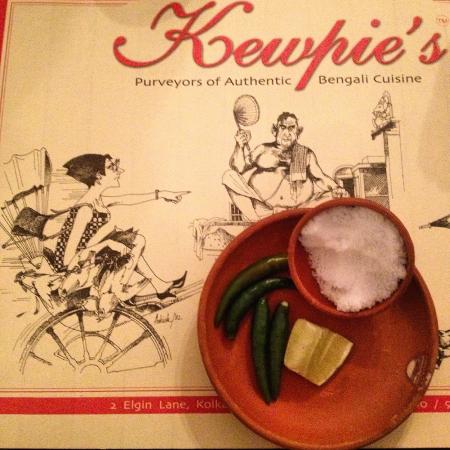

Kewpie's placemats have charming vintage-inspired drawings of Calcutta life


During my frequent lunches at Kewpie’s in the late 1990s, I enjoyed food served on banana leaves and old-fashioned terra cotta plates. There would always be several extraordinary fresh chutneys served. Not to mention spicy pickles--but vegetable pickle is a story for another column!


My tomato chutney, which does not include raisins or too much chili firepower, is great on sandwiches, burgers, alongside grilled meat and fish. You can mix in 1/3 cup of it with eggplant that’s been roasted and mashed. You wind up with something very much like the famous dish Baigan Bharta, but with 75% less work.


Chutney's jammy consistency, when it's ready


The farmer’s market sells larger bunches of herbs than can be eaten in a week—so again, the answer is chutney. I make my cilantro-mint chutney with Greek yogurt for extra protein. It’s a natural with crispy treats like samosas, pakoras or with grilled fish. This green chutney is a great marinade for chicken pieces to be baked or grilled.

Here are my tomato, cilantro-mint and rhubarb chutney recipes. Please note that these chutneys are designed to be refrigerated in glass jars or bowls with lids. They are not shelf-stable.

I'm winding up my culinary adventures to return to my real work: writing a novel. It strikes me, though, that concocting a chutney is a bit like writing a mystery. There are so many interchangeable small parts: fruits and vegetables, spices, and preserving vinegars or oils. When I write, I pull together many pieces: characters, plots and sub-plots, settings, conflicts, motivations. I contemplate when I've got too much of one thing or am missing an important element. My book's components are adjusted as it grows toward a finished state.


But while it takes a year for me to write a book, a chutney rarely simmers more than thirty minutes.  This makes it a small but gratifying accomplishment.


Tuesday, August 1, 2017

So sorry to hear of AnnaMaria's loss.
 We lost another great person today, Jeanne Moreau, the French actress. Of the many who praised her I like this quote, 'Her charisma, intelligence, sexuality and star quality created a new space in postwar cinema'.  She played in the New Wave but she wasn't defined by it or any genre of performance. She was her own person.


In her own words:
When you live under the power of terror and segregation, you can't ever start a work of art.
Age does not protect you from love. But love, to some extent, protects you from age.
As long as you don't make waves, ripples, life seems easy. But that's condemning yourself to impotence and death before you are dead.

Miss you Jeanne 

Monday, July 31, 2017

Rest in Peace: Andrew Puglise

Annamaria in mourning


My older brother passed away this past Friday evening.  Here is his official obituary:

Born in Paterson, New Jersey, 20th November 1939 to Samuel F. Puglise and Anna Maria Pisacane Puglise, Andrew Puglise was educated at Our Lady of Lourdes School and Don Bosco Technology Academy.  After high school, he served for six years as a paratrooper in the U.S. Marine Corps, including a tour of duty in Japan aboard the U.S. aircraft carrier Coral Sea.  An early expert in computer technology in the business sector, he was an independent management consultant to clients such as Fidelity Investments, where he installed their first applications of mobile technology.  In Nashville, he consulted with Avo Aerostructures, the Rogers Group, and Service Merchandise, where he became the corporate CIO.

He was an enthusiast of trout fishing and golf, a passionate music lover, and a car aficionado.

He is survived by his beloved wife, Patricia Ball, his son Michael Puglise, daughter Linda Elizabeth Little, dear daughter-friend Robin Banner and her wife Diane Dunn; grandchildren—Christan Odum, Chelan Branham, Austin and Annamarie Puglise; great-grandson Riley Sweat; sister Patricia King and brother-in-law David Clark,  brother Paul Puglise and sister-in-law Kathleen Puglise, brother Mark Puglise, and several nieces and nephews, his sister-in-law Kay Hillyard and her husband Rick.


There is of course much, much more to his story than that.  I have been thinking of our early, early days.


Just sixteen months apart, we were raised as a two-kid unit.  “Andy and Patti, wash your hands and come to the table.”  “Andy and Patti, finish your oatmeal.  It’s time to leave for school.”  “Andy and Patti, brush your teeth.  It’s bedtime.”

When I was five and he was six, he took to cutting pictures of snakes out of National Geographic and hanging them over his bed in the room we shared.  I got nightmares.

On the other hand, my treasured wanderlust developed when we two lay on our tummies on the living room floor, turning the pages of the atlas and fantasizing about those faraway places with the strange-sounding names.  His curiosity about them evaporated once he developed his passion for golf.  Mine persists, and I would not have it if it weren’t for him.

We grew up in that lovely bygone era when kids played outside, largely unsupervised.  We swarmed through the neighborhood in packs, jumping backyard fences and stealing under-ripe fruit from other people’s trees, getting many tummy aches and spankings in the process.


On many a Sunday, we went for a ride out in the country in the family’s early-model Ford jalopy.  Our destination was the Dairy Barn—where a farmer had turned his roadside building into a place to get ice cream.  I savored my scoop of chocolate. Andy ate his cone fast and then, with the tippy end of it, stole some of mine.  One Sunday, the following exchanges took place in the car:

(On the way out of town.)

Me:  Mommy, Mommy, Andy is pulling my hair.

Mom:  Stop that.  Sit down and be quiet.

(On the way home.)

Me: Mommy, Mommy, Andy is stealing my ice cream.

Mom: Stop that.  Sit down and be quiet.

(Nearly home, as daddy slowly turns the corner onto our street, Andy leans on the door handle with his elbow.  The door swings open and Andy gently rolls out of the car.)

Me:  Mommy, Mommy, Andy fell out of the car.

Mom: Stop that. Sit down and be quiet.


Our greatest caper took place after our grandfather had died and our grandmother moved in with us.  Each evening before going to bed, Andy and I stood side by side at the bathroom sink, brushing our teeth.  Once grandma moved in, at night she left her false teeth on the shelf under the mirror in a glass of water.  They grossed us out.

When, at the age of six, I lost my front tooth, the tooth fairy left me a nickel.  That evening Andy and I thought what to do.  Neither of us wanted to fish the dentures out of the water with our fingers.  He dumped the glass in the sink.  I took a washcloth from the bathroom closet, picked up the teeth, and hid them in the back of a closet shelf.  We refilled the glass and dropped in the nickel, brushed our teeth, and went to bed.

Shouting awakened us the next morning.  Grandma was running around the apartment, with one hand masking her empty gums, exclaiming, “Where are my teeth?  Where are my teeth?”

It did not take long for mommy and daddy to burst into our room.  “Where did you put them?” Mommy demanded.

“The tooth fairy must have taken them?” we peeped, tentatively.  Our formidable grandmother glared at us over mommy’s shoulder—most seriously displeased.  We fessed up and took our punishment: no dessert for the next three days.

Looking back, I can now imagine our parents’ laughter once they were alone.

We didn't just look like The Little Rascals, we
were the little rascals.
   
And so it went.

And so it goes.  Those precious moments of our childhood that are coming to me now that he is gone.

He died far too soon.  It’s hard for me to imagine that this is the same planet without him on it.  But his death was beautiful.  He breathed his last with us holding hands in a circle—two holding hands with him.  His last days had kept us together long enough to forgive one another our sins.

I am writing this the next day.  This morning, of the 745 songs on my iPad, this below was the first one the shuffle played for me.


I listened to Dylan’s words and thought of Andy and how lucky I was to be with him when we were kids and how glad that, if this tragedy had to happen, at least I was with him when the deal went down.

A bottle of champagne for the first person who writes a
comment identifying what Andy is holding in his hands.

Those friends thou hast, and their adoption tried,

Grapple them to thy soul with hoops of steel.

Sunday, July 30, 2017

Berlin Part 1: Lawton Reflects On A City That Won’t Let Go (at least in his novels)

Zoë Sharp

This week I'm playing a substitute, again, in the form of the talented John Lawton, who wanted to explain his fascination with the city of Berlin.

Berlin does not pall. No idea why. So much else does. After umpteen visits it still fascinates.

I first went there almost by accident, and at that by an odd route, in 1989.

           
I was in Prague, for Channel 4 (UK TV) covering a visit by Harold Pinter who was there to see one of his plays, Mountain Language, performed at The Magic Lantern and to meet fellow playwright Vaclav Havel, who was unlucky enough to be stuck with the job of president of Czechoslovakia – Havel told me he wanted out as soon as possible … that didn’t happen for another thirteen years.

I thought I’d wrapped the shoot when visas and carnets arrived with instructions to film at the premiere of Margaret Atwood’s The Handmaid’s Tale in West Berlin – a film Harold had scripted. Visas, carnets but no airline tickets … but the visas seemed to cover us for the rapidly collapsing DDR (East Germany) as well as Berlin so I got the cameraman and myself on a train from Prague to East Berlin and crawled across Prussia (quite the most boring stretch of countryside imaginable, and unlikely ever to be in anyone’s ‘Great Railway Journeys’) via Dresden and into the Lichtenberger Station in East Berlin.

It was way past midnight.

Cabs aplenty, but no driver willing to take us to our hotel on the Kurfurstendamm

“We’re the wrong side of the fuckin’ wall,” the cameraman said, unhappy about the journey from the start.

“It’s OK. I speak the universal language.”

I did what I had done in many a city, I fanned out a hundred dollars in twenties and waved them. I have known directors more blunt than that, who simply yelled out “Bribes! Dollars! Bribes! Who do I have to fuck to get out of here?”

After a few minutes a driver approached and said he’d take us but there would be no guarantees we’d get to the other side.

“A lot has happened,” he said. “The rules don’t work any more.”

He was right.

He brought the cab to a halt in Friedrichstraße, in an eerily empty car-marshalling yard, just to the north of Checkpoint Charlie.


“There’s no one here,” he said, incredulous.

We drove on. Reached the second barrier manned by the Americans – or in this case, unmanned by the Americans. They too had gone home.

“Must be summat good on the telly,” the cameraman opined. “Juventus versus Nottingham Forest.”

At the Kempinski Hotel, we unloaded our sizeable kit and I gave the driver his hundred dollars. He just stared at it and I realised it was probably an utterly over-the-top sum. I hadn’t a clue what the exchange rate was.

“Keep it,” I said.

“I think you just paid off his mortgage,” said my miserable companion.

The next day the cameraman pulled a few strings. He had a mate in the British Army of Occupation – and he got us a car with a Ministry of Defence registration … and a willing driver.

We drove back to Checkpoint Charlie, now fully manned. Both sides noted the number plate but no one asked for so much as a glimpse of a passport. We were ‘Military’. So we roamed around East Berlin, breathed in the rarified air of ten thousand farting Trabants, shot a few rolls of ‘general views’ and went back to the West, equally unmolested by authority.

In the evening … we were supposed to film the premiere. It just didn’t work out that way. The quiet of day erupted into the riot of night.

We found our way to Potsdamerplatz, where kids with sledgehammers were knocking holes in the Wall (Der Mauer), and East German guards were futilely trying to stop them.


The top of the wall wasn’t flat, it was more like a sausage. All the same dozens, if not hundreds were standing on it, taunting the guards. We filmed for a few minutes, then the cameraman said, “I’m not missing this,” strapped the camera to his back and shinned up the hand-chipped footholds in the side of the wall. I had the tripod. You think directing is the tops? No such luck. Directors mostly just carry the tripod. I couldn’t climb the wall with a fekkin’ tripod on my back, but by now one of the holes in the wall was big enough to step through. I followed half a dozen students through the gap, only to meet armed guards shoving us back. The cameraman waved at me. I just glowered.

The party went on all night.

I got fed up after a couple of hours, left the cameraman up there and went back to the hotel.

The next day I pointed out that the wall just didn’t run through the middle of the city, it wrapped West Berlin completely – and I wanted shots of the wall in the middle of the countryside. Something real but against the grain of most newsreel shots of the Berlin Wall.

It wasn’t hard to find a spot on the north side of the city, at the top end of the French Sector.


Already, Berliners had been out with their sledgehammers, and there was a gap between the concrete plates just big enough to squeeze through.

I stood in an open meadow in the DDR. No stink of Trabants. Not a human being in sight. The cameraman stuck the lens of the camera through the hole. I walked to the brow of the hill, and as I topped it three Stasi with sub-machine guns ran up the far slope towards me. I have never been the sporty type – all sport bores me – but my one accomplishment in shorts and plimsolls at school had been sprinting. I shot back towards the camera, Stasi in pursuit, knowing full well that this would probably end up in the company’s Christmas Party video, an annual festival of embarrassment most commonly featuring news readers caught picking their noses or reporters using the lens as a mirror while renewing lipstick unaware the bastard cameraman was recording it.

I got away. Not a shot fired. Well, I never thought they would.

The day after we came to leave Berlin. Tegel airport. No film of Harold Pinter and Margaret Atwood, plenty of GV’s to keep us in TV ‘wallpaper’ for weeks if not months, and a few minutes of me evading arrest that the cameraman refused to let me destroy.

Our gear was ... hefty. It was probably worth around £120,000, so we travelled with a sheaf of carnet papers for customs simply to avoid paying the earth in import duty every time we boarded a plane. It was de rigeur to get them stamped every time you entered or left a country.

But … no one had seen us enter West Berlin.

The West German Customs were baffled.

“How did you get here?”

“Through Checkpoint Charlie.”

“But there are no stamps.”

“They’d all gone home for the night.”

“What?”

“Both sides. No Germans, no Russians, no Americans.”

I was not believed. These were young men. The Wall was a fixture. It had been there before they were born and for the whole of their short lives. That it had days, if not hours to live, had not occurred to them. It was as if I had told them mountains moved.

The cameraman said, “We’ll end up like that mythical BBC crew. The one that keeps a kit permanently at Heathrow ‘cos they ain’t got the carnets to bring it into London. No kit, no ‘Arold bloody Pinter. Boss’ll kill you.”

Reason or, more likely, my gift of the gab prevailed.

“You may be waiting for re-unification,” I told them. “Most Berliners reckon it’s already happened. Go down to Potsdamerplatz and see for yourself. You could practically push the wall over.”

It was years before I saw Berlin again. Berlin united has changed so much and I am constantly grateful for two days spent in the Cold War, lukewarm as it was by 1989 … without them I would be a writer bereft of a subject.


Saturday, July 29, 2017

"Is This the Real Life? Is This Just Fantasy?"


Jeff—Saturday

This week marks the twelfth year of publication of Mykonos Confidential, an annual summer magazine celebrating all things Mykonos.  All the glitz, all the hype, all the shopping, sipping, supping, seducing, and sunning for which the island is renown, wrapped up in one sleek, four-hundred page “Bible of Mykonos.”

Yes, it’s a cheerleading magazine for modern day Mykonos, but its publisher, Petros Bourovilis, has a long history of telling it like it is in his editorials, and encouraging his contributors to do the same.  This summer’s theme for the magazine is the island’s “Bohemian Past,” which necessarily involves reminiscences of a lifestyle far different from today.  How one evaluates the changes depends on your perspective.

I was asked for my thoughts on the subject, and so I gave them. 


In the interest of full transparency, I should mention that against a half-century of “old Mykonos hands” the magazine has kindly included me as one of “fifty-six people who symbolize the Mykonos Free Spirit.”


In keeping with that label, which I proudly wear, here is the article I wrote for this summer’s Mykonos Confidential issue, titled “Is Mercury or Mykonos in Retrograde?”


That title should give all you astronomers, astrologers, and music fans something to ponder. 

In astronomy retrograde means “a body in motion in a direction contrary to that of the general motion of similar bodies,” in astrology believers say you’d best “ready yourself for frustrating times,” and in music (at least for me) it conjures up visions of Queen’s incomparable Freddie Mercury shaking up the rock world with the eclectic punch of his 1975 classic song, Bohemian Rhapsody. All three offer unique insights into the state of our island.

Over the decades of this writer’s life, a once obscure and impoverished Mykonos transformed itself from wartime years of starvation and bitter struggle, into a modern international symbol of tourist hedonism and 24/7 glitz—barely pausing long enough to digest its good fortune and appreciate its natural gifts.  Yet, as quantum levels different as modern day Mykonos is from what it once was, first time visitors to the island, whether arriving by sea or air, still are awe-struck at their first glimpse of this dazzling white beauty set off against a stark desert mountain landscape.


Astronomically speaking, Mykonos adopted a trajectory retrograde to the orbits of its neighboring Aegean islands, fueled by an unwavering commitment to the benefits of unfettered development and entrepreneurial freedom.  Today, the results of the unquestioned economic success of Mykonos’s retrograde model has driven other islands to alter course, some to follow Mykonos’s lead, others to maintain a tighter fix on their cherished old ways.  As to which course is wiser, that depends on the goal, and what one is willing to endure to attain it.

A retrograde astronomical path

In terms of astrology, even non-believers have likely heard, “Mercury is in retrograde” tossed out as an explanation for why things are going very wrong, be it a business deal, politics, romance, or a broken lawnmower.  For sure, Mykonos has had its share of those moments (with the possible exception of the lawnmower), but just like Mercury, it manages to hang in there until things turn around—with one significant difference: Mercury always returns to the same orbit, Mykonos does not.  Where that might take our island, only time will tell. 

Astrologically speaking...

Now, on to the music.  Bohemian Rhapsody is regarded as one of the greatest rock songs ever, much the same as the rock known as Mykonos is considered in the tourist world. Many have analyzed the meaning of Freddie Mercury’s lyrics, but I tend to go with the description he offered as its composer: It is simply the story of a young man who accidentally kills someone and, like Faust, sells his soul to the devil, but on the eve of his execution calls out, “Bismillah” (“in the name of God” in Arabic) and with the help of angels regains his soul from Shaitan (“the devil” in Arabic).


I can only guess at the plethora of parallels observers of all things Mykonos will find in comparing that “simple” explanation of the meaning of a song with the state of their island.

Just to fuel the buzz, permit me to quote the opening and closing lyrics of Bohemian Rhapsody. [For those interested in the entire experience, here’s a link to Queen’s official video performance.] 

I think most would agree that the first two lines capture the essence of modern day Mykonos:  

“Is this the real life?
Is this just fantasy?”

As for its final two lines, they’ll undoubtedly elicit more serious discussion over the state of our Island of the Winds:

“Nothing really matters to me.
Any way the wind blows.”

Thank you, Queen, for giving us all a lot to think about.


—Jeff

Friday, July 28, 2017

The Last Leg and the caves of Smooooooooooo

The last day had very eventful weather.
We were at Stoer and then drove up to Durness which is right on the top of Scotland.
It is very windy.


A summer day on the road to Stoer
A sheep with its coat half blown off.
A resident, similar haircut,  looking rather handsome


Two more residents of the campsite

The coastline is getting a bit more rugged.
And Icelandic

Our Motorhome nestled in the site by the bay.
Beautiful fine white sand.
Cold. 


We sat and watched these Islands appear and disappear as the haar rolled in.
Creepy.

He wasn't impressed that we were on his road.
                                                A dog looking for something to herd.
trying my 1/ 1000 shutter speed.
The wave came in and the wind blew it back out again
And then all was calm

Down on the beach


That night we got about two hours sleep. We were parked at the top of this cliff and the wind and the rain was battering on the motorhome. The noise was louder than a military tattoo and the wind was so strong we felt the motorhome 'lift' slightly.  We had travelled to Durness to see the famous Caves Of SMOOOooooooo....
So we were determined to go.
The caves were one mile away from our campsite.
We couldn't even get the door of the Motorhome open because of the wind.
I had to wear sunglasses to protect my eyes from the jaggy, stinging rain.
In three minutes we were soaked, right down to our underclothes.
At one point I was hanging onto a fence as I was being blown off my feet.
But being an intrepid MIE blogger, onwards I went.
All the sheep were lying down as they were in danger of being blown over. 

I didn't take my good camera with me as it would have been ruined in this weather.
So here are some pics from the Caves Of SMOOooooo take from their Wiki page.


The cave swallowed this river..

It didn't look like this when we were there! There was water pouring everywhere and instead of bats, there were pigeons.

What the cave opening looks like in sunshine. I had planned to put a body in it (fictionally) but there are tourist coaches arriving every five minutes so that was that idea wrecked.

The inside of the cave has one big hole, full of water, floodlit and covered in a metal grate. There were huge signs everywhere warning that if the grate is closed, it's closed and don't attempt to go down the hole.

It was too noisy, too wet and too cold so we ran away.
A patient told me that in good weather you can pay five pounds and climb down into the hole by a ladder to a boat.  The boat is then rowed in an subterranean canal, the passengers have to lie down in the boat as the rocks overhead are so low. Then the boat  floats out into a huge cave and the 'rower' shines his torch round at the fossils that glint and shine in the cave walls.
The time frame of getting in and out before the tide comes in and cuts off the canal is very narrow.
The channel the boat goes through is also very narrow.

I am very fearful of being in rising water with the risk of being cut off.

It wouldn't bother Joe Hunter. Sure as hell bothers me.


Caro Ramsay  28th July 2017
