Sunday, February 5, 2017

A Hairy Tale of Love and Justice in Japan

--Susan, every other Sunday

While visiting Japan last autumn, I spent a night at Tatsueji, a Shingon (esoteric) Buddhist temple on Shikoku - the third of Japan's four largest islands (counting from north to south).

The hondo (worship hall) at Tatsueji.

Tatsueji is #19 of the 88 Buddhist temples on the Shikoku Junrei, a pilgrim route which circles the island of Shikoku. Pilgrims (henro, in Japanese) walk the 750-mile circuit for a variety of reasons -  someday, I hope to walk the entire route myself.

Tatsueji, which lies in the southeastern part of Shikoku, about 30 minutes by train from Tokushima City, is also one of four sekisho, or spiritual checkpoints, where pilgrims are supposed to reflect on what they have learned from the journey so far. In spiritual terms, a sekisho was (and is) similar to the checkpoints between provinces, where travelers had to show their documentation and receive permission from the local lord, or daimyō, to proceed. At the sekisho, a pilgrim's "travel permit" was obtained through self-reflection and personal confirmation that (s)he had, indeed, been transformed in some way by the journey.

According to some, pilgrims who have not experienced personal transformation upon reaching a sekisho are supposed to turn around, go back to temple #1, and start over. Japanese legends also say that people who are impure of heart cannot pass through the gates of a sekisho temple.

Fortunately, I had no problem entering:

The view from the front gates of Tatsueji.

and the view from my room was spectacular:

The view from the guest room, Tatsueji.

The statue to the right of the pagoda is Kōbō Daishi, the priest who brought Shingon Buddhism to Japan from China, and established it as a major Japanese sect.

Kobo Daishi

Like most temples, Tatsueji's gates have guardian statues in its alcoves--but the left-side alcove also holds a tangle of rope and human hair, which is one of the temple's most sacred objects and a symbol of the temple's most famous legend.

The rope is actually to the left of this giant sandal - but sadly, it did not photograph clearly.

Centuries ago, a young woman named Okyō was sold into prostitution in Osaka because her family could not afford to keep her. The story varies a bit by source, but most versions agree that Okyō eventually killed one of her lovers in order to run away with another one; after the murder, Okyō and her surviving lover fled to the island of Shikoku, disguised themselves as pilgrims, and began walking the pilgrim trail in hopes of evading justice.

Upon their arrival at Tatsueji, Okyō's long hair became entangled in the bell rope for the temple bell (apparently the same bronze bell that still hangs in the temple tower):

Tatsueji's famous temple bell.

The priests cut her free, but Okyō realized that she could not escape her crime by running. Instead, she confessed to the temple priest and decided to spend the rest of her life nearby, meditating and living her life as a Buddhist hermit.

According to the legend, Okyō's former lover became a priest and spent the rest of his life working, praying, and meditating at Tatsueji.

The bell rope, twisted with hair, remains at the temple as a symbol and a reminder of Okyō's story.

The bell tower at Tatsueji, site of Okyō's transformation.

Tatsueji is not the only temple on the Shikoku pilgrim trail that claims a miraculous transformation; quite a few have legends of people who renounced their evil ways and made new starts upon, or shortly after, arrival at the holy sites.

Regardless of religion, personal belief, or the truth of legends like Okyō's story, the temples on Shikoku's pilgrim trail are both an important part of Japanese history and a perfect place for meditation and reflection on the traveler's personal journey.

I rose the following morning at dawn, refreshed--and, yes, a bit transformed by the experience.

Dawn, en route from Tatsueji to the train.

Which was good, because I had a train to catch -
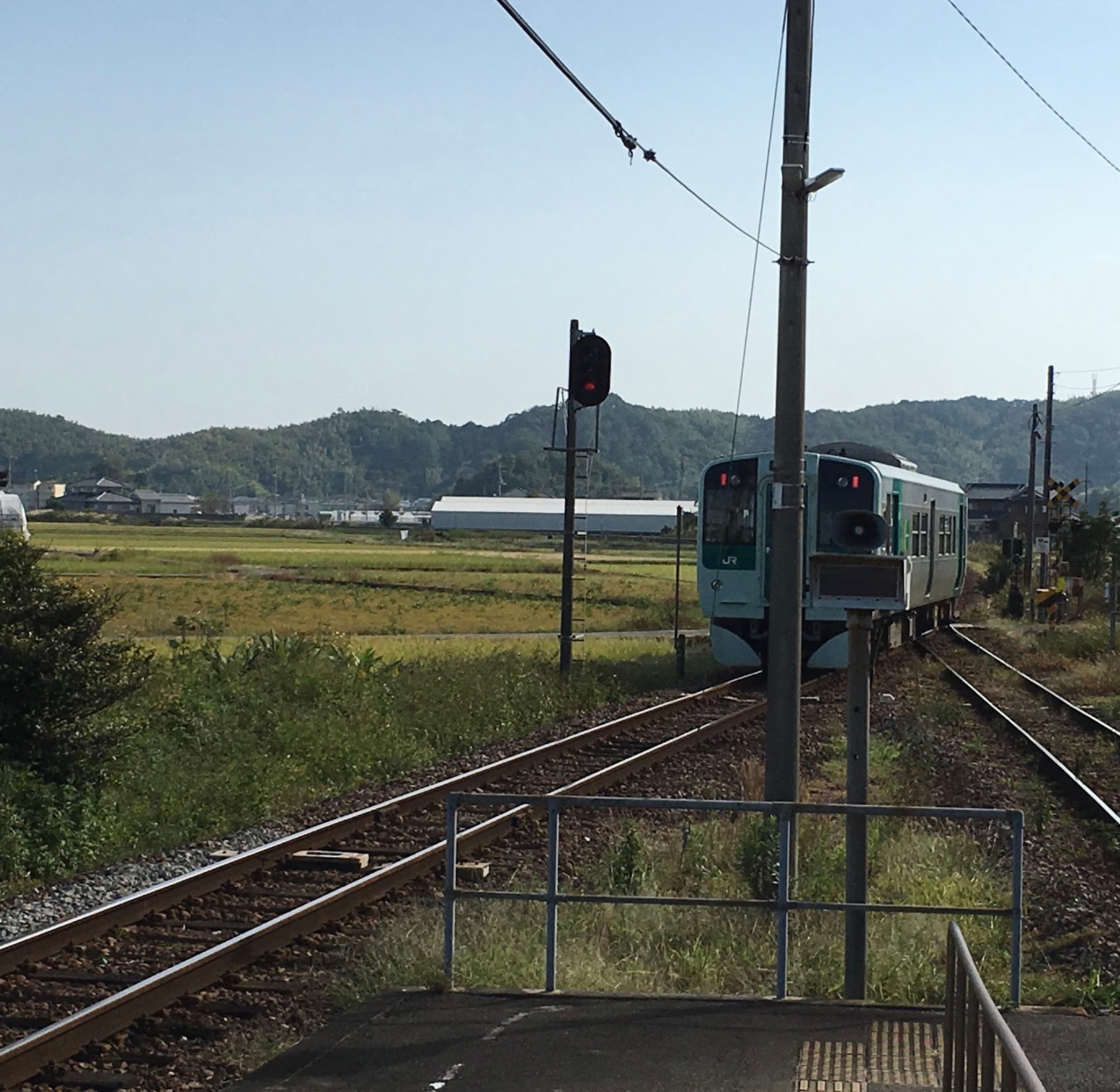
Train departing from Tatsue Station.


and no time to start the journey over.

Saturday, February 4, 2017

My Week Life in Pictures


Jeff—Saturday

Sorry to be a bit late in posting this, but in cataloging my week I wanted to include a photo or two from my final California event, and it ended close to midnight East Coast time. But there’s a bigger reason than the three-hour time difference.  It appears I booked us into San Diego’s “cage fighting” hotel. Yes, mixed martial arts cage fighting. And tonight was an event, complete with cheek to jowl traffic.


I wish I could have taken photos of the crowd to show you, but I decided that might lead to a literal embodiment of the phrase, “fighting through a crowd.”

Anyway, we made it to our room and now I can show you how a book tour degenerates over nine days of north-to-south West Coast driving, interrupted at times by mudslides, meditation moments, and wild-eyed fan fests.

Bye Bye Big Sur

Though some might argue it’s more in keeping with how a degenerate goes on a nine-day book tour. I guess you’ll have to ask my inveterate photo-bomber for clarification.
               
Anyway, here are the photos. Words fail me.

As mentioned last week, it all begins in Berkeley at Janet Rudolph's with Cara

The kickoff bookstore event in Corte Madera (San Francisco)

Mykonian friends reminding me why I love the island so.

San Francisco friends doing the same for the Bay Area

And of course family.
Reflections on the meaning of it all

Answered by meeting friends in Carmel.

And pondering the vast wilderness of Big Sur

Shared with the right one...at least in my case

Crossing California's Central Valley in the foot steps of a Giant...the one in the background.

To get to Pasadena and Vroman's

Yep, that's the famous Tiny 

The after party


Laguna Beach holds surprises....and old friends

But there's still work to do

And Orange's Book Carnival

Plus moments of self-realization along the way

To San Diego's Mysterious Galaxy

The End...for now


—Jeff

Friday, February 3, 2017

The Forgotten Sister


She was the third of the White Star Line’s Olympic class of vessels. Her fate might not have been so famous as that of the Titanic but it is still a story steeped in tragedy.  


The HMHS Britannic was launched at the start of the first World War. Her build had been held up due to the lessons learned by the Titanic disaster which resulted in higher safer standards than on her original blue print.  So she was wider than her sister,  doubled hulled in her vulnerable parts over the boilers and the main engines. Her water tight compartments were reinforced to be ‘water tight' and she was built with extra engine power so that she could steam out of any trouble and remain afloat – which was the original idea for the Titanic. Her main difference though, was that the lifeboats could be electronically lowered (they were all manual on the Titanic). And they could be lowered from either side of the ship even if the ship was listing badly ( so the theory went). There was an electronic crane device that lifted the lifeboat up and away from the hull. I do remember that surreal film of the passengers making their way down the hull of the Costa Concordia filmed with a night vision camera, little glow worms in distinct formal lines, a snaking descent on the hull of the ship as they clambered down a rope to the lifeboats.
So when launched, the Britannic had 48 lifeboats each carrying over 70 people -  more than enough for her full capacity of crew and passengers.
                                      

Her keel was laid in the same dock as the Titanic in November 1911, 13 months after the launch of the Olympic. Then history took a turn in 1915. The Cunard liner – the Lusitania was torpedoed over the Irish coast and the Britannic was called into national service with 4 weeks notice. The navy had requisitioned many British ships and paid handsomely for their use. But it was very risky work with a high probability of loss. The big ocean liners were not considered fit for that purpose – too big, too slow, too unwieldy. “Runs like a horse steers like a cow” was a common phrase. Then the Gallipoli campaign started and caused a huge number of casualties, and on the 13th of November 1915 the Britannic set sail as a hospital ship, repainted white with a red cross and a green line. She carried out 5 successful crossings to the Dardanelles. On the 21st of November 1916, she was steaming full speed ahead, making up for lost time due to an earlier storm. She  entered the strait of Messina and then in to the Kea Channel with 673 crews, 350 army medics and 77 nurses on board.
                                         

At 8.12AM there was a load explosion.

With the lessons learned from the Titanic she should have been OK but bad luck and human nature played their part. Those breakfasting in the dining room knew they had been hit by a torpedo or a mine and immediately went to their emergency posts. Those near the stern heard little and presumed they had just hit a smaller ship. Some of those working in the engine room knew exactly what had happened to their colleagues on the Titanic and rushed on deck, using the electronic system to lower the rear lifeboats to make their own escape ASAP.

Captain Bartlett was an experienced sailor and he knew the ship was listing but she had her water tight compartments so he ordered the water doors closed. She had enough engine power so he turned her towards her listing and headed to shore, totally unware that some life boats had already been launched from the stern. The Britannic was sending distress call after distress call but nobody answered. Unknown to those onboard, the explosion had broken the radio mast so she was transmitting but not receiving. Captain Bartlett had no idea that help was on its way. As far as he knew, he had closed the doors, she was watertight and would make it to shore.

He had no idea that port holes had been left open, causing huge water ingress. Her sixth compartment flooded and she was doomed. In only 10 minutes the Britannic had reached the stage the Titanic had reached after an hour.

Horror was occurring at the back of the boat. Stewards on board, those in charge of the lifeboats,  held their nerve and stopped the decent of the lifeboats 2 metres above the water. The captain had not yet ordered the lifeboats to be launched as he was well aware of the power of the huge, churning propellers -  one of which was coming closer to the surface as she listed. Unrest broke out, fighting started and some lifeboats unwisely entered the water. The assistant commander then spotted the lifeboat that had been taken by those from the engine room.


And he watched, as those aboard were sucked into the blades of the propeller.

News very quickly got back to the Captain and he immediately ordered the engines be turned off – a brave decision. But one supposes he was considering the remainder of the passengers, the lifeboat availability, the temperate climate, the relatively calm water although he had no idea that anyone had heard her distress calls. Once the engines had been stopped, he ordered abandon ship as he considered it now safe to do so. By 8.45am the lifeboats on the high side of the ship were inoperable as the list was so great. There were heroic efforts to launch the smaller lifeboats then the crew  threw collapsible rafts and deckchairs into the water to assist those already overboard and trying to swim for it. At this point, the fact that the remaining personnel were army maybe afforded them some order amongst the chaos. At 9 o’clock Bartlett gave 2 long blasts of the whistle and as the water was already in the bridge he swam from there into a collapsible lifeboat. Then there was a final whistle which formally released all remaining crew from their posts. The captain was still in his pyjamas.

From the 1065 people on board, 30 lost their lives. Most of them hacked to death by the propeller. At 9.07 she sank completely.

She was the largest ship lost in the first world war and to this day she remains the biggest wreck on the sea floor.

And then I found this, not historically accurate but chilling all the same.

https://www.youtube.com/watch?v=8q_HNWv6ADo
Caro Ramsay 03 02 2017

Thursday, February 2, 2017

Displacement activity

Michael - Thursday

As a displacement activity to the news, I’ve been letting my mind come up with a phrase or saying which seems to fit, and then focus on that. Then I think about the origin or derivation of the phrase and what I know (or not) about it. Not only does this lead to some entertainment, but it takes my mind off the news and that’s a very good thing these days.

"A big, beautiful wall"
The first one was the Two Thousand Mile Wall. You know, the one Trump wasn’t really going to build, it was all playing to the crowds? Well, the bulldozers are on the way, and so is a trade war with Mexico. The phrase ‘a white elephant’ immediately popped into my head, and I was intrigued. Obviously a white elephant is an albino elephant and such creatures certainly occur. But why the connection with something useless, and even worse, something that is not merely a waste of money, but also going to be a pain to keep? To quote a definition “a possession that is useless or troublesome, especially one that is expensive to maintain or difficult to dispose of.” That seems to fit the Wall to a tittle. If you think at least Mexico will pay for it one way or the other, you may want to take a look at what Paul Krugman has to say about that.

Indra riding a white elephant
It turns out that white elephants are sacred in the Buddhist and Hindu religions and highly prized for their rarity. Kings of Burma and Thailand who possessed them were thought to rule with power and justice. Naturally the kings made a point of collecting as many as they could. And the gift of one to a courtier or trusted lieutenant was a sign of particular favor. 
White elephant at Amarapura palace
 1855
Except there was a catch. If the king gave you such a noble gift, you certainly couldn’t give it away or sell it. What would you do the next time the king popped round and asked to see how dear old Jumbo was getting on?  Also, since they were sacred, you couldn’t put your white elephant to work, so you received no return on the tons of food it was eating and the people you had to employ to look after it. An empathetic monarch would find other gifts to bestow favor on his less wealthy underlings, but a sly one might well present a white elephant to bankrupt a courtier he wanted to dispense with.

White elephant in Myanmar
The phrase seems to have come into English usage through PT Barnum’s fixation on obtaining a rare white elephant for his circus. He paid $100,000 to a nobleman in Siam (presumably enough money to be worth the wrath of the king) and tried to smuggle it out of the country, but it was poisoned and died. Eventually another $200,000 bought him one from the king of Burma. The wretched creature cost him a fortune to transport and feed, and turned out in reality to be very pale grey with some pinkish blotches. Hardly a superstar attraction.


Then, we recently had a meeting of the ANC Executive here to discuss a motion of no confidence in our president, Jacob Zuma. Plagued by multiple scandals, mismanagement, and corruption, it’s hard to see how anyone could have confidence in him. Yet in the end he squeaked through. Saved by the bell, I thought.

No mystery with that phrase, right? A boxer on the ropes or on the mat, being saved by the end of the round. Yet there is another possible origin for the phrase that is popular as much for being colorful as for being correct.

In the nineteenth century, when medical science hadn’t developed much beyond leaches, there was quite a widespread fear of being buried alive. This was not a vain fear; everyone had heard of miraculous recoveries of people pronounced dead only to revive from a coma. An enterprising inventor came up with an idea for a ‘safety coffin’ and patented it in the mid eighteen hundreds. The device allowed the incumbent to pull on a cord which was then connected to a bell on the surface. Thus if you recovered from a premature departure, you would be able to ring the bell and gravediggers would rush to exhume you and allow you to rejoin the world. Hence you would be ‘saved by the bell’.

Sadly, there is no evidence that the safety coffins were ever actually built or used, let alone that anyone was ever saved by one. Even more damning, the first recorded use of being ‘saved by the bell’ was at the end of the nineteenth century and was a newspaper report of a boxing match. Anyway, if our president chose to be put to rest in a safety coffin to be on the safe side, and the bell started to ring after the state funeral, I’m sure it would rapidly be disconnected.

For that matter a ‘dead ringer’ was supposed to come from the same coffin idea, but that one is much more prosaic. A ‘ringer’ is a horse being passed off for another, and ‘dead’ has the alternate meaning of ‘exact’. Too bad. Made a nice story.

Finally, a positive note. The Finance Minister here says the economy has bottomed out and we've turned the corner. Well, as a South African he should know since the phrase comes from ships turning north after coming south on the trip round the Cape of Good Hope or Cape Horn.

Enough. I’ll leave you with a parting shot: if you look a gift horse in the mouth, you may find it long in the tooth. Let's see what Jeff does with that one!


____________________________________________

Murder Is Everywhere
Author Recognitions and Events

LEYE ADENLE

Won the 2016 Prix Marianne for the Lagos Lady, the French translation of Easy Motion Tourist: http://www.marianne.net/leye-adenle-prix-marianneun-aller-retour-noir-2016-femme-n-est-pas-egale-homme-son-futur-100246794

Easy Motion Tourist / Lagos Lady, was number 2 on Le Monde's list of best thrillers of 2016: http://polar.blog.lemonde.fr/2016/12/26/top-20-des-romans-noirs-et-des-polars-2016/

Easy Motion Tourist featured in the Guardian's Best Recent Crime Novel Review Roundup: https://www.theguardian.com/books/2016/jun/04/the-best-recent-crime-novels-review-roundup
  
Upcoming Event:

March 7 to 16: South African Word Festival, Stellenbosch.


ANNAMARIA ALFIERI

Strange Gods: Paperback, Felony and Mayhem, Feb 2016
Idol of Mombasa: Paperback, Felony and Mayhem, Oct 2016
Sunshine Noir: Editor, White Sun Press, Oct 2016

CARA BLACK

Murder in Saint Germain, Aimée Leduc’s next investigation, comes out June 6, 2017.
Just signed the contract for the next two Aimée Leduc investigations in Paris with Soho Press.

 CARO RAMSEY

Signed two-book contract with Severn House.

JEFF SIGER

2016 Barry Award Finalist for Best Novel.

Upcoming Events:

Thursday, February 2, 2017 @ 7:30 PM
BOOK CARNIVAL
Orange, CA

Friday, February 3, 2017 @ 7:30 PM
MYSTERIOUS GALAXY BOOKS,
San Diego, CA

 MICHAEL STANLEY


Sunshine Noir: Editor, White Sun Press, Oct 2016


Wednesday, February 1, 2017

The Faces of Protest

Sujata Massey


I regret to interrupt my regularly scheduled post--which was going to be food-related, alas!--because my life keeps getting interrupted.

Just like my nation's standard operating procedure.

These days, my writing schedule seems divided between fiction and emails to senators, congressmen, and activist friends. And I've been on Facebook more in the last week than in the last six months.

My new, highly distracted life began with the election of Donald Trump and the day after, my participation in the Women's March on Washington. It was a large march with more than 500,000 participants. I imagine this might have been the largest group gathering I'll ever attend.

Statisticians specializing in crowd counts put the talley of marchers participating in 500 simultaneous marches throughout the US on Jan 21 at between 3.3-4.6 million.  Marches around the globe added thousands. As if to answer us, the day after the Women's March, President Trump defunded Planned Parenthood and made other sweeping actions against women, including closing down the federal office that assists domestic violence prevention organizations. He also halted US aid for women's health clinics overseas, if the clinics had anything to do with abortion.

I knew we were getting close to the march when I saw from the bus window a lot of women wearing pink hats. One week before, word spread via Internet to wear "pink pussy hats". Some women confided they had learned to knit just to make a hat for the occasion, following a simple pattern for a cap with pussy-cat ears, a reference to the president's vulgar reference to female genitals. The problem with throwing around a nasty word is that it can come back in a way that makes your eyes hurt.


Washington DC March photo: Helen Dellheim


The red-haired woman and the other one with a camera were reporting for Time magazine.


With me are fellow Quaker friends Kathy (right) and Nancy and Emilia (behind)


For me, the best thing about the Women's March on Washington was the patience and kindness people showed to each other. It was a textbook example of peaceful protesting. I saw no pushing, lots of smiles and encouragement, and plenty of admiration for the witty signs and costumes. Women of all ages--from young children to grandmothers--came together for a shared purpose. The rallywas multiracial and diverse, and included perhaps ten percent male participation. These men, who almost surely believed that "women's issues are everyone's issues" (thank you, California Senator Kamala Harris) were treated like equals.


A porta-potty line at the DC March is far longer than my camera could show


The march's map showed plans to proceed together on on one street toward the White House, but the crowd was so vast that it spilled onto the mall itself. There were plenty of police around, but they were non-threatening and in some cases, even jovial. They realized the impossibility of keeping marchers off the mall grounds. Can you believe a march of more than a half-million people without a single arrest? 


Riding the bus home from the protest, we sang songs including "We Shall Overcome." I felt so much stronger and happier.  

But--wouldn't you know?--disturbing executive orders kept coming from the White House. The most shocking, at week's end, was that that refugees and green card-holders bornin seven predominantly Muslim countries were being denied entry into the U.S.  Because we have laws barring immigration discrimination on religion and national origin, I was stunned. Freedom of religious expression is precisely what drove pilgrims from England and Europe to set up a colony that later became a nation.  

 On Saturday, I participated in a forum entitled "Emotional Survival During Difficult Times" at the Stony Run Friends Meeting in Baltimore. I sat with many of the same people who'd traveled to Washington together on the bus. The strategies for survival were helpful. One of the points a Friend made was that people who engaged in activism were happier and less stressed than those who stayed home. Therefore, when another person at Meeting mentioned there would be an airport protest that evening, I decided to change my plans and participate.


The airport protests of Jan 28-29 were spontaneous and had no central planning committee. It was very different from the two months of planning that preceded the Women's March. That Sunday, a Facebook event page appeared with links to information about protests being held at dozens of airports around the U.S.  The biggest protests were in New York, Los Angeles and Dulles International outside of Washington D.C.


I headed out to Baltimore-Washington Intenrational Airport (BWI) with a friend and her college student son. As we entered the airport, it was very quiet. We decided the protest was likely near the customs exit, so we headed in that direction. We walked along and soon enough were flanked by dozens of people carrying signs with statements like "We Welcome Everyone." These protesters seemed to be mostly age 40 and younger. Because the presidential order targeted prospective immigrants, the draw to this protest included many people who were either immigrants themselves, or the children or grandchildren of people who came to this country. 


Young crowd at BWI/Abhinav Khushalani


A global aspect to this gathering /Abhinav Khushalani


Compared with Women's March, this protest felt very different.

It started with the sound. The airport's high ceiling filled up with many call-and-response chants led by men with powerful voices. I chanted and took photos and shared a hug with a woman wearing a stars-and-stripes hijab,similar to the image on the Shepard Fairey "We are the People" poster we both carried.


Another difference was the presence of spectators--dozens of US military service members on an upper floor, pushing carts with luggage. The sight of us protesting would be their last image of the United States, as they headed off to the Middle East.


The airport protest was confined to two floors in the international arrivals and departures area. It was easier to move around than at the Women's March. I wandered and came to chat with a large group of lawyers sitting at a table. They'd come as volunteers to assist families who might have someone arriving from the seven banned countries was being held. No such travelers were coming in during my time at BWI. Still, resounding cheers broke out anytime non-American travelers emerged from customs. I can imagine how surprised and pleased they were by this rousing welcome.


Jewish protesters shared their family experience with discrimination


Although there was no formal program of speakers, several lawmakers who came to BWI included former Maryland governor Martin O'Malley, who ran for the Democratic party's presidential nomination, and Maryland Democratic Congressman Elijah Cummings, who thanked me for being part of the protest.

High school photographer Abhinav Khushalani, far right of his mother and younger brother

Another highlight was running into friends from book club, the children's schools, the Quaker Meeting, and neighborhood. I sensed that I could have sat down and enjoyed a cup of coffee and good talk with almost anyone in the estimated crowd of 2,000.


Many Muslims represented /Abhinav Khushalani


He looks like a Scot but said he was a mutt!

Our new president might see himself as a populist leader. However, his actions have surprised all of us with the creation of a new people's movement that is filling airports, city streets, and points still unknown.
