Showing posts with label volcano. Show all posts

Sunday, June 23, 2019

Murder on the Jogasaki Coast

-- Susan, every other Sunday

Last week I visited the Jogasaki Coast, a volcanic coastline on the east side of the Izu Peninsula. (About three hours from Tokyo by a combination of Shinkansen and local trains.)

The chariot awaits.


About 4,000 years ago Omuroyama (Mt. Omuro) erupted, sending a massive lava flow down the eastern side of the Izu Peninsula.


You can see the route of the lava flow in the jagged coastline.

The lava cooled as it reached the sea, but the flow was so massive that fingers of lava continued to push out into the ocean, creating raised cliffs and tentacular projections known as Igaigane.

Igaigane, with surf crashing beneath.


Surf crashes and swirls in the caves between the igaigane, sending spray more than twenty meters into the air. (And creating rainbows, as you can see if you look closely at the picture below.)

The real treasure at the end of the rainbow. (The rainbow is lower center, across the gap.)

In places, rock-like chimneys of cooled magma rise along the edges of the coast.

The large "boulder" is a volcanic magma neck. (The island in the distance is Oshima.)

These chimneys were created when lava vents opened in the earth and magma flooded up to the surface and cooled inside the conical vent. Over time, the earthen column that surrounded the magma eroded away, leaving only the cooled column of magma that had hardened in the neck of the volcanic vent. They look like boulders, but in fact they're unique geological formations.

Another unique geological feature visible on the Jogasaki Coast is columnar jointing.

Columnar Joints visible at the base of the igaigane, center frame.


Columnar joints are created when closely-spaced parallel fractures occur in cooling igneous rock (i.e., volcano barf), resulting in "columns" of prismatically-shaped rock that run in the same direction.

Close-up of columnar joints. Look at the base of the rock.

The columnar joints on the Jogasaki Coast are particularly dramatic because the surf breaks over them, creating miniature waterfalls along the columns as each wave recedes.


In typical Japanese fashion, most of the Jogasaki Coast has been designated a Geopark. A beautiful trail runs along the shore, zig-zagging along the igaigane and passing a number of spectacular deserted coves and tide pools.

The inhabitant of a Jogasaki tide pool.

I had this view entirely to myself.

Two suspension bridges cross over particularly large inlets, and the inland portions of the trail (which still have views of the sea) run through a forest filled with wild ajisai (hydrangeas).

Jogasaki forest.


So, what does this lovely place have to do with murder?

Tell me this isn't a perfect (crime) scene.


The volcanic eruption that created the Jogasaki Coast killed everything in its path--including the ecosystem that existed at the time. It took centuries for the forests to reclaim the area, and even now only certain species of hardy plants can survive on the igaigane at the edges of the sea.

Wild but beautiful.


However, the volcano's vegicidal tendencies created a unique and beautiful ecosystem, which I'm glad to see the Japanese government and people are dedicated to preserving as a wild space for people to enjoy. Signs along the coast (in English and Japanese) explain the history and ecology of the area, and as you can see from the pictures you do not have to read anything to enjoy it.

Suspension bridge, Jogasaki Coast


Then again, if you've read this far, you already know what the signs will tell you anyway.

People often ask me whether I prefer the mountains or the sea. At Jogasaki, I didn't have to choose.


. . . what about you? Do you prefer the mountains or the sea?


Sunday, October 1, 2017

Tamago* Versus the Volcano

-- Susan, every other Sunday


Japan sits entirely within the Ring of Fire, a 25,000-mile horseshoe-shaped portion of the Pacific Ocean, the earth's most seismically active region where volcanoes and earthquake eruptions are regular occurrences.

Japan has over 100 active volcanoes - almost 10% of the world's supply of fire-breathing mountains.

Adding to this the Japanese spirit of adventure and love for the outdoors, it should come as no surprise that volcanoes are the star attractions at some of Japan's most popular tourist sites.

Case in point: Ōwakudani, in Hakone.

Hakone lies about 90 minutes southwest of Tokyo by bullet train. The area is part of the "Fuji Five Lakes" region, and well-known for its cuisine, ryokan, and onsen (hot spring baths - the best of which are heated by volcanoes).

Hakone foliage in autumn.

During the medieval era, the Tōkaidō passed through this area, en route from Kyoto to Edo - in fact, the Hakone leg was considered one of the most physically strenuous parts of the journey. (More on that another day.)

Hakone is also known for its famous shrine, beautiful lake . . . and, of course, for the chance to "enjoy traveling on multiple modes of transportation" . . . including a ropeway ride over the steaming mouth of a live volcano.

Wherein, as always, lies a tale.

A TALE OF A LIVE VOLCANO!

The moment I arrived in Hakone last autumn, I dropped my bags at the ryokan, jumped on the Hakone Tozan Railway (Japan's oldest mountain train) and rode 45 minutes up the mountain to Gora.

From there, I hopped a 5-minute, 1 km cable car ride to Sounzan on a funny little cable car packed with other excited travelers eager to catch a glimpse of the volcano (and, hopefully, Mount Fuji, which is visible from the top of Owakudani on clear days).

Here comes the cable car!

Sounzan sits at an elevation of 767 meters (just over 2500 feet) above sea level, and is primarily known as the southernmost terminus of the Hakone Ropeway. In other words, it's where thousands of probably-crazy-but-nonetheless-eager people climb willingly into ten-foot gondola cars for the chance to dangle several hundred feet above the gaping, steaming maw of a live volcano.

Your one-way ticket to the volcano.
But I digress.

Upon arriving in Sounzan, I followed the crowd up a steep set of stairs, showed my Hakone Freepass to the attendant (a $30 ticket that gets you free access to all modes of transportation in Hakone for 2 days, $40 for 3 days - and is worth the price many times over) and accepted a pre-moistened towelette wrapped in plastic "for use if volcanic gases threaten to overwhelm respiration."

I see no way this could possibly go wrong. 

After a five-minute wait in a fast-moving line, I boarded a ropeway car, snagged a seat at the front to ensure good views, and started up the mountain.

Fuji Five Lakes in autumn.
The ride to the summit crest takes about 5 minutes, with gorgeous views the entire way. In autumn, the foliage is breathtaking, and in summer the valleys are filled with gorgeous greenery. (I went back again this summer, and can't wait to see it in spring and winter, too.)

Most of that white is volcanic steam, not clouds.
The steam from the volcano is visible long before you reach the summit. It rises from the crater in thick, white plumes like the breath of a sleeping dragon.

After reaching the summit, the ropeway cars take a leisurely, 2-minute ride across the volcano's crater, giving amazing views of the steaming sulphur vents and scientific research and monitoring stations set up in the mouth of the volcano.


Welcome to the volcano!

Why yes, that is a live volcano directly beneath you.


On the far side of the crater, the cable cars stop at Ōwakudani Station, where visitors disembark to walk around, visit the museum, gift shops, and restaurants, or (weather and volcanic emissions permitting) hike one of the trails that climb up and around the crater.

View from the restaurant overlooking the crater.
I opted for lunch in the restaurant overlooking the crater, and chose the local specialty: Ōwakudani black curry (it's made with pork) and onsen tamago- soft boiled eggs made in the mountain's volcanic springs. 

Pork tonkatsu, black curry, onsen tamago 

"Black eggs" boiled in the sulfuric volcanic springs are a local specialty of Ōwakudani. Eating one supposedly adds 5 years to your life - which means after all my visits there, I'm a couple of decades to the good.

After spending time on top of the mountain, visitors take another ropeway car down the opposite side of the mountain. The views are even better than the first ones - especially if the day is clear, when Mount Fuji's iconic cone rises up behind the nearby foothills.

The lower 2/3 of Mount Fuji . . . Thanks for nothing, cloud.

I take this on faith, by the way, because Mount Fuji and I have unresolved issues - as the photo above demonstrates.

I loved my visit to the volcano so much I returned the following day, and went again this summer with my son, who loved Hakone--from its volcano to its shrine--as much as I do.

My son, with the water gate of Hakone Shrine

When it comes to Japanese volcanoes, the eggs might lose in Hakone, but for the rest of us it's a resounding win.


* Tamago is the Japanese word for "egg." See what I did there.

Sunday, January 8, 2017

Celebrating the Different

-- Susan, Every Other Sunday

Across the world, people celebrate the new year as a beacon of hope, an opportunity for change, and a chance to be different than they were before.

Some years seem more hopeful than others, and the opportunity for real change is a slippery and difficult thing to lay a finger on (some years, more so than others) - but *different* is something I understand, and that's the direction I'm taking this initial MIE post of 2017.

For me, and I suspect for many of my co-bloggers and fellow writers, here and across the world, reading, writing, and travel attract me because they allow me to leave the "same" and explore the "different" - to learn, to celebrate, and to enjoy new things I would never have otherwise seen or imagined.

I love sharing photos from my travels, but on occasion I end up with photographs of things so different that they don't really fit in the context of other posts. Some have sufficiently detailed stories behind them that they support themselves, but others typically languish in the "loved this, but how can I share it?" file.

No longer.

Today, I'm sharing a few of the odd and unusual things I saw last October and November in Japan.

While passing through Tokyo station en route to the Japan Writers' Conference, I discovered that in Japan...bananas roar.

The Roaring Banana. Complete with Bow and Bell.


(Apparently, "Banana Roar" is a type of twinkie-like filled cake sold in Tokyo Station.)
From Tokyo, I traveled south to Shikoku, the third of Japan's four primary islands. Tokushima City, on Shikoku, was home to the 2016 Japan Writers' Conference, and Tokushima Castle Park, home to one of the more unusual statues I've seen in my travels:

Boy Pees on Pigeons, Tokushima Castle Park, Japan
When activated, the statue of the boy pees on the pigeons. Turnabout is, indeed, fair play.

After the conference ended, I hopped a highway bus back to Kyoto to start the research portion of my trip. En route, I passed not one but three different free-standing ferris wheels. Each stood near the side of the road, with no sign of other attractions in the area.

Random Ferris Wheel Sighting.
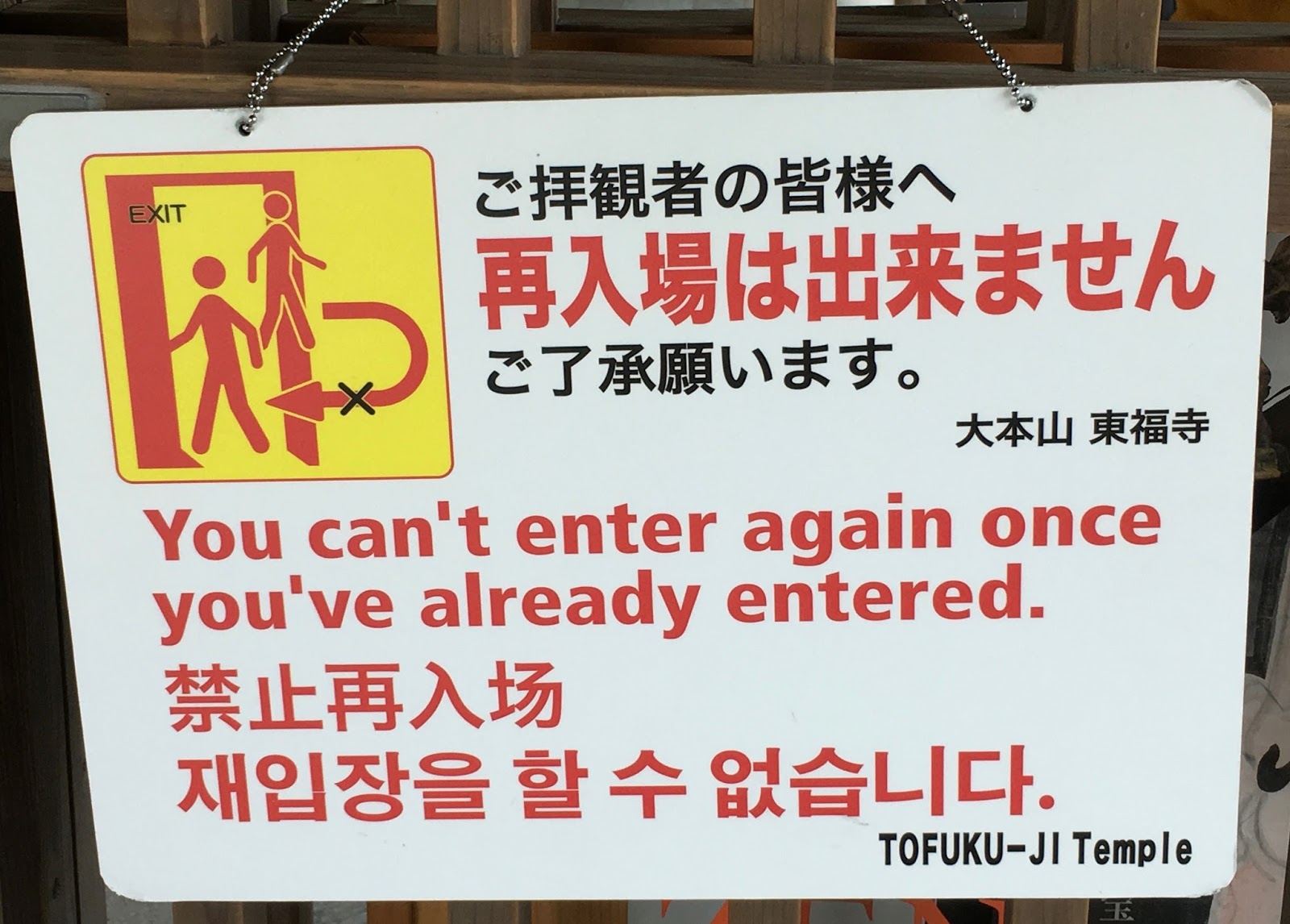
Signs in Japan are often posted in Japanese and English - a fact that never ceases to impress me - and, at times, amuse . . . especially when the translation offers an inadvertently philosophical context as well as a practical one.

True of many things in life.

If that message seems entirely practical, just think on it for a moment.

After spending a couple of days in Kyoto, I headed south to Osaka and Mount Koya, and then north to Gifu, home of Gifu Castle and a somewhat lesser-known attraction called "Squirrel Town."

Squirrel Town.

Sadly, I arrived too late in the day to tour both the castle and the squirrel village, and responsibility won the coin toss. I'll have to investigate the squirrels more closely another time.

After three more stops, and many other adventures (more on those in another post) I found myself in Hakone, near Mt. Fuji, where visitors can ascend, cross over, and have lunch atop a live volcano. Here's my favorite shot from the ropeway car as we crossed the caldera - made even more perfect by the visitor waving to us from his car as it approached ours on the ropeway.

Hello from the volcano!

Roaring bananas, peeing on pigeons, ferris wheels, squirrels, and live volcanoes.

If that's not a "different" post . . . I've nothing more.