Showing posts with label pigeons. Show all posts

Sunday, January 8, 2017

Celebrating the Different

-- Susan, Every Other Sunday

Across the world, people celebrate the new year as a beacon of hope, an opportunity for change, and a chance to be different than they were before.

Some years seem more hopeful than others, and the opportunity for real change is a slippery and difficult thing to lay a finger on (some years, more so than others) - but *different* is something I understand, and that's the direction I'm taking this initial MIE post of 2017.

For me, and I suspect for many of my co-bloggers and fellow writers, here and across the world, reading, writing, and travel attract me because they allow me to leave the "same" and explore the "different" - to learn, to celebrate, and to enjoy new things I would never have otherwise seen or imagined.

I love sharing photos from my travels, but on occasion I end up with photographs of things so different that they don't really fit in the context of other posts. Some have sufficiently detailed stories behind them that they support themselves, but others typically languish in the "loved this, but how can I share it?" file.

No longer.

Today, I'm sharing a few of the odd and unusual things I saw last October and November in Japan.

While passing through Tokyo station en route to the Japan Writers' Conference, I discovered that in Japan...bananas roar.

The Roaring Banana. Complete with Bow and Bell.


(Apparently, "Banana Roar" is a type of twinkie-like filled cake sold in Tokyo Station.)
From Tokyo, I traveled south to Shikoku, the third of Japan's four primary islands. Tokushima City, on Shikoku, was home to the 2016 Japan Writers' Conference, and Tokushima Castle Park, home to one of the more unusual statues I've seen in my travels:

Boy Pees on Pigeons, Tokushima Castle Park, Japan
When activated, the statue of the boy pees on the pigeons. Turnabout is, indeed, fair play.

After the conference ended, I hopped a highway bus back to Kyoto to start the research portion of my trip. En route, I passed not one but three different free-standing ferris wheels. Each stood near the side of the road, with no sign of other attractions in the area.

Random Ferris Wheel Sighting.
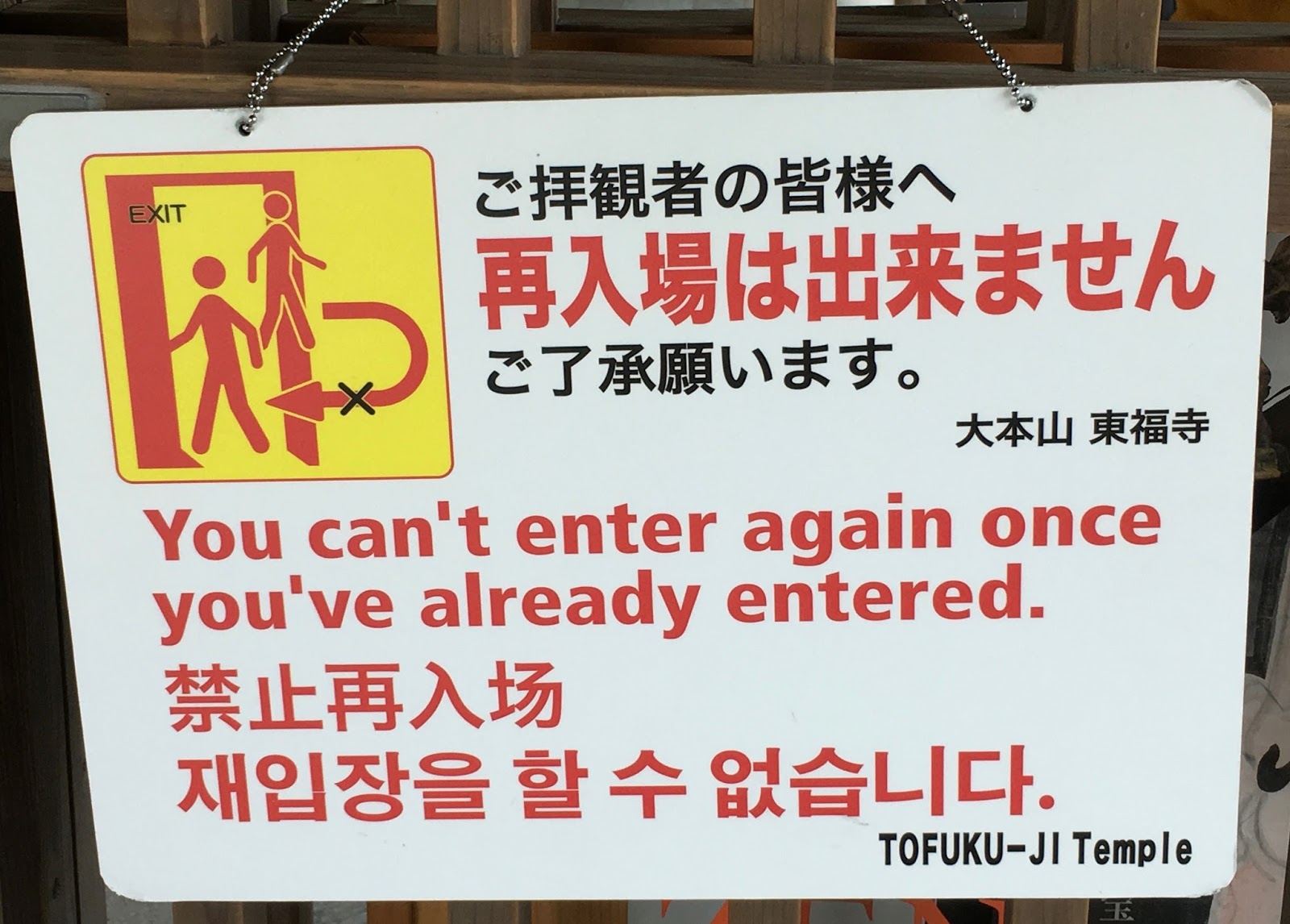
Signs in Japan are often posted in Japanese and English - a fact that never ceases to impress me - and, at times, amuse . . . especially when the translation offers an inadvertently philosophical context as well as a practical one.

True of many things in life.

If that message seems entirely practical, just think on it for a moment.

After spending a couple of days in Kyoto, I headed south to Osaka and Mount Koya, and then north to Gifu, home of Gifu Castle and a somewhat lesser-known attraction called "Squirrel Town."

Squirrel Town.

Sadly, I arrived too late in the day to tour both the castle and the squirrel village, and responsibility won the coin toss. I'll have to investigate the squirrels more closely another time.

After three more stops, and many other adventures (more on those in another post) I found myself in Hakone, near Mt. Fuji, where visitors can ascend, cross over, and have lunch atop a live volcano. Here's my favorite shot from the ropeway car as we crossed the caldera - made even more perfect by the visitor waving to us from his car as it approached ours on the ropeway.

Hello from the volcano!

Roaring bananas, peeing on pigeons, ferris wheels, squirrels, and live volcanoes.

If that's not a "different" post . . . I've nothing more.

Tuesday, December 8, 2015

two things and George Perec

Here's two things, from the many things, Stephen King advised in his book 'On Writing': “In my view, stories and novels consist of three parts: narration, which moves the story from point A to point B and finally to point Z; description, which creates a sensory reality for the reader; and dialogue, which brings characters to life through their speech. You may wonder where the plot is in all of this. The answer—my answer, anyway—is nowhere.”
The second thing. “Nobody is “the bad guy” or “the best friend” or “the whore with a heart of gold” in real life; in real life we each of us regard ourselves as the main character, the protagonist, the big cheese; the camera is on us, baby. If you can bring this attitude into your fiction, you may not find it easier to create brilliant characters, but it will be harder for you to create the sort of one-dimensional dopes that populate so much pop fiction.”
Of the many writing tips in King's book these two things hit me full on this week. I struggled with a secondary character, found her too simplistic too informational. After all she was there to give information, to move the plot forward.
It soured me writing it - but the story needed this to get from A to B. Reading these, I knew this secondary character needed to exist in a sensory world, she needed to come to life and her world too. Even if for a brief memorable few pages. I could see her, the apartment, the light, hear the noises on the stairway. I mentally sat down across from her and re-worked this apartment scene.
The best friend, the concierge with a nose for other people's business, felt stereotypical. If they'd become stereotypes after Simenon's novels with Inspector Maigret it was because his concierges jumped off the page. King said in real life each of us regard ourselves as the main character - so whether it's a walk on, a secondary character, the salesgirl in the YSL boutique or it's, as King says, we're the big cheese, the camera is on us, baby.' Not one dimensional even if you rate a paragraph. I'd never read George Perec, once the enfant-terrible of the French literary world. He was famous for writing a book that had no 'e's in it or words with 'e's I guess. I never read it. But I got hold of a novella 'An Attempt at Exhausting a Place in Paris.'
This novella consists of Perec's chronicling all the the people and things he saw over three days in the square fronting Saint Sulpice church in Paris. At the time he wrote this, the square had three café's one of which was a café-tabac. Now it has one café. Perec wrote from inside the cafe's, from a bench in the square by the fountain for three days. That's his book.
One overcast weekend in October 1974, he set out in quest of the "infraordinary": the humdrum, the non-event, the everyday--"what happens," as he put it, "when nothing happens." His choice of locale was Place Saint-Sulpice, where, ensconced behind first one café window, then another, he spent three days recording everything to pass through his field of vision: the people walking by; the buses and driving-school cars caught in their routes; the pigeons moving suddenly en masse; a wedding (and then a funeral) at the church in the center of the square; the signs, symbols and slogans littering everything; and the darkness that finally absorbs it all.
In An Attempt at Exhausting a Place in Paris, Perec compiled a melancholic, slightly eerie and oddly touching document in which existence boils down to rhythm, writing turns into time and the line between the empirical and the surreal grows surprisingly thin.
I tried to picture it as he saw it and as it is now. Not that different or the people or busses that cross it. Like a study in observation, a slice of the daily life in the quartier. Would I have noted what he did? Why did he slavishly record these details? What did he mean to say, to express? A review said he'd lost his parents in the Holocaust. Anaïs Nin said 'we write to experience life twice.'