Showing posts with label political protest. Show all posts

Wednesday, March 9, 2022

A War on Words

Sujata Massey 


Russia’s invasion of Ukraine is sending ripples of pain from the traumatically besieged country to the rest of the world. I fear for the trapped Ukrainians and foreigners unable to escape the Russian military. I marvel at the resistance of Ukrainians who are literally giving their lives for their country's independence. 


What can I do? is a question a lot of us in the West are asking. 


Some people dress in yellow and blue, and others sew Ukrainian flags to hang from their homes. Bartenders stop pouring Stony. People who have dealings with Russia, including authors and literary agents, are pondering whether these ties should also be severed. 


Shortly before the invasion, I signed a book publishing contract with an independent Russian publisher (an organization that is not supported by or affiliated with the government). I realize this pending sale is far more than a financial transaction. 


Ukraine’s chapter of PEN, a nongovernmental organization devoted to protecting freedom of speech and authors’ rights, called for a global boycott of books by Russians. They also advised authors and agents to stop selling rights to Russia. This year’s Frankfurt Book Fair in Germany, and the Bologna Children’s Book Fair in Italy, decided to exclude Russian publishers and agents. Stephen King and Linwood Barclay, American-born authors who are bestsellers worldwide, both said they won’t renew existing contracts to publishers in Russia.


Avoiding publication in Russia is every writer’s choice—just as it is to publish or not in any country, including the United States, Israel, and other controversial countries. Yet I am concerned by the quick dismissal of the importance of foreign books in Russia. Novels, nonfiction, memoirs, poetry and graphic novels teach us about the unfamiliar. Books support us when we’re isolated, and they can sometimes even inspire us to change our lives. 


Another consideration is whether the people working in Russian publishing are actually in solidarity with Ukraine. Several hundred publishing professionals inside Russia have spoken out   against the invasion in a powerful letter of protest. Some of the independent publishers have been arrested. Their bravery is a huge contrast from the silenced publishing world of the Soviet era.
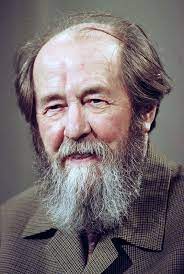


Aleksandr Solzhenitsyn, courtesy Brittanica


During my childhood, the Russian dissident author Aleksandr Solzhenitsyn couldn't be published in his own country, and he emerged as one of the world's most popular cultural heroes. I remember hearing that he won the Nobel Peace Prize in 1970. I was shocked that an author of a book somebody disliked could be sent to a forced labor colony. 


Vasily Aksyonov, courtesy Brittanica


In the 1980s, a lauded novelist named Vasily Aksyonov was allowed to leave the Soviet Union after years of censorship and imprisonment. Aksyonov spent 24 years in the US, and among his many professorships was one teaching at Johns Hopkins University. My husband was in his class and remembers Aksyonov explaining how a small group of Russians typed copies of his banned books. He stressed the scarcity of copies in the country—less than fifty existed—and how these packaged papers were secretly passed between people, each hoping the next wasn’t a spy who would turn them in. 


After the U.S.S.R. was dismantled into independent countries, both writers returned to Moscow, where they died as elderly men of natural causes.


I bring up these Russian writers because, although I support sanctions against big Russian players like oil, airlines and banks, I am concerned about taking away books; and also the plight of Russian war resisters. I'm picturing Russian citizens who feel as endangered and powerless today as their parents and grandparents did. Yet despite the risks, political protests are roiling the streets of Russia. On Sunday, March 6, 4500 protesters were arrested. Even children as young as five years old have been taken from public protests to jail. I expect bloodshed at forthcoming protests in Russia, just as blood is flowing in Ukraine.


The history of Soviet censorship can be compared with the acts of other governments. My historical novels explore the history of a subjugated colony whose people have a seemingly impossible-to-reach goal of ruling themselves.  In The Widows of Malabar Hill, The Satapur Moonstone and The Bombay Prince, women protect each other and gather strength to fight power during India’s very difficult period of protestor suppression by its non-elected, foreign government. 


Now that Russia is at war, and its citizens back home are restless, would the Kremlin censor such books? 


Possibly. 


And that’s why I'm not doing the job for them.


Wednesday, September 26, 2018

The Monday Women Marched in Black

Sujata Massey


Wear all black,” the woman said over the phone.

Come at eight-thirty, and don't carry too much. 

Be prepared to go from the Supreme Court of the United States to the offices of senators.


Last Sunday, I learned the Women’s March organizers were a series of actions this week in Washington D.C. I wanted in. Over the last two years, I have been increasingly agitated by the attempts by male lawmakers to erase established civil rights, especially those of women and minorities. It feels like the final straw that the President’s nominee for an open seat on the U.S. Supreme Court is Brett Kavanaugh, a conservative judge alleged to have sexually assaulted a young woman during his high school days. Despite the fact that more claims have come about the judge’s sexually aggressive behavior, the President and most Republican senators don’t want an F.B.I. investigation or to postpone voting for Kavanaugh’s confirmation.


President Trump and his supporters insist Chrstine's report must be false, or else it would have been told to the police years ago.But I know that many women who do report rapes have their stories ignored or suffer repercussions for telling. 

Dr. Christine Blasey Ford is a psychologist now living in California. She says that when she was fifteen, a teenaged Kavanaugh and his friend, Mark Judge, forced her into a bedroom at a party. She claims Kavanaugh put his hand over her mouth so nobody could hear her cry out for help. The men fell off her, and Christine did escape being raped, but she suffered post traumatic stress disorder. Christine moved 3000 miles away to get away from her painful memories, which she had discussed with others over the years, but that became increasingly hard to ignore when Kavanaugh came onto the national stage. Some months ago, Christine wrote a letter about her experiences to her Senator, California Democrat Dianne Feinstein. Christine asked Feinstein to keep her identity confidential but to share Kavanagh's past actions with the F.B.I. However, information was made public, and now Christine has received death threats and left her home.


I am grateful to live close enough to Washington DC to reach it in an hour's train ride. I wanted to make a physical declaration that I believe women don't make up stories about rape. I followed the instructions the woman had given me to assemble in front of the US Supreme Court on a gray Monday morning. Rape survivors among the marchers spoke about who hurt them and how the trauma still affects them. Some of their voices were very low, because the emotion was strong, and it was the first they had told these painful histories. After each story, our voices swelled in answer. "We believe you."

The rally started out with a few hundred people, but as we marched to the Hart Senate Office Building, the numbers swelled. Long lines of cars had to stop to let us cross the intersection, and by the time we reached Hart, it seemed like close to one thousand were marching. There were so many marchers, we had to divide up to make it into the building through two different sides. Because we had no bullhorns, messages passed through the crowd by repetition. When people in the line began holding up a hand, it meant it was time to fall silent and listen for directions.


In the Hart and Dirkson Senate Office Buildings, the police were already waiting and had stiff plastic wrist bands, the modern version of handcuffs. While it is legal for people to enter a building to visit a senator, the police told us that it is against the law to protest inside government buildings. 


In the atrium, some people prayed and many others got to know each other. I met many students from Yale Law School, the alma mater of Kavanaugh, and women and men from all over America. The organizers divided us into smaller groups that lined the halls outside the offices of Republican Senators Susan Collins and Jeff Flake, as well as some others who might be swayed to vote against Kavanaugh. 

I was unable to get inside any of the senators' offices, but the people who did spoke to the senator’s staff about how the experience of rape impacted them. I did not know that during the same time, other rallies were being held around the country, that many women were wearing black as a sign of protest, and at 1 p.m.that Monday, many women would walk out of work for an hour to show they believed Christine.


At the Senate Buildings, 128 people were arrested in Dirkson and the Rotunda. The rest of us made it out.

As I walked through Capitol Hill, I caught sight of a protest sign about the nomination of Brett Kavanaugh on a food truck, making me realize that people are creatively speaking their voices.


It was still raining when I reached Union Station, and my thoughts went back to my own social history. Christine and I came of age at the same time, and there are several uncomfortable experiences with men I've pushed very far back into my memory. Three decades ago, I believed that if I got away from someone without being hurt, I should consider myself lucky. Why should there be a consequence for the perpetrator? 

In my Perveen Mistry series, I write about a woman solicitor battling for social justice for females constrained by the legal system in British colonial India. A century later, it is shocking that so much is still the same.
