Showing posts with label Washington DC. Show all posts

Wednesday, June 26, 2024

The Imagery of Doublethink

 John Copenhaver, Guest Author


The adventurous young women joyriding across the magazine cover remind me of Philippa and Judy, the sleuths in John Copenhaver's latest historical mystery, HALL OF MIRRORS. 

I recommend John Copenhaver's books highly, especially for people interested in 20th-century American social history and  fashion and architecture. John is both a co-founder of Queer Crime Writers and an at-large board member of Mystery Writers of America. His two previous mystery novels have won the Macavity, Lefty and Lambda Literary awards. The reviews for HALL OF MIRRORS are superlative. The Los Angeles Times mystery critic called the book a 'stunner,' and the New York Times cited the author's breathtaking skill."

I was fortunate to read an early copy of HALL OF MIRRORS, and also to see John speak at the Ivy Bookshop in Baltimore during his recent book tour. I invited him to share his thoughts about how the aesthetics, buildings and history of Washington DC shaped his brilliant book. Given the depth of his visual descriptions, I can easily imagine the book as a gorgeous suspense film.--Sujata Massey


My new historical mystery, Hall of Mirrors, is set in post-WWII Washington, DC. It’s the second book in a trilogy that began with The Savage Kind, set in 1948. Midcentury America was a period rife with contradictions, a time of relief after the Second World War but paranoia that communism would infiltrate and corrupt the “American way of life,” a time of technological progress, such as television and space travel, but conservative regress, limiting the roles of women in the home and the workplace and oppressing Blacks and LGBTQ+ people (from the racist G.I. Bill to the Lavender Scare) and a time of economic prosperity and future-thinking cast in the shadow of the threat of nuclear extinction.


On the surface, everything was high-gloss, buffed chrome, shades of bright pastels, and clean, wholesome looks, but underneath that veneer, the streets, schools, workplaces, and domestic spaces hummed with fear and dread. This fear has a very real impact on my characters, especially the gay couple at the heart of the story, one of whom dies in an apartment fire, purportedly by his own hand. He was booted from the State Department for being gay, which, according to officials, made him a security risk because he could be easily blackmailed by Soviet agents. 


To recreate this world of casual denial and high anxiety, I chose to contrast the beautiful and the horrible. My opening paragraph of Hall of Mirrors begins with mingling the “dusk sky” and “cherry blossoms hanging in the breeze” with “smoke” and 2101 Connecticut Avenue’s “demonic grotesques .. looming in vain, having failed to ward off evil spirits.” Along with 2101 Connecticut—which is one of DC’s more notable apartment buildings from the 1920s—I “scouted” various locations to set scenes that would offer these contrasts, from an empty ballroom at the Mayflower Hotel to the blood-red interior of The Colony Restaurant, which echoes the interior of Ernie’s Restaurant from Vertigo, to the Tidal Basin at peek cherry blossom bloom moments before a storm to the gorgeous farmland of Virginia, which may hold a grim secret. 


While I gave The Savage Kind a muted shadowy palette—fall leaves, rain, snowfall—I wanted Hall of Mirrors to be suffused with hyperreal colors like a Douglas Sirk melodrama or Vertigo’s vibrant technicolor. The bright décor, clothing, and setting are meant to contrast with the confusion, fear, and violence the characters experience to remind us that this was an age of denial, or at the very least, a kind of doublethink: how can the future be buffed to a shine, but fatalism and mass devastation be so prevalent in people’s minds?


During my research, I came across the cover of the April 5, 1954, Newsweek, and it captures this doublethink mindset so perfectly that I referenced it in my novel. On the cover, two women ride in a convertible, smiling and carefree, with their hair in bright scarves and suitcases tossed in the backseat. The photo's caption reads, “Spring-Summer Travel: Biggest Ever.” Then, a bright yellow banner across the cover says, “The Bomb: What Odds for Survival Now?” What an absurd contradiction: What will it be … vacation or annihilation?


As Hall of Mirrors develops, the bright surfaces burn away, and the rot underneath emerges, demanding acknowledgment and frank consideration. I believe we’re living through a similar time now. We have a strong economy, but the disparity between the haves and the have-nots has only been this great since the Fin de siècle, the age of the robber barons. The shiny veneer of contemporary life, especially the glitchy glow of social media and the 24-hour news cycle, is slowly crumbling; like the characters in Hall of Mirrors, we’re beginning to confront darker truths underneath.


Wednesday, April 5, 2023

A Secret Garden

Sujata Massey 


It seems amazing that two weeks ago, I was marveling at springtime in the desert. I'm back home in the Mid-Atlantic or "Delmarva," a nickname that includes the states of Delaware, Maryland and Virginia. Washington DC doesn't appear in the moniker, but it's the ultimate springtime destination. 

Springtime in the District is magical, with airy, pastel-colored trees and shrubs decorating the 1920s and 1930s grand architecture that marks neighborhoods like Chevy Chase, Woodley Park and Kalorama. And it seems to me that these old-fashioned, courtly perennial gardens have distinctly British layouts, but a dash of Japonisme when it comes to shrubs. Consider the original cherry trees planted in 1912 near the Tidal Basin by First Lady Helen Taft and Viscountess Chinda, wife of the Japanese Ambassador. Following this famous example, cherry and plum and quince trees were planted all over the district and the aforementioned Delmarva.

I would rather visit a private garden, with few crowds, then fight for space among thousands on Washington Mall's. One of DC's best kept secrets is the large formal garden behind the Omni Shoreham Hotel.


I enjoyed a lovely day flower-gazing in DC, and drove home in heavy traffic that I  blame (at least partly) on cherry blossom viewers. Two hours to go 35 miles!

Fortunately, the same flora  is in bloom in my own neighborhood. Daisy, our little brown terrier, walks with me several times a day. Her favorite season is undoubtedly spring. I suspect her affection is driven by the fascinating  smells.


               And Daisy told me that the best way to savor spring is to share it with someone else.


Wednesday, April 24, 2019

A Pink Moment

by Sujata Massey


My baby cherry tree!


These days, pink is everywhere. Millennial Pink is the official name of the soft hue that now colors chairs from Target, rose-gold phones from Apple, and yes, pink clothing for both genders. Why this soft shade now? Is it because treatment of people has become so hard? Pink is a color of childhood, whether you call it blush, petal, nude or cherry.

Cherry is a pink that simply gives me joy. The Baltimore-Washington area has a long, mild spring, and the crowning glory of our area from March through April are the cherry trees, which bloom in waves, depending on their age and variety. I grew up in snowy Minnesota reading Japanese fairytales with cherry blossom themes and books about dolls from Japan such as Rumer Godden’s 1961 delight, Miss Happiness and Miss Flower. Did that set me on  a lifetime love of sakura trees?


One of the old-friend cherries nearing end of bloom


My street in North Baltimore has some very large, sprawling flowering cherry trees that might be older than the 40 years I’ve been told is the average cherry tree lifespan. But how old are they?

Sakura trees were brought into the United States by an American food explorer working for the US Department of Agriculture called David Fairchild. Mr. Fairchild first shipped them from Japan to his garden in Chevy Chase, MD in 1902. 

President Taft’s wife, Nellie, took to heart his idea of beautifying Washington with cherry trees. It was also a difficult time in the country, when there was popular agitation over immigration of Asians. This idea was a variation of an olive branch. Could Americans see something good about Japan?

Mr. Fairchild was tasked with brokering a deal for cherry trees in the nation's capital with the Mayor of Tokyo, who then offered them free. The first cherry trees were shipped to Washington DC in 1909; however, their roots were found to be heavily infested with insects that could have wreaked havoc across many agricultural species in the United States. These trees were burned in 1910. The Japanese who heard about it were not angry—they were sorry to have sent a defective gift and insisted on sending more. In 1912, healthy trees were planted in Washington and celebrated ever since.

I have been to the Tidal Basin to admire this sweep of cherries and see the excitement of Washington DC’s annual Cherry Blossom Festival. I’ve also seen the blossoms celebrated this year in Vancouver, Canada. Cherry blossoms create a kind of worldwide party where we all stop and pay attention to nature. And in the 1990s when I lived near Yokohama, I've participated in Hanami parties, enjoying not just the trees but the special decorations throughout Japan and cherry-themed foods that go with the fleeting blooms.


Cherry blossom fans in downtown Vancouver


Entering their second century of life in the United States, the cherry blossom tree is no longer a fragile, exotic beauty. The City of Baltimore’s tree program donates all kinds of trees to neighborhoods where residents want them; not just cherry, but serviceberry, redbud, and others that are beautiful, yet support native insects. My street had suffered the death of several aged giant cherry trees, so an enterprising neighbor put together a plea for more cherries to go on any street in our neighborhood five years ago.


The green-leafed cherry in background is one of our grand dames


One early spring day, trained gardeners planted four seven-foot-tall trunks with bare limbs in front of my house. I bought water-bags and tucked them around the young trees ,so they would have a slow release of water all the time during our hot summers. Now the trees are approaching 30 feet high and don’t need their waterbags, except in extremely prolonged heat waves. They flower several weeks after the street’s grand dame cherries, so we are fully blooming two weeks long.

I am grateful to our block’s seven new children, and four senior citizens, for showering me in pink every spring regardless of politics and fashion.  


Wednesday, September 26, 2018

The Monday Women Marched in Black

Sujata Massey


Wear all black,” the woman said over the phone.

Come at eight-thirty, and don't carry too much. 

Be prepared to go from the Supreme Court of the United States to the offices of senators.


Last Sunday, I learned the Women’s March organizers were a series of actions this week in Washington D.C. I wanted in. Over the last two years, I have been increasingly agitated by the attempts by male lawmakers to erase established civil rights, especially those of women and minorities. It feels like the final straw that the President’s nominee for an open seat on the U.S. Supreme Court is Brett Kavanaugh, a conservative judge alleged to have sexually assaulted a young woman during his high school days. Despite the fact that more claims have come about the judge’s sexually aggressive behavior, the President and most Republican senators don’t want an F.B.I. investigation or to postpone voting for Kavanaugh’s confirmation.


President Trump and his supporters insist Chrstine's report must be false, or else it would have been told to the police years ago.But I know that many women who do report rapes have their stories ignored or suffer repercussions for telling. 

Dr. Christine Blasey Ford is a psychologist now living in California. She says that when she was fifteen, a teenaged Kavanaugh and his friend, Mark Judge, forced her into a bedroom at a party. She claims Kavanaugh put his hand over her mouth so nobody could hear her cry out for help. The men fell off her, and Christine did escape being raped, but she suffered post traumatic stress disorder. Christine moved 3000 miles away to get away from her painful memories, which she had discussed with others over the years, but that became increasingly hard to ignore when Kavanaugh came onto the national stage. Some months ago, Christine wrote a letter about her experiences to her Senator, California Democrat Dianne Feinstein. Christine asked Feinstein to keep her identity confidential but to share Kavanagh's past actions with the F.B.I. However, information was made public, and now Christine has received death threats and left her home.


I am grateful to live close enough to Washington DC to reach it in an hour's train ride. I wanted to make a physical declaration that I believe women don't make up stories about rape. I followed the instructions the woman had given me to assemble in front of the US Supreme Court on a gray Monday morning. Rape survivors among the marchers spoke about who hurt them and how the trauma still affects them. Some of their voices were very low, because the emotion was strong, and it was the first they had told these painful histories. After each story, our voices swelled in answer. "We believe you."

The rally started out with a few hundred people, but as we marched to the Hart Senate Office Building, the numbers swelled. Long lines of cars had to stop to let us cross the intersection, and by the time we reached Hart, it seemed like close to one thousand were marching. There were so many marchers, we had to divide up to make it into the building through two different sides. Because we had no bullhorns, messages passed through the crowd by repetition. When people in the line began holding up a hand, it meant it was time to fall silent and listen for directions.


In the Hart and Dirkson Senate Office Buildings, the police were already waiting and had stiff plastic wrist bands, the modern version of handcuffs. While it is legal for people to enter a building to visit a senator, the police told us that it is against the law to protest inside government buildings. 


In the atrium, some people prayed and many others got to know each other. I met many students from Yale Law School, the alma mater of Kavanaugh, and women and men from all over America. The organizers divided us into smaller groups that lined the halls outside the offices of Republican Senators Susan Collins and Jeff Flake, as well as some others who might be swayed to vote against Kavanaugh. 

I was unable to get inside any of the senators' offices, but the people who did spoke to the senator’s staff about how the experience of rape impacted them. I did not know that during the same time, other rallies were being held around the country, that many women were wearing black as a sign of protest, and at 1 p.m.that Monday, many women would walk out of work for an hour to show they believed Christine.


At the Senate Buildings, 128 people were arrested in Dirkson and the Rotunda. The rest of us made it out.

As I walked through Capitol Hill, I caught sight of a protest sign about the nomination of Brett Kavanaugh on a food truck, making me realize that people are creatively speaking their voices.


It was still raining when I reached Union Station, and my thoughts went back to my own social history. Christine and I came of age at the same time, and there are several uncomfortable experiences with men I've pushed very far back into my memory. Three decades ago, I believed that if I got away from someone without being hurt, I should consider myself lucky. Why should there be a consequence for the perpetrator? 

In my Perveen Mistry series, I write about a woman solicitor battling for social justice for females constrained by the legal system in British colonial India. A century later, it is shocking that so much is still the same. 

Wednesday, December 6, 2017

Death in the Dollhouse


Dollhouses have a shelf in my life. I played with dolls and miniatures for a very long time--longer even than my little sisters. Our house had a tall, narrow built-in bookcase on the second floor landing, and I set up rooms for my tiny doll family on five "stories." These went from kitchen to living room, dining room to bedrooms. The coup de grace of a Victorian bathroom with pull chain toilet and free standing china tub. I could play "A Little Princess" or "Borrowers" or a story of my own devising. 

While I made doll clothes and tablecloths and tiny books, the home was furnished mostly with dozens of very fine wooden and porcelain furniture pieces, a long-term loan from a kind neighbor. These beds and sofas and dining cabinets dated from probably the 1940s and '50s and were often in the nostalgic Victorian or Colonial style. Was it the dollhouse that gave me an appreciation of antiques? And was the art of playing family stories set in the past practice for later writing historical and mystery novels?


Frances Glessner Lee, born in 1878, also loved dollhouses. But she transformed a picturesque child's hobby into a dark art. Her miniature rooms are the center of a magnificent show currently at the Smithsonian's Renwick Gallery in Washington, D.C. 


A parlor scene with victim


Frances's path to her gory, tiny rooms was utterly original.  She was a lady of privilege, the only daughter of the industrialist John Jacob Glessner, who owned the International Harvester agricultural and construction machinery company.  Frances and her brother were tutored at home;  he attended Harvard, but her parents denied her the chance for higher education due to her gender. It was a sad, too familiar story.

Some of the activities that filled Frances' time as a girl were making dolls and miniatures and reading the novels of Sherlock Holmes. Her marriage to a lawyer named Blewett Lee was unhappy; she wanted much more than life as a society wife. Frances appreciated the central concept in Sherlock Holmes stories about clues being essential--and often overlooked. But her husband didn't want her to pursue the forensic pathology work that she spoke about learning. The couple divorced, and her parents dissuaded her from trying to enter the field. 

But Frances didn't give up. After her brother died, she he had access to her inheritance and used some of it to endow a brand new department of Legal Medicine at Harvard. She realized this could be a venue where she could contribute. The school was named Magrath in recognition of her lifelong friend,the doctor George Burgess Magrath, a coroner who was on Harvard's faculty. Her idea was to take a crime, create a tiny room filled with a victim and clues, and let police and coroners study it for their own education. 

Frances and Ralph Moser, her estate's carpenter, spent between three to six months fabricating a "nutshell," as she called these incredibly detailed dollhouse rooms. To make the piece known as "Barn", Ralph was directed to shave pieces of wood from an aged shed on her property and put them together to be the barn's boards. Frances knit tiny stockings using straight pins and recreated tiny newspapers by hand. 

The Barn. Did the farmer suffer suicide or murder?


All the ideas for the crimes presented were hers, and often featured women at risk in domestic situations, and the poor and working class. Her dollhouses show the real world of the United States between the thirties and the fifties. Some of them are still used by the Baltimore Police Department for training. 

I visited the exhibition over the Thanksgiving weekend, and it was packed with viewers, young and old, peering in at the lit-up nutshells. The line went out the door, the show was so popular. It was heartening to see a woman like Frances appreciated after her death. In her late years, she was the inspiration for some fiction by her friend, Erle Stanley Gardner. She also is said to have been the model for Jessica Fletcher in the television show "Murder She Wrote," although Jessica was a writer, not an artist.

The exhibition, "Murder is her Hobby" runs through February 2018 and is well worth a peek. If you visit the Renwick's web page about Frances Glesser Lee, you can take a virtual tour and also hear a podcast about the show.


Wednesday, April 12, 2017

A Tale of Two City Festivals

Sujata Massey


Thousands of cherry trees blossom every spring in Washington DC, a tradition spanning 105 years. At the same time, brilliant light sculptures and art installations glow along the port promenade in Baltimore. Two festivals I'd never experienced drew me away from my work. Which festival first?


I started out on a gray Thursday morning toward Washington DC, hoping rain wouldn't come. It was my wedding anniversary, and my husband Tony and I had taken the day off. The traffic gods were kind and the car reached the cherry blossom zone just an hour after leaving Baltimore. We strolled from the parking garage to eat ceviche and amazing tacos at a fine Mexican restaurant, Oyamel, owned by chef Jose Andres. We visited the Building Museum and National Portrait Gallery, spending not enough time because we wanted to reach the nearby cherry blossom trail.

The DC cherry blossom festival has quite a history. The trees would never be there, if it weren't for a woman's persistence. Bringing Japanese trees to Washington DC was the idea of a globe-trotting journalist, Eliza Ruhamah Scidmore, who fell in love with Japan's signature tree when she was touring the East. Starting in the 1880s, Mrs. Scidmore lobbied the US government for 24 years with her idea of a mass transplantation of Japanese trees to beautify the new parkland in the city that had been reclaimed from the Potomac.


She had no luck until 1909, when she found a fellow cherry blossom enthusiast in David Fairchild, an Agriculture Department official who'd transplanted Japanese cherries to his own home. However, the government only agreed after Eliza reconnected with an American lady she'd once met in Japan. As the nation's new First Lady, Helen Herren Taft got the cherry tree plan in motion.


However, the first 3000 trees sent from Japan in 1911 were never planted During their shipment, they fell  victim to insect infestation. The only thing that could be done to keep the environment safe was to burn them all. Still, the Tokyo government, and a Japanese chemist named Jokichi Takamine, were willing to send 3020 more trees the next year. This group of healthy trees took root and flourished, even through World War II, when Japan was an enemy and the trees were referred to as "Oriental cherry trees" in the hopes of avoiding their destruction.


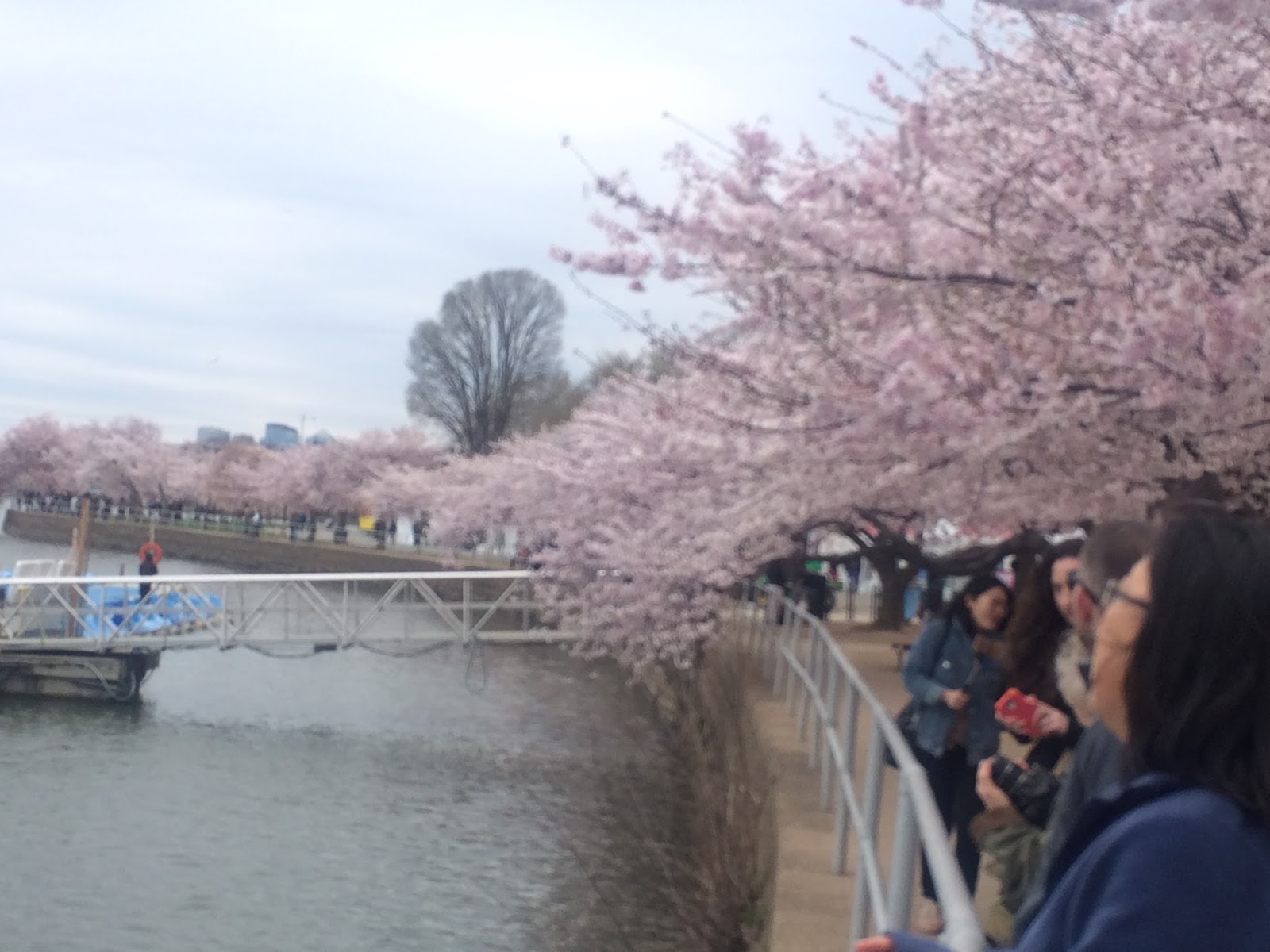
Cherry trees typically live 40 to 45 years, so the trees one sees today are not Eliza's trees. But they are splendid indeed and provide a fairyland feeling when you stand underneath. It was delightful to be walking in the cherry fairyland, rather than being trapped inside one of the many giant tour buses circling around. I was also pleased that the parkland hadn't been overtaken with more sales vendors than usual.  The photo-snapping crowds made me recall Japan's "Hanami", a special cherry-blossom viewing time that inspired The Flower Master, my mystery novel set in Tokyo's flower arranging world.


The day after our DC excursion, the rains came. And this slowed the beginning of Baltimore's Light City Festival, which was set to run for 9 days for the second year in a row at Baltimore's Inner Harbor. Brooke Hall and Justin Allen, a married arts-and-marketing couple, came up with the idea of a new festival that would bring the arts to the heart of the city. They did their research and crafted a proposal for a spectacular walk filled with lighted sculptures and entertainment. Fortunately, it did not take 24 years to get the Baltimore Office of Promotion to agree to fund Light City Baltimore.


Then the fun began. Artists from many states and countries vied for placement in a very challenging venue--as several of the electric installations are in the harbor's waters, and all the pieces were subject to high winds and rain at various times during the nine-day festival period. It's one thing to have your art in an international show--it's another to realize doing this outdoors could cause its destruction.


The Saturday night we went to Light City Baltimore was the rain date for the delayed opening celebration, with a full line-up of musicians, dancers and magicians. The harbor promenade was edged with vendors selling food and drink, and harbor restaurants and bars were packed. There was a great sense of energy and happiness. Some artists were on hand to explain their work, and other art works were open for exploration, including a field of bright dots, an illuminated see-saw, and a lighted rickshaw with a glamorous Chinese lantern. Among my favorites were a floating installation of 400 umbrellas and an illuminated honeycomb. I've been to a lot of festivals over 25 years in Baltimore, and this was the most spectacular.


As I came away from the festivals, I had two thoughts. The Japanese cherry trees were brought to beautify a fledgling city that has subsequently prospered.And the lighted art walk illuminates an old city trying to recast itself in its fourth century.
