Showing posts with label hiking. Show all posts

Sunday, March 13, 2022

A "New Normal" Japanese Rite of Spring

--Susan, every other Sunday

After living much of my life in California, where the changing seasons are observed primarily on the calendar, I never tire of watching the seasons change here in Japan.

Spring and Autumn are particular favorites, because their emergence tends to be both sudden and very welcome after the freezing or hot and humid (think "drinkable air") temperatures that went before.

This week, the temperatures in Tokyo once again changed on a dime--in the course of two days, we went from close-to-zero (C) to some of the most spectacular spring weather anyone could hope for. The cherry blossoms (which will be early this year) are a week or two from blooming, and people have begun to shed their winter hats and parkas for lighter clothes.

It's difficult to celebrate when the world as a whole is suffering, but I also think it's both possible and important to observe (and even enjoy) the changing seasons.

In Japan, the traditional hanami (flower viewing) parties that take place at cherry blossom time did not occur last year. In many places, towns and cities even put up orange cones and ropes beneath the trees, to prevent people from spreading out picnic blankets. An unprecedented suspension of a centuries-old tradition, in response to an equally unprecedented global situation.

As a result, it was necessary to find other ways to appreciate the blossoms. For me, that meant a trip to Lake Ashi (Ashinoko) in Hakone, for a hike that supposedly featured some blooming trees. 
A lovely day for a hike

The hike began on the shore of Ashinoko, near the pier where the sightseeing (aka "pirate") ships depart for their hourly trips across the lake. The swan boats had emerged from their winter storage, too.

The first sakura of the day

I'd picked up breakfast from a local bakery, hoping to find a place for a picnic meal along the trail. To my delight, I found not only blooming sakura trees but an empty, open-air gazebo atop a hill near the start of the hiking trail.
Blooming sakura

Sakura symbolize the arrival of spring, and the impermanence of both life and beauty; the flowers are lovely, but die and fall within a couple of days after opening. Even the smallest breeze can knock the petals from the trees by the thousands, creating a "rain" of pale pink petals.

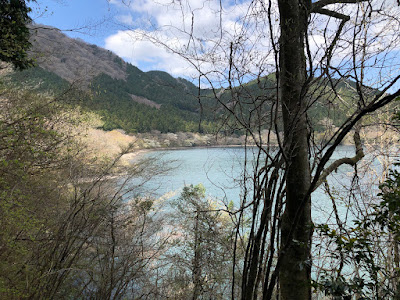
Lake Ashi from the hiking trail

This trail was new to me last year; I'd heard about it, but never hiked it myself. It runs halfway around the lake, and takes about 2 hours to hike from one end to the other.

A fisherman on the shore of Lake Ashi

The trail is also an access point for a number of secluded fishing spots along the lake. 


For the most part, the trail parallels the shore, passing through groves of pine, maple, and sakura trees, with ongoing views of the lake.


Monument in the trees.

One segment of the path moves away from the shore, presumably in order to pass this shrine and monument in the trees. Unfortunately, the sign was so weathered that it had become almost illegible. I could make out only that the site has been here for over a hundred years. 


A couple of times each hour, I saw the sightseeing ships pass by...


The trail was essentially empty--I saw only about half a dozen people the entire morning (most of them fishing rather than hiking)--which made it feel as if I'd somehow stumbled onto a world filled with blooming trees and secret coves. In the cove above, a family was playing with a little, remote-controlled speedboat. I think I enjoyed watching it almost as much as they did. 

Hidden treasure of the day

About two-thirds of the way around the lake, I came upon a cove entirely surrounded by blooming cherry trees. In a normal year, in most places in Japan, a grove like this would have been filled with people admiring the blooms or picnicking beneath the trees. But this wasn't a normal year, and I was the only person there.

(In truth, I suspect that even in normal years, this grove remains almost entirely empty--visible to people passing by on the sightseeing boats, but accessible only to those intrepid enough to make the two-hour hike to get there. In related news: I know where I plan to have my sakura picnic this year...)


Spring has sprung in Japan, so to speak, and although the sakura aren't yet in bloom, we're rapidly approaching our third sakura season since the start of the C-19 pandemic. Japan hadn't yet shut down at sakura time in 2020 (though it happened soon afterward), but people had to get creative to see the blooms last year. Discovering the "secret trail" in Hakone ended up being far more fun than jockeying for space in a crowded park, or looking up at the blossoms from a group. In fact, it's likely to become my "new normal"--and I have to admit, it's nice to reflect on the positive things the last two years have wrought, even as I hope and pray that the next two years are easier for all of us than the ones that came before.

How have your traditions changed in the last two years? Have you found any new ones you hope to continue even as the world opens up again?


Sunday, December 5, 2021

An Autumn Visit to the Dragon King

 --Susan, every other Sunday


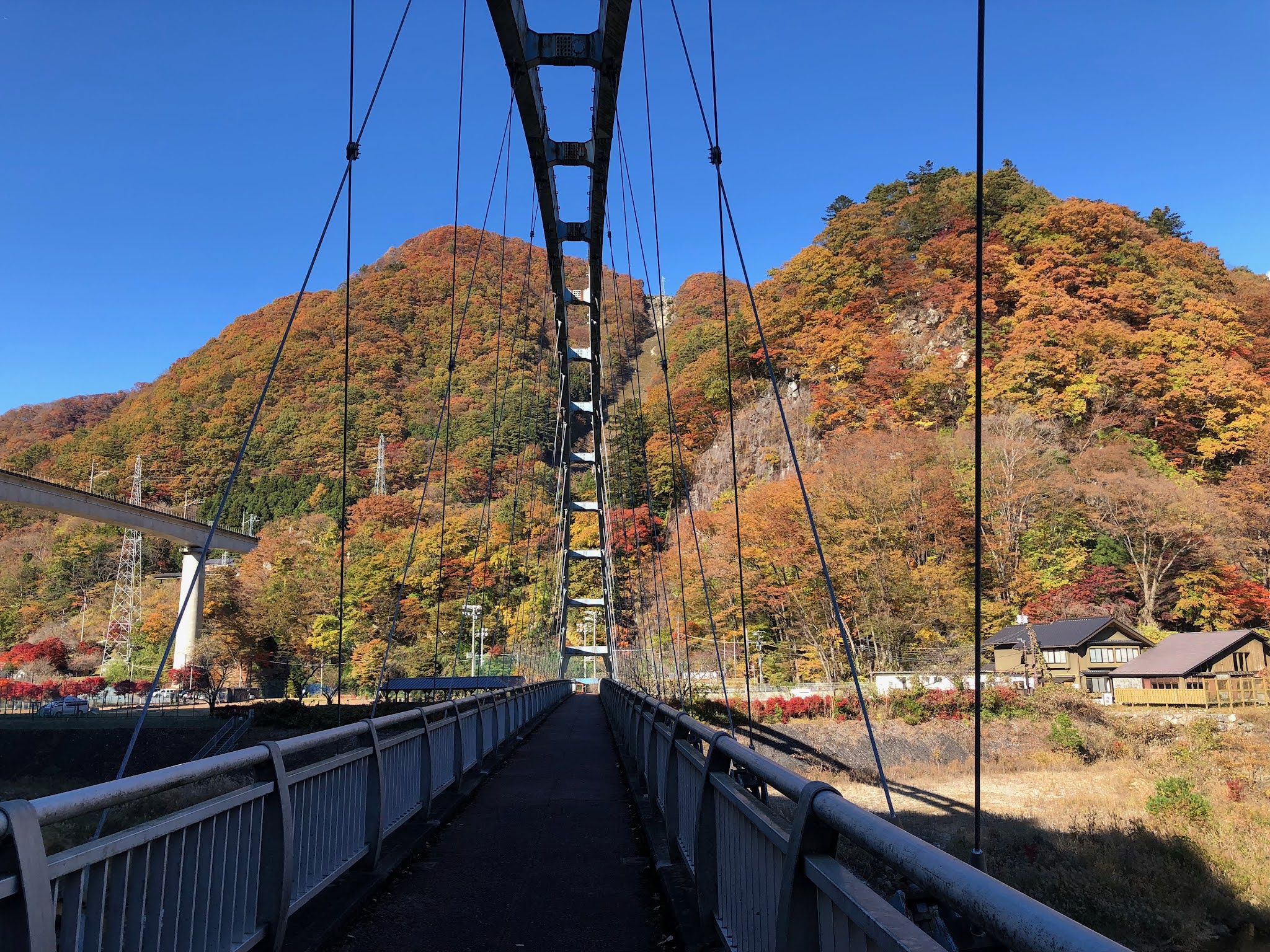
Last month, I headed three hours north from Tokyo, to (re)hike the delightfully named Ryu-ō-kyō (which translates "Gorge of the Dragon King") - a three-hour hike through the ancient, winding gorge the Kinugawa ("Angry Demon River") has carved through the mountains of Tochigi Prefecture over the course of millennia. 

I've hiked the Ryuōkyō before, but never at the height of autumn foliage (for which it's justifiably famous) and always alone.

This time, the autumn leaves were at their peak, and I was hiking with my son (a rare occurrence, because while he loves nature, he's not generally up for the "leave at 6am and hoof the trail all day" way I spend my weekends).

Autumn leaves at Ryuōkyō

The trail begins not far from a lovely waterfall--the largest of the half-dozen that flow down into the gorge at intervals along the trail.


The hills surrounding the falls were ablaze with color - although the Kinugawa was at low ebb. November marks one of the lowest points in its annual flow. The rocks on either side of the river will be entirely submerged when the spring thaw melts the snow on the surrounding mountains. 

I am the shadow to the right of the group, about 3/4 of the way across the shadow the bridge casts into the gorge.

My son, talking with his girlfriend via Zoom

We stopped for photos at the bridges, and at one point my son made a zoom call to his girlfriend, so she could enjoy the colorful foliage too. It's pretty thought-provoking to stand in a natural channel carved by time and water, which historically was so difficult to reach that only a few people in Japan ever even laid eyes on it, and watch someone share it virtually, in real time, with a person a thousand miles away, in another time zone. 

My son, hiking in the gorge


It's a pity Japan isn't pretty in autumn, isn't it...

About halfway through the gorge, we stopped for lunch in a secluded, sandy cove beneath a bridge. I'd made us wagyu-stuffed onigiri (Japanese rice balls), and brought some of the season's first mandarin oranges to go with them--along with chocolate chip cookies, which are always in season. 

Our lunch spot


After lunch, we continued along the trail, past more lovely foliage. Before the hike, my son mentioned that the one thing he had been wanting to see in Japan, but had never yet seen "with [his] own eyes" was a brilliant, flaming red maple tree. I told him I thought our chances were pretty good, but for most of the day, we saw only "partial reds" - trees that were mostly flaming red, but with some leaves that leaned toward gold or orange instead of fully and purely crimson.

Five minutes before the end of the trail, we finally found what he'd been searching for: a tree that was not  only in peak foliage, but entirely decked out in scarlet leaves.

The perfect tree

As we started over the final bridge at the end of the gorge, my son said he was really glad he'd made the hike with me. "It was an adventure," he said--and then hurried to add, "a really great one."

The addendum made me wonder whether he remembered our first hike together--which also happened in Japan, in the summer of 2016. The events of that day were so disastrous that the story ended up as chapter 1 of my nonfiction book, CLIMB--and, at the time, resulted in me promising never to make him participate in another of my "adventures."

Five years and oh-so-many adventures later, I didn't have to make him. He'd asked to come--and the result was a perfect day, and a splendid visit to the Dragon King.

End of the trail - but not the adventures.


Sunday, December 6, 2020

Walking Into History on the Koshū Kaidō

 --Susan, every other Sunday

By now, it's no secret that I love both hiking and Japanese history. Fortunately, so does everyone else in Japan, including the people manage the mountain trails. 

Autumn Foliage on the History Trail, December 2020

Many of Japan's most famous ancient routes remain (at least partially) intact and walkable, from the 88-temple pilgrimage that circumambulates the southern island of Shikoku to the Kumano Kodo, the Nakasendo, and countless other partially-or-entirely preserved trails across Japan.

The country has numerous "modern" hiking routes as well, including the 1,799-meter (1,118 mile) Kantō Fureai no Michi, which consists of 160 day-long (and in some cases, long day!) segments that pass through 7 different prefectures, ultimately carving a circular route through the mountains and along the coast, around the perimeter of the Kantō, Japan's largest flatland plain.

Mt. Sengenrei, as seen from the History Trail segment (Tokyo #4)

Earlier this month, I began what I hope will be a three-year (mostly weekend) journey to walk the entire trail. Last weekend's segment (Tokyo #4) is called "The History Trail" because a portion of the hike follows the route of the Koshū Kaidō, one of the "Five Great Roads" built during the Edo period (1603-1868) to connect the then-new capital of Edo (read "Tokyo") with other important areas of Japan.

Monuments at the start of the History Trail


Outside Japan, the Tokaidō, or Eastern Sea Route, once connected Edo with the former capital of Kyoto, and is by far the most famous of the Five Great Roads--all of which began at Nihonbashi (the Great Bridge of Japan) in Tokyo. (The bridge still stands, though now it's surrounded by a modern skyline of steel and glass.)

Full-scale 17th century Nihonbashi Replica, Edo-Tokyo Museum, Tokyo

A second "great road" called the Nakasendo (Central Mountain Road) connected Kyoto with Edo by passing through the center of Japan, up the mountainous Kiso Valley. 

In constructing the Great Roads, the Tokugawa Shogunate cobbled together pieces of older travel roads and commercial routes, many of which had been used on a local or regional basis for centuries.

A mountainous portion of the Koshū Kaidō in Tokyo Prefecture


Unlike the other roads, which led mostly to and from centers of commerce, the Koshū Kaidō connected Edo with Kai province, in what is now Yamanashi Prefecture, west of Edo. The first Tokugawa shogun, Ieyasu (who unified Japan and claimed the shogunate in 1600), seized the important military stronghold of Kai in 1582. 

44 post towns connected Kai with Edo along the Koshū Kaidō, but in fact the route was rarely used. The road was considered militarily sensitive, and passage required special permission from the shogun. Most travelers, including important samurai and their retainers, were forced to use the longer Nakasendo or Tokaido routes to travel to the capital. Military outposts along the road enforced the rules and prevented unauthorized travel.

The Fukushima Barrier, on the old Nakasendo - similar barriers existed on the Koshū Kaidō


Sadly, the outposts along the Koshū Kaidō were not preserved, and have been lost to history. The route itself is well documented, however, and when plans were made to establish a "long trail" around the Kantō the planners took advantage of this ancient road (and other historical sites of interest) and arranged for an overlap along the History Trail.

A section of the History Trail that follows the route of the Koshū Kaidō


Few people outside Japan have heard the name Koshū Kaidō--and even among Japanese people, the road is less well-known than its better preserved, more famous counterparts. Fortunately, the Kantō Fureai is preserving, and hopefully revitalizing, this piece of history by encouraging a new breed of travelers to walk the ancient paths once walked by samurai. 

A view from the Koshū Kaidō, near the summit of Mt. Sengenrei

We may have traded hand-woven sandals for hiking boots, and carbon-fiber poles for swords, but the history of the Koshū Kaidō survives, and lives on, on Tokyo's History Trail. 

Sunday, September 27, 2020

Pause for Breath

-- Susan, every other Sunday 


"Whoever fights monsters should see to it that in the process, (s)he does not become a monster. And if you gaze long enough into an abyss, the abyss will gaze back at you."--Nietzche


"Perception of an object varies according to the mind. When the mind is polluted, the object becomes tainted." -- Kōbō Daishi


Today, I am turning my back on the abyss, to cleanse my mind with a (virtual) walk in the woods. I hope you'll join me.


Shinrin-yoku (lit. "forest bathing")

The Japanese practice of entering nature (specifically forests)

for the purpose of cleansing and healing the mind and soul.

Take a walk in the trees.

Sit in silence. Contemplate the mountain. 

Breathe fresh air.

Listen to the wind in the reeds.

Follow a trail to a destination you cannot see.

See the grasses turning gold as summer gives way to autumn.

Feel the breeze on your cheeks and the sunlight on your head and shoulders.


Pause for breath.

Find a place to be alone, if only for a moment.

No phones. No Internet.

Walk off the beaten path, and feel the earth beneath your feet.

Go past the place where the trail ends.


And when you're ready, begin your return to civilization. 

Eat the pancake. Drink the coffee. Remember that life is sweet as well as bitter.

Remember that when you need them, the mountains and the trees will be waiting for you.

And remember . . . it's OK to take time to breathe.


Sunday, August 30, 2020

The Unexpected Joy of Japanese Manhole Cover Art

-- Susan, Every Other Sunday

As the summer of 2020 breathes its last, insanely hot and humid gasps here in Japan, my thoughts have shifted forward into autumn. While this year won't be the same as the ones that went before, I'm hoping to have the chance to spend some time on the road (technically, the rails) and in the mountains I love so much.

My thoughts, looking through the darkness into autumn.


While I wait, I'm looking through old photographs and enjoying the memories of travels past, as well as re-exploring some of the things I love most about Japan.

One case in point: manhole cover art.

Yep. "Just" a manhole cover.


In the parts of the United States I've lived in, manhole covers are generally functional--pressed metal discs engraved with the name or initials of the municipal district responsible for maintaining what lies beneath. For the most part, passersby barely notice them (and, all things being equal, prefer it that way) except when workmen access them and block the road.

In Japan, however, even the manhole covers have succumbed to the Japanese tendency to transform ordinary objects into works of art. This is true not only in Tokyo, where the various wards all have their own designs, but in the smaller cities, and even the countryside.

Manhole cover celebrating traditional courtly dance.


Sometimes, the designs are unexpectedly whimsical:


This town is not on the ocean, so I never did figure out what the whale symbolizes.

But in most places, the images depict something the location is famous for,


Spring flowers in Nakatsugawa


or a historical event or practice.

While walking the Nakasendo through the mountainous Kiso Valley last November, the covers celebrated the region's centuries of history as an important travel route:

Ochiai sits along a river that once served as a transport artery.


Bonus points for positioning the manhole where the shadows of the trees it celebrates fall on the ground around it.

Celebrating the heavily burdened porters and standard bearers of the travel road.


When I travel now, I find myself looking for the manhole covers, eager to see the next work of art and what it says about how the city, town, or village sees itself--an unexpected mirror in the mundane.


If you visit Japan (and travel is beginning to open up again here, so I trust that eventually the opportunity will come) be sure to look down occasionally while you're walking.

One of Hiroshige's famous "Views of the Nakasendo" transformed into a manhole cover near the start of the travel road.


You just might find an unexpected masterpiece.