Showing posts with label Japanese traditions. Show all posts

Sunday, January 1, 2023

Hatsuhinode: The First Sunrise of the Year

 -- Susan, every other Sunday


HAPPY NEW YEAR!

It's rare that January 1 and my week here at MIE converge, so it seemed like the perfect time to share one of Japan's most important New Year traditions: hatsuhinode (初日の出)  the first sunrise of the year.


The first sunrise I ever saw from the top of Mt. Fuji

Seeing the sun rise can be a powerful experience at any time. The rising sun is a symbol of strength and power, but also hope and a new beginning.


Dawn from the summit of Mt. Fuji

The very name of Japan - 日本  - means "origin of the sun" - a fact reflected in the country's long standing nickname: land of the rising sun. That nickname dates to at least the seventh century, when the Emperor of Japan sent emissaries to China bearing a message from "the emperor of the land where the sun rises to the emperor of the land where the sun sets."

At that time, Japan was known as Wa or Yamato. The country's name was changed to Nihon (later romanized "Nippon" or "Japan") in the 8th century--a reflection of the Imperial nickname (and the fact that from the perspective of the Chinese empire--in the 7th century, one of the greatest powers in the world--the sun rose in the direction of Japan).

The moment the rising sun crests the crater rim of Fuji

The tradition of hatsuhinode goes back many centuries, too. In Japan, it's traditional--and considered very good luck--to rise before dawn on New Year's Day and watch the sun rise over the horizon.


Dawn in Kii-Katsuura, on the Kii Peninsula

The custom has its origins in Japan's indigenous Shintō faith, in which Toshigami (a New Year deity known for bringing good fortune) must be greeted, and honored, precisely at dawn on New Year's Day to ensure good fortune and blessings in the year to come.
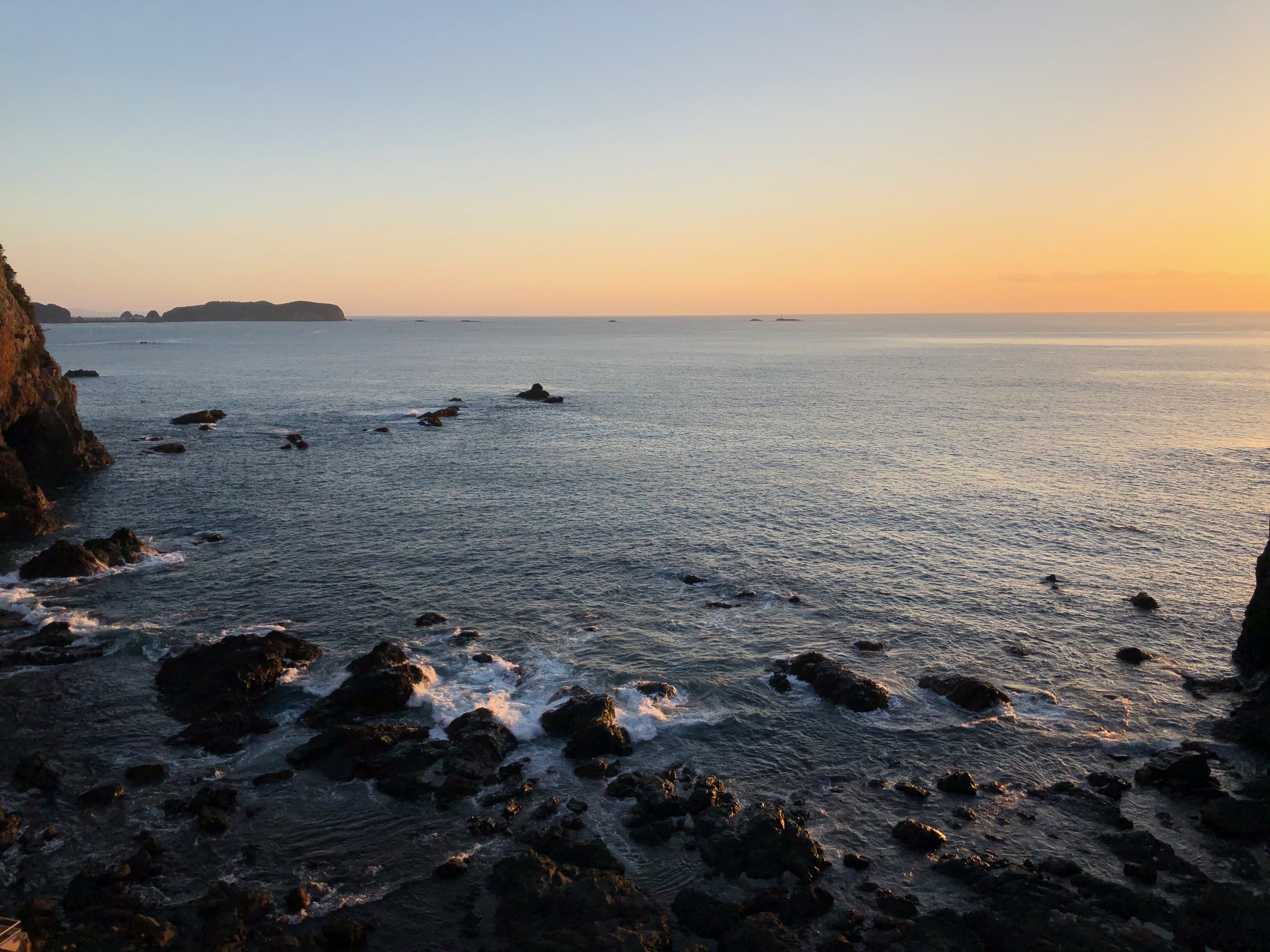
Another Kii-Katsuura Dawn 

Many people in Japan try to combine hatsuhinode with another New Year tradition: hatsumode, the first Shintō shrine visit of the year. Visiting a shrine on New Year's Day is also deemed to bring good luck, good health, and happiness in the year to come - and many people also bring home a hamaya--a traditional wooden arrow that's supposed to protect the family from all kinds of harm and illness throughout the year.


Dawn on the Nakasendo

As you're reading this after dawn on New Year's Day--or possibly later--you've technically "missed" the first sunrise of 2023. No worries...I've got you covered...  

Sunrise on Japan's inland sea

As a hiker, I'm used to getting up before dawn to head to the trail. The pictures in this blog are some of my favorite Japanese sunrises, seen throughout the years.

Sunrise near Tokushima on the island of Shikoku

Although they're not the first sunrises of the year, it's the first time you've seen them--and for many of you, they also may be the first sunrises you've seen in 2023.

Which, technically speaking, makes them your first sunrise of the year.

Sunrise At Lake Shikotsu, Hokkaido

See what we did there?

In Japan, the most coveted hatsuhinode is one that involves Mt. Fuji--so I've saved the best for last. I took the photo below in late November, at Lake Kawaguchi (Kawaguchiko), precisely at dawn.

It may not be the first, but it's absolutely the most beautiful sunrise I saw all year. 

And now you've seen it too.


Mt. Fuji at Dawn, November 2022

Wishing each and every one of you a happy, healthy, prosperous, and blessed 2023.


Sunday, June 5, 2022

Summertime in Tokyo

 -- Susan, every other Sunday

One of the many things I love about living in Japan is the way the country changes with the seasons--and it's not only the weather that changes. Everything from menus to clothes to decorations shifts to mark and harmonize with the changing temperatures.

Tokyo's rainy season "officially" begins in early June--and given the weather the last few days, I'd say it's now upon us. From now until the end of July, we'll have showers and/or thunderstorms just about every day, though fortunately they don't normally last too long. (On a lot of days, they'll come and go all day, though.)

While I'm not that fond of the heat and humidity of Tokyo summers, I do love taking walks in my neighborhood under the fresh, green canopy of new leaves on the cherry trees.


Fresh green leaves in Meguro


Earlier this week, I bid a sad farewell to hot coffee...for the most part, I'll be drinking the iced version until fall.


Goodbye, old friend. I'll see you soon. (Though not soon enough, if I must be honest.)

The local wildlife loves the warmer weather. The turtles at the shrines, and in the parks, have come out of hibernation and are soaking up the rays when the sun is shining.


Welcome back, little guy! Did you have a nice sleep?

While walking through Ueno Park a couple of weeks ago, I noticed the swan boats are also out of hibernation, and back in service for the summer. A paddle on the lake is a popular way to escape the summer heat--and yes, this park is in the center of downtown Tokyo.


Swan Boats in Ueno Park - a sure sign of summer.

The last of the cherry blossoms fell several weeks ago, but on the day I took this walk, a few "late bloomers" were still scattered on the ground.


"dove" in Ueno Park.

For the most part, though, the trees are brilliant green.


In a few months, this pond will be full of giant lotuses

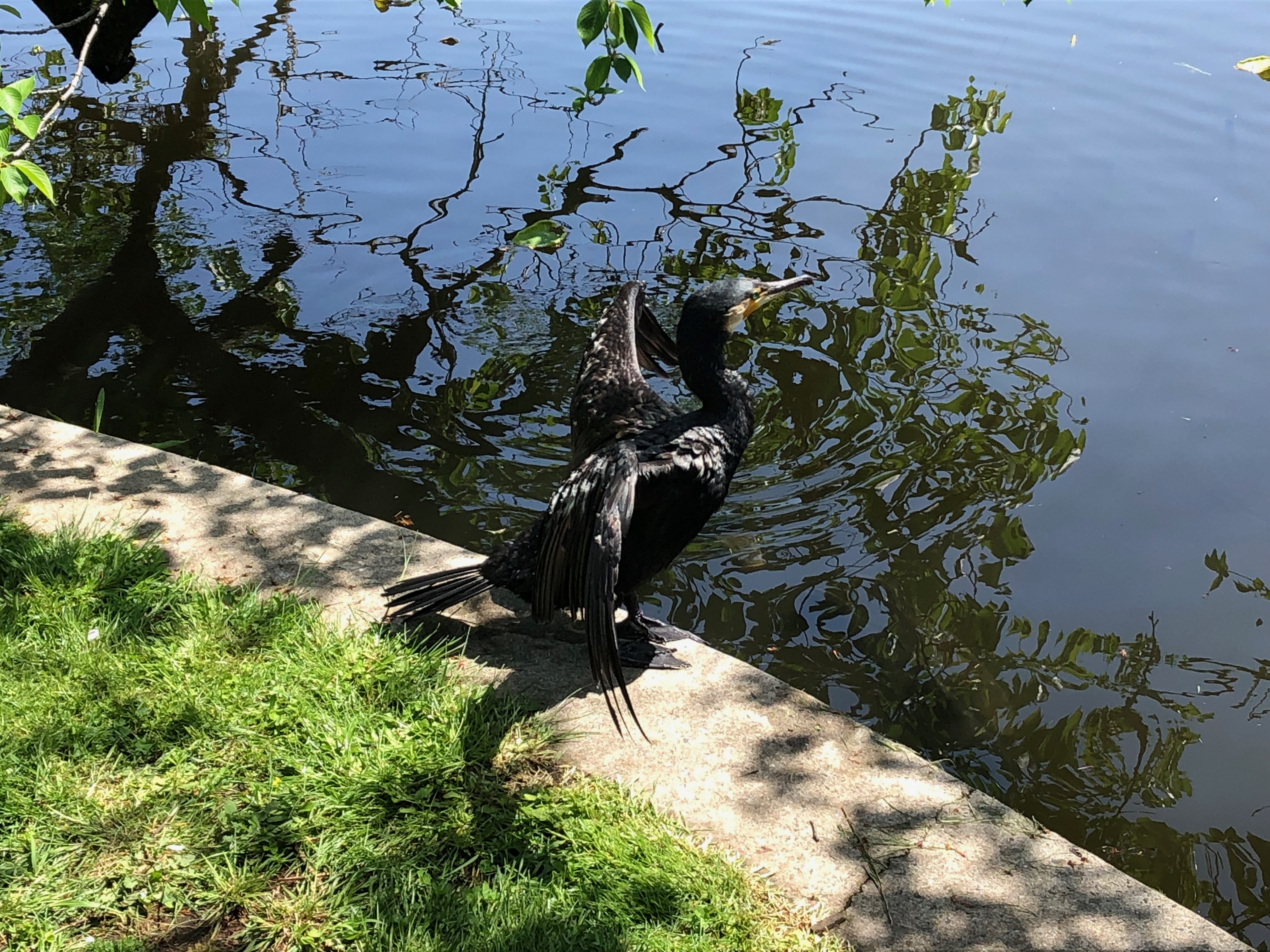
I also saw a cormorant sunning himself at the edge of the lake - a rare sight in central Tokyo, though the birds are not that uncommon in other parts of Japan.


Even cormorants love the summer sun

As the summer stretches on, the days will get hotter and muggier. By August, when we've reached the "drinkable air" portion of the summer, I know I'll be desperate for autumn--and not only because it's my favorite season of the year. But now, with the bloom still (literally) on the rose, I can't help but welcome summer's vibrant colors, pleasant warmth, and tasty treats. Any day now, the shops will start selling kakigori (traditional Japanese shaved ice), and with tourism poised to reopen (and already starting, slowly and on a small scale), I'm looking forward to friends and family returning to Japan as well.

Like the swan boats, I'm out of hibernation and ready for some summer fun!


Hello, summer!

  How do you welcome summer in your part of the world? I'd love to hear!

Sunday, March 13, 2022

A "New Normal" Japanese Rite of Spring

--Susan, every other Sunday

After living much of my life in California, where the changing seasons are observed primarily on the calendar, I never tire of watching the seasons change here in Japan.

Spring and Autumn are particular favorites, because their emergence tends to be both sudden and very welcome after the freezing or hot and humid (think "drinkable air") temperatures that went before.

This week, the temperatures in Tokyo once again changed on a dime--in the course of two days, we went from close-to-zero (C) to some of the most spectacular spring weather anyone could hope for. The cherry blossoms (which will be early this year) are a week or two from blooming, and people have begun to shed their winter hats and parkas for lighter clothes.

It's difficult to celebrate when the world as a whole is suffering, but I also think it's both possible and important to observe (and even enjoy) the changing seasons.

In Japan, the traditional hanami (flower viewing) parties that take place at cherry blossom time did not occur last year. In many places, towns and cities even put up orange cones and ropes beneath the trees, to prevent people from spreading out picnic blankets. An unprecedented suspension of a centuries-old tradition, in response to an equally unprecedented global situation.

As a result, it was necessary to find other ways to appreciate the blossoms. For me, that meant a trip to Lake Ashi (Ashinoko) in Hakone, for a hike that supposedly featured some blooming trees. 
A lovely day for a hike

The hike began on the shore of Ashinoko, near the pier where the sightseeing (aka "pirate") ships depart for their hourly trips across the lake. The swan boats had emerged from their winter storage, too.

The first sakura of the day

I'd picked up breakfast from a local bakery, hoping to find a place for a picnic meal along the trail. To my delight, I found not only blooming sakura trees but an empty, open-air gazebo atop a hill near the start of the hiking trail.
Blooming sakura

Sakura symbolize the arrival of spring, and the impermanence of both life and beauty; the flowers are lovely, but die and fall within a couple of days after opening. Even the smallest breeze can knock the petals from the trees by the thousands, creating a "rain" of pale pink petals.

Lake Ashi from the hiking trail

This trail was new to me last year; I'd heard about it, but never hiked it myself. It runs halfway around the lake, and takes about 2 hours to hike from one end to the other.

A fisherman on the shore of Lake Ashi

The trail is also an access point for a number of secluded fishing spots along the lake. 


For the most part, the trail parallels the shore, passing through groves of pine, maple, and sakura trees, with ongoing views of the lake.


Monument in the trees.

One segment of the path moves away from the shore, presumably in order to pass this shrine and monument in the trees. Unfortunately, the sign was so weathered that it had become almost illegible. I could make out only that the site has been here for over a hundred years. 


A couple of times each hour, I saw the sightseeing ships pass by...


The trail was essentially empty--I saw only about half a dozen people the entire morning (most of them fishing rather than hiking)--which made it feel as if I'd somehow stumbled onto a world filled with blooming trees and secret coves. In the cove above, a family was playing with a little, remote-controlled speedboat. I think I enjoyed watching it almost as much as they did. 


Hidden treasure of the day

About two-thirds of the way around the lake, I came upon a cove entirely surrounded by blooming cherry trees. In a normal year, in most places in Japan, a grove like this would have been filled with people admiring the blooms or picnicking beneath the trees. But this wasn't a normal year, and I was the only person there.

(In truth, I suspect that even in normal years, this grove remains almost entirely empty--visible to people passing by on the sightseeing boats, but accessible only to those intrepid enough to make the two-hour hike to get there. In related news: I know where I plan to have my sakura picnic this year...)


Spring has sprung in Japan, so to speak, and although the sakura aren't yet in bloom, we're rapidly approaching our third sakura season since the start of the C-19 pandemic. Japan hadn't yet shut down at sakura time in 2020 (though it happened soon afterward), but people had to get creative to see the blooms last year. Discovering the "secret trail" in Hakone ended up being far more fun than jockeying for space in a crowded park, or looking up at the blossoms from a group. In fact, it's likely to become my "new normal"--and I have to admit, it's nice to reflect on the positive things the last two years have wrought, even as I hope and pray that the next two years are easier for all of us than the ones that came before.

How have your traditions changed in the last two years? Have you found any new ones you hope to continue even as the world opens up again?