It's a big deadline week for me. I'm sifting through the pages of Perveen Five looking for tired phrases, plot errors, and every other kind of trouble. Whenever I close my laptop to take short walks with my dog Daisy in our neighborhood, I indulge in the beautiful spring gardens made by my neighbors. I feel bad for my own spring flowers, like the petite Turkish tulips, still cloaked in dead leaves. And then there's the neighborhood's most invasive weed, Lesser Celandine, rampantly spreading through my lawn and some flower beds. Gardening seems like the ultimate wanna-do whenever I'm stuck on a book. To have an hour outside...half a day...maybe I'll get that chance next week! In the meantime, I'm plugging away on my book and reposting a blog from 2018 all about the time that I once threw my deadline to the wind for the sake of urgent fall gardening.
Showing posts with label gardening. Show all posts
Wednesday, April 9, 2025
Gardening on Deadline (redux)
For too long, I’ve been lost in the LED-lit, indoor world of writing. Over the last month, I was intent on doing nothing else except finish a book.
It also happened that late November turned out to be the only time to plant a garden. Fall planting is easier on trees and shrubs that will get a good watering all fall and winter. Yes, I had a book due; but the garden also had to be installed, after having been delayed by several months due to Maryland’s unusually dry fall.
The garden and I have been at loggerheads before. My quest to unsettle a little less than an acre of city land began when I moved in with my family during the fall of 2012. The first thing we did was absolutely violent. We hired a company to drill four wells 500 feet deep inside our long, sloping lawn. The racket it made! The ash that spewed into the neighborhood air! The sky looked so gray over our street that somebody called the fire department.
Ah, the geothermal wells. They make it possible to have a modern air conditioning system where the air passes over the cold water, deep in the ground, and returns to the house. No chemicals, no excessive use of electricity.
From almost the start, our land has served us. But it has always been scraggly around the edges. Every spring I would be filled with inspiration that would trickle away about the time the mosquitoes settled in for feasting at the end of June. I wanted a garden full of native plants to support wildlife and suppress weeds. But how? The longer I fretted, the more the weeds spread.
Three years ago, I dug a small front garden myself with native plants, but it was such a hodge-podge without coherent flow that I wanted more assistance the next time I tried an improvement. This fall, I felt blessed to be aided by a native gardening education consultant/garden artist/all-around genius. Kay McConnell is well known in Maryland for the beautiful native plant gardens she designed and installed at the Friends School of Baltimore, Stony Run Meeting, and other spots.
Under Kay’s eagle eye, a weed-filled stretch running along the back of the property was cleared in late August as the site of our future rain garden. The clearing and regrading of the earths was done by strong men driving big machines. The new space they created wasn’t flat smooth dirt, but two raised banks surrounding a long basin. This would catch water that ran down our sloping lawn toward the lane. The saved water would feed the kind of plants like native iris and milkweed that like their feet wet.
As the dry fall turned into a rainy November, the prepared, empty garden space slowly became wet. Kay rooted through her native plant stock and area nurseries, looking for the best shrubs, trees, grasses and native perennials. A willow, magnolias and dogwoods were found, along with itea, bayberry, buttonbush, various ferns, swamp milkweed, oak leaf hydrangea…
The list went on. Over several days in late November, Kay unloaded shrubs and flowering plants and grasses from her car. The trees came in with European Landscapes and Design, the company that had done the original garden clean-up and preparation.
I recently heard a few different people use the phrase: “We go big, or we go home." It's a 2019 cliché. However, I could not deny that things were getting very big, right at my home.
I was thrilled to realize that every single tree, grass and shrub would feed local birds and insects. The garden design has woodland, meadow and swamp sections, with everything flowing together in an artistic manner, with fields of color, and high and low points. I found myself spellbound watching Kay. She is a true artist in the garden, arranging plants and rearranging them as the visual flow becomes apparent to her.
As I worked under Kay’s direction, I learned so much. She taught me how to plant a natural looking drift of small flowers. I absorbed the new thinking on weed control: don’t tug them out, which disrupts the earth and activates weed seeds. Instead, cut them close to the ground to weaken the plant.
I saw, through her eyes, how an aged stretch of asphalt pavers could become a dining terrace or site for a fire-pit gathering spot. And as my neighbors strolled along the lane that runs on the other side of the new garden, they had plenty to say. Michael, after visiting with us a few times, commented that he felt that spirits had entered the garden that were never there before.
And that’s how writing works, too. A bulky stone is chipped away to reveal the story hiding within. It takes time, but it's always waiting for you.
And the thing about gardening deadlines is that the only one that really matters is set by nature. One can't dig after the ground is frozen--unless, perhaps, you have a geothermal drill.
And putting a plant into earth does not guarantee it will emerge in the spring. That is the mystery I'm entering.
Wednesday, July 15, 2020
Roots of Writing
Sujata Massey
I scrawled the grand statement, which sounds like a cheesy advertisement, and taped it next to the guest room desk back in March. I was upset about the pandemic, and I was trying to reframe what I could do with the quiet time in my future. There would be no school activities, doctors’ appointments, no grocery shopping, no hours at the gym. The time would really be mine alone to write.
I got a three-month writing retreat with every comfort needed!
I scrawled the grand statement, which sounds like a cheesy advertisement, and taped it next to the guest room desk back in March. I was upset about the pandemic, and I was trying to reframe what I could do with the quiet time in my future. There would be no school activities, doctors’ appointments, no grocery shopping, no hours at the gym. The time would really be mine alone to write.
Of course, I wrote down the hours I planned to write. They came just before or amid zoom appointments and phone calls. In between those appointments I had other duties, ranging from cooking to dog walking and gardening. All of it went into my bullet journal. Some days, I felt like I was writing more in my bullet journal than anywhere else.
It’s crazy how fast the three months of retreat turned to four. And no end in sight.
Here's my plan, which no longer requires documentation for myself, or anyone else. I work on my writing for as long as I can before my brain goes dead. usually, two to three hours. And then I credit myself for what I've done and move onto something else. Often, it's the garden.
I’ve described the growing pains for my fledgling victory vegetable garden, which has yielded the tiniest radishes I’ve ever seen, a bit of parsley, and some shallots that may or may not be ready. I’m afraid to dig them out and be disappointed.
My native plant gardens are different. Started in fits of activity and lulls of laziness over the last four years, I have three distinct zones filled with cuttings and young seedlings that took root, require little water or care, and are bursting with enthusiasm. If you could imagine a book that would write itself for each year—yes, that is my actual fantasy—you only need to see a native plant garden doing just that.
Pictured at the top of my blogpost is a native plant to the Maryland-Delaware-Virginia area; it’s called veronicastrum virginatum and is more commonly known as Culver’s Root. Already it’s almost five feet tall, with flowery stems set up like a candelabra. I’m thrilled this one huge clump of vv has become Studio 54 for native bees, all shapes and sizes.
I am not afraid of my bees. I love to watch them dance around the Culver’s Root and the other neighboring plants in flower. I smile when I see the squirrels chase each other in the trees, and I even tolerate watching a rabbit munch the leaves of a baby native flower.
Insects and animals are my company, breaking up the isolation. And the distraction they offer is oddly medicinal. When I am literally grounded—with my hands in the earth, I mean—I look two feet away and discover a small robin has settled down to watch me, and doesn’t budge when I move.
Gardening does something magic, even if it means I’m not writing. After I dust off the dirt and shower, I feel like a new person eager to return to my book. I wind up able to write longer, because of time spent in nature.
A writer’s lament is that her job is never done. Just as a garden is never finished; something’s always coming up, whether it is noble and bountiful like the Culver’s Root, or unhealthily dominant, like the pesky unnamed green vine that shoots up and twists the good guys down to the ground. Such drama to clip those vines and attack their roots.
I’ll always have writing work to do. But thank God for it. The volume of my work fills the void. Having a creative project at home gives order to a life when rules have evaporated.
I do not know the future. Come August, I’ll probably be done with edits to my third Perveen Mistry novel. Maybe not.
What I do know for sure is that the Black-Eyed Susans are going to burst into full, glorious bloom, and the bees will be drinking their fill.
Wednesday, July 1, 2020
Chocolate, Sourdough, and Other Blessings
Sujata Massey
![]() |
| MFK Fisher in France |
A few weeks into the pandemic, a big bang broke this stillness of a stay-at-home Saturday afternoon.
An electric fuse had blown, which meant the third floor had no lights, and the wi-fi was down as well.
When I say a fuse was blown, I don’t mean a modern one made of steel that’s neatly labeled. We have those fuses in the basement. The fuse that blew was antique, the kind of curiosity no contemporary electrician would have on hand.
My husband called around to a couple of historic neighborhood hardware shops. The second store, Falkenhan’s Hardware, still had such early 20th century fuses in stock. Tony got six of them for ten dollars, and an hour later, he screwed in the new fuse while I kept my fingers crossed. Once again lights shone, fans whirred, and a wi-fi signal allowed us to keep going with our work.
![]() |
| The famous King Arthur pizza! |
We are now solving problems with our own hands. In my neighborhood, several homeowners are up on their roofs, replacing shingles and painting the porch trim. And we are gardening like gangbusters. Seed companies and nurseries have an estimated 300-plus percentage rise in business. The green proof is visible in raised beds, garden boxes, and potted plants growing everywhere you look. 2020 is the best year for gardening, ever.
And while I don't peer through people’s windows, I suspect many more people are cooking, some for the first time in their lives. Fortunately, newspaper websites abound with cheerful instruction, as do websites like Kitchn, Food52, and Bon Appetit, and King Arthur. Six times already I’ve baked King Arthur Flour’s Recipe of 2020, a deep dish cheese pizzaa that involves making pizza dough yourself and setting it up for a no-fail rise by using a cast iron frying pan. King Arthur is also the go-to spot for fledgling sourdough bakers, and those who use sourdough discards to thriftily make more food, like the sourdough-chocolate cake below.
![]() |
| A sourdough chocolate cake! |
I leave no stone unturned, when it comes to culinary thrift. Before I got my garden box going, I harvested dandelion leaves and wild onion from my garden. I freeze vegetable scraps, chicken bones, and shrimp shells to make dfferent stocks. In fact, I’ve become such an old-fashioned homemaker that I’m freezing cut-off pieces of fat to melt down into lard.
I can stay out of the stores because I've found local farmers who sell to customers directly--not just at farmers markets, but by porch delivery, the US mail, or curbside pickup. And within the city, at least four restaurants I know are not just offering takeout, but regular ingredients to home cooks.
Here in Baltimore, curbside pickup from my local restaurant, La Cuchara, means signing up online a day ahead for what they can order in for us from their farmers and food distributors. On the luxurious side, these curbside pickups have included fresh Chesapeake Bay oysters and diver scallops and rockfish. More goodies have been local strawberries and turnips, garlic ramps, and morels, oyster and porcini mushrooms: all priced at, or slightly below, regular grocery prices. I’ve adjusted to buying what the farmers and restaurants can provide—blocks of butter rather than sticks, and takeout containers of olive oil and canola that I funnel into clean, recycled bottles at home.
![]() |
| Local kohlrabi and sugar snap peas |
I wonder how long restaurants will keep going with the marketplace model. The truth of it is, I'd rather swing by a restaurant and open my trunk than enter the maelstrom of a grocery store, where I cannot count on all patrons being masked.
I also experiment with foods that arrives weekly in a Community-Supported-Agriculture (CSA) bag: things like kohlrabi, tatsoi, and many kinds of lettuce. The CSA movement across the United States was started by small farmers who want to sell their harvest to customers who've committed at the season's beginning to paying them for four to six months worth of vegetables, fruits, and other products.
And what if the CSA throws more collards and kale into the bag than the Masseys can handle? It’s easy to drop off extra greens or asparagus or lettuce to someone who needs it . Food is so precious now. One of the stories I like best is that of Michelle Brenner, a furloughed worker in Washington. During this pandemic, she got a new name: The Lasagna Lady, after baking and donating more than 1200 large pans of lasagna.
My mother was born in Germany during the war years. As long as I’ve known her, she has carried a small bar of good chocolate in her purse and kept an ever-changing assortment of chocolate bars and boxes in the house. All this chocolate--even though I rarely have seen her eat more than one square. The chocolate is for giving to others. She says having it in her bag is a legacy of growing up as a child of war. With the pandemic, I’m starting to understand this better. While chocolate’s sugar is an energy and mood boost—instant food that keeps well—it’s much more. Emotionally, holding onto something like chocolate is a reminder that we are safe, and we still have treats to enjoy.
World War II food reminds me of the legendary Mary Frances Kennedy Fisher. Best known as MFK Fisher, Mary Frances was born in 1908 and became a legendary cook and writer during a time that gourmet food was a man's business.
My first taste of her writing was The Gastronomical Me, witty and wonderful essays about her life as a young bride discovering 1930s France through its food. Her adventures made me eager to start my own writing life overseas. And with the help of my husband, that wonderful amateur electrician, all that did come to pass in Japan in the early 1990s.
One of Mrs. Fisher's greatest works was written and published during World War II. It's a book of essays and recipes called How To Cook a Wolf. The grim title is a play on words referring to finishing off fear, and also satisfying one’s appetite when there’s little available to eat. Although my assumptions could be wrong; has a graphic chapter on cooking small animals such as "hare" and pigeons.
My first taste of her writing was The Gastronomical Me, witty and wonderful essays about her life as a young bride discovering 1930s France through its food. Her adventures made me eager to start my own writing life overseas. And with the help of my husband, that wonderful amateur electrician, all that did come to pass in Japan in the early 1990s.
One of Mrs. Fisher's greatest works was written and published during World War II. It's a book of essays and recipes called How To Cook a Wolf. The grim title is a play on words referring to finishing off fear, and also satisfying one’s appetite when there’s little available to eat. Although my assumptions could be wrong; has a graphic chapter on cooking small animals such as "hare" and pigeons.
Mrs. Fisher believed that while the war was terrible, it also shook people into the right frame of mind. Here’s a bit that amused me, especially because of the COVID-19 sourdough boom.
“Lastly, perhaps because of the very propaganda that seems so contradictory, it has been easier to buy food with a little taste to it, once you have conquered your distrust of the thick neat slices and the transparent wrappings. You have even been able to get sourdough bread once a week in some groceries: a frail wisp of the old nose-tickling loaf, but at least an effort in the right direction . . . Sometimes, when you go past a factory in the “foreign” section of a town, and smell the honest exciting smell of real bread baking, you remember a part of your childhood, and feel a child’s helplessness before the fact of a whole nation’s cautious acceptance of its own simplicity.”
Wednesday, April 22, 2020
Victories for Nature
Sujata Massey
The skies are blue, the clouds dense, and it's quiet enough that you can hear the birds. Our two dogs have never had more attention. And with a lack of places to go, I am in my garden.
The leading picture for this blogpost is a raised bed garden belonging to my neighbors, Joe and Sarah. Their practical, proud use of front-yard real estate takes on new meaning this year, as people long for a small way to be in control during a time of uncertainty. Everywhere, people are planting masses of herbs, vegetables and fruit into so-called victory gardens--a term that hasn't been used since World War II, when people were encouraged to provide for themselves to allow more resources for men and women serving overseas.
Growing vegetables and fruit is an exciting challenge for me, because I am more of a wishful gardener than a skilled one. I have had the blessing of green space around home throughout my life. I have been planting and marveling at my small progresses over the years. Yet I don't believe I will ever have the commitment to be a daily gardener.
My mother gave me Frances Hodgson Burnett's The Secret Garden when I was 9. This masterwork of children's literature was written in 1911. It romantically details how gardening transforms two depressed children--her very old-fashioned theory that has recently been recognized as a therapeutic practice. In the novel's Misselthwaite Manor, an estate in Yorkshire, England, gardens are described as being set up in a series of outdoor rooms that literally have stone walls and wooden doors that lock, presumably to keep out animals and others who don't have rights to food or flowers. Glancing through my beloved book this afternoon, I realized that gardens in my American city suburb are anything but walled and hidden. Quite a few people, like Joe and Sarah, have turned their front yards into working kitchen gardens. Fruits and vegetables and flowers intermingle, and in my particular section of North Baltimore, plants native to the Mid-Atlantic and Appalachian mountains are widely encouraged, with transplants shared like bonbons by those in the know.
I enthusiastically visit public gardens and my neighbors yards with an appreciate eye. Until recently, I would say, "next year I will get serious about gardening." Fortunately, I decided 2020 was going to be my serious year, and I had the foresight to start working last fall. Kay McConnell, a tremendous, environmentally oriented garden designer in my city, masterminded a backyard garden planted with natives that would thrive in the various conditions of my space; wet, dry, shaded, and sunny. Together Kay and I planted over 400 native perennial flowers, shrubs, and trees.
In the past, I've grown a few herbs and capsicums and lettuce in a tabletop vegetable garden (often called a salad box). My husband built the structure in a weekend (yay!) and we filled its shallow pan with soil meant for raised bed gardens. It works fine, but it's pretty small.
I decided a few weeks ago to go a little bigger with vegetables. I began by making Zoom calls to accomplished gardening friends who had been eating from their gardens for years. I picked and chose from what they were doing. I see that almost all of my mentors have blueberries growing, some of them interwoven in floral landscapes; others set aside as little monarchs, walled off from intruders. When you plant things that taste good, you have to put in obstructions, if you want some of it for yourself.
I heard that blueberries are good in sandy soil, but I will spread them around to various spots to hedge my bets. The blueberries will be shielded from the birds by netting. I don't feel guilty, because there's an open row of flowering chokeberry shrubs for the birds and anyone else. Apparently, squirrels and rabbits aren't interested in garlic and onions, so I planted shallot bulbs and garlic cloves right in the dirt under the lilacs.
I hope to harvest something for our family; therefore, most of our vegetable and herb plantings are on an elevated, gated deck just off our kitchen. This is the same location of the tabletop vegetable garden, and various pots of struggling tomatoes. And something new--dresser drawer garden. It's just like it sounds. We drilled holes in the bottoms of the boxes for drainage, filled them, and put them on a granite workbench.
I'm fortunate to live in a state with an early spring, and long warm summers that allow fruit trees like plums and peaches. Another blessing is that although my city of Baltimore offers plenty of restaurants, shops, and arts establishments and diversity of experiences, it also has city neighborhoods with trees and gardens and plenty of walking space.
How can I feel housebound when my garden has so many corners to spend time in --whether it's to attack a patch of truculent ivy, or plant herbs and flowers in a pot, or hunt down dandelion leaves for salad? To stroll onto the deck and pluck a few chives to sprinkle over soup makes me feel wealthy beyond measure.
This spring, gardening books are piled high in the living room coffee table, next to my bed, and fill the shelves of the dining room. Still, nobody should feel they need a book to explain how to start growing flowers, fruit and vegetables. The internet is full of help. For a non-commercial, knowledgable overview, check out The New York Times column by Margaret Roach, as well as her long running podcast, A Way to Garden. (The podcast episode I've linked is a discussion of the idea of a pollinator victory garden). Adrian Higgins, the longtime gardening columnist for The Washington Post also writes inspiringly about modern victory gardens and many other topics.
The quarantine gives us room to breathe and get close to the soil. And that's a victory in itself.
![]() |
The leading picture for this blogpost is a raised bed garden belonging to my neighbors, Joe and Sarah. Their practical, proud use of front-yard real estate takes on new meaning this year, as people long for a small way to be in control during a time of uncertainty. Everywhere, people are planting masses of herbs, vegetables and fruit into so-called victory gardens--a term that hasn't been used since World War II, when people were encouraged to provide for themselves to allow more resources for men and women serving overseas.
![]() |
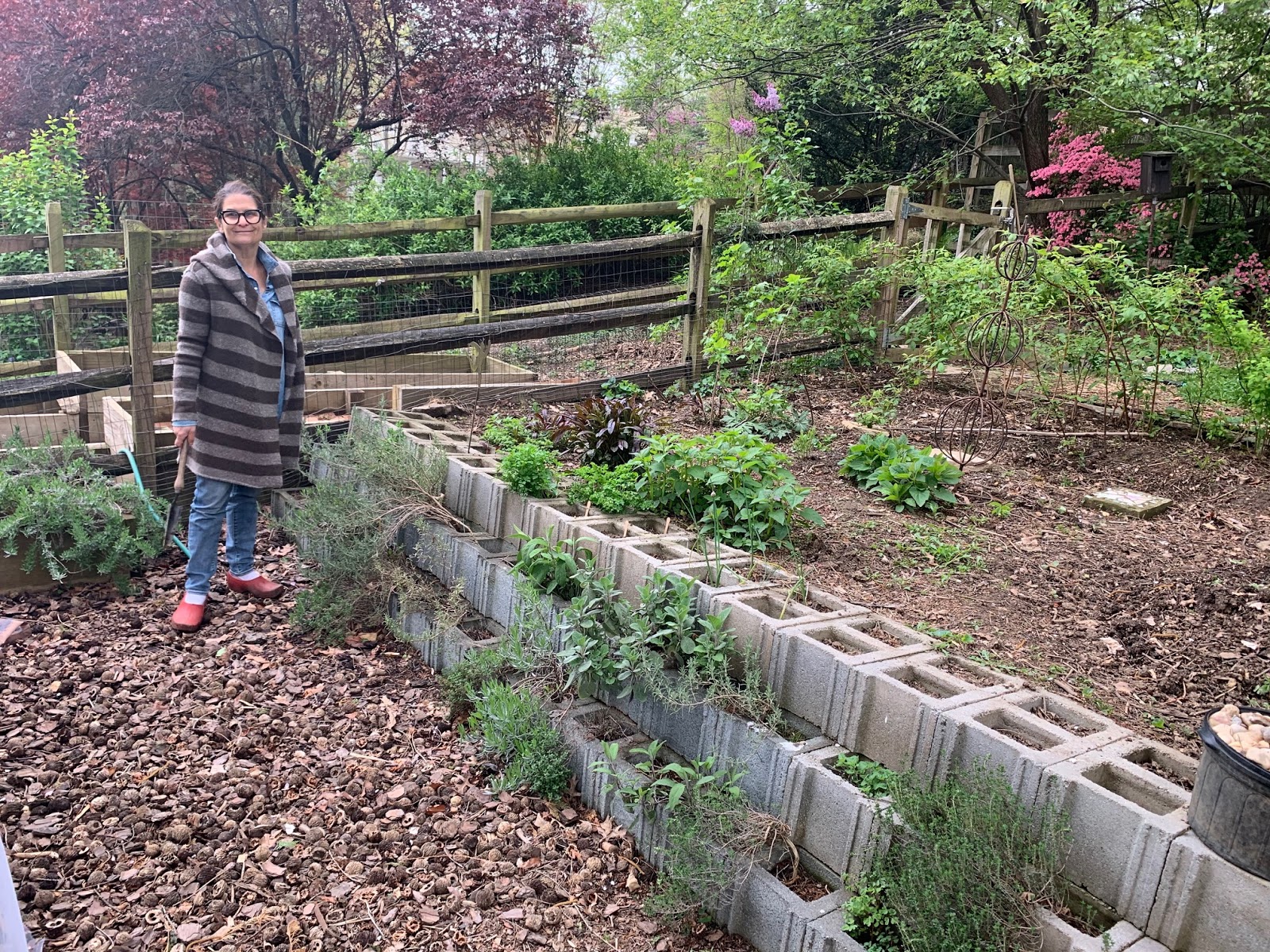
| Debbie planted herbs in cinderblocks, and so much more |
Growing vegetables and fruit is an exciting challenge for me, because I am more of a wishful gardener than a skilled one. I have had the blessing of green space around home throughout my life. I have been planting and marveling at my small progresses over the years. Yet I don't believe I will ever have the commitment to be a daily gardener.
![]() |
| Native Toad Trilliums grown by master gardener Debbie |
My mother gave me Frances Hodgson Burnett's The Secret Garden when I was 9. This masterwork of children's literature was written in 1911. It romantically details how gardening transforms two depressed children--her very old-fashioned theory that has recently been recognized as a therapeutic practice. In the novel's Misselthwaite Manor, an estate in Yorkshire, England, gardens are described as being set up in a series of outdoor rooms that literally have stone walls and wooden doors that lock, presumably to keep out animals and others who don't have rights to food or flowers. Glancing through my beloved book this afternoon, I realized that gardens in my American city suburb are anything but walled and hidden. Quite a few people, like Joe and Sarah, have turned their front yards into working kitchen gardens. Fruits and vegetables and flowers intermingle, and in my particular section of North Baltimore, plants native to the Mid-Atlantic and Appalachian mountains are widely encouraged, with transplants shared like bonbons by those in the know.
I enthusiastically visit public gardens and my neighbors yards with an appreciate eye. Until recently, I would say, "next year I will get serious about gardening." Fortunately, I decided 2020 was going to be my serious year, and I had the foresight to start working last fall. Kay McConnell, a tremendous, environmentally oriented garden designer in my city, masterminded a backyard garden planted with natives that would thrive in the various conditions of my space; wet, dry, shaded, and sunny. Together Kay and I planted over 400 native perennial flowers, shrubs, and trees.
![]() |
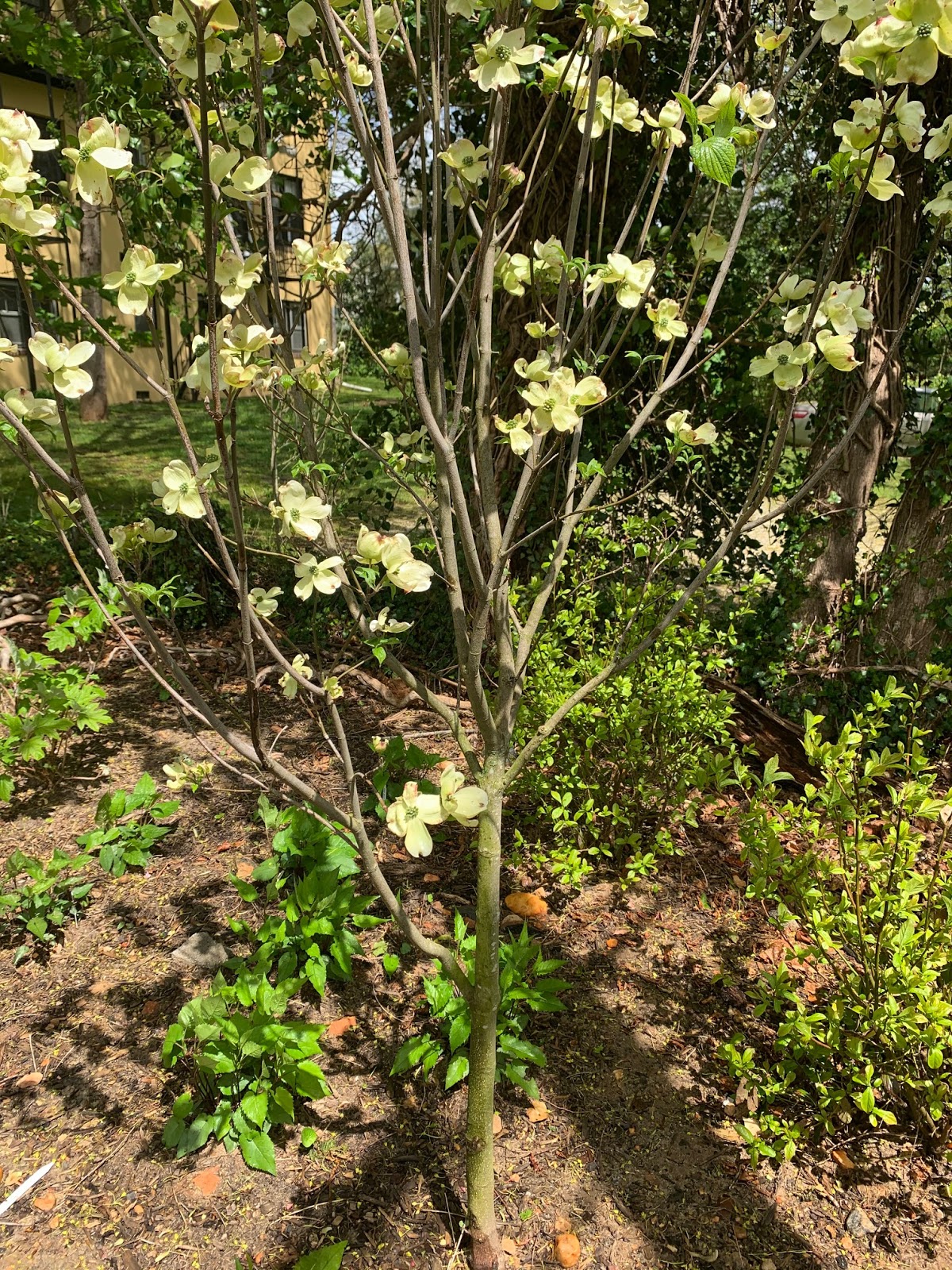
| my garden's baby dogwood is part of a group a woodland grove |
![]() |
| tulle protects strawberries in Debbie's garden |
![]() |
| The "salad box" only has chives at the moment |
I decided a few weeks ago to go a little bigger with vegetables. I began by making Zoom calls to accomplished gardening friends who had been eating from their gardens for years. I picked and chose from what they were doing. I see that almost all of my mentors have blueberries growing, some of them interwoven in floral landscapes; others set aside as little monarchs, walled off from intruders. When you plant things that taste good, you have to put in obstructions, if you want some of it for yourself.
![]() |
| Tom and Liz's blueberry has to be fenced to keep it from the family's chickens |
![]() |
| No chickens are getting to Tom and Liz's Stuttgarter mini onions! |
I heard that blueberries are good in sandy soil, but I will spread them around to various spots to hedge my bets. The blueberries will be shielded from the birds by netting. I don't feel guilty, because there's an open row of flowering chokeberry shrubs for the birds and anyone else. Apparently, squirrels and rabbits aren't interested in garlic and onions, so I planted shallot bulbs and garlic cloves right in the dirt under the lilacs.
![]() |
| Betsy's blueberry is artistically melded into a perennial landscape |
![]() |
| Garlic and onions underground |
I hope to harvest something for our family; therefore, most of our vegetable and herb plantings are on an elevated, gated deck just off our kitchen. This is the same location of the tabletop vegetable garden, and various pots of struggling tomatoes. And something new--dresser drawer garden. It's just like it sounds. We drilled holes in the bottoms of the boxes for drainage, filled them, and put them on a granite workbench.
![]() |
| Dresser drawers hold shallots and radishes |
I'm fortunate to live in a state with an early spring, and long warm summers that allow fruit trees like plums and peaches. Another blessing is that although my city of Baltimore offers plenty of restaurants, shops, and arts establishments and diversity of experiences, it also has city neighborhoods with trees and gardens and plenty of walking space.
![]() |
| If I plant marigolds, will it keep pests from my veggies? |
How can I feel housebound when my garden has so many corners to spend time in --whether it's to attack a patch of truculent ivy, or plant herbs and flowers in a pot, or hunt down dandelion leaves for salad? To stroll onto the deck and pluck a few chives to sprinkle over soup makes me feel wealthy beyond measure.
This spring, gardening books are piled high in the living room coffee table, next to my bed, and fill the shelves of the dining room. Still, nobody should feel they need a book to explain how to start growing flowers, fruit and vegetables. The internet is full of help. For a non-commercial, knowledgable overview, check out The New York Times column by Margaret Roach, as well as her long running podcast, A Way to Garden. (The podcast episode I've linked is a discussion of the idea of a pollinator victory garden). Adrian Higgins, the longtime gardening columnist for The Washington Post also writes inspiringly about modern victory gardens and many other topics.
The quarantine gives us room to breathe and get close to the soil. And that's a victory in itself.
Wednesday, December 4, 2019
Gardening on Deadline
Sujata Massey
For too long, I’ve been lost in the LED-lit, indoor world of writing. Over the last month, I was intent on doing nothing else except finish a book.
It also happened that late November turned out to be the only time to plant a garden. Fall planting is easier on trees and shrubs that will get a good watering all fall and winter. Yes, I had a book due; but the garden also had to be installed, after having been delayed by several months due to Maryland’s unusually dry fall.
The garden and I have been at loggerheads before. My quest to unsettle a little less than an acre of city land began when I moved in with my family during the fall of 2012. The first thing we did was absolutely violent. We hired a company to drill four wells 500 feet deep inside our long, sloping lawn. The racket it made! The ash that spewed into the neighborhood air! The sky looked so gray over our street that somebody called the fire department.
Ah, the geothermal wells. They make it possible to have a modern air conditioning system where the air passes over the cold water, deep in the ground, and returns to the house. No chemicals, no excessive use of electricity.
From almost the start, our land has served us. But it has always been scraggly around the edges. Every spring I would be filled with inspiration that would trickle away about the time the mosquitoes settled in for feasting at the end of June. I wanted a garden full of native plants to support wildlife and suppress weeds. But how? The longer I fretted, the more the weeds spread.
Three years ago, I dug a small front garden myself with native plants, but it was such a hodge-podge without coherent flow that I wanted more assistance the next time I tried an improvement. This fall, I felt blessed to be aided by a native gardening education consultant/garden artist/all-around genius. Kay McConnell is well known in Maryland for the beautiful native plant gardens she designed and installed at the Friends School of Baltimore, Stony Run Meeting, and other spots.
Under Kay’s eagle eye, a weed-filled stretch running along the back of the property was cleared in late August as the site of our future rain garden. The clearing and regrading of the earths was done by strong men driving big machines. The new space they created wasn’t flat smooth dirt, but two raised banks surrounding a long basin. This would catch water that ran down our sloping lawn toward the lane. The saved water would feed the kind of plants like native iris and milkweed that like their feet wet.
As the dry fall turned into a rainy November, the prepared, empty garden space slowly became wet. Kay rooted through her native plant stock and area nurseries, looking for the best shrubs, trees, grasses and native perennials. A willow, magnolias and dogwoods were found, along with itea, bayberry, buttonbush, various ferns, swamp milkweed, oak leaf hydrangea…
The list went on. Over several days in late November, Kay unloaded shrubs and flowering plants and grasses from her car. The trees came in with European Landscapes and Design, the company that had done the original garden clean-up and preparation.
I recently heard a few different people use the phrase: “We go big, or we go home." It's a 2019 cliché. However, I could not deny that things were getting very big, right at my home.
I was thrilled to realize that every single tree, grass and shrub would feed local birds and insects. The garden design has woodland, meadow and swamp sections, with everything flowing together in an artistic manner, with fields of color, and high and low points. I found myself spellbound watching Kay. She is a true artist in the garden, arranging plants and rearranging them as the visual flow becomes apparent to her.
As I worked under Kay’s direction, I learned so much. She taught me how to plant a natural looking drift of small flowers. I absorbed the new thinking on weed control: don’t tug them out, which disrupts the earth and activates weed seeds. Instead, cut them close to the ground to weaken the plant.
I saw, through her eyes, how an aged stretch of asphalt pavers could become a dining terrace or site for a fire-pit gathering spot. And as my neighbors strolled along the lane that runs on the other side of the new garden, they had plenty to say. Michael, after visiting with us a few times, commented that he felt that spirits had entered the garden that were never there before.
And that’s how writing works, too. A bulky stone is chipped away to reveal the story hiding within. It takes time, but it's always waiting for you.
And the thing about gardening deadlines is that the only one that really matters is set by nature. One can't dig after the ground is frozen--unless, perhaps, you have a geothermal drill.
And putting a plant into earth does not guarantee it will emerge in the spring. That is the mystery I'm entering.
Wednesday, August 28, 2019
Mid Atlantic Native
Sujata Massey
I came to the Mid-Atlantic at age 18, so I cannot claim to be a Mid-Atlantic native. I didn't marry a local man, either--I married someone from the Deep South. Yet I'd like to think Tony and I have thoroughly embraced this area for raising our family, building friendships, working hard, and planting our dream garden.
Light-snow winters followed by sunny warmth from April to September make vibrant spring, summer and fall gardens. It's easy for strong plants that survived here for millennia to spread and thrive in home gardens without the watering can or sprinkler. Maryland, Delaware, Virginia, Pennsylvania abound with a diverse range of flora. If planted in supportive layers, these trees, shrubs, flowers and vines shelter each other and feed helpful insects and animals.
A few beneficial plants, like swamp milkweed, are the only food that newly hatched monarch caterpillars can eat before they turn into gorgeous winged beauties. (Milkweed grows in different varieties in other parts of the country, too).
A few years ago, I had the grass removed from the small double gardens in front of my Baltimore house. I planted the soil with an assortment of Mid-Atlantic natives. My novice's theory was that if most of the native plants I picked were of varieties taller than two feet, it would mimic the feeling of the English cottage gardens I love, but would be totally native.
OK, what happened?
It worked too well.
I now have tall, sprawling forests of mountain mint, rudbeckia, coneflowers, bleeding heart and liatris on either side of my front walk. I'd heard the rhyme about a garden sleeping, creeping and leaping as the first three years pass. In year four, this garden is booming with some seven-foot flowers that need to be re-homed!
My garden is healthy, but it's not glamorous. When I look at garden magazines, I sometimes envy the aesthetic glory that comes with choosing plants for beauty, rather than whether they help insects and animals.
But I believe in natives with all my heart, and I believe that natives can be used decoratively in many different ways. I need to see it to believe it--so I went to visit the Mid-Atlantic Native paradise called Mt. Cuba Center.
Mt. Cuba Center is an old mansion surrounded by more than a thousand acres of undeveloped countryside in Hockessin, Delaware. The place began in 1935 as a 126-acre wedding gift from the du Pont family to the newlyweds, Lammot du Pont Copeland and Pamela Cunningham Copeland. At the time, Pamela appeared the perfect country lady; nobody knew she would emerge as one of the most forward-thinking horticulturists in America.
The Copelands' handsome brick colonial revival house started out with proper, pretty plantings of perennials of all types bordering the brick paths. But as years passed, Pamela became more interested in the native plants of the area. In the late 1950s, she hired landscape architect Seth Kelsey to revise the gardens to be natural--highlighting plants of lower Appalachia in a beautiful way, and tucking man-made ponds at the end of forest paths, and so on. I find it refreshing that the Copelands became serious gardeners more than twenty years after getting married--a similarity Tony and I share with them.
Lammot DuPont Copeland passed away in 1983, Pamela Copeland wisely established the Mt. Cuba Foundation before her death in 2001. Since that time, the foundation has added adjacent packages of land and expanded naturalistic design education. Some of the most useful features are trial plantings of popular native plants to help the public figure out how to incorporate the most successful cultivated natives in their own homes. The public can walk along on small guided tours by volunteers who clearly practice what they preach.
Mt. Cuba has greatly expanded its boundaries. Last year, the Red Clay Reservation and Mt. Cuba merged, so there is now a grand sweep of protected land to serve as a haven for endangered plants and wildlife. In all, it's almost 1100 acres. I can only imagine how thrilled Pamela Copeland would be to see this.
Lucky for me, Mt. Cuba is less than two hours drive from my house. It seems that in the Mid-Atlantic, you can get almost anywhere--from beach to mountains to city--in about an hour or two.
On a lovely day in late July, I drove out to Mt. Cuba with Tony, our picnic basket, two straw hats, and bug spray. Temps were in the 90s, but because of the shady tall trees, it felt more like the 80s. And we didn't need our insect repellent--maybe because there were so many beneficial insects devouring mosquitoes?
I had been here once before, in late spring, so the ephemerals were not showing their small sweet faces, but bolder colors were on stage. Along the great stands of milkweed, the monarch butterflies drank pollen and debated where they would lay their eggs.
How red the native azalea was! How delicate, the pale green ferns. Dragonflies zoomed over the ponds, and tiny frogs swam with elegance.
As I sat at an antique lawn furniture eating a cucumber sandwich and drinking a cup of tea, I contemplated the gardens' rolling, green hills, utterly devoid of street lamps, roads, and cars.
I realized that Mt. Cuba is more than a native plant sanctuary. It's a living embodiment of "This Land is Your Land"--the heritage we can't risk losing.
![]() |
| All pictures in this post are of Mt. Cuba Center, Hockessin, DE |
I came to the Mid-Atlantic at age 18, so I cannot claim to be a Mid-Atlantic native. I didn't marry a local man, either--I married someone from the Deep South. Yet I'd like to think Tony and I have thoroughly embraced this area for raising our family, building friendships, working hard, and planting our dream garden.
Light-snow winters followed by sunny warmth from April to September make vibrant spring, summer and fall gardens. It's easy for strong plants that survived here for millennia to spread and thrive in home gardens without the watering can or sprinkler. Maryland, Delaware, Virginia, Pennsylvania abound with a diverse range of flora. If planted in supportive layers, these trees, shrubs, flowers and vines shelter each other and feed helpful insects and animals.
A few beneficial plants, like swamp milkweed, are the only food that newly hatched monarch caterpillars can eat before they turn into gorgeous winged beauties. (Milkweed grows in different varieties in other parts of the country, too).
A few years ago, I had the grass removed from the small double gardens in front of my Baltimore house. I planted the soil with an assortment of Mid-Atlantic natives. My novice's theory was that if most of the native plants I picked were of varieties taller than two feet, it would mimic the feeling of the English cottage gardens I love, but would be totally native.
OK, what happened?
It worked too well.
I now have tall, sprawling forests of mountain mint, rudbeckia, coneflowers, bleeding heart and liatris on either side of my front walk. I'd heard the rhyme about a garden sleeping, creeping and leaping as the first three years pass. In year four, this garden is booming with some seven-foot flowers that need to be re-homed!
My garden is healthy, but it's not glamorous. When I look at garden magazines, I sometimes envy the aesthetic glory that comes with choosing plants for beauty, rather than whether they help insects and animals.
But I believe in natives with all my heart, and I believe that natives can be used decoratively in many different ways. I need to see it to believe it--so I went to visit the Mid-Atlantic Native paradise called Mt. Cuba Center.
Mt. Cuba Center is an old mansion surrounded by more than a thousand acres of undeveloped countryside in Hockessin, Delaware. The place began in 1935 as a 126-acre wedding gift from the du Pont family to the newlyweds, Lammot du Pont Copeland and Pamela Cunningham Copeland. At the time, Pamela appeared the perfect country lady; nobody knew she would emerge as one of the most forward-thinking horticulturists in America.
The Copelands' handsome brick colonial revival house started out with proper, pretty plantings of perennials of all types bordering the brick paths. But as years passed, Pamela became more interested in the native plants of the area. In the late 1950s, she hired landscape architect Seth Kelsey to revise the gardens to be natural--highlighting plants of lower Appalachia in a beautiful way, and tucking man-made ponds at the end of forest paths, and so on. I find it refreshing that the Copelands became serious gardeners more than twenty years after getting married--a similarity Tony and I share with them.
Lammot DuPont Copeland passed away in 1983, Pamela Copeland wisely established the Mt. Cuba Foundation before her death in 2001. Since that time, the foundation has added adjacent packages of land and expanded naturalistic design education. Some of the most useful features are trial plantings of popular native plants to help the public figure out how to incorporate the most successful cultivated natives in their own homes. The public can walk along on small guided tours by volunteers who clearly practice what they preach.
Mt. Cuba has greatly expanded its boundaries. Last year, the Red Clay Reservation and Mt. Cuba merged, so there is now a grand sweep of protected land to serve as a haven for endangered plants and wildlife. In all, it's almost 1100 acres. I can only imagine how thrilled Pamela Copeland would be to see this.
Lucky for me, Mt. Cuba is less than two hours drive from my house. It seems that in the Mid-Atlantic, you can get almost anywhere--from beach to mountains to city--in about an hour or two.
On a lovely day in late July, I drove out to Mt. Cuba with Tony, our picnic basket, two straw hats, and bug spray. Temps were in the 90s, but because of the shady tall trees, it felt more like the 80s. And we didn't need our insect repellent--maybe because there were so many beneficial insects devouring mosquitoes?
I had been here once before, in late spring, so the ephemerals were not showing their small sweet faces, but bolder colors were on stage. Along the great stands of milkweed, the monarch butterflies drank pollen and debated where they would lay their eggs.
How red the native azalea was! How delicate, the pale green ferns. Dragonflies zoomed over the ponds, and tiny frogs swam with elegance.
As I sat at an antique lawn furniture eating a cucumber sandwich and drinking a cup of tea, I contemplated the gardens' rolling, green hills, utterly devoid of street lamps, roads, and cars.
I realized that Mt. Cuba is more than a native plant sanctuary. It's a living embodiment of "This Land is Your Land"--the heritage we can't risk losing.
Wednesday, June 5, 2019
A Writer's Garden
Sujata Massey
I was home for a short week between book tour traveling, and the main thing I realized was how delicious it felt to be home for spring.
The more common wish in America is to be "home for Christmas." But Maryland's shining moment is spring. It is a long, fruitful, blossoming season. It starts in February with crocuses, continues with daffodils and forsythia and hellebores in March, rises to tulips, azaleas, plum and cherry trees in April, and rioting roses everywhere in May and June. Maryland is not one of those places that suddenly switches to summer--it's a very slow, enjoyable process, whether the plants are native or adopted.
It is fun for a garden enthusiast to spot gardens in Arizona, California, Wisconsin and Washington, but I feel an urgency to get back to my ragged garden, which is only growing more outspoken every day. My husband only has so many hours in his day, so I sent out an SOS for help. I was very lucky to find a local gardener to take care of the six or so old rose bushes in the back and also attack the weeds. So when I come home, I feel pleased, rather than defeated.
During my time home I also did a lot of daily writing. It's inevitable that these two loves, garden and book, coincide in the spring.
I believe a lot of writers like to garden. Tending flowers and writing books are quiet, meditative processes that each involve creation and reshaping. Both are hard and take years to get results. And often, an interest in gardens can begin no matter what kind of place you grew up in, because of books.
Did you read The Secret Garden by Frances Hodgson Burnett? I read this famous 1910 serial-turned-novel set in Yorkshire when I was a third grader living in snowy Minnesota. My mother had not yet started her odyssey into passionate gardening, so I knew nothing about gardens except for being charmed by the wildflowers that edged our paths, and climbing the sprawling old apple tree with bird-pecked fruit to read a book. I probably read The Secret Garden in that tree.
Many years later, I live in my own old house on almost an acre, which is a big lot for a house inside the city. In a few ways, it is similar to the garden experience of the fictional Mary Lennox. One certainly has to chop, tear and pull what is overgrown, but then come surprising discoveries.
Here's one. Under a rectangular expanse of weeds that rise to happy heights every summer, there is an actual cement floor about twenty feet long by ten feet wide. It's likely that it once was the foundation for a garage. And there are neatly paved paths throughout the garden, mostly covered by a thin layer of earth and lovely moss.
I love the moss and plants that belong to Maryland. The native plant garden I put in three years ago in the front of the house is growing so vigorously that birds have decided to secret themselves in a thicket of four-foot-high black-eyed Susans (which won't flower until August). Daisy, the little Yorkie-Cairn terrier who lives with us, realizes the birds like to go there, so the rudbeckia forest has become her number one spot for exploration every time she goes out. As Daisy charges in, there is an explosion of feathery action. So far, nobody's been caught!
During the brief time I was home, I worked on Perveen 3 in fresh air with the sun on my face. This is entirely possible because we have an outdoor sort of room on two sides of our houses: screened porches attached to bedrooms, in the event it is too hot to sleep inside.
I have seen photos of old sleeping porches fitted out with enough cots so the whole family could sleep in air that finally turned cool. I imagine all the story telling that went on, finally quieting down so the go-to-bed soundtrack would be left to the crickets. In those days, there might have been a nighttime call from a train, not drag-racing cars. And the wake-up alarm would have been birds.
Writing on our second floor porch is a sacrosanct ritual starting every May that lasts through September. I've set my porch with a vintage wicker chaise for reading and sleeping, a table for eating and writing, and a cheap old desk that faces tall trees where I stare at squirrels when I'm bored.The dogs stay with me, looking down two stories to the lane behind the house. They enjoy the power that comes with being high up and feel invincible from the wrath of those they bark at.
When I first moved into my Baltimore home, a few people suggested glassing in the sleeping porches in order to have more bathrooms. The suggestion was never taken seriously. I would never want to lose the joy of being outside-in that the porch provides. I hope whoever takes over the house after I'm gone feels the same.
I was home for a short week between book tour traveling, and the main thing I realized was how delicious it felt to be home for spring.
The more common wish in America is to be "home for Christmas." But Maryland's shining moment is spring. It is a long, fruitful, blossoming season. It starts in February with crocuses, continues with daffodils and forsythia and hellebores in March, rises to tulips, azaleas, plum and cherry trees in April, and rioting roses everywhere in May and June. Maryland is not one of those places that suddenly switches to summer--it's a very slow, enjoyable process, whether the plants are native or adopted.
It is fun for a garden enthusiast to spot gardens in Arizona, California, Wisconsin and Washington, but I feel an urgency to get back to my ragged garden, which is only growing more outspoken every day. My husband only has so many hours in his day, so I sent out an SOS for help. I was very lucky to find a local gardener to take care of the six or so old rose bushes in the back and also attack the weeds. So when I come home, I feel pleased, rather than defeated.
During my time home I also did a lot of daily writing. It's inevitable that these two loves, garden and book, coincide in the spring.
I believe a lot of writers like to garden. Tending flowers and writing books are quiet, meditative processes that each involve creation and reshaping. Both are hard and take years to get results. And often, an interest in gardens can begin no matter what kind of place you grew up in, because of books.
Did you read The Secret Garden by Frances Hodgson Burnett? I read this famous 1910 serial-turned-novel set in Yorkshire when I was a third grader living in snowy Minnesota. My mother had not yet started her odyssey into passionate gardening, so I knew nothing about gardens except for being charmed by the wildflowers that edged our paths, and climbing the sprawling old apple tree with bird-pecked fruit to read a book. I probably read The Secret Garden in that tree.
Many years later, I live in my own old house on almost an acre, which is a big lot for a house inside the city. In a few ways, it is similar to the garden experience of the fictional Mary Lennox. One certainly has to chop, tear and pull what is overgrown, but then come surprising discoveries.
Here's one. Under a rectangular expanse of weeds that rise to happy heights every summer, there is an actual cement floor about twenty feet long by ten feet wide. It's likely that it once was the foundation for a garage. And there are neatly paved paths throughout the garden, mostly covered by a thin layer of earth and lovely moss.
I love the moss and plants that belong to Maryland. The native plant garden I put in three years ago in the front of the house is growing so vigorously that birds have decided to secret themselves in a thicket of four-foot-high black-eyed Susans (which won't flower until August). Daisy, the little Yorkie-Cairn terrier who lives with us, realizes the birds like to go there, so the rudbeckia forest has become her number one spot for exploration every time she goes out. As Daisy charges in, there is an explosion of feathery action. So far, nobody's been caught!
During the brief time I was home, I worked on Perveen 3 in fresh air with the sun on my face. This is entirely possible because we have an outdoor sort of room on two sides of our houses: screened porches attached to bedrooms, in the event it is too hot to sleep inside.
I have seen photos of old sleeping porches fitted out with enough cots so the whole family could sleep in air that finally turned cool. I imagine all the story telling that went on, finally quieting down so the go-to-bed soundtrack would be left to the crickets. In those days, there might have been a nighttime call from a train, not drag-racing cars. And the wake-up alarm would have been birds.
Writing on our second floor porch is a sacrosanct ritual starting every May that lasts through September. I've set my porch with a vintage wicker chaise for reading and sleeping, a table for eating and writing, and a cheap old desk that faces tall trees where I stare at squirrels when I'm bored.The dogs stay with me, looking down two stories to the lane behind the house. They enjoy the power that comes with being high up and feel invincible from the wrath of those they bark at.
When I first moved into my Baltimore home, a few people suggested glassing in the sleeping porches in order to have more bathrooms. The suggestion was never taken seriously. I would never want to lose the joy of being outside-in that the porch provides. I hope whoever takes over the house after I'm gone feels the same.
Subscribe to:
Posts (Atom)