Showing posts with label film. Show all posts

Wednesday, December 1, 2021

My Holiday Movie at The Charles

Sujata Massey

A Thanksgiving movie is as much of a tradition for me as the cooking. When I used to return from Baltimore to St. Paul, Minnesota, in November, my sisters and mom and I always endeavored to find a special film to watch at an art house theater like the late Uptown, and still flourishing Lagoon, in Minneapolis. The theater would always be packed, and we would inevitably run across old friends in the venue and go out afterward for coffee and film discussion.

Since 2020, Thanksgiving has been different for everyone. We had only two guests this year for Thanksgiving in Baltimore--our college student son and my youngest sister. We were so grateful for both of them. When they left on Saturday, life was suddenly dead. Sunday loomed large, and I asked my husband Tony if he'd like to go to the movies. 


I hustled my husband off to see the new documentary on Julia Child at The Charle Theatre, an "art house theater" that is Baltimore's reputedly Baltimore's oldest--dating back to 1930, although the building's former life was as a barn housing streetcars dating back to the 1890s. The theater, a smartly renovated brick building row with Tapas Teatro, a great small-bites restaurant, is sited one block from Baltimore's Penn Station, where we had recently  dropped our son for his trip back to Boston. Driving past The Charles on Saturday surely put the notion in my brain that I must return to the movies, fear of omicron be damned.


Late Sunday afternoon, a few people were wandering into nearby restaurants, but there was no queue for theater tickets. Inside, we found the ticket box just as we remembered it. However, the attendant surprised us by swiveling an iPad-like device to us showing a sea of green dots--dozens and dozens of available seats for Julia. Only four people other than ourselves were present. How weird! There would be no need for an aisle seat, or to worry about tall heads in front of us. The theater would be our living room. Masking was required, a precaution that I'm happy to oblige.

The Charles was once a small player in the city's film scene. Through the 1960s, Baltimore was filled with independently owned cinemas, according to author/photographer Amy Davis, who created Flickering Treasures, a gorgeous photographic history book. I've been in many of them, which still functioned during my life as a student and young newspaper reporter of Baltimore. But of all my Baltimore theaters, The Charles makes my heart throb. On many nights from 1982 through 1986, I came with classmates from the Johns Hopkins University campus to see films by the directors we were hearing about from our then-writing seminars professor, Mark Crispin Miller.  I saw Fritz Lang's Metropolis and Paul Verhoeven's The Fourth Man and so many other films that are lost in my faraway memories. 


In my day and earlier, The Charles  was an inelegant, wide squat structure whose architecture was dominated by its approximate 500-seat auditorium. Between 1939 and 1958, it was known as The Times Theatre and specialized in newsreel cinema only--a precursor to television news. In 1958, The Times was taken over by another owner and became immortalized as the more elegant-sounding Charles, showing a wider range of fare.


In the 1960s through the 1980s, the large room above the theater was called The Famous Ballroom and home to The Left Bank Jazz Society, which hosted musicians famous and infamous, including Dizzy Gillespie and John Coltrane. I remember taking in a show and buying delicious fried chicken, a far better refreshment the popcorn offered downstairs at the cinema. 

I'm exercising my use of a captilized "The" a bit more than usual. The Charles is that inspiring. The John Waters was a longtime friend to the theater, and reworked it to pose as an X-rated theater in his 1977 masterpiece, Polyester. Many Baltimoreans appeared in John Waters' films, including Edith Massey--no relation--and Mink Stole, who I see at neighborhood potlucks. 

Another of my filmi Baltimore neighbors was a man named George Udel. George was a television cameraman and filmmaker who ultimately became the director of two film festivals and the Baltimore Film Forum organization. George was the fellow who could get special films from thousands of miles away to The Charles. He also became the beloved founder and host of Cinema Sundays, a one-time-only special film show with bagels, coffee, and audience discussion on Sunday mornings at The Charles. 

In the late 1990s, when I had only written just two novels set in Japan, George recruited me to be the discussant for an Akira Kurosawa film for Cinema Sunday at the Charles. I protested that I had no credentials or film expertise beyond a few courses I'd taken at Hopkins, but he prevailed, and I had the once-in-a-lifetime experience of standing on the big stage at The Charles and being part of the film discussion that ensued after.


George is sadly passed on from this world. He died from heart disease just few months after the theater's grand reopening in 1999. The legendary Raoul Middleman--also deceased--and painted  a massive portrait of George that hangs in the theater's hall in a forward-facing position. Nobody going into a film misses George. 


As I mentioned at the start of this blogpost, only four others were present at the 4:10 p.m. showing for the Julia Child documentaryJulia is also being streamed, so I hope more people can see this terrific film either in the theater or outside. It includes diary entries and never-seen photographs--including a tasteful nude of Julia shot by her husband Paul! I felt so grateful that movie theaters are continuing to keep doors open, despite low numbers of attenders. 


I was so warmed by my reunion on Thanksgiving weekend with The Charles that I returned alone on Monday to see The French Dispatch. This time, only two people were in the theater. By now, I wasn't surprised by the number. My own spouse--a fellow Charles Theatre aficionado from the '80s--wasn't interested in this one. From the preview, it was clear that this Wes Anderson film would be long on scenery and storytelling, and short on action. A better film for someone like me to see.


It turned out that The French Dispatch was basically a love letter to the hardworking and creative writers in the history of The New Yorker. The film was too long, but it was a charming, meandering feast for the eyes and ears. I thoroughly enjoyed laughing by myself at the best moments, which were plentiful.  The film also inspired me to renew my subscription to The New Yorker after many decades absence.

The two shows I saw reminded me that watching a film is as private an encounter as reading a book. That was the magical experience that George Udel believed in--why he worked so hard to bring odd and far-flung films to Baltimore. 

We'd see things that we never dreamed were there.


Wednesday, March 15, 2017

Bollywood Adventures

Sujata Massey


It had been a challenging week. The shooting of two Indian professionals in a Kansas bar was followed by the knifing of an Indian-American outside his home and the news that a number of  South Asian business owners have had their shops torched. Whether or not the attackers misjudged these South Asians as “Arabic” or “Muslim” doesn’t matter. It only means that the danger to immigrants has become very personal for me.

I felt the need for a temporary retreat from bad news, so I went looking for a Bollywood movie. 

Fortunately, it’s easy to find Indian movies in my state . These days, if you want to catch a film in Hindi, Tamil, Kannada or Bengali, it's likely that a megaplex in the AMC or Regal chain  is screening it—often late at night, or just a few times a week. A great way to hunt for Indian movies is through   Pragathi.com.

You may have heard that Indian movies take some time to watch. They are typically three hours long with a 20-minute intermission (observed in India, but skipped in the US and Canada). On a Tuesday afternoon in Arundel Mills, Maryland, I paid a whopping $5.64 to be the sole viewer for the afternoon matinee of Rangoon.


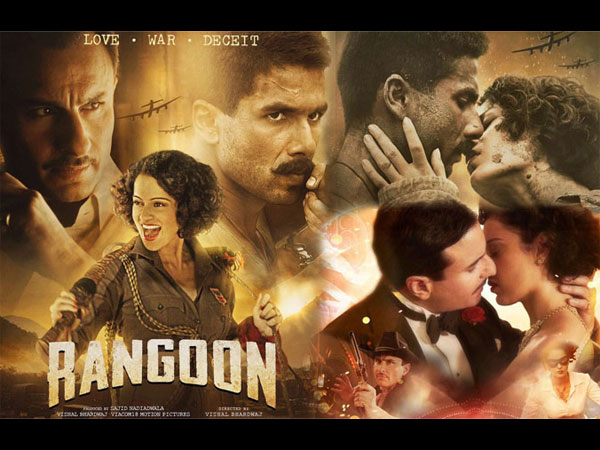
Rangoon hit India’s screens in late February and made it here within the same week The title is rather misleading, because nothing happens in the former capital city of Burma, now Myanmar. Yes, there are plenty of nature scenes in the jungle along the Irrawaddy River between Burma and India. I suspect the vague name was give to draw male viewership, because the film’s central focus is a fictional 1940s film star called “Miss Julia” played by Kangana Ranaut.

A promotional poster for Rangoon that references late colonial Indian cinema


Julia is a beautiful Anglo-Indian actress best known for the line “Bloody Hell!” though her songs and dialogue are all in Hindi. As the top stuntwoman actress in Bollywood, she’s in love with Rusi Billimoria, a former film star who lost his right hand performing a film stunt. Rusi and his father are wealthy Parsis (Indian Zoroastrians) who own the cinema company; Rusi directs while his father sits in Bombay and tells him what to do. Their studio is pro-British, so when an army general tells Rusi he’d like Miss Julia to come to the Burma front to perform for the soldiers, Rusi’s father says she must go. Julia is horrified by the idea of going into the jungle, but she’s packed on a train with a handsome bodyguard from the army who attempts to prevent her escape.

True to the romantic-adventure genre, there are plenty of song and dance scenes, made even better because of the historical references in some numbers to Hitler and Churchill. The visions of late colonial homes and film studios are gorgeous, not to mention the river and jungle. Kangana Ranaut in the star role is beautiful and haughty, and a kick-ass pilot, motorcyclist, horseback rider, dart thrower, and dancer. A dance scene on top of a train is film convention—however, Miss Julia’s fights atop a vintage Northwest Frontier Train reprised and beat actor Shah Rukh Khan's famous "Chaiyya Chaiyya" dance scene from the late 1990s.  Her songs, sung by Bollywood legend Farah Khan, are great.

Kangana gets on top of the train and really rocks it!


And now for a brief intermission into some facts:

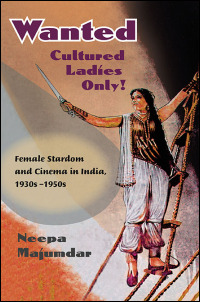
Miss Julia, the actress character, has historic origins. Soon after silent pictures began, a subgenre developed wherein actresses played physically daring roles, often fighting men with their fists, knives, swords, and guns. In Bollywood, these actresses were typically Anglo-Indian, Jewish or American rather than 100% Indian. Film producers feared offending India’s religious communities by subjecting Hindu, Muslim or Parsi women to the male gaze. These outsider actresses typically had Hindu names and played Indians. And at a time when the British were in control—and Indian men couldn’t act out—sword-wielding women were a very subtle way of expressing nationalism. You can read more about the history of Indian women actresses in Wanted: Cultured Ladies Only! by Neepa Majumdar.


From Majumdar’s excellent book, I learned that one of the first action stars of Indian cinema was Sulochana, originally named Ruby Myers, who began in silent films and transitioned to talkies. Sulochana who was considered both a beauty and a flapper, acted in five to six films a year during her heyday. Many of her roles involved the idea of giving up a debauched Western existence for a more simple and honorable Indian identity.


Sulochana’s best-known film was Cinema Queen (1925) which is about the travails of a movie actress—just like Rangoon.

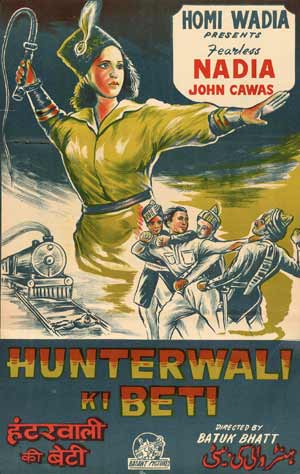
Some articles in the Indian press compare “Miss Julia” character in Rangood with the famous 1930s stunt actress known as Fearless Nadia. The woman who was born in Australia and had Scottish-Australian-Greek ethnicity came to India when her father was a soldier in the Indian Army. After his death, she was first a circus performer and later an actress in over 50 movies produced by Wadia Tone pictures run by two Parsi brothers. Her most famous film, Hunterwali, tells the story of a princess who dons a mask and cracks a whip when she goes forward to avenge injustice.


Descendents of the Wadia brothers are concerned the film may have breeched the trademarks they hold on the character of Fearless Nadia.But in addition to Sulochana, there were other Indian women stars in the genre with names like Miss Zebunissa, Miss Padma. And Fearless Nadia was a blonde who never disguised her European origins. In Rangoon, Miss Julia bluntly explains to a snobbish maharani that she was born to an unmarried Indian mother. 

Okay, the intermission on Indian film history is over and we are back to Rangoon—the modern remake of a 1940's woman-centric action picture.

Every good Indian film must have a villain, and the British general takes on that role with such awful lines as “Because I’m white I’m right.” There’s also a love triangle; Julia goes missing and is rescued by handsome Sergeant Nawab Malik, her mysterious bodyguard. Nobody will be surprised by the love triangle that develops between these two and Rusi; but the grand finale, where the battle for loyalty and India’s future plays out on a rope bridge, is simply breathtaking. For a look at some videos of dance scenes, check out this Times of India review.


Kangana Rangaut, Shahid Kapoor and Saif Ali Khan are the film's leads


The story’s underlying theme is the battle between the Indian Army (British-government controlled) and the Indian National Army (INA) sponsored by the Japanese. These forces really did fight along the Burma-India border during the late years of the war. In this film, there’s a secret mission to deliver a jewel-encrusted Indian prince’s sword to ensure this army of rebels would have funds they needed to support an invasion without needing the Japanese.  I wrote about the INA in my books The Sleeping Dictionary and India Gray, so it was exciting to see a partially accurate depiction of the forgotten army.


I walked into Rangoon feeling like a person at risk, but left singing Jana Gana Mana, the Tagore poem  that later became the anthem of independent India.  Miss Julia and her comrades had stood up to those who wanted to keep them in their place. Onward I'll go.


Tuesday, March 1, 2016

Césars - le French Oscars

The Friday before the Hollywood Oscars, the French film industry celebrates their equivalent at Théâtre du Châtelet in Paris. The creme de la creme of French showbiz gathered for the 41st Cesars just two days ahead of its Hollywood equivalent, the Oscars, which had been panned as "too white". Florence Foresti, a comedian, hosted. She's Billy Crystal, Tina Fey and Amy Poehler all in one very Parisian package.
The best picture accolade went to "Fatima", a movie about an immigrant Moroccan woman struggling to raise her two teenagers in France and working as a cleaning lady to give them the best life possible.
However, with her rudimentary French while her daughters have trouble speaking Arabic, communication is strained, especially with her rebellious younger daughter.The leading role was played by Algerian Soria Zeroual, a real-life cleaning lady who found herself nominated for best actress alongside French cinema greats Isabelle Huppert and Catherine Deneuve. Michael Douglas became the latest Hollywood star honored with a lifetime achievement award by the Cesars, and delivered his acceptance speech entirely in French. "It is a little like French cuisine, to make a great dish you need excellent ingredients. To make a great film you need a brilliant screenplay, a great director and exceptional actors," said Douglas."I have nearly always had the chance to count on these good ingredients." The broad sweep of actors and film themes on offer comes in stark contrast to those up for the Oscars. In France, three women filmmakers were nominated for a Cesar -- none of them won -- while not a single woman got the nod in that category at the Oscars. The best actress gong went to 10-time Cesar nominee Catherine Frot, 59, for her role in "Marguerite" which tells the tale of a diva who wants to be an opera singer and seems oblivious to the fact that she cannot sing. Minor details, right?
Vincent Lindon, 56, scooped the best actor prize for his role in "Le Loi Du Marche" (The Measure Of A Man) in which he plays an unemployed factory worker faced with humiliating job interviews and useless internships.
And forget all those Oscar parties, everyone in Paris heads up to Fouquet's on the Champs Elysées for THE party.
Cara - Tuesday