Showing posts with label World War II. Show all posts

Wednesday, February 3, 2021

World War Zero

Stanley - Thursday

Last December I wrote a blog about a quandary I have with respect to the disposition of some of my African art when I die.  I am particularly worried about one piece - a 500-yer-old terracotta head from the Kingdom of Ife in the country now known as Nigeria.


It concerns me because there is a reasonable likelihood is that it was stolen from Ife - even though I have formal documentation that it was legally exported from Nigeria. It was not given to me by the Nigerian government, but rather I bought it from a gallery in Johannesburg.

In recent years, there has been a growing movement to repatriate such works of art to their countries of origin. The modern movement was probably started by the famous actress Melina Mercouri, who became Greece's first female Minister of Culture of Sports. 


Melina Mercouri

In that capacity, she told the world that the Elgin Marbles (or Parthenon Marbles, as the Greeks call them) had no right to be in the British Museum because they had been stolen. 

Parthenon Selene horse

A Centaur and a Lapith fighting

In a famous 1983 television debate, the Museum director, David Wilson, responded that they had been a gift to Thomas Bruce, 7th Earl of Elgin. "A gift from the occupying Turks," Mercouri responded, "who had no right to them in the first place." In a talk to the Oxford Union debating society she explained what they meant to Greeks: "They are our pride. They are our sacrifices. They are our noblest symbol of excellence. They are a tribute to the democratic philosophy. They are our aspirations and our name. They are the essence of Greekness."

To this day, the Marbles are still in the British Museum.

You may wonder how this is connected to the title of the blog: World War Zero.

When I think of the First World War, I think of a Bosnian-Serb nationalist, by the name of Pricep, assassinating the heir to the Austro-Hungarian empire, Archduke Franz Ferdinand, in Sarajevo on June 28, 1914. (I remember the date only because June 28 is my brother's birthday.) Five weeks later, the situation had escalated into a war in which almost all European nations were involved, drawing into the fray their territorial possessions around the world, including Africa. The United States eventually joined in April, 1917. 

The toll was horrendous, far surpassing any conflict that had gone before: an estimated 9 million combatants and 13 million civilians. It also changed the world politically and financially.

Trenches

When I think of World War II, what comes to mind is the German invasion of Poland on September 1, 1938 and the subsequent declaration of war against Germany by the United Kingdom and France two days later. The Japanese attack on Pearl Harbour on December 7, 1941 brought the United States into the mess. WWII became the costliest war in history in terms of loss of life: a total of between 70 million and 85 million dead, once again with more civilians killed than military personnel. Of course, it also had. profound impact on the world politically.

German troops advancing

Both WWI and WWII had dramatic and memorable events that kicked them off.

What about World War Zero?

Towards the end of the Nineteenth Century, a British army officer, Major General Sir Charles Callwell, wrote a sort of how-to book titled Small Wars: Principles and Practice. 


For the flavour of the book, here are some quotes:

Small wars are 'campaigns to punish and wipe out an insult or avenge a wrong.'

Small wars are fought 'to chastise a people who have inflicted some injury.'

Small wars are undertaken 'for some ulterior political purpose or to establish order in some foreign land - wars of expediency, in fact.' (Think trade, money, territory; don't think charity or philanthropy!)

The history of small wars has been obscured by the big conflicts of WWI and WWII - to such an extent that they barely warrant mention in the history books and are often not thought of as wars at all. 

On Wednesday, September 23, 1986, Queen Victoria became the longest reigning monarch in English history. The Western Gazette reported 'The Victorian Age has been one of peace.'

Queen Victoria

 The Western Gazette then went on to detail what that peace looked like:

Afgan war 1838-1840,

first Chinese war 1841,

Sikh war 1845-46,

Kaffir war 1846,

second war with China 1849,

second Afgan war 1849, 

second Sikh war 1848-49,

Burmese war 1850,

second Kaffir war 1851-52,

second Burmese war 1852-53,

Crimea 1854,

third war with China 1856-58,

Indian Mutiny 1857,

Maori war 1860-61,

more wars with China 1860 and 1861,

second Maori war 1863-65,

Ashantee war 1864,

war in Bhootan 1864,

Abyssinian war 1867-68,

war with the Bazotees 1868,

third Maori war 1868-69,

war with the Looshais 1871,

second Ashantee war 1873-74,

third Kaffir war 1877,

Zulu war, 1878-79

third Afghan war 1878-80,

war in Basutoland 1879-80,

Transvaal war 1879-81,

Egyptian war 1882,

Soudan 1885-89,

third Burma war 1885-92,

Zanzibar 1890,

India 1890,

Matabele wars 1894 nand 1896,

Chitral campaign 1895,

third Ashantee campaign 1895,

second Soudan campaign 1896.'


In fact, there was a small war in every year of Victoria's peaceful reign.


British Press: 'Valiant British soldiers repelling vicious attack by local savages.'


Reality Press: 'Outgunned citizens attempting to repel hordes of plunderers.'

And that was only the Brits. Think also of the Germans, French, Italians, Portuguese, Spanish, etc., etc.

It is this mass of punitive expeditions, reprisal raids, campaigns, peace excursions, etc. that Dan Hicks, author of The Brutish Museums, calls World War Zero. There are two major reasons for it being much less well known than its two successors. First, in almost every case, the history of what happened was written by the victors (since most victims had no access or ability to write and publicise what happened). And second, in almost every case, the one-sided historical record indicated that the victims were to blame. Not surprisingly, as time passed, history books and newspaper reports pumped up the justification and heroism of the victors and showed the behaviour of the victims to have been increasingly barbaric.

One other fact invariably holds true: the victors were white, and the victims not.

In addition to the tens or hundreds of thousands of people killed by the white powers in these small wars, communities were destroyed, belief systems shattered, and families separated.

As horrific as these outcomes were, the worst and longest lasting, were the lies told by the perpetrators of the wars about the people they destroyed. It was these accounts that built the foundation of contemporary racism.

And now to circle back to the beginning of this blog. It was during these small wars that almost all of the artefacts in Western museums were looted. And many of these museums continue to weave a tale around the artefacts that only reflects the popular view of what happened. Dan Hicks suggests that at least the museums should 'fess up and place what they show into a realistic context, whether they come from Greece or Ife.


Sunday, November 29, 2020

Anything To Anywhere: ATtAgirls of the ATA

Zoë Sharp


In 2018, a lady called Mary Ellis, née Wilkins, died at her home in the Isle of Wight, aged 101. She was one of the last of a rare breed – female pilots who flew during World War II.


Mary Ellis in her ATA uniform
 

Ellis started learning to fly while she was still at school. “I was not very good at hockey, and the school let me go to Witney Airfield for flying lessons instead.”


I wasn’t very good at hockey, either, but I don’t remember being offered that alternative…


After gaining her licence at around sixteen or seventeen, she flew constantly until all civilian flying ceased at the outbreak of the Second World War. Ellis thought that was the end for her. “Then one day I heard on the radio that female pilots were required for the Air Transport Auxiliary. I said to my mother that I was thinking about applying, and she said ‘No, I shouldn’t if I were you’, but I did it anyway and was accepted.”


Mary Ellis during her service with the ATA
 

The Air Transport Auxiliary (ATA) was set up as a civilian organisation in May 1938, initially to carry mail, supplies and personnel. However, it soon became apparent that the pilots were needed to work with the Royal Air Force, ferrying aircraft from factories to the maintenance units where guns and other equipment could be added. Once war broke out, they also had to replenish the active duty squadrons with aircraft, thus freeing up RAF pilots for combat duty.


To begin with, the ATA recruited male pilots who had been turned down for active service, usually because of age or injury. Providing they could fly, the ATA ignored any such disabilities, and such pilots referred to themselves as the Ancient & Tattered Airmen.


Already, in 1939, an aviatrix and engineer called Pauline Gower proposed establishing a women’s section of the ATA, to be based at Hatfield. It didn’t hurt that Gower’s father was MP Sir Robert Gower—or that Gower herself was a highly experienced flying circus and taxi pilot. She was duly appointed head of the women’s branch in November 1939.


Pauline Gower, head of the women's section of the ATA
 

By the start of 1940, Gower had recruited her first eight female pilots, who were initially allowed only to fly Tiger Moths. These women were a remarkable bunch. Of them, Joan Hughes went on to become one of the UK’s first test pilots. Margaret Cunnison was Scotland’s first female flying instructor. Gabrielle Patterson was Britain’s first female flying instructor.


Gower firmly believed that women should be allowed to fly all types of aircraft. By July 1941, founding member Winifred Crossley Fair became the first woman to fly a Hurricane, while Margaret Fairweather flew a Spitfire for the first time the following month. Pilots were trained in the ATA’s own programme rather than at the RAF’s Central Flying School. They qualified on single-engined planes and progressed in stages according to the classification of the aircraft. By gaining experience on all types of aircraft belonging to that class before returning for more training at the next level, they could proceed at their own pace and still make an invaluable contribution.


During the war, there were 168 women flying for the ATA—one in every eight pilots. Among these ATtaGirls, as they were known, was record-breaking pilot Amy Johnson, who was tragically killed when she had to bail out into the Thames Estuary in January 1941.


record-breaking aviatrix, Amy Johnson
 

Pilots from neutral countries were accepted, and 28 different nations flew with the ATA. This included Maureen Dunlop from Argentina, who became a pin-up after being featured on the cover of Picture Post, and Margot Duhalde from Chile, who initially spoke almost no English. When she was forced to make an unscheduled landing due to weather, the crew at the airfield could not understand a word she said and actually had her arrested.


Argentine pilot Maureen Dunlop on the cover of Picture Post
 

There were also pilots from Poland, Canada, Australia, South Africa, New Zealand, Holland, and the US. One of the notable American pilots was Jacqueline Cochran. By the time of her death in 1980, Cochran had apparently set more speed, altitude, and distance records than any other pilot—male or female—in aviation history.


Jacqueline Cochran with Col. Chuck Yaeger,
the first woman and man to break the sound barrier
 

Another remarkable pilot was Diana Barnato Walker, who flew 80 different types of aircraft for the ATA, including 260 Spitfires. After the war, she became the first British woman to fly faster than the speed of sound, achieving Mach 1.6 in 1963.


Diana Barnato Walker during her ATA service
 

During the Second World War, the sixteen ferry pools of the ATA delivered more than 309,000 aircraft of 147 different types, clocking up 415,000 hours in the air. Almost 900 tons of freight was safely carried, along with 3,430 passengers. Sadly, 174 pilots were lost, including fifteen women.


Joan Hughes with a Stirling Heavy Bomber delivered by the ATA
 

Perhaps the most remarkable feat of the ATtaGirls of the ATA, however, was the fact that, from 1943, they received equal pay to their male counterparts of equal rank. Until then, they had earned 80 percent. This parity was reported to be the first time the British government approved equal pay for equal work in an organisation it controlled.


Is it just me, or do we seem to have gone backwards since then?


This week’s Word of the Week is anthypophora, which is a rhetorical term for the practice of asking oneself a question and then immediately answering it. Closely related to hypophora, which is sometimes seen as the statement or question, and anthypophora as the immediate reply. From the Greek against plus allegation.

Monday, May 25, 2020

Memorial Day 2020

Annamaria on a Holiday Monday

Today's holiday used to be called Decoration Day and began as a day to decorate the graves  of the fallen in war, starting with the Civil War here in the USA.  Many towns and cities in the country have claimed to be the birthplace of the tradition.  In 1966, President Lyndon Johnson awarded that official honor to the village of Waterloo, New York.  Now part of Seneca Falls, a small, out-of-the-way place that also happened to be the scene of the first US Women's Rights Convention in 1848.


These days, when so many have and still are falling in a pandemic, I have been thinking of how we might memorialize them.  The New York Times front page this Sunday has begun to attempt such a daunting task.  Perhaps every town and village will have to have its own monument.  Here is as much of today's front page as I can manage to display.


The sub-headline says:
 "They Were Not Simply
 Names on a List.
They Were Us."
  

In the traditional spirit of Memorial Day for the fallen in war, I share my post from three years ago.  The good thing about writing of history, as I am always fond of saying, is that it never goes out of date.   


I am thinking of World War Two, the war that shaped my young life, so my post today will be highly personal one.  Here are some images that tell of the people who fought, the people who worked and prayed on the home front, of one who did not come back and one who did.

Here is the data; the numbers are in MILLIONS:


Here is the moral of the story:


 Here are my personal remembrances:


My brother Andy and me (c.1945), wearing hats that belonged to our uncles.

My vague earliest memories are of saying our good-byes and of how tense my mother and my grandmother were for all those years.


A flag like this hung in the front window of the two-family house that my family shared with my grandparents.  Ours had five stars, for my dad and for four of my mother's brothers.  They were all blue until the last year of the war.


Our gold star was for my godfather John Pisacane, who served in Patton's army and then in a tank battalion under General Eisenhower.  He was killed during the push to Berlin.


I was lucky enough to get my daddy back.  Sam always felt to me like the guardian angel that he appears as in this post-war trip to the beach.  I'm the little girl on the right next to my brother Andy.

The other children are my cousins Jimmy, Joann, and Tony.

I longed for my daddy so much for the years while he was gone that images of returning soldiers still move me to tears.


Every year, on Memorial Day I watch this clip from the incredible TV documentary series. Victory at Sea.  If you don't see the link, PLEASE find it on YouTube: Victory at Sea Episode 26 Part 3--
Don't miss the footage of joyful reunions after years of separation.


I have to go now.  I watched it again, and I am weeping.

Monday, June 17, 2019

A Paean to my Dad: Samuel F. Puglise

Annamaria on Monday


I am writing this about my father on Sunday, June 16th - Father's Day in the USA.

Summing up Sam’s life is difficult, because he ranged so far and so deep for so long.  Sam was an extraordinary person masquerading as everyman.  He was modest and thought little of his gifts.  But they were huge.

He was an eyewitness to many of the historic events of his century.  And he had the wisdom and sensitivity to see them for what they were.

He was born on the 5th of March 1914 to Andrea Puglisi and Concetta Bruno in a coal mining village - Holsopple - in Western Pennsylvania.  His father was a miner.  His mother bore six children, kept a cow and chickens, raised vegetables, and was required to keep house for five other Italian-speaking coal miners in exchange for the privilege of living with her husband and children in mine-owned housing. Sam was baptized Salvatore Francesco Puglisi the following September.  The spelling of his family name had been changed on US official records by some immigration clerk's failure to dot the final i when his father came through Ellis Island.  

Sam's earliest memory was of the influenza epidemic of 1917 and 18: of standing in the doorway watching his mother who lay on the bedstead with her own infant cradled between her knees while she nursed two other babies who had lost their mothers in that plague.  When Sam—who must have been only three or four years old at the time—described the tears running down his beloved mother’s cheeks, you felt you could see them too.

When he was six or seven, he hid in that bedroom with his mother and his siblings, while his father sat guard outside the door with his hunting rifle and a shotgun across his lap.  Outside the window, on the hills, the Ku Klux Klan were burning crosses, threatening the immigrants, the Catholics who worked in the mine, and their families.

Little Salvatore became Samuel Frank when he went to school.  His teacher told him she was giving him a real American name, that the name his parents had given him was not American enough.  In his adult life, everyone, even his children, called him Sam.  

He became intrigued when early flying machines appeared in the sky, and he tried to make an airplane of his own.  His flight began at the edge of a cliff and landed in a hawthorn tree, and his first adventure in flying ended with a spanking.  He also saw planes overhead in the Pacific battles of World War II.  And he even had a connection with space flight: he was so proud to have worked on the components of the Apollo Spacecraft.

When he was nine, his beloved father died.  Coal miners don’t live long.  The mining company put Concetta and her six children, ranging in age from 2 to 14, and her meager belongings on a wagon and drove them to the edge of the “town,” which was in the middle of a woods.  They left her there.  

Concetta moved the family to Paterson, New Jersey, where there was a group of people from her village on the outskirts of Siracusa in Sicily.  Sam’s oldest brother Paul, aged 14, went to work in the silk mills and took over support of the family.  Sam never went back to school until after WWII.

Though the Great Depression and the early death of his coal miner father robbed Sam of any chance at education, it also sent him as a CCC youth to the Idaho wilderness.

Sam in Northern Idaho at a CCC Camp in 1933
with a group building infrastructure still in use
 in a United States National Park.  
At the end of that grievous decade, he fell in love with and married Annamaria Pisacane.  They both looked like movie stars. 


World War II was a central experience of Sam’s life.  He fought in the Pacific, and described the battle for Okinawa as hellish.  After fighting in many major battles, while others were on their way home, he was detailed to become a China Marine.


After V-J Day, part of the negotiations between the USA and Japan was a deal that the Japanese in China would surrender, not to the Chinese, but to the Americans.  (Japanese treatment the of Chinese had been so brutal that the Japanese feared putting their 700,000 men still in China at risk of retaliation.)  Sam was one of 3000 American Marines of the First and Sixth Divisions sent to keep the Japanese prisoners of war safe until they could be returned home.


Sam described to me his time there.  When the Marines first arrived in Tsingtao, the Japanese were being held in huge barbed wire enclosures.  With so many inmates and too few guards, understandably enraged Chinese were slipping under the wires in the night to take their revenge with knives.  The American officers in charge decided to increase the guard power by rearming the Japanese officers and having them join the guard patrols.  My dad described as otherworldly the experience of walking guard duty with officers who, two weeks before, had been trying kill him.

Sam's story: His unit in China was not being properly supplied and the mess was out of
food. The guys chipped in and bought an ox that they butchered and ate.  The meat
 was so tough that they referred to the beast as Confucius' Calf!


Sam remained in China for six months and finally returned home in March of 1946, with souvenirs of China and memories: many funny, many fascinating, but also dreadful images that he later told me he had spent his life trying to forget, but that haunted him until the end.  He had volunteered to fight to defend his country, and though he was proud to have served, after experiencing battle, he hated war.  “It’s the stupidest way man ever invented to solve a problem,” he said.  “No one who had ever been in combat would start a war.  And no one should ever have to endure one.”  Endure he did and returned from all the violence the gentle man he had always been.


He taught me too many things to enumerate.  To love and desire education.  Though his father’s untimely death put an end to his formal schooling when he was only nine years old, Sam read and studied all his life—got his GED and took some courses at Rutgers on the GI bill, even while he worked two jobs to keep his family.  He read Freud, he told me, because he wanted to understand people and Plato and Aristotle and Schopenhauer because he wanted to understand life.

He taught me and my brothers how to be part of a family—not to judge one another’s faults, but the importance of accepting each other.  Once when I was angry at my brother, he said, “No, Sweetie.  Don’t think that way.  You can look at a man and say ‘He used to be my friend or even he used to be my husband, but you can’t look at a person and say he used to be my brother.’”

He was the least judgmental person I ever met—finding the good in everyone, even people who harshly misjudged him and mistook his charity and gentleness for weakness.

He was beautiful, movie star handsome, yet never vain.  What was important to him was who and what he loved.

He loved his father and described himself dogging his footsteps and trying to emulate his father’s industriousness, sense of adventure, and loyalty.  All virtues he himself achieved, but never bragged about.

He loved music and dancing.  He loved to play cards and golf.

Sam and me at my 50th birthday celebration
He loved the out of doors, especially fishing and left me with vivid memories of following him on sunny spring days, wading in sparkling trout streams and one particularly delicious dinner of fresh-caught trout and sautéed early dandelions gathered on the banks of pristine water.


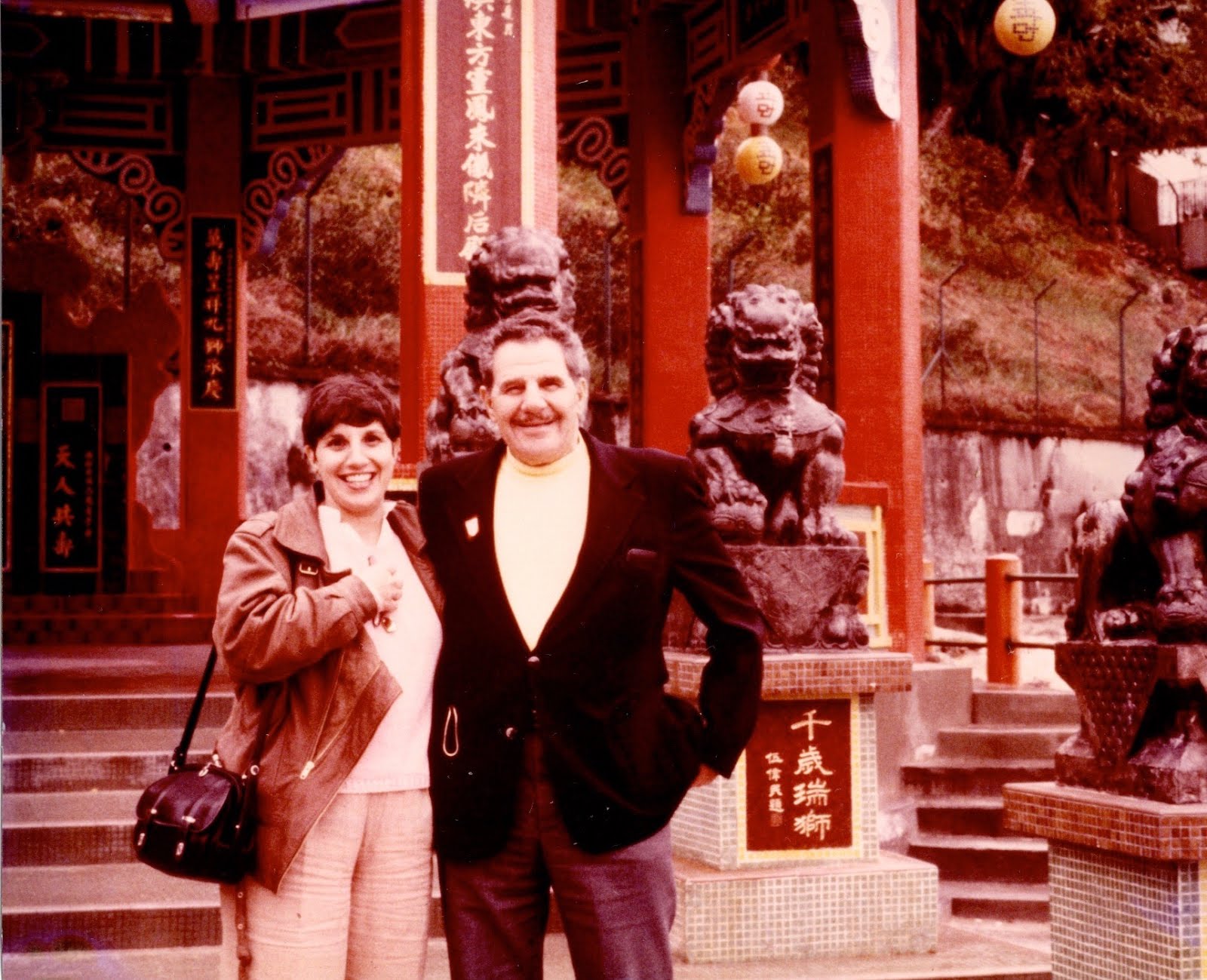
In 1986, as soon as it was possible to visit, David and I took Sam back to China for a three week tour.  He was pleased with what he saw.  The China he had experienced had been filled with starving, down-trodden, sick people.  The China we saw together was on the cusp of becoming the modern power it is now.  My favorite memory: An evening in the Rathskeller at the Peace Hotel in Shanghai, when Sam and I danced the polka to the music of six old guys in Mao uniforms playing from sheet music from 1946.


Mostly Sam loved his family and took a Sicilian man’s joy in the fact that his family was united.  He always asked, “Have you talked to your brothers?  How are Kerry Ann and Ted and the children?  Give everyone my love.”  He always in every way gave us all his love.  

Sam’s life was long, but more important his love was deep and true.

He said he only regretted one thing—smoking cigarettes.  He died of complications of emphysema at the age of 94. 

He still looked like a movie star.


Sunday, June 9, 2019

The Ryozen Kannon, Redux

-- Susan, every other Sunday.

I'm writing to a tight deadline this week, but since last week marked the 75th anniversary of D-Day (6 June, 1944), I hope you'll enjoy this post about Kyoto's Ryozen Kannon, commemorating the unknown soldiers who perished during World War II: 

Many nations have memorials to the unknown soldiers who died in various wars. In addition to showing respect for the dead, they remind the living that war creates deep and permanent losses that transcend time and don't go away when the fighting ends.

The Ryozen Kannon memorializes all the fallen, not just the Japanese

One such memorial, the Ryozen Kannon, stands in a historic section of Kyoto's Higashiyama district. Though surrounded by thousand year-old shrines, the Ryozen Kannon memorial dates only to 1955. The memorial commemorates, and pays tribute to, the unknown soldiers from every country who died in the Pacific War (the Pacific theater) during World War II. Its placement in the center of a deeply historical area ensures it visibility--tens of thousands of Japanese and foreign visitors pass by it, and visit it, every year. The size of the Kannon statue ensures that even those who don't visit the shrine will see her--and, hopefully, ask about her meaning.

The Kannon as seen from a neighboring street

The shrine's unassuming entrance . . .

A deceptively neutral entrance for such a lovely shrine

. . . leads to a large graveled court with a reflecting pool, a large incense burner, and the Kannon-do (Kannon hall).

Beyond the gate

For a $3 admission fee, visitors receive access to the grounds and a stick of incense to set in the burner on behalf of the unknown dead.


Incense burner in front of the Kannon-do

Kannon, the Buddhist bodhisattva of mercy and compassion, has been venerated in Japan since at least the sixth century. Her name means "the one who sees all." Her role is to see and hear the cries of all who have troubles during life, and to help them attain enlightenment (and merciful release from suffering) after death. Although sometimes portrayed as male, in Japan Kannon is almost always shown in a female form.

The Ryozen Kannon

The massive Ryozen Kannon sits atop the Kannon-do, watching over the reflecting pool. Inside the hall, priests conduct observances and prayers on behalf of the dead four times each day. Visitors can watch the services, and arrange for private prayers as well.

The Kannon makes the building look deceptively small.

Kannon herself is made of concrete and steel, measures 24 meters in height, and was built by Japanese artist Hirosuke Ishikawa. Photos don't do justice to her massive size and presence.

In the wake of World War II, the Japanese people foreswore war and erected memorials like the Ryozen Kannon (and the Hiroshima memorial) to remind themselves and others of the true cost of violence. In remembering those who gave their lives, they also remember that war is a choice--and one that we as a species must try to avoid.

The Kannon, as seen from a neighboring temple

Instead, as these memorials remind us, we should strive to have compassion, not just for the lost, but for the living too.