Showing posts with label hyakumeizan. Show all posts

Sunday, June 11, 2023

Another Classic From Susan Spann: From Tohoku With Love...and Horses.

[Five years ago yesterday, Susan announced her self-imposed challenge to scale 100 Japanese peaks over the next 12 months. Another challenge she met and overcame.]

Sunday--Susan 

 
June is here, and with it the official start of my hyakumeizan odyssey--over the next twelve months, I'll be attempting to climb all 100 of the nihon hyakumeizan (100 Famous Mountains of Japan). It's a hefty task, considering that the Japanese climbing season starts in June and ends when mid-to-late November snow shuts off the peaks.

For the mathematically inclined, that basically means I need to climb a mountain every other day from now until the snow flies.

The summit of Mount Iwaki - hyakumeizan #2
Did I mention the rainy season starts in June?

With little time to spare, I kicked off the climbs with a trip to Tohoku, a region located in the northernmost part of Japan's largest island (Honshu).
Looks a little like Mordor, if you didn't know better...

To test my fitness, I planned for a pair of back-to-back climbs with a single rest day in between.

Half way to the summit - and pointing where I need to go.
Fortunately, the weather and my knees held out, and I summited all four peaks.

The summit of Mount Hakkoda (this is where the previous photo pointed).

I planned to spend my rest day in Morioka--a city I knew little about, aside from the fact that it's known for the Chagu Chagu Umakko Matsuri (Festival) that takes place the second weekend in June (this weekend, in case you're counting).

A horse decked out for Chagu Chagu Umakko

The festival originated centuries ago, when farmers in the Morioka area festooned their horses with elaborate costumes and bells ("chagu chagu" is the sound the bells on a trotting horse make in Japanese) and paraded the horses to the local Shintō shrines for special blessings. Horses were exceptionally valuable, and their labor was critical to the farmers' survival, so the farmers hoped the festival would ensure the horses' health and continuing welfare.

Today, the festival still involves parading the jingling horses to the shrine in Morioka. Children in traditional costumes ride on the horses' backs--hence the last word, "Umakko," which means "horse children."

I couldn't afford to delay my first Tohoku climbs by a week to see the festival, but it bummed me out that I'd miss the horses. (I've loved them all my life, and rode competitively in high school.)

Imagine my surprise when I reached Morioka for my rest day . . . and discovered it coincided with a matsuri (festival) celebrating all of the festivals of the Morioka region--including Chagu Chagu Umakko!

Hooray! A festival!

I watched a parade with dancers from several of the regional matsuri:

The name of this one basically translates "flower hat festival"
Ate festival food near the site of the Morioka Castle ruins, and spent a delightful almost-hour at the "Chagu Chagu Umakko Horse Encounter" park, getting up close and personal with some of the hundred horses that would participate in this weekend's matsuri.

The regalia looks heavy, but these draft horses can bear the weight.
Including one very sleepy little foal:

At one point he was actually snoring.

The lesson here--and it's not a new one--is that travel often provides us with amazing opportunities if we don't over-schedule and leave ourselves open to the adventure that presents itself. Whether you want to attribute it to God, the Universe, Karma, or just turtles all the way down, it's impossible to deny that there's a larger force than us at work out there, and that it's pretty darn amazing at planning really cool surprises, if we leave ourselves open to them.

A lovely surprise indeed.


I came to Japan in search of adventure and, as always, it does not disappoint. I'm looking forward to seeing what the rest of this adventure has in store.

 --Susan

Sunday, June 24, 2018

A Snark's Eye View From the Mountains of Japan

--Susan, every other Sunday

As by now I'm sure you're all aware, I'm spending the next few months in Japan, attempting to become the first American woman over 45 to climb the Nihon Hyakumeizan in a single year--as well as the first cancer survivor to climb them within a year after finishing cancer treatment (chemotherapy).

On the summit of Mount Bandai. (A mile high, but you'll have to take my word for it.)

But this journey has quickly become about far more than merely tagging peaks and adding notches to a climbing belt. (Spoiler alert: I always knew it would, and intended it to.) My climbing notes often wax philosophical -- sometimes, downright "woo-woo" -- and yet, I think it's impossible to undertake a project of this magnitude without a great deal of internal dialogue and growth.

I WILL BECOME A BEAUTIFUL BUTTERFLY. (Or perhaps a moth . . .)

Or, if you did, I think you'd cheapen the journey and deprive yourself of a critical aspect of the journey. As every writer knows, the protagonist's internal arc is actually more important than the physical one (s)he undertakes--and that's true in life as well as in fiction.

However, it's also true that wherever I am, my herd of snarks is never far behind--and since I'm not revealing the bigger side of the lessons learned until I know for myself what those lessons really are, you're going to have to live with reports from the snarky side.

Tell me there's something NOT snarky to say about a display like this . . .

Let's be honest . . . the snarks are more fun anyway.

So here's the snark-cap of my travels since last we met here at MIE:

I have summited five more hyakumeizan--Mounts Nasu, Bandai, Ibuki, Omine, and Odaigahara--bringing my total climbs to 11. (And I'll be climbing number twelve by the time you read this blog.)

Technically, I didn't actually climb Mount Omine, since apparently the world will end if women cross the Great Seal at the base of the mountain--but I took my photo at the highest marker I was allowed to reach, and since that marker lies at the base of the mountain, I'm proud to say I reached the summit in record time.

(Non) Summit Photo, Mount Omine

On Ibuki, I learned that climbing mountains in the rain is a horrible idea--and that hiking through abandoned ski resorts has all the makings of an excellent horror film.

I see no way this could possibly go wrong.

On Bandai-san, I discovered something that moves even slower than I do on the trail (though not by much).

The only other hiker I outpaced on the way to the summit.

I also acquired a new, and louder, bear bell (the third bell on my pack, in case you're counting), so I can jingle up a storm with all the Japanese hikers on the mountain trails.

Chausu-dake, the active volcanic cone on Mount Nasu, taught me that volcanic gases are so nice, you smell them twice: the first time when you hike up the mountain, and the second time about twelve hours later, when you use the bathroom at your hotel.

Yay! A live volcano! (And yes, I hiked all the way to the top)

Fun fact: it smells exactly the same coming out as it did going in. (Which, I'm well aware, is more information than you needed, but now you know--and knowing is half the battle.)

Omine taught me that if you don't let women on the mountain, they'll have time to hike a beautiful gorge,

The cataracts at Mitarai Gorge


ride a monorail, visit limestone caves,

Breathtaking limestone formations in Dorogawa

cross giant suspension bridges,

One of at least half a dozen I crossed while hiking Mitarai Gorge. They wobble quite reassuringly underfoot.

and clock a 29,000 step hiking day--all the while having far more fun than the men standing naked under waterfalls on the mountain.

Respectfully submitted in place of the missing photo of naked priests beneath a waterfall.

In other words: NEENER. (Despite the law degree--or perhaps because of it--maturity has never been my strong suit.)

And Odaigahara taught me to recognize poop.

Actual sign on the summit plateau, Mount Odaigahara.

Because Japan.

(It also showed me some breathtaking vistas, which probably is more in tune with what you'd like to see - so I'll drop a photograph of that instead of something more scatalogically-oriented.)

The view from Daijagura, an outcropping on Mount Odaigahara.

Today I traveled to Nagano Prefecture, in preparation for tomorrow's planned ascent of Kurumadake. I visited an ancient shrine, watched the sun set over a gorgeous lake, and drank dragon spit--as you do, when the opportunity presents itself.

Sacred dragon drool for the win. Delicious!

As you can tell, there's plenty to snark about on this adventure--as well as enough to marvel at, admire, and learn from that it's likely to take a lifetime to fully process. One thing is already clear, however--the choice to pursue my dreams today, instead of waiting for a "someday" that might never come was the right decision for me, and it's the right decision for you as well. Whatever it is you're burning to do, find a way to do it now.

The mighty (and sacred) Tenkawa River, Mitarai Gorge, Nara Prefecture

And don't forget to let the snarks out for some exercise along the way. Traveling is much more fun with their running commentary by your side.


Sunday, June 10, 2018

From Tohoku With Love . . . and Horses

--Susan, every other Sunday

June is here, and with it the official start of my hyakumeizan odyssey--over the next twelve months, I'll be attempting to climb all 100 of the nihon hyakumeizan (100 Famous Mountains of Japan). It's a hefty task, considering that the Japanese climbing season starts in June and ends when mid-to-late November snow shuts off the peaks.

For the mathematically inclined, that basically means I need to climb a mountain every other day from now until the snow flies.

The summit of Mount Iwaki - hyakumeizan #2
Did I mention the rainy season starts in June?

With little time to spare, I kicked off the climbs with a trip to Tohoku, a region located in the northernmost part of Japan's largest island (Honshu).
Looks a little like Mordor, if you didn't know better...

To test my fitness, I planned for a pair of back-to-back climbs with a single rest day in between.

Half way to the summit - and pointing where I need to go.
Fortunately, the weather and my knees held out, and I summited all four peaks.

The summit of Mount Hakkoda (this is where the previous photo pointed).

I planned to spend my rest day in Morioka--a city I knew little about, aside from the fact that it's known for the Chagu Chagu Umakko Matsuri (Festival) that takes place the second weekend in June (this weekend, in case you're counting).

A horse decked out for Chagu Chagu Umakko

The festival originated centuries ago, when farmers in the Morioka area festooned their horses with elaborate costumes and bells ("chagu chagu" is the sound the bells on a trotting horse make in Japanese) and paraded the horses to the local Shintō shrines for special blessings. Horses were exceptionally valuable, and their labor was critical to the farmers' survival, so the farmers hoped the festival would ensure the horses' health and continuing welfare.

Today, the festival still involves parading the jingling horses to the shrine in Morioka. Children in traditional costumes ride on the horses' backs--hence the last word, "Umakko," which means "horse children."

I couldn't afford to delay my first Tohoku climbs by a week to see the festival, but it bummed me out that I'd miss the horses. (I've loved them all my life, and rode competitively in high school.)

Imagine my surprise when I reached Morioka for my rest day . . . and discovered it coincided with a matsuri (festival) celebrating all of the festivals of the Morioka region--including Chagu Chagu Umakko!

Hooray! A festival!

I watched a parade with dancers from several of the regional matsuri:

The name of this one basically translates "flower hat festival"
Ate festival food near the site of the Morioka Castle ruins, and spent a delightful almost-hour at the "Chagu Chagu Umakko Horse Encounter" park, getting up close and personal with some of the hundred horses that would participate in this weekend's matsuri.

The regalia looks heavy, but these draft horses can bear the weight.
Including one very sleepy little foal:

At one point he was actually snoring.

The lesson here--and it's not a new one--is that travel often provides us with amazing opportunities if we don't over-schedule and leave ourselves open to the adventure that presents itself. Whether you want to attribute it to God, the Universe, Karma, or just turtles all the way down, it's impossible to deny that there's a larger force than us at work out there, and that it's pretty darn amazing at planning really cool surprises, if we leave ourselves open to them.

A lovely surprise indeed.

I came to Japan in search of adventure and, as always, it does not disappoint. I'm looking forward to seeing what the rest of this adventure has in store.  


Sunday, May 27, 2018

A Mountain, A Lesson, And a Wish

-- Susan, Every Other Sunday

If all goes well, by the time this post goes live, I will have stood atop two of the Nihon hyakumeizan (100 famous mountains of Japan) - the start of my quest to climb the hyakumeizan in a single year.

I originally conceived of this journey as a way to face my fears (little knowing I would have to face and conquer one of the greatest--cancer--before I even set foot on the mountains). I'd grown tired of living "safe" and doing what everyone else expected. I'd spent decades reading books about mountain climbing, living vicariously through others, and dreaming of mountains I knew I would never climb.

Like my dreams - except that this one, I did climb.

Even after I decided to pursue my hyakumeizan quest, it still felt more like "something other people do" than something I would live. Even so, I planned my climbs through chemo. I trained through the pain. (And for the pain, as it turns out. These aren't bunny hills.)

Ten days ago, I got on a plane with my husband and my cat, and flew to Tokyo.

And a week ago, I stood atop the first of the hundred summits: Mount Akagi (Akagiyama) in Gunma Prefecture.

On the summit of Akagi-yama. 99 more to go.

More accurately, I stood atop three summits, since Akagi is a stratovolcano with several peaks, and I traversed across two of the lower ones to reach the mountain's highest point.

The view from the saddle, traversing between the peaks.

Several times on the ascent (and more than that while coming down again) I wondered whether my legs would give out before I achieved my goal.

My legs cry just remembering this.

But they didn't.

I worried I'd move too slowly, and miss the final bus back to the train.

That didn't happen either.

I worried about slipping on the steep, rocky slopes, and falling (doubtless to my death) on the boulder-strewn chaos of the descending path.

Guess what . . . those worries never came to pass.

And the other worries? The ones that plagued me daily during my life "before" the mountains? The fear of failure, of loss, of hardship? The fear that I'm not good enough, successful enough, worthwhile enough?

On the mountain, those fears were nowhere to be found.

Last Sunday on Akagi I re-learned a vital lesson I'd half forgotten. Mountains have a way of forcing you to focus on the truly important things in life.

Like the beauty of a crater lake:

The smaller of the two crater lakes in the Mount Akagi volcano

The size of the task in front of you:

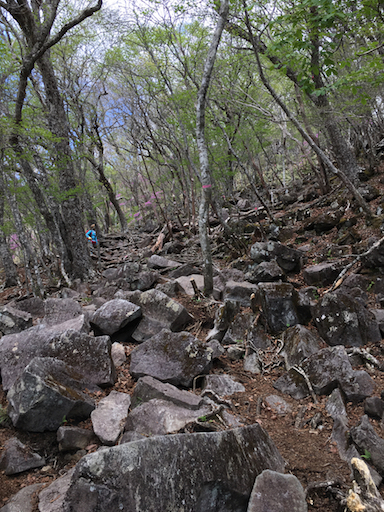
There's a path in there. Somewhere.

The breathtaking scope of the world as it appears from a mountaintop.

Onuma, the larger of Akagi's crater lakes.

This focus is one of the things I love the most about climbing mountains. Climbing's not easy, but the things you see, the time you get to spend with yourself, and the sense of true achievement that comes from standing on top (and then safely back at the bottom) aren't things it's easy to find in the daily nine-to-five that filled my life until this quest began.

The terror of descending this isn't easily found in office environments either...

When asked why he climbed Mount Everest, Sir George Mallory is famously quoted as saying "Because it's there."

My personal answer is somewhat different. I've known for decades that these mountains exist, but that alone was not enough to make me endure the pain of standing on their summits (or climbing back down again).

I climb because in the mountains I feel alive, at peace, and "enough" in a way I've never experienced elsewhere.

I climb because, in the mountains, I am there.

Wild azaleas in bloom on Mount Akagi, with Onuma in the background.

And my wish - for everyone reading this and everyone else in the world -- is that you find your mountain, your dream, and your peaceful place, and that you go there just as often as you can.