Showing posts with label shinkansen. Show all posts

Sunday, January 29, 2023

Trains, Wonderful Trains....

 --Susan, every other Sunday


I've always loved trains. There's something about the nature of travel by rail that slows you down, (while simultaneously speeding you up as you miss the traffic). I didn't have many chances to ride on trains while living in the States, but since coming to Japan, I'm making up for lost time.

Most people have heard of Japan's ultra-high speed shinkansen--the "bullet trains" that have impressed the world for decades--and the crowded Tokyo metro trains that carry millions of people to and from work and play on a daily basis.

But these don't even scratch the surface . . . from tiny, one-car rural trains to the fanciful "Joyful Trains," sightseeing trains, and even trains dedicated to eating local specialties "on the move," Japan is a country that loves its rails--and there's a lot of rail to love.  

Today I thought I'd share a few of the ones I've ridden during the past few years:

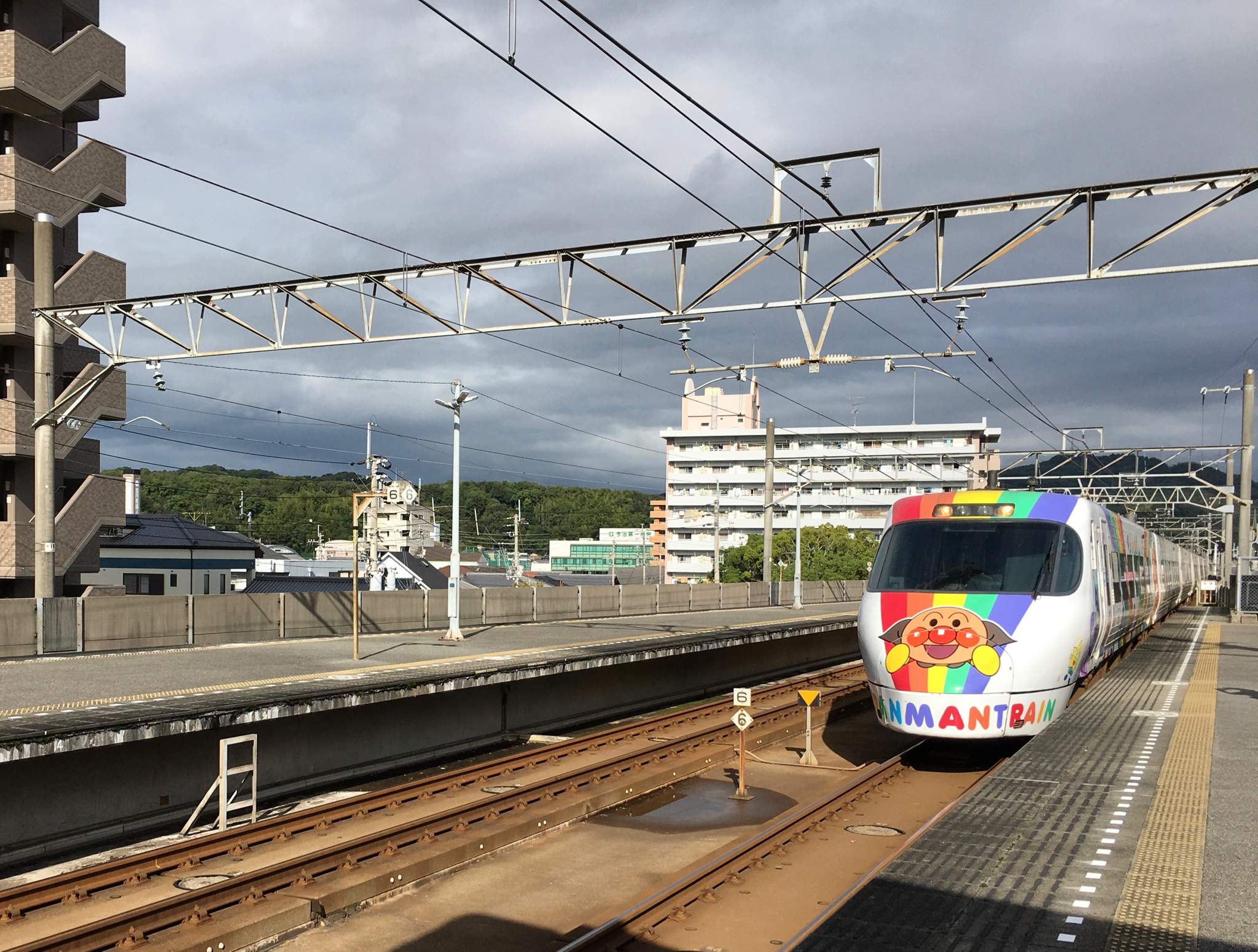
The AnPanMan train in Shikoku features characters from the popular children's anime (called AnPanMan), whose heads and bodies are made of different types of special bread.

Here comes the AnPanMan express!

Anpan is a round bread filled with adzuki bean paste (called "an" in Japanese). Anpanman is enormously popular with Japanese children - and while riding this train, I saw more than a dozen little kids standing near various crossings, waving to the train as we passed by.


Anpanman and friends

I may not have grown up on a diet of anpan(man), either real or on TV, but I loved this train. Even the memory makes me happy.

More anpanman ...

There are dozens of "character trains" like this around Japan, featuring everything from Thomas the Tank Engine to Pikachu, Hello Kitty, and many more. 

Specialty food trains are also popular. One of the leading candidates is actually close to home: the FujiView Sweets Express, which runs on the FujiQ railway to Kawaguchiko Station in the Fuji Five Lakes district.
 
The Fujiview Sweets Express, living up to its name

While the last three cars always operate as a standard train, and don't require reservations, on weekends the first car becomes the "Sweets Express"--a reservation-only experience that includes incredible views (including Mt. Fuji, in good weather) and a special dessert menu that changes seasonally. 

Car 1 - the sweets car

Car 1 - all aboard for dessert...

Instead of standard seating, the inside is set up like a cafe; when you board, the staff take you to your assigned seat or table. The huge windows make for amazing views.

My seat!

I've ridden twice - once in the summer and once in the winter. I'll definitely go again, too. 

Winter sweets: chocolate mousse "Fuji" and raspberry-chocolate eclair "sweets express"

Dessert with a view

No post about trains in Japan would be complete without a shinkansen - the fastest of which is currently the Hayabusa (the Japanese word for peregrine falcon) that runs on the Tohoku Shinkansen lines, north of Tokyo.

Hello, Hayabusa!

For rapid travel one step down from the shinkansen, Japan has a lot of futuristic-looking express trains, which cover distances much faster than standard trains, though not quite at the shinkansen's 150+MPH speed. They also look like transformers come to life: 

The real-life mandalorian...

When heading north from Tokyo, you may get to ride a conjoined shinkansen, like the one below. The red train (in front) is a "slower" shinkansen, bound for Akita Prefecture, while the sleek green machine is a Hayabusa bound for Hokkaido (the northernmost terminus of the shinkansen lines). From Tokyo Station to Morioka Station (about two hours north of Tokyo), the trains are joined together, to take advantage of the Hayabusa's powerful engines. At Morioka they uncouple; the red train heads west to Akita, while the Hayabusa keeps racing north alone.  

This is where baby trains come from.

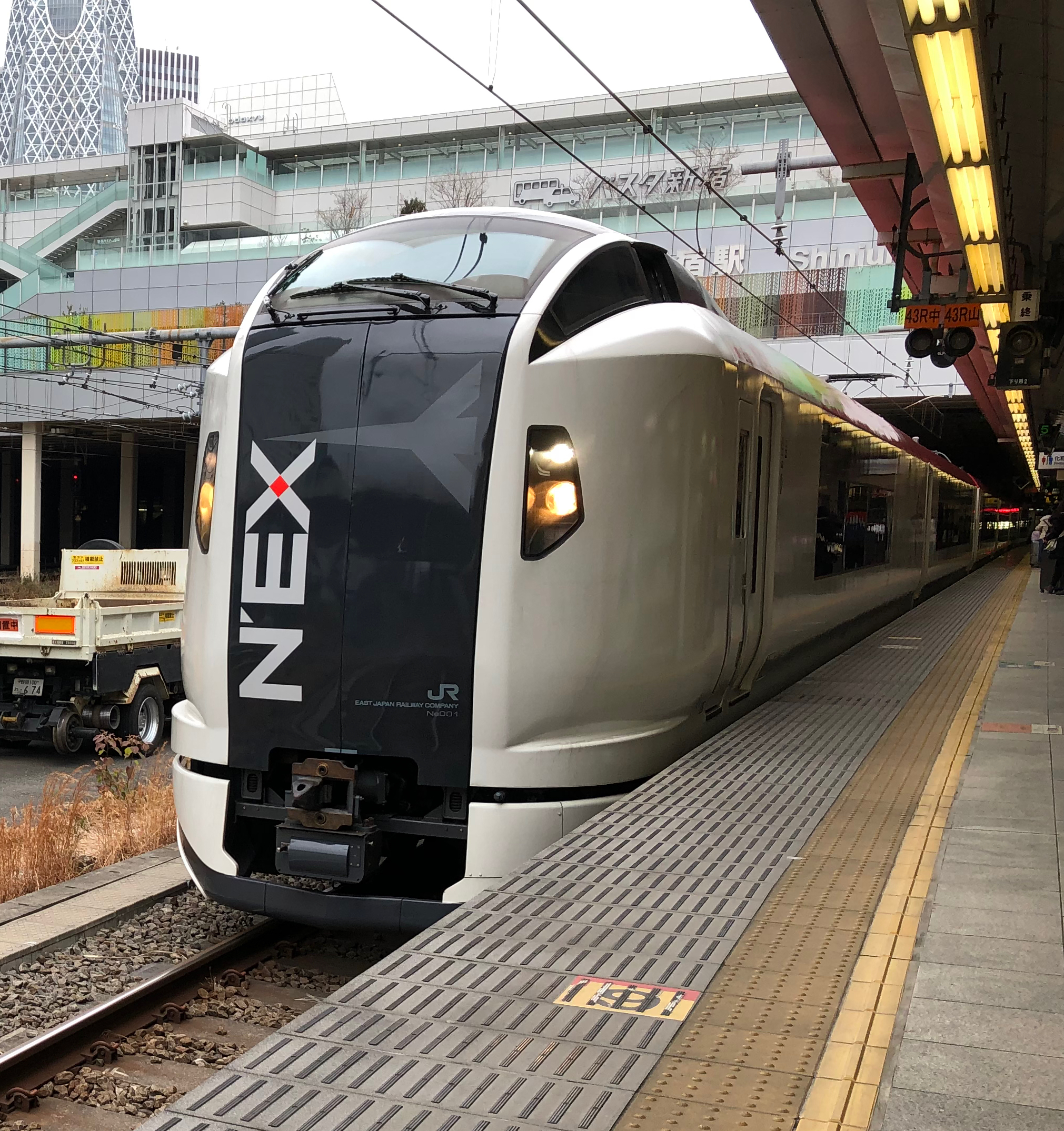
I've even ridden fancy trains without leaving Tokyo. The sleek N'Ex runs north to south through Tokyo, with its northernmost end at Narita Airport (N'Ex means Narita Express). Like many Japanese express trains, all of its seats are reserved, and you need a designated seat ticket to get on board. 

All aboard the Narita Express

Japan even has a number of historic trains still in operation - or, like the one below, on display at museums and parks near the tracks where they used to run. I haven't ridden any of the old steam engines yet, but it's high on my list.

A steam locomotive on the historic Kiso Road

The workhorses of Japanese rail remain the little local trains, which usually have between 1 and 3 cars, depending on the needs of the communities where they run.

The local Tobu train, at Ryuokyo, Tochigi Prefecture

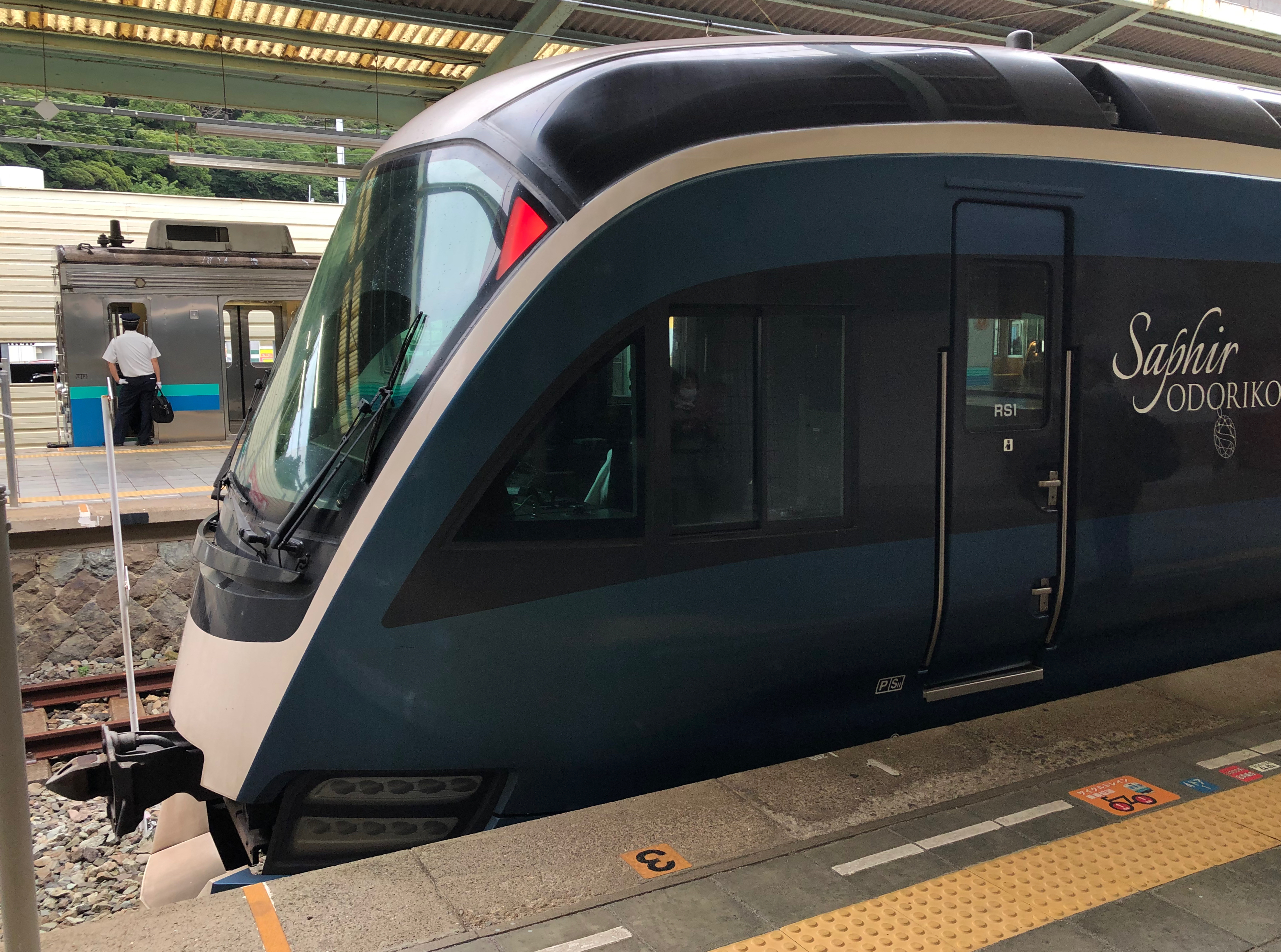
Sightseeing trains are gaining popularity. While some people ride them purely for transport purposes, the rail companies advertise special trains like the Saphir Odoriko below as a destination in and of themselves.  

Saphir Odoriko, Izu

And they're not wrong. The Saphir runs along the coast between Tokyo and the southern tip of the Izu Peninsula, about 3 hours from Tokyo. All of the cars have a view of the ocean, and it's a lovely way to spend a relaxing afternoon.

Still other trains feature exterior "wrap" designs intended to draw attention to special aspects of the area in which they run, or local history or culture. 

Wakayama History on a train

The traditional samurai images on this train in Wakayama prefecture are designed to share a little about the history of the region, and inspire interest in travel to local historical sites. 


In the last few years, Japan has increased its focus on sustainability (always an important part of Japanese culture, but now being taken to a more global level). And yep, it's made its way to the trains as well, with the Sustainable Smile Panda, a special train in Wakayama Prefecture that hopefully makes riders think about conservation of animals and the environment. 

Sustainable Smile Panda

In addition to the cute design, signs inside the train remind riders about the importance of conservation and sustainability, and explain that the train is using prototype engines that reduce emissions, conserve fuel, and use alternative fuels; the hope is that this technology will spread throughout Japan in the years to come. 

Don't look now, but I think they're watching us.

In case you hadn't noticed, it's also really, really cute.

Pandas in Wakayama

A lot of the special trains I've ridden to date were happy accidents, but I like them so much that I'm turning into a nori-tetsu (乗り鉄) - the Japanese term for a train enthusiast who enjoys riding trains (as opposed to a model train collector). In the years to come, I plan to ride as many special trains as possible - and I promise I'll take you along, both on my own blog and here at MIE!

All aboard!!

So... are you a train enthusiast too? Or would you rather not be ridden out of town on a rail?

Sunday, October 10, 2021

All Aboard! Celebrating Japan's Unusual Trains

 --Susan, every other Sunday

The first railway in Japan was built in 1872. The single-line track connected Tokyo and Yokohama, and featured an imported British locomotive that ran at a dazzling maximum speed of 32 kph (20 mph).

Like many items imported from the West, trains were enormously popular in Japan, and the idea of travel by rail literally took off running. By 1889, it was possible to travel all the way from Tokyo to Osaka by train--a distance of 515 km. There was one daily departure in each direction, and the trip took 20 hours.

Today, the high-speed shinkansen bound for Osaka (and points beyond) departs from Tokyo station every 30 minutes between 6 a.m. and 9 p.m., and if you board one, you'll disembark in Osaka in a little less than 3 hours' time.

The country is so enamored with rail travel that it's possible to get almost anywhere by train--including some places so rural that the stations are little more than an elevated platform beside the rails. (Some of them, not even covered, though fortunately most of them do offer basic shelter from the elements.)


Semi-rural platform in Hokkaido, near Lake Onuma

At least two kinds of trains run on most standard tracks: local trains, which stop at every station, and express trains, which cost more, but move faster (and generally bypass smaller local stops).

Limited Express Hokuto, in Hokkaido

While many local trains are more utilitarian, and less colorful, in design, there are exceptions--usually either limited-time promotions (like the Pokemon trains in Tohoku, north of Tokyo) or sponsorships (like the "Thomas the Tank Engine" themed trains that run on the FujiQ line to the Fuji Five Lakes region).

Historic trains also usually get special colors and themes, like the brightly colored cars of the Hakone Tozan Railway--which also look delightful in the snow.


Trains on the Hakone Tozan line, near Gora (Hakone area)

The Narita Express offers rapid service between central Tokyo and Narita Airport--the more distant of Tokyo's two major airports. (It stops at other places too, along the way.)

Narita Express

Japan is proud of its history--including the history of its rails--and has several train and railroad-themed museums around the country. The train below is one of the original steam locomotives that traveled the mountainous Kiso valley; it's now on display near Kiso-Fukushima, along the old Nakasendo travel road.

A memory from the days of rail travel in the Kiso Valley

Local trains like the one below are utilitarian "workhorses," moving the majority of the (more than) 18.5 million Japanese people who travel by rail every day.

Local train in Tochigi Prefecture, north of Tokyo

Many trains have decorations painted on the outside to promote the history of, or sites of interest in, the prefectures or regions in which they run.

Express in Wakayama Prefecture painted with historical figures related to the region

More historical scenes on the Wakayama Express

Express trains are often named for regional features too, like the "Stork" pictured below, which runs through Osaka, Kyoto, and Hyogo Prefectures - the latter of which is home to a reintroduced population of endangered Oriental White Storks.


Let's ride the stork!

Preservation of endangered animals, and environmental conservation, are increasingly important issues in Japan--and what better way to raise awareness than a train?


The "Panda Conservation" train in Wakayama Prefecture


Side paintings on the Panda Conservation Train

No post about Japanese trains would be complete without a mention of the biggest, best, and fastest: the shinkansen--often known outside Japan as the "bullet train"--the high-speed rail system that connects all four of Japan's major islands, and makes it possible to travel all the way from Hokkaido in the north to Kyushu in the south--a distance of over 1,900 kilometers--in twelve hours. (Flying is faster, but to travel that far by ground in a single day is pretty impressive.) 

As of October 2021, the fastest shinkansen travels at top speeds of 320 kph in service (and there are plans to introduce a new Alpha-X train, which will travel at 382 kph, in the next few years). 

Shinkansen (look closely) arriving at Odawara Station

Shinkansen are longer than other trains, and travel much faster, so they require much larger stations--usually with passing tracks in the center, so the faster trains can pass through without stopping while other trains are stopped at the station platforms.


A long-nosed beauty pulling into the station

Although all of the high-speed trains are "shinkansen," they're subdivided based on travel speed, number of stops, and rail line. The Nozomi, Hikari, and Kodama shinkansen run along the most heavily traveled Tokaido-Sanyo line, which connects Tokyo with popular destinations like Kyoto, Osaka, Kobe, and Hiroshima. Of the three, the Nozomi is the fastest, and makes the fewest stops--and is one of the few trains that isn't covered by the Japan Rail Pass (which allows foreign visitors to travel for 7 or 14 days without paying for individual fares on every train they use, but requires them to use the slightly slower Hikari and Kodama trains).

This is how baby shinkansen are made...

The fastest shinkansen, called the Hayabusa, runs only to the northern Tohoku region (and to the shinkansen terminus at Shin-Hakodate-Hokuto, on the island of Hokkaido). The engines are so fast and strong that they often couple slower trains to a Hayabusa for the first part of the journey north from Tokyo, and uncouple them at Morioka, where the track splits into a northern line (for Aomori and Hokkaido) and a western line (to Akita).

Railroad tracks in Hokkaido

 
I've always loved trains, and living in Japan has only made my attachment to them stronger. I can't begin to count the number of hours I've logged on every type of Japanese train--but I can tell you I plan to ride many, many more.

Are you a fan of travel by rail? Would you go out of your way to ride a special one? (I have, and I'll do it again!)



Sunday, June 12, 2016

To Kyoto by Shinkansen

-- Susan, every other Sunday

Today (Sunday, June 12) I'm headed to San Francisco, to put my son (in the blogging realm, I call him The Junior, though he's starting his senior year this autumn so that might have to change) on a plane for Tokyo. He's spending the summer working at a children's home (essentially, an orphanage) just outside the Japanese capital.

I must confess, I'm more than a little jealous.

Admittedly, my jealousy has less to do than spending eleven weeks surrounded by small, demanding humans than with the weeks before and after the internship, which my son will spend traveling in Japan.

This is what he'll be seeing.

And this.

In honor of his departure (and also in anticipation of my next research trip, which will fall sometime in the next 18 months), I thought I'd share a little about the joys of travel by Japan's most popular mode of transportation . . . high speed rail.

The distinctive nose of the "bullet train."

The shinkansen (or, in English, the "new trunk line"), also known as the "bullet train," is the world's busiest high-speed rail line, carrying over 150 million passengers per year.  Although the shinkansen can operate at speeds in excess of 325 miles per hour, the maximum operating speed on public lines is "only" 200mph (320 kilometers per hour).

The Japanese countryside at 200mph

The original shinkansen rails were laid in the early 1950s, and by 1957 the Odakyu Electric Railway set a world record of 90 mph (145 km/h) with its high-speed narrow-gauge train. The Tokaido Shinkansen line opened for service in October 1964, and the high speed trains have been one of Japan's most popular (and most famous) forms of transportation ever since.

It takes about two hours--including stops--to travel from Tokyo to Kyoto by shinkansen (a distance of just over 300 miles).

Another shot of that lovely, aerodynamic nose.

Travelers can either opt for "reserved seating" or "open seating"--and travelers with a Japan Rail pass (think Eurail....for Japan) can either hop into any open car or reserve a seat at the ticket counter for a specific train. During last year's research trip, we opted for reserved seats, and realized fairly quickly that it's a fantastic way to ensure a quiet ride:

Apparently, we're the only ones who plan ahead...

(Truthfully, Japanese train etiquette requires silencing mobile phones and either reading, listening to music via headphones, or talking at whisper levels so as not to disturb or inconvenience those around you. Japanese trains are thus a delightful, quiet way to travel.)

Although the landscape rushes by, the train is silent and surprisingly still--you hardly feel it moving.

Again - taken at almost 200 mph.

Periodically, the door at the front of the car will open to admit a uniformed woman pushing a "snack cart" laden with a breathtaking array of treats, everything from cookies, candy, and sodas to entire bento box lunches. (One variety of travel lunch even includes a "heat pack" that warms the sesame beef and rice inside to restaurant-quality temperatures in less than three minutes. Japanese travel food technology is something I dearly miss in the U.S.A.) If you've ever wished to partake of the snack trolley on the Hogwarts' Express . . . the shinkansen snack cart offers an excellent stand-in.

Chocolate matcha (green tea) sponge. DELICIOUS.

Electronic signboards at the front of every car announce the name of upcoming stops and, in between, gently remind travelers to silence mobile phones and show respect for those around them. "Thank you for traveling on the shinkansen," one message reads, "we hope you have a pleasant day."

Some lines have these messages in English, too.

I never thought I'd consider an afternoon on public transportation "pleasant" but the shinkansen always proves me wrong.

Any day when I get to cross Japan by train is a pleasant day, indeed.