Showing posts with label Floods. Show all posts

Wednesday, April 6, 2022

Staying Above Water

Sujata Massey 


It takes just two tanks of gas to get the 11100 miles between here and Southern Louisiana--and no tolls to pay either. I know this because last week, I drove there with my husband to see his mother and brother and the rest of the family. Sharing the driving made it relaxing, as well as our decision to stay in old hotels and inns both ways. 


Louisiana is the kind of place where there’s so much to look at, taste, and feel that I inevitably become interested in something unexpected. This time, I saw the rebuilding of houses after Hurricane Ida. I casually use the expression 'keeping my head above water' to express that I feel too much is going on. But in Louisiana, that phrase is literally something people worry about  every fall. 


Tony grew up with his older brother, Don, in Metairie, a near suburb of New Orleans. A few years after the destruction of 2005’s disastrous Hurricane Katrina, both my mother-in-law and my brother-in-law worked hard to rebuild their properties. And then they both made decisions to get farther away from the Gulf, settling in the towns of Mandeville and Covington. These neighboring towns lie on the north side of Lake Ponchartrain, a massive body of water that has a 35-mile long causeway that connects it to New Orleans and its near suburbs.  


While still classified as South Louisiana, my inlaws' new home base--part of St. Tammany Parish--is too far to be at risk from a gulf surge. However, there is that lake I just mentioned.  630 square miles.  


Don’s spacious house was built on pilings 20 feet high. It lies about two blocks from Lake Ponchartrain. My mother-in-law’s nursing home in nearby Covington was built far from the lake. However, it is vulnerable to the threats of wind damage and power outages.


Tony remembers many hurricanes from his childhood in the 1960s through the early eighties. He recalls the routine of piling into the car and evacuating to a motel in Northern Lousiana whenever the evacuation orders came. After 1969’s devastating Hurricane Camille, my late father-in-law, Sam, took Tony and Don on a road trip  along the coastline of Louisiana and Mississippi so they could see things like massive fishing boats run aground into the middle of shopping districts. 


Katrina is the biggest hurricane on record for Lousiana. Reaching Category 5 status in the ocean, it reduced slightly to a Category 3 hurricane when it arrived in New Orleans. The water surge was so forceful that several New Orleans levees failed. Much of New Orleans flooded, with people drowning in their own houses or on the road when they tried to flee. Katrina caused 1577 deaths in the state, with smaller numbers of deaths in Mississippi, Georgia, Alabama and Florida, as well as plenty of property destruction. 


When Katrina came, Tony's family was safely evacuated to North Louisiana. However, their homes in Metairie were damaged. Don's home had flooded; even though it was less than a foot, that was enough moisture to destroy all the walls. Part of the roof was pulled off at the house in Metairie where the boys grew up and Tony's mother, Harriot, still lived. Harriot came to live with us in Baltimore for several months, until Don had overseen the completion of repairs to her house; his took a lot longer. 


They were among the lucky ones. Other people never were able to salvage their houses and became renters. Thousands of people left New Orleans as disaster refugees, their homes and possessions destroyed, and settled in other parts of the country. 


Katrina brought so much pain that Hurricane Ida arriving in 2021 seemed like a cruel cosmic joke. I’d planned to be in New Orleans in September 2021 for the Bouchercon World Mystery Convention. In late August, I reluctantly cancelled my hotel and flight because Delta was spreading exponentially in Louisiana--faster than anywhere else in the country. Enough Bouchercon participants were cancelling for this reason that the convention organizers opted to cancel that year's convention, postponing the hotel reservation for a future year. Lo and behold, Ida announced she was coming into town that very weekend. 


Ida came on Sunday, August 29, with 150-mile an hour winds and heavy rains. Evacuation had been recommended and most people, but not all, had left New Orleans. Fortunately, the redesigned levees held the water from flooding the city. The greatest damage came from the fierce winds. An estimated 92 people died due to the storm in nine states.


Tony's mother stayed in the nursing home and all was well there, given its good location and back-up power sources. Don, his wife and youngest daughter evacuated north. It was a good thing, because their part of Mandeville was flooded, leaving two feet of mud in the open area under the house where his cars would have been parked, if he hadn't removed them. 


House elevated on pilings in Old Mandeville


People in Louisiana are used to storms, and they clean up as fast as they can afford--and if FEMA and insurance come through for them. This time around, because of pandemic supply chain problems, construction supplies took months to arrive—and construction workers were in short supply, as they are across the country.  


A neighbor's house on temporary risers


As I walked around the neighborhood filled with lush trees and tropical foliage, I noticed most houses were on pilings, and others were in the process of being raised, with blocks underneath. I gazed into the neighborhood's ditches, a historic and simple way to assist with the diversion of overflowing lake water. These ditches are cut into the earth alongside the roads near the lake. The ditches held murky water, weeds, and occasionally, visitors from the lake. We were advised to go out walking carrying a long pole in order that an alligator might emerge and behave aggressively. During our walk, it turned out the gators had better places to be. 


I paused at one house right on the lake that was vastly bigger than the others with an unusual wrap around style. Someone had recently bought the acreage, which originally had an old, small house on it. The original house had very inexpensive flood insurance. In order to keep the same low insurance rate, the home buyer could not tear down the original residence. Instead, he built his dream home  to encapsulate the old one. And yes, it’s on stilts—but because he elevated at 15 feet, rather than 20, the space below isn't highenough to house all his vehicles. 


The truck on the left just can't make it in


Mandeville has a charming historic section nestled along another stretch of the vast lake. In "Old Mandeville," you can eat biscuits and shrimp and grits at Café Lalou and shop for candles and vintage towels at a number of small shops.  The town was developed as a summer resort community for wealthy New Orleanians to visit in the mid 1800s through the early 20th century. Most of the historic cottages in this area were built so long ago nobody thought about elevation from possible lake flooding. Many of the vintage cottages still rest on the ground, while others are getting a boost. 


Classic old Mandeville cottage


A historic lake-side building in the process of rising


While we were in Louisiana, we visited Randy, my husband’s close friend since primary school days in Metairie. Sitting together in 79-degree warmth of a back yard in Covington, Randy mentioned he was part of the Cajun Navy.   This informal volunteer group—which came together around Hurricane Katrina--is a term for the owners of private small boats who drive them into flooded areas to rescue people trapped in their homes. 


Randy has driven his boat as far as Texas to assist in rescue missions down flooded highways. When Ida came and power was lost to many neighborhoods around Lake Ponchartrain, repairs were delayed because of giant fallen trees that blocked access to streets. Randy got in his own truck, brought some saws from the garage, and went to a neighborhood and chopped the trees apart so the neighborhood could be entered. He did this because he knew about a friend's elderly mother living alone in this cut-off neighborhood. He got to her and brought her out to stay with him and his own family until her neighborhood's electricity was restored. i


The ongoing work of Randy and other volunteers in Louisiana reminds me of a legendary water rescue in Europe known as  Operation Dynamo.  In the aftermath of the Battle of Dunkirk in 1940, 338,000 British and Belgian soldiers were trapped on the beach in France. Nazi forces had control of the town. British people living along the coast sailed out to rescue them at the French beach, assisting the Royal Navy. Saving so many lives was a miracle and surely essential to the Allies ability to continue the war and ultimately defeat the Axis powers.


To drive away from the threat of surging water, leaving everything behind to uncertainty, is a fear I've never experienced. Just as I could not picture myself commandeering a boat on flooded highways. But with a lifetime of storms, people can gain extraordinary strength.  

Monday, September 4, 2017

The Rains of East Africa

Annamaria on Monday


Author’s Note: I wrote the piece below just as it stands and collected the photos you see here the week before Hurricane Harvey began to threaten the Gulf Coast.  The forces behind the disasters I describe and the ones in Texas and Louisiana are the same.  Our planet needs more than prayer.  It needs us to behave as if we care about it.  And about one another!


Unlike the Fall/Winter/Spring/Summer weather pattern that most of are used to, Equatorial East Africa ordinarily has two seasons: wet and dry.


People going on safari and keen to see animals are ordinarily advised to go in a dry season.  This is when thirsty animals are guaranteed to visit water holes.  Most camps provide a water source so animals will come and put on show for their guests.  In this situation, the dry periods are considered optimum.


Back during the time I write about in my historical mysteries, attitudes were different.  Almost all the early European memoirists of British East Africa expressed longing for the rains.  Most of them were farmers, and farmers have always fussed over rainfall.  Those early Twentieth Century newcomers adopted the attitudes of their tribal neighbors—early and plentiful rains were a joyous event.  In Out of Africa, Isak Dinesen expresses a continual worry over failing rains, which would lead to failing crops, which would mean bankruptcy, forcing her to return to Denmark.  She characterizes the rains as a potential perpetrator of a fearsome crime.  A misery that eventually befell her.

My settler characters have a similar relationship with the weather.

In East Africa, from Somalia far down into South Africa, the vagaries of the rains were then and still are potentially life threatening.


The climate of the area is alternately dry and wet.  Two rainy periods are expected (actually, hoped and prayed for) every year: the Long Rains and the Short Rains.  The first ordinarily begin in March or April and end in May or June.  This is followed by a dusty period until October, when the short rains are supposed to begin and last into November, perhaps December.


A major factor in Mother Nature’s properly delivering the vital water is the temperature of the Indian Ocean, which—no surprise—has been rising.  This makes the rains even more unpredictable.  The warmer ocean is what climatologists call “anthropogenic”—caused by the activities of human beings.  It is a direct result of greenhouse gasses collecting in our sacred planet’s atmosphere.  We used to call it “global warming,” but that is too simple a moniker.  What’s really happening is that climate change ramps up the extremes: wet areas get wetter and dry ones get drier, bringing floods and droughts.  These phenomena are more pronounced in East Africa with its ordinarily alternating dry and wet seasons.  Sudden heavy rains on parched earth mean flash floods, when bridges and animals and people are carried away.  Drought conditions mean no food—not for the people and not for the animals.  Flooded fields mean rotted crops.


Tragedy has struck in these past few years.   Millions of people in the area are threatened with starvation.  They are not the people who have created the current situation.  But they the ones paying the price.

I end with a hymn—a prayer, for beautiful rain—in just the right amount—for the suffering animals and people of Africa.


Sunday, June 23, 2013

This week


Lisa asked me to fill in for her today as she is on tour for her newest book, HOUR OF THE RAT.  We all hope that it is very successful.

It has been another strange week in the world, so I thought I would highlight various items that caught my eye.

Nelson Mandela

My hero, Nelson Mandela, is in hospital yet again having been admitted about two weeks ago.  According to South Africa’s President Zuma, Madiba, as Mandela is known, was responding to treatment and is in serious but stable condition.  America’s CBS News, however, reported that Madiba hadn’t opened his eyes for days and that his liver and kidneys were only functioning at 50 percent, and that he had undergone two surgeries.  It also claims that Madiba’s heart had stopped at one stage, and he had to be resuscitated.
A young Mandela - in 1937

A more recent photo


It also came to light this week that the emergency ambulance that was taking Madiba to hospital in the middle of the night two weeks ago broke down en route to the hospital in Pretoria leaving him and his wife stranded for 40 minutes in 45 F (8 C) temperature.

Rapport newspaper reported that Mandela’s close family was deliberating on ““just how much medical intervention was enough for an old and very sick man”.  My cynical side wondered about Michael’s blog of a couple of weeks ago (Don’t live too long . . .) in which he reported that Mandela’s daughters, Zenani and Makaziwe, were in court seeking to get control of their father’s trusts.

[For those of you interested in why Mandela is called Madiba, it is customary to honour someone in South Africa by giving them the name of the clan they belong to.  Mandela is a Xhosa of the Madiba clan.]

Water

It seems that it is raining heavily almost everywhere in the Northern hemisphere.  My newspaper today reported that 4500 people may have died in flooding and landslides resulting from pre-monsoon rains in Northern India and Pakistan.

Rescue worker in India

Shopping is difficult in monsoon season

Calgary in Canada suffered its worst flooding ever, leaving 70,000 people homeless until the floods recede.

Devastating Calgary flooding

More from Calgary


Here in Minneapolis, we had three waves of thunderstorms come through over the past three days, leaving more wind damage than flooding.  Half a million people were left without power, largely due to thousands of trees that were blown over because the soaked soil was unable to hold them up in the face of the high winds.  Fortunately the temperatures were balmy.

Water-logged soil caused trees to fall

And road to collapse

More from Minneapolis

Protests

The civil war in Syria took a backseat to the protests in Turkey that started initially in reaction to the government wanting to develop part of one of Istanbul’s only green spaces, Gezi Park.  There was a lot of water there and in Taksim Square, where police doused protesters with water cannons.  Prime Minister Recep Tayyin Erdogan took a firm stance against the protesters, saying at one stage “Nobody but God will have the power to overthrow our government.”  Several protesters have died in the turmoil.

At least it's not bullets

I hope it wasn't cold outside


Brazil too saw massive protests initially against a hike in bus fares in Sao Paulo.  It rapidly spread across the nation of 195 million into protests against corruption and lack of basic services, as well as anger that so many billions were going to spent on the 2014 Football World Cup and 2018 Olympic Games instead on education and uplifting the poor.

We need more jobs

No caption needed

Millions protest

Tear gas

I fear South Africa could see similar protests when Madiba dies.  

Is it possible that it will pick up the World Cup if Brazil defaults?  After the 2010 World Cup, which it hosted so successfully, it is not out of the question.


World’s oldest embrace

South Africa’s Mail & Guardian newspaper reported this week on what must be the world’s oldest embrace:

“The rain was pouring down as the skies opened up in the Karoo Basin 250-million years ago. An injured amphibian Broomistega, possibly hurt by the storm, crawled into a sleeping animal's burrow to shelter from the violent weather. It is suspected that the mammal-forerunner Thrinaxodon – which, from simulations resembles a furry Komodo dragon – was hibernating, although when done for short periods of time this is called aestivation.
Both animals died, and their fossilised embrace, discovered by South African scientists, marks a world first. “

I, Broomistega, take you, Thrinaxodon, to be my ...

Creationism,

I read something this week that I found quite remarkable.

"Forty-six percent of Americans believe in the creationist view that God created humans in their present form at one time within the last 10,000 years.  The prevalence of this creationist view of the origin of humans is essentially unchanged from 30 years ago, when Gallup first asked the question. About a third of Americans believe that humans evolved, but with God's guidance; 15% say humans evolved, but that God had no part in the process."
                                                                                                2012 Gallup poll

Greece closes public television station

In what was called an effort to deal with the budget crisis in Greece, conservative Prime Minister Antonis Samaras decided to close down the Hellenic Broadcast Corporation (ERT). The country’s national broadcast service.

Great poster
The leaders of the other two parties in the government coalition were outraged. 
Protests have taken place against the decision.  Hopefully Jeff can fill in the details.

Lost firearms
Gun dealers in the USA lost 10,915 firearms last year.  So much for responsible gun ownership.

Obama’s African safari


The Telegraph reported last week: “Barack and Michelle Obama have reportedly scrapped a safari during their trip to Africa because of the costs of snipers needed ’to neutralise cheetahs, lions and other animals if they became a threat’.”


I’m delighted.  Who knows what would have happened had a baboon jumped on the game vehicle to pilfer food.

Oh Barack, what am I going to wear?

How I beat Serena Williams at .. tennis

Last Tuesday, as I was checking in for my Delta flight from Heathrow to Minneapolis, I had an interesting experience.  (And, no, it’s not another airline story of woe like Michael’s unbelievable experience last weekend – A Personal Best).  A woman, obviously from Delta, walked up to me and asked if I would like to play table tennis with Serena Williams.  I agreed with great alacrity – after all, Serena is one of the greatest tennis players of all time.  Why would I not want to play against her?  Needless to say, it was a puzzling request.

Apparently Delta was having a big promotion for its new terminal at JFK in New York, from whence Serena had just arrived.  A table tennis table had been set up in the check-in area in Terminal 4 at Heathrow.  There were cameras everywhere, and reporters were buzzing around like mosquitoes on a Minnesota lake to witness the several passengers who had been recruited to compete. 

That's me hidden on the left!


After a brief warm-up, my partner – a talented young woman with a two-fisted backhand (in table tennis?) – and I squared off against Serena and her partner.  The game was somewhat abbreviated I have to admit (best of five points), but my partner and I prevailed 3-1.

Serena waves graciously after losing to my partner and me

As you can see, I am going to make the most of these bragging rights.


Stan for Lisa - Sunday

Thursday, January 31, 2013

The Great Escape

Shingwedzi Camp, Kruger National Park
I stayed in one of those bungalows with friends last year.

Last week saw a mass break-out of around fifteen thousand highly dangerous inmates on death row.  They were held at Rakwena in north-west South Africa, near the Botswana border and also near the Limpopo River.  Although some of the escapees have been recaptured, nearly ten thousand are still at large.  They were the beneficiaries – perhaps the only beneficiaries – of a major cyclone over Mozambique which caused the Limpopo River and much of the Limpopo province of South Africa to experience another massive flood event.  Kipling’s “great grey-green greasy Limpopo” showed what sort of stuff it’s really made of.


So back to the great escape.  Actually, it wasn’t an escape but an evacuation.  As the flood waters rose at the Rakwena Crocodile Farm (Kwena means crocodile), the external pressure of the water on their holding areas became intolerable.  So the staff opened the gates, and shortly afterwards 15,000 crocs of various ages – destined to become handbags and the like – took off into the great outdoors.  In fact, the river eventually flooded the farm completely, so the crocs were heading for the exit in any case.

 The escapees made it their business to put as much distance between themselves and the crocodile farm as quickly as they could.  Well, so would you if you were going to be turned into fashion boots.  One was found a few days later nearly eighty miles away on a rugby field at Muskina.  Others were spotted at parks, rivers, golf courses…

Water trap?
The crocs were described as “not large,” which seemed to mean under eight foot.  I would hate to meet any of these “not large” crocs on a dark night!  The Rakwena folks also said they were “domestic” animals and used humans to supply food rather than as food.  Hmmm.  I’m not too sure how crocodiles think about us humans; the Nile Crocodile is the animal responsible for the largest number of human deaths in Africa.  Wildlife authorities advised people to "stay indoors and keep away from the crocodiles".  Not easy to do when your house is being flooded!


Catching the crocs is mainly attempted at night, when their eyes reflect bright red in the beam of a spotlight.  It’s still a messy business, involving jumping on the creature, taping its jaws and avoiding its tale.  I won’t be applying for that job, thanks.  If you want some tips as to how it's done, take a look at this video Capture


A less humorous aspect of the story is that the floods forced people to wade through these swollen waters.  They probably found the thought of sharing it with fifteen thousand crocs less than hilarious.  Still, in fact there have been no reports of attacks. It was the floods themselves that killed more than twenty people…

Michael – Thursday.

Monday, June 11, 2012

Wet and Dry


From North to South, Brazil spans a little over thirty-nine degrees of latitude, more than four-thousand-three-hundred kilometers, (greater than the distance between New York and Los Angeles). 

From East to West it's not quite that big -- by about fifteen kilometers.
No wonder, then, that Mother Nature subjects this country to great variations in climate.
But this year the Old Lady has been unusually capricious.
To begin with, rainfall has been at record levels. This sign showed the high-water mark of the worst flood ever to hit the city of Manaus on the day the record was broken.
There, not far above the point where the Rio Negro becomes the Amazon, many people build their homes on stilts.
This year, for the first time, they’ve been forced to add extra floors - or suffer the invasion of their homes by water, rats and snakes.
And while the people in the Amazon region have a surfeit of water, the farmers in Bahia can’t get enough of it.
As a result of which, their crops and their cattle are dying.
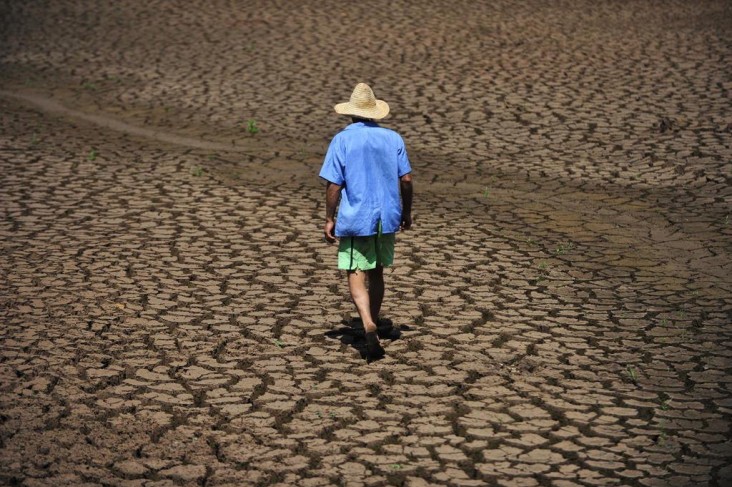
Their rivers have run dry.
Their reservoirs have emptied.
And the little water that remains has become largely undrinkable due to the concentration of ground salt.
Meanwhile, at the other end of the country, the scenario is much the same.
In Rio Grande do Sul two hundred and seventy-nine communities have declared a state of emergency for lack of water.
More ruined crops.
More dying cattle.
And yet twelve other communities in the same state have been forced to ask for federal aid to solve a different kind of problem.
Flooding.
Yet, despite it all, Brazil’s economy continues to grow, and São Paulo continues to be one of the most expensive cities in the world to live in. 
Please don’t ask me to explain this, because I can’t.
And most Brazilian economists can't either.
And all I know is that, in this town, poverty and great wealth have always lived side-by-side - no matter what Mother Nature keeps doing to us.
Leighton - Monday