Showing posts with label Books. Show all posts

Tuesday, September 9, 2025

Books, Books, Books and Book Space

Ovidia--every other Tuesday

I’ve kind of been struggling with books lately—not just the ones I’m writing, but the ones I’ve been living with. I have shelves and stacks and cupboards full of books. Some of them books I haven’t opened in years,some that I've never opened--period. And that's the big problem; I’m not reading them. And they're sitting there judging me and my weak eyesight or weak will power or just lack of energy... and that’s not fair to the books—or to me.

Yet it feels wrong to give them away because many/ most/ all of these books feel like a part of myself. If I let them go, would I be losing the person I was when I first bought them? When I first fell in love with them?

Because isn't my whole identity that of someone who reads?
But why?
I want to read for enjoyment, of course. That's how I first started reading, and that still holds. But I realise the primary way I take in the world around me is through reading. It's what feeds me. And lately, I've been reading less than any other time in life. Reading over lunch or dinner or for an hour before bed... quite pathetic, really. But I wasn't doing anything about it because it only came up when I was too tired to deal with it.

But recently I was 'forced' to confront this.
I’ve signed up for something called the 5X5 'Flow Prone' course by the Flow Lab, which is designed to help you reliably achieve flow state in your work--in my case, writing.

(This isn't an ad--I'm just starting the 3rd week, but I'll let you know how it goes!)

The idea is take action, however small, in the 5 key areas, 5 days a week. PRONE an acronym for Physiology/Regulation (mental)/Optimisation(work smarter)/ Nutrition / Environment.

The first 4 categories were pretty easy, once I got organised.

Physical: I get 60 to 90 min of pilates or yoga in the morning and walking, slow jogging and swimming in the evening.
Mental Regulation: I do my morning pages, including noting things I’m grateful for, what can be improved, and pick the day's steps towards my weekly, monthly and long-term goals.
Optimisation: I've downloaded the Freedom app, which blocks apps and distractions on all my devices during my work hours (9–11 a.m. and 2–5 p.m.).
Nutrition: We're happy with our meal plan.
But the fifth one—environment—is where I’ve fallen down most badly--and it's mostly because of all my books.

One step I have taken is exiling my “writing buddies” from my desktop to the shelf above...


I need them nearby, because they're the ones who play roles when I'm trying to figure things out.


And these are the editors who listen (and sit in judgement) when I read passages out loud to see how they sound!

But the big step, that's much harder but I'm determined to take, is giving away some of the books I know I’ll never read again. And that is really painful.


I am still reading, but moving from paper to ebooks and audiobooks feels a little like betraying a first love. But then I remind myself: people probably once said the same about hand scripted parchment manuscripts when Gutenberg’s press came along. Weren't early printers were accused of destroying tradition? And before that, perhaps stone carvers sneered at the newfangled feather quills—would the Ten Commandments have counted if they’d been written on treated rawhide instead of chiseled in stone?
And even the act of writing something down was a step away from the stories we used to share around the campfire after a day of hunting wasn't it?
Because in the end, it’s not about the medium but the stories we share, the chance they give us to look at ourselves, our lives and the wonderful, unbelievable potential of being alive in time and space.
And my precious paper books? One day they may feel like those tiny lotus shoes once worn by women with bound feet—treasured relics and part of heritage while being too impossibly constricting to be worn. I marvel at them even as I walk everywhere freely and easily in my huge Sketchers.
Because yes, a big advantage of e-readers is that I can zoom in and increase font size, and contrast, making reading much easier on the eyes.
And yes, I still treasure my paper books. They will always be a precious part of me and of the life I crafted around my love of reading.
So yes, some of my books are going new homes--via book exchange shelves and the library's Big Book Giveaway (September 13-14, 2025, from 10am to 4pm at The Plaza, National Library Building, Singapore if anyone's interested). The biggest risk is of course that I might come home with more books than I leave there! I still own more physical books than I will ever finish reading and I'm still buying them... I'd really like to know how everyone else is managing their libraries. I'm guessing it's easier in less humid climes.

Thursday, May 29, 2025

Book Problems

 Wendall -- every other Thursday

 I’ve got a book problem. I have too many.

I have more books than bookshelves and more bookshelves than we can really fit in our apartment. 


Obviously not organized in any way.

At all.


I have books from childhood, beloved school reads, tons of college textbooks and tomes (with all my notes), as many books as I’ve been able to afford by my wonderful friends in the mystery community, research books for all my scripts and Cyd Redondo novels, and as I’ve posted before, a significant stack of particularly precious and ancient paperbacks held together with rubber bands.


Yes, that's a Bunyip.


For many years I’ve tucked books into strange places, added a few “front facing” copies, or “extended” the shelves I have with tall stacks of books on one side, topped with some kitschy object or other, to make it look intentional. Though the tops/pages don’t get as dusty this way, it still breaks my heart to have them on the floor.


For my husband, the solution is easy. Get rid of them! Horrors. Whenever he suggests a “clear out,” I just remind him that we could easily have physical copies of the 647 titles on my Kindle, so he should be grateful.


But, when a recent trip to Josh Spencer’s new Studio City branch of The Last Bookstore yielded a few particularly huge non-fiction beauties, I knew I had to find another way to handle books.


And I found it. Pottery Barn pedestal shelves – on the floor!


The pictures above only constitute some of the books in our living and dining room. Don’t even let me get started on our bedroom or our office. . .


I’ve talked about physical media before and how much it means to me and I feel the same way about the books. I realize I am probably part of the last generation that will ever have a house rammed with books and CDs and DVDs and albums this way. And I know from culling my albums six years ago, no one will really want this stuff when I am gone.


But for now, having books I can see and touch is one of the few things that makes me hopeful in a time of upheaval for all of us. I’m grateful we have a house full of knowledge and solace and inspiration and will, as long as we have any floor space left.


Because, in the end, can you ever really have too many books?


~ Wendall


Wednesday, June 12, 2024

Eating With My Eyes

 Sujata Massey


When life is stressful, resting my eyes on clear surfaces and straight lines helps me take a deep breath. Getting through the last pages of an edit is always a tough time--I'm housebound and frustrated. So during one of my stomps around the house, I caught sight of some overcrowded bookshelves and became obsessed with purging them. I expected this book cleanse would be easier work than my semi-annual clean-outs of the towering shelves in our dining room. This was a simple matter of tending to the walnut and maple-joined bookcases my husband built in our butler’s pantry twelve years ago. He's tremendously creative, and it its a sturdy, six-foot long, granite-topped set of two sturdy shelves that can hold almost two hundred cookbooks.  


I find it difficult to retire a cookbook. This is no matter whether it’s been used a lot in the past and has become threadbare or is pristine because of minimal use. I probably struggle also because I have strong feelings about cookbook authors. These writers often have professional cooking backgrounds. They test their recipes multiple times, they use science and history, and they are usually involved in the food styling and photography. My very favorite cookbook writers are also charming storytellers who mix personal tales along with teaspoons. This contingent is headed by the dearly departed MFK Fisher, Laurie Colwin and Elizabeth David. Still living, and writing wonderful stories along with their recipes, are Molly Wizenberg, Amanda Hesser, Dorie Greenspan, Hannah Che, and Priya Krishna. 


Until now, I hadn’t realized that so many food writing favorites are women. Is focusing on writing because of women’s exclusion from chef jobs for so many years? Or is it because cookbooks are a subgenre of "women's books?" What about the madness of dessert cookbook reading--does reading them hit the same brain receptors as a kiss?


There still are male authors on the shelves, of course. The most favored one is the late Craig Claiborne, who was restaurant critic and food editor at The New York Times from 1957 to 1986. Claiborne doesn't make time for stories, but he writes luscious recipes, never mind the vast amounts of butter and cream in most of them. Claiborne is known for multiple books, but our family favorite was THE NEW YORK TIMES INTERNATIONAL COOKBOOK,  published in 1971, the time my parents were setting up house in Minnesota. I can still picture the thick, dogeared hardcover taking up a big part of a small shelf in the tiny hall just off the kitchen. Whenever my parents wanted to make something exotic like Greek pastitsio or Hungarian goulash, they cooked from this book. The three children in our family had the chore of cooking supper once a week; the good news was it could be anything we wished. I tended to use the cookbook’s French section, because I was enthralled with the poetic names of the soups and entrees. My sisters favored the Italian section and became adept with spaghetti and meatballs, spaghetti carbonara, and even pizza. Yes—in the 1970s, in our family, nobody ever phoned out for pizza delivery--it was made from scratch! My parents and I sometimes had a conversation about what we would cook for Mr. Claiborne if he ever came to dinner. I wanted to make Chicken Chasseur, but my parents said Indian. They were firm in their belief that this was one area of cooking in which they were accomplished, and he was an amateur. 

After I went away to college in Baltimore, I was thrilled to find a first edition of THE NEW YORK TIMES INTERNATIONAL COOKBOOK in a used bookshop. I used it to cook for roommates and friends. The first meal I ever cooked for my future husband, during our college days, was his French section’s Chicken with Cream and Tomatoes. I was nervous about Tony having to wait too long, so I cooked very fast—and part of the interior of the chicken breasts was a vivid pink.
 

The following summer, I had a New York romance and was exposed to sophisticated cooking of the moment. I became enchanted with a cookbook that may have defined the 1980s: THE SILVER PALETTE COOKBOOK, written by Julee Rosso and Sheila Lukins. I learned about the luscious recipes paging through the book while visiting my boyfriend's mother's dream kitchen--and yes, she cooked from it--and did it well.  My romance fizzled, but the fabulous mother generously gave me my own copy of the cookbook. I left New York without a boyfriend, but I now had a mastery of pesto and dark chocolate cake.  


After college I went to the Baltimore Evening Sun as a general assignment features reporter, and cookbooks fell into my life at a rapid pace. It all started because I offered my reviewing services to a food editor overwhelmed by dozens of books sent by publishers each week. I tried out at least one recipe from each book and wrote reviews, getting letters of thanks—and sometimes anger—from the book’s authors. In the process I filled my Ikea Billy bookcases with that spanned such topics Thanksgiving dishes, biscuits and scones, and Indian microwave cooking. 


I gave away about a third cookbook collection before I got married and moved to Japan. At the Japanese bookstore Kinokuniya, I bought several beautifully photographed Japanese cookbooks—not quite admitting to myself that the dishes were more time-consuming than I could manage. But I still ate through those books with my eyes. 


It’s the same for me now that I’m back in the United States: I have an insatiable hunger for cookbooks that is only amplified by cookbook author interviews on podcasts and cooking videos on YouTube and Instagram. Because of the plethora of food bloggers, it’s easy to find recipes for free on the internet; however, the likelihood of these recipes failing is far greater than recipes by an experienced food writer tested and cleared for publication in a book. Because of the rise of googling for recipes, I fear for the economic wellbeing of cookbook writers; and this is another reason why I rationalize my cookbook buying.  


 Passing the milestone of forty, health became a powerful reason to invest in new cookbooks. I find myself going through phases of various eating styles with great enthusiasm. My vegetarian period involved several books on Indian vegetarianism by Madhur Jaffrey, and American books like Mark Bittman’s 996-page doorstopper, HOW TO COOK EVERYTHING VEGETARIAN. Mark Bittman also helped me through a pescetarian phase with his seminal book, FISH. During the years my kids were young, food sensitivities flew by the wayside. In the interest of time management, I turned to slow cooker books and anything that had the word “Quick” on the cover. 


Late at night is still my quiet time and the perfect opportunity to turn to rereading my favorite food memoirs. My love for literary food writing began when I accidentally discovered a few MFK Fisher classics that described her years living and dining in France—from glorious carefree days to severe food shortages during World War II. I devoured it all. The example of brilliant MFK Fisher led me to think I could make the best of leaving the newspaper to be a trailing spouse—if it were overseas. As a newlywed—just like MFK!—I would settle abroad in an unfamiliar, stimulating location where I would gamely take up a life of eating at restaurants, shopping at exotic markets, and learning to cook another cuisine. 


And reading these books brings me back to that honeymoon period with Tony in Japan. Throughout our time living in Hayama, a small town an hour south of Tokyo, we explored every type of café and home dining experience. This translated to rotary sushi bars, tea ceremonies, tofu-making classes, and old-fashioned US Navy dinners where a Campbells Soup-based casserole might be served with fanfare. But instead of writing a food memoir about this period, I found myself drawn writing a mystery that included food. For instance, there’s a horse sashimi appetizer in THE SALARYMAN’S WIFE that is taken straight from my memory of a tense New Year’s Eve dinner in the Japanese Alps. Another book, THE PEARL DIVER, delves into the backstage world of a Japanese fusion restaurant. Years later, I can’t imagine writing a book without the help of restaurant experiences or cookbooks. I often turn to regional Indian cookbooks to set the tables in scenes within the Perveen Mistry series. THE WIDOWS OF MALABAR HILL’s paperback edition contains an easy menu of dinner recipes meant for book-club potluck meals. 


So now that I’ve kissed a few cookbooks goodbye, I have good news. My brain calmed, and I finished my book edit. And I predict the eleven books I’ve left at various Little Free Libraries around the city will soon find themselves in new homes, inspiring people—whether they make a meal or not. 


Sujata recently had the good news of a Macavity nomination! Specifically, it’s a best historical novel nomination for her 203 novel, THE MISTRESS OF BHATIA HOUSE—which  describes in detail Gujarati teatime food. Multiple recipes from all her books and past blogposts can be found at her website.

Tuesday, December 5, 2023

Happy December Down Time!

Ovidia--every other Tuesday

Warning: hotchpotch ahead!

I'm happily nursing a minor infection, meaning I've been skipping yoga, pilates and the final round of proofs (not due till 15th Dec) with a clear conscience. And I'm really enjoying this down time!

The timing is perfect, since all my 'big' projects for the year are done (apart from those proofs) and I'm enjoying short walks, short swims and just being alive.

And I just got a gift from Ms Manja, my drosera binata--


--it's the first time she's flowered and I hope it doesn't mean she's going dormant!

I've also been catching up on reading, though I've still barely made a dent in my TBR pile.

Most striking: Ken Liu's The Hidden Girl. 


I found it weird and wonderful and surprisingly easy to get into, even with my tired brain. Old Chinese myths, internment of Japanese Americans, choosing the Matrix... I'll need to come back to this. What I found strange was, even though much dealt with the drastic ramifications of continuing on paths we've already started on, it ultimately left me feeling hopeful, simply because bringing these things up and playing with them helps us all survive them.

The other book that struck me most was Melissa Broder's Death Valley:


I was afraid this was going to be a depressing read--the writer protagonist is caring for a chronically ill husband while her father is in the ICU and she's trying to write in a Best Western in the desert the book's named after--and there's her grief and her fear of death--not of the moment of death, but of non-existence, something I totally empathise with. But it was comforting and cathartic, I felt like I'd spent time with an old friend, her offbeat tangents, bathroom humour and poignant observations--how 'love' is sometimes more a verb than an emotion--returned me to my own life feeling reassured that we're all just trying to figure out the best way to live.

And... I treated myself to the new Moriarty audiobook!


I didn't like the premise (Holmes and Moriarty working together? No...) But I got it because: Helen Mirren. And yes, she sounds super and horribly villainous here!

I've been listening to it while my eyes and hands work on other stuff, so I don't know what I think of it yet--


This is the crochet project--I'm almost finished, now working on the first of two sleeves of what's going to be a Christmas present/ next year's office cardigan for the Beloved.

This one, the waffle knit cardigan, is for myself! (cotton yarn, good for wearing in air conditioned rooms over sleeveless tops/ dresses)


I know playing mahjong is supposed to be great for mental and physical dexterity, but I'm hoping that listening to audiobooks while handcrafting will deliver some good too.

And Christmas is coming! The Christmas lights are up--


And the air plants are sharing space with  Christmas ball ornaments!

Happy December everyone, I hope you all get some great refreshing and recharging time!


Wednesday, April 20, 2022

The Book Challengers

Sujata Massey


I was messing with my books today and turned them so that the spines were hidden. No titles, no idea of content. They seem like a visual representation of how powerless books are if we don't see what they're about. 


Blank books remind me of silenced voices. The volumes make me think of the growing movement inside the United States to ban books from schools and public libraries. In 2021, almost 2000 titles were challenged by citizens, according to this recent New York Times article. Much of the banning action is in states like Florida, Georgia, Iowa, Idaho, Indiana, Kansas, New Hampshire, Oklahoma, South Carolina, Tennessee and Texas. 


The book challenges bring back memories of my own relationship with libraries. Back in my 1970s and ‘80s childhood, we were regulars at the public library. My mother usually drove me and my two sisters to the Ramsey County public library once a week, sometimes twice during summer vacation. I walked to the beautiful little Carnegie Library in neighboring St. Anthony Park myself, and of course, I always got books from the school library when my class had visiting time. My father always gave us books specially chosen for our particular interests at Christmas and birthdays. He still does; and I do the same for him.


I recall vanishing into the faraway, much more charming worlds of these library books. I adored a series about a Jewish family in turn-of-the century Brooklyn (All of a Kind Family). I marveled at the hardships of pioneer children in the Midwest (the Little House books), and the fantasy landscapes in The Dark is Rising Sequence. My sisters and I also read close to one hundred Amar Chitra Katha children’s comic books that my father got for us in India. This Indian publishing house, founded in 1967, specialized in the pictorial depiction of religious stories, epics, folktales and South Asian history. The comics felt special because they told me something about the country of my heritage, when the libraries had no books about it except for those by British Colonials. As my sisters and I matured, we were attracted to reading darker themes, especially books set during World War II that detailed the Holocaust. With the other half of my personal identity rooted in Germany, I felt a dissonance between my own experiences in the country and the history emerging for me in literature. 


I recall a handful of children’s books with Black characters. However, when I recently researched the books’ authors, I discovered they were all White. In my late teens, the first African-American author I read was Maya Angelou, followed by Alice Walker and Toni Morrison. As a teenager, I finally got a peek behind the curtain shielding the mysterious and alluring world of sex. My favorites were Rosemary Rodgers' Sweet Savage Love, and an erotic essay collection by Nancy Friday, and the ultimate mind-blower, Rita Mae Brown’s tour-de-force novel about lesbianism, Rubyfruit Jungle. Not that these particular titles were carried in any of my libraries: I remember buying My Secret Garden using my weekly allowance, and getting a battered second-hand copy of Rubyfruit Jungle handed to me by one of my sisters. 


Prior to 1999, most books removed from school libraries were done so due to profanity and sexual or political content. Think George Orwell’s 1984 and J.D. Salinger’s The Catcher in the Rye and Mark Twain’s The Adventures of Huckleberry Finn


The next area where books were attacked was in a perceived threat against Christianity. I remember back in the early 2000s, some conservative parents had success banning J.K. Rowling’s Harry Potter books using the argument it encouraged witchcraft. 


One of the strangest recent bans is against mathematics textbooks in Florida. Its Governor, Ron DeSantis, has not named the titles of the books involved, nor the instances, but the state dept of education has rejected 70 percent of math materials for K-5 students, 20 percent of math material for Grade 6-8, and 35 percent of the math materials for grades 9-12. With the hiding of book titles and any excerpts deemed offensive, it seems absolutely crazy that this recall could succeed. He's also requiring all schools to provide a searchable list of all books in their libraries for parents, and to continue updating parents with details of every book that the school acquires.


After looking at the lists of the most banned books in the United States, I’ve come away with the impression that the challenged books are mostly be by LGBTQ authors and writers of color. 


Here is a tiny sampling of some of the most often-contested books that some people are trying to keep out of libraries.


Nonfiction

Caste by Isabel Wilkerson

Between the World and Me, by Ta-Nehisi Coates

The End of Policing by Alex Vitale


Fiction 

The Autobiography of a Part-Time Indian by Sherman Alexie

Their Eyes Were Watching God by Zora Neal Hurston

To Kill a Mockingbird, by Harper Lee

Beloved by Toni Morrison

The Color Purple by Alice Walker

The Hate U Give by Angie Thomas

Stamped: Racism, Antiracism, and You, by Jason Reynolds and Ibram X Kendi

All American Boys by Jason Reynolds and Brendan Kiely

.

Are you wondering exactly who the people are who are fearful of books about social issues?


Often, they’re parents who complain to a teacher or principal. Or library volunteers quietly snapping pictures of books that they are shelving. They could be church or political party members taking their issue with a book to a lawmaker who wants their support.


In Virginia, just south of my home state of Maryland, Glenn Youngkin ran for governor promising to prohibit teaching of course material that addresses the history of racism (in his words, critical race theory). He won the election.


Texas State Representative Matt Krause is running for re-election in a tightly contested primary. He created a list of 850 children’s and young adult titles he believes could make youth feel uneasy or uncomfortable or guilty. He sent it to the state’s school boards and asked them to let him know whether they had any of these books in the school libraries.


Censorship activism has been nicknamed by some as the Ed Scare as a reference to the 1950’s “Red Scare.” Seventy years ago, people were so afraid of losing their jobs that they signed oaths professing no connection to the Communist Party. Today, librarians might keep a book behind a counter, or teachers would think carefully about what they can share during read-aloud time. Some of the proposed bills could criminalize the teaching of a book that someone judges to be obscene.


Last week, I received an email from one of my past publishers. Jonathan Karp, the CEO of Simon and Schuster, wrote to its authors about the publisher’s intention to stand firm and keep publishing books without fear of censorship. It also included resources for readers and writers to fight book challenges.  


The New York Public Library and the Brooklyn Public Library are allowing people across the country who aren’t NYPL cardholders to borrow banned books as digital downloads. It’s a generous move made to support access, but it also reveals the tragedy of how different library culture is from state-to-state. After all, the people in Texas and Florida pay taxes to support these libraries, so they can have access to what they want to read. 


Wednesday, January 12, 2022

When a Book Needs a New Home

 Sujata Massey


Have you ever thought about what happens to a particular book after it's been read? Does it settle into a gentle slumber on a shelf, or a haphazard spot on the floor?  How will it continue to do its work? 


I love having a house full of books; in the butler's pantry, dining room, living room, all bedrooms, sunroom, and study. Yet even though I have space, it's not enough, nor is it right for me to store them with limited or no future use. 


Necessity forced me to shed books shortly after I'd finished college. After five happy years working at the Baltimore Evening Sun newspaper--acquiring many novels for pleasure reading--I was moving to Japan with my husband. I was thrilled. I also knew the four hundred or so books packed into my worn-out IKEA bookcases would sink the shipping allowance the Navy had provided. So, I took a deep breath and whittled down my collection. I took four boxes to Japan, and these books were a great comfort and inspiration. 


My husband and I returned to the US with a few more books I'd bought in Japan. And in the three decades since coming back, we have moved house six times! And with every move, I learned to give away books, no matter how dear they were to me when I used them.


The pandemic that began in 2020 led a lot of us to clear clutter out of their homes, including books. As soon as we were in official lockdown in March, 2020, I felt called to examine the thousand plus books that had slowly crept into my home. The challenge was that it was hard to bring donations to the usual spots during the pandemic, since they were also locked down,


Hopes rose when I heard about the Maryland Book Bank. This grassroots book hub sounded like perfection: a warehouse site a few miles from my house with an open-door policy of taking all books and no-contact drop-off. That particular day I brought my books, it was raining heavily. I was anxious leaving my boxes of books beside the loading dock's series of dumpsters that were already overwhelmed with print. 


But I let those books go, and my house became a little less cluttered.


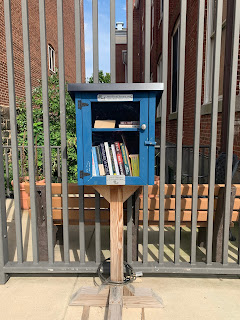
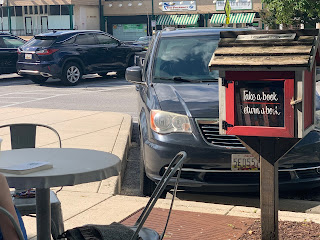
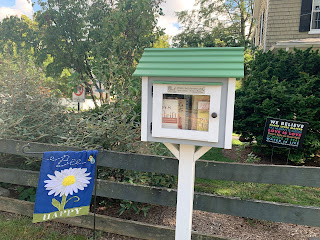
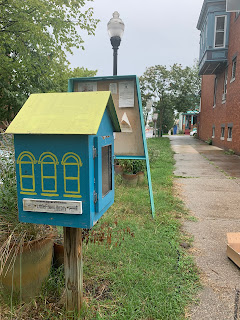
As we all know, the pandemic continued past the spring of 2020.  During the early autumn of  2021, I had the energy to examine my bookcases again, and withdrew about sixty more books from hibernation. During my neighborhood walks, I had often passed some curious structures shaped like child-drawn houses on stilts.  These cabinets, bearing labels that called them "Little Free Libraries," were packed with donated books. The sign on the cabinet was inviting. “Leave a Book, Take a Book.”  And I thought…maybe this is another donation solution?


Ednor Gardens neighborhood


I went to the website for Little Free Library  and learned about the history of these intriguing cabinets, which began in 2012 when a Wisconsin man named Ted H. Bol built the first Little Free Library in honor of his late mother. The idea of “Take a Book, Give a Book,” caught on and became very popular in Wisconsin’s neighbor state, Minnesota, where the nonprofit now is headquartered. Today LFLs are common inside and outside of homes, businesses, and community centers in every state of the U.S. and more than 100 countries. And every book-box that stands is only there because of a specific person who sets it up and maintains it.


Most LFL structures have two shelves and they are not tall or wide. The LFLs can fill up fast, especially in bookish neighborhoods. I started off donating books to the LFL near a church two blocks from my home, but it was always packed to overflowing. There was no way I could pack in seventy books.


I also yearned to bring books to areas that didn't have the same overwhelm as my neighborhood. . I did more reading on the LFL website and learned that Little Free Libraries in economically disadvantaged neighborhoods didn't get regular drop-offs. They also didn't have many books that featured diverse people and settings.  I packed up my car with works by the likes of S.A. Cosby, Kwei Quartey, Vivien Chin, Jesmyn Ward, and so many others. 


East 25th Street


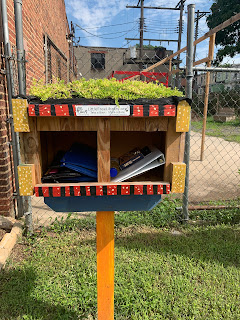
The first LFL I visited on East 25th Street in Baltimore was near a community center. The wooden cabinet was cheerfully painted in red and yellow and had a garden on its roof. What was missing was a clear plexiglass door to shield books from rain. That made it look vulnerable. Nothing was inside the library, except for two school supply bags and a bottle of cooking oil. 


I slid in a donation of teenage and adult fiction by authors of color, or set in various parts of the world. A few months later I returned, happy to find the books I’d brought had all found takers. There was ample room for the extra books and school supplies I'd carried with me. 


The Abell Open Space


North Charles Street


Belvedere Square


Since that first expedition, I’ve donated at many other Little Free Libraries around the Baltimore, most of them found with the help of the online mapping tool at the LFL website. And this activity of purging and sharing doesn’t mean I’m reading less. Writing historical fiction makes it essential to hunt down books that might be out of print for the sake of research. I also continue buying books to support authors who are launching or continuing careers during a time that there are few opportunities for in-person book signings.  


Bellona-Gittings Neighborhood


Recently, I decided to research Sophia Duleep Singh, the“suffragette princess” who was an activist in India and Britain during the Edwardian period. Sophia, a biography written by Anita Anand in 2015, was out of print. However, Amazon listed a hardcover edition as being available for mail order from a used-book seller at a very low price. Amazingly, the seller of this former library book was…


The Maryland Book Bank! Yes, the very first place I'd gone on the odyssey with my books.


Thursday, October 7, 2021

I need your help, please

 Stanley - Thursday

For many years, I've been part of an organisation called Books for Africa. It's a Minneapolis/St Paul-based non-profit whose goal is to provide as many books as possible to schools, libraries, and universities in Africa. You can read more about it here.

Over the past thirty years or so, Books for Africa has sent over 51 million books to the continent, to every one of its 55 countries - from the huge Nigeria to the minute Lesotho. It has also started sending e-readers and e-books, as well as complete law libraries. 

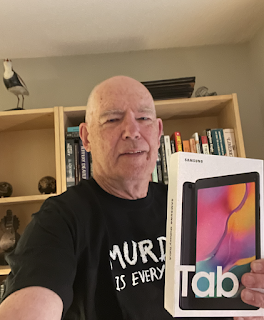
I'm taking 10 Samsung e-readers loaded with a law library to a library in South Africa

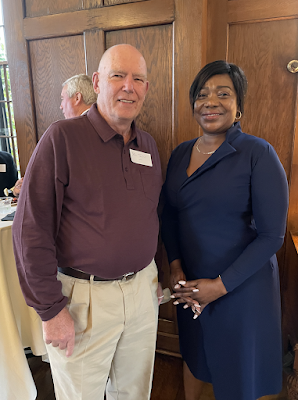
Yesterday, I attended a fund-raising event held at the University Club in St Paul. They keynote address was given by the African Union's ambassador to the United States, Her Excellency Hilda Suka-Mafudze. I was moved listening to the impact a simple initiative like Books for Africa can have on people's lives.

With Her Excellency Hilda Suka-Mafudze from Zimbabwe

In the past, I was involved in sending one container (approximately 40,000 books) to South Africa, now I want to help send another to Botswana, a country that has been so good to Michael and me, both for the setting of our books and the friendliness and helpfulness of its people. 

It is very expensive these days to send containers anywhere - approximately $11,000. Books for Africa feels it is essential that recipients have skin in the game, so it requires them to fund getting the container through customs and its transport to the distribution centre. 

There is an existing project in Botswana that I would like to support. It is called the Botswana Book Project, and you can read it about it here. Its goal is to raise $16,000 - more than just shipping a container. It will also fund the logistics and provide essential supplies such as solar lighting, bookshelves, etc. The project is about a quarter of the way to its goal. 

Please consider making a tax-deductible donation, even if it is $5. Every bit works. If you have friends who have travelled to Africa or who are believers in the power of books, please ask them to participate. I am committed to help the Botswana Book Project reach its goal and will match the first $1000 of donations.

If every reader of Murder is Everywhere contributed just the minimum of $5, we would be over halfway there.

Thank you.


Sunday, July 19, 2020

The State of Publishing . . . in Edo Period Japan

-- Susan, every other Sunday


During the 11th century, a female Japanese courtier named Murasaki Shikibu set brush to washi and penned a lengthy tale that followed the romantic (mis)adventures of a hero (or antihero, depending on your view) named Hikaru Genji.

The resulting work, which she titled The Tale of Genji, is widely considered to be the world's first novel. The book runs 1,300 pages (in English translation) and consists of 52 chapters, each of which essentially reads like a separate novella.

The work received widespread acclaim, and began to circulate among the Japanese nobility--first, in hand-copied form and later in illustrated woodblock print editions.

The Tale of Genji - a novel in many, many parts.

Jumping forward in time . . . when Tokugawa Ieyasu moved the capital to Edo (now Tokyo) at the start of the 17th century, a love of books--and a thriving printing and publishing industry--had spread across Japan. Much of the population was literate, and people of all social classes enjoyed reading (and discussing popular works was a popular pastime at teahouses and sake shops).

A "chart of book rankings" - essentially, a bestseller list - published in Tokyo in 1831

Although some illustrated works were produced as scrolls, bound books were already quite common by the end of the 16th century. At that time, the most popular binding method, known as fukuro-toji, involved writing on only one side of the page, folding the pages over, and binding them with string.

Woodblock print showing customers browsing a bookstore in early Edo


Moveable type came to Japan from Korea at the end of the 16th century, but woodblock printing remained the dominant form of publishing in Japan until the end of the 1800s. Skilled artisan-publishers could, and did, produce large numbers of inexpensive books to meet the ever-growing demand for reading material.

Book making tools, Edo Period

By the 19th century, Edo alone had over 600 bookstores, many of which also served as tiny publishers, producing most or all of the books they sold. The narrow storefronts speckled the district around Nihonbashi, at the end of the Tokaidō (the largest of the famed travel roads connecting Tokyo with Kyoto), where many travelers entered the city of Edo.

Reconstruction of an Edo-period bookshop

While many bookstores sold their books directly, quite a few were "lending shops" that produced and rented books for short-term use. For a reasonable fee, much lower than outright purchase, customers could rent any title they wished, and the shop would send an employee to drop off the book at the customer's home.

Even then, Japanese people had a fascination with cats. 

Lending bookstores were especially popular with members of the working class, whose homes frequently consisted of only a single room. Like the libraries of today, lending bookshops allowed them to read many more books than they could afford to purchase or had room to store.

As a historian and a bibliophile, I love looking back at the history of books and reading around the world. It's interesting--and reassuring--to realize that love of a page-turning story is neither new nor likely to disappear any time soon. Books and stories are part of who we are.

Do you like old books? Print books? Ebooks? What's your favorite when it's time to escape into the pages of a tale?