The past six weeks have been such a period of highs and lows. I've lost a beloved cousin and a friend of thirty-five years, but was also able to return to Australia for the first time since the pandemic.
As I take some time to grieve for these loved ones, I'll offer some photos from our days in Tasmania, land of the lost thylacine, and particularly, in this post, from MONA, the privately owned Museum of Old and New Art.
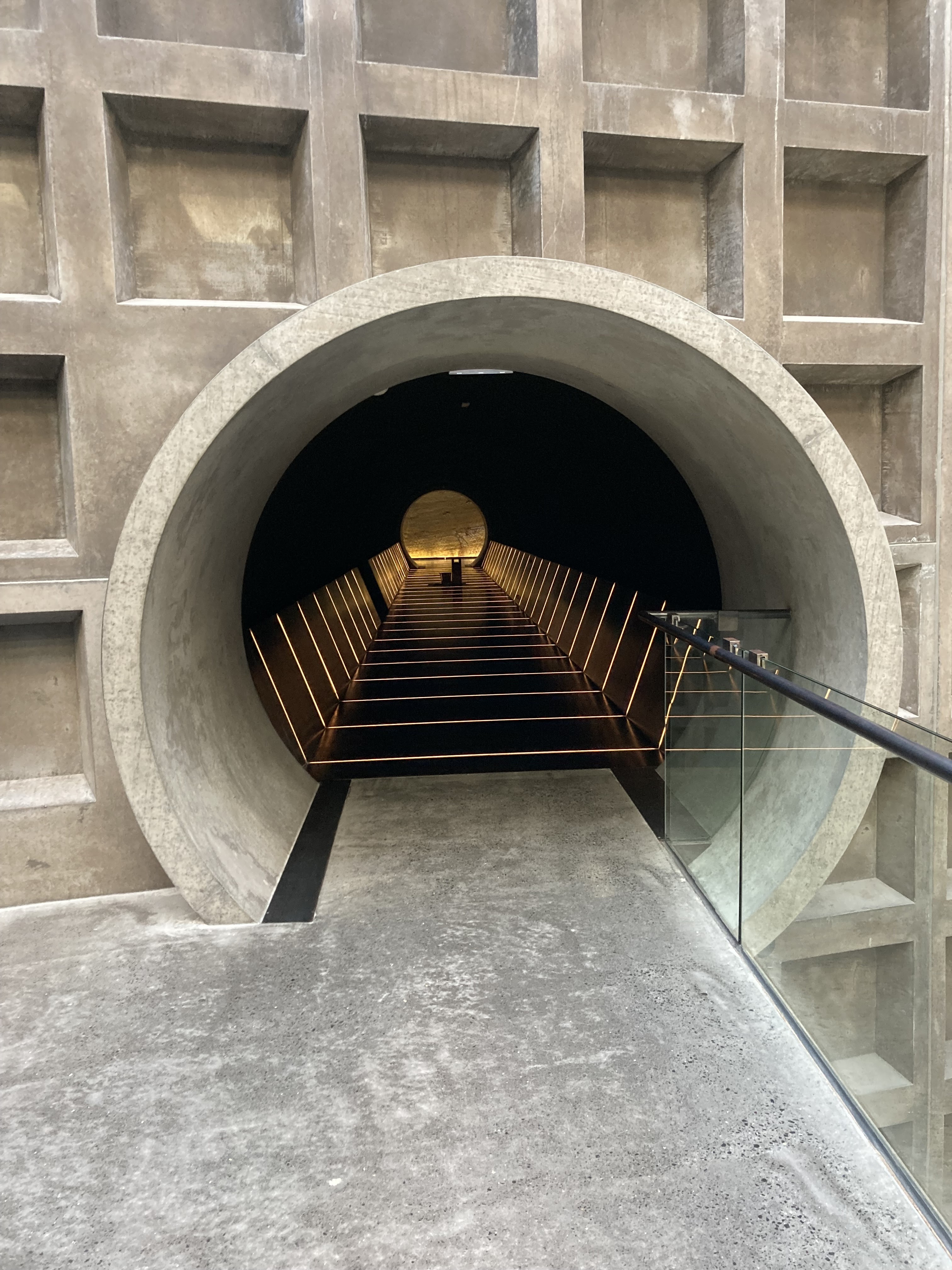
The Museum is one of the most extraordinary places James and I have ever visited. You must book a 25 minute ferry-ride to get there, and once you do, the bulk of the museum is entirely underground, tunneled out of a sandstone cliff. Currently, it has three levels, connected by stairs and tunnels and a round, see-through elevator. I wish I were a better photographer, but here are a few moments and objects from our visit.
The Ferry Ride:
Looking back at Hobart.
Looking back towards the "posh pit," where there's champagne for the 25 minute journey.
A detail from the stairway on the ferry.
ARRIVAL:
We climbed 96 stairs from the ferry to the outside of the Museum.
Another view from the top.
The Museum entrance.
INSIDE SPACES:
Looking into the lowest floor from above. Note the sandstone walls.
Another view from above, looking back towards one of the bars.
Another tunnel.
A view through one of the galleries.
A different view.
Three levels at once.
The Faro bar, complete with a James Turrell installation.
This huge architectural space has a deep pool of oil at the bottom, which becomes invisible and reflects everything around it.
The tunnel into the space.
The promontory into the liquid.
Looking at the reflection of the ceiling in the oil.
RANDOM ART:
James and the Giant Statue.
Passage to a crystal temple.
The Grotto.
Looking up towards the elevator.
The obligatory Warhols.
And for the (mystery) writers, these two:
An entire room of empty books. Yikes.
Yep.
THE SOURCE RESTAURANT:
View from our table.
Their "grilled cheese" appetizer.
This was my risotto!
It truly is an extraordinary place, as is all of Tasmania (more on that in my next post), and it's a quick and inexpensive one hour flight from Melbourne, so if you're ever there, Cyd Redondo and I suggest a visit. Book ahead!
Hope everyone had a great time, hotel notwithstanding, at Bouchercon.
Poppy wreaths laid at the Australian War Memorial in London on Anzac Day
Craig every second Tuesday
Kia ora and gidday everyone,
In the past week a rather significant day for Australians and New Zealanders has passed by again. 25 April may just be a date on the calendar for most countries, but down in New Zealand and Australia, and for others all around the world who have links to our two nations (including Turkey), it is a very special, and sombre day; ANZAC Day. A public holiday, but more akin to one like Memorial Day in the United States than its more festive holiday brethren.
Anzac Day is a day when Aussies and Kiwis pause and remember the soldiers, sailors, and others who have served (and are still serving) our countries in wars and conflicts all over the world. 109 years ago, our two nations first fought side by side under the Australian and New Zealand Army Corps (ANZAC) banner – our soldiers landing together at dawn on a desolate beach on the Gallipoli peninsula in Turkey. It was a military bungle by the British commanders - but the attitudes, actions, and courage of the Australian and New Zealand soldiers both at Gallipoli and over the many battles and years since, stoked a burgeoning sense of independent identity and nationhood.
Despite being about as far away from the main First World War conflict as you could be, more than 100,000 New Zealand troops and nurses served overseas during the First World War, from a population of just over one million. 42% of men of military age served. The losses were huge. You've only got to drive around New Zealand and spy the war memorials in various rural towns, where there are dozens of names listed even from tiny farming communities, to realise the impact the First and Second World Wars had on a couple of generations. Service, sacrifice.
Wreaths at New Zealand war memorial in London. Green one is Royal Family
Over the past century, Australia and New Zealand have contributed greatly on the world stage in many ways and in many diverse areas, generally 'punching far above our weight' given our geographic isolation and small populations - and in some ways this can be traced back to the values associated with 'the ANZAC tradition'.
I've been thinking a lot about Anzac Day recently, and what it means. It's thirteen years since I made the pilgrimage to Gallipoli myself, camping out overnight with hundreds of fellow Kiwis and Aussies by the beach where the Anzacs landed in 1915, waking for dawn service then hiking up the steep cliffs for morning services at Lone Pine and Chunuk Bair. You can read more about my thoughts on that experience at a prior Murder is Everywhere post. A couple of years ago I attended an Anzac Day ceremony in my hometown of Richmond, Nelson in the top of the South Island of New Zealand. The place where I used to march in Anzac Day parades as a little kid in the Boy Scouts, joining the then-current military personnel and the veterans wearing their medals.
That April we were back visiting family, for the first time in three-plus years because of the pandemic (we usually go back every year). Some significant things have changed for me since, and I've learned more personally about loss, and grief.
Flight Lieutenant Edward Te Keu Bennett, a rare indigenous pilot
This year I toyed with attending the dawn service in London for the first time. It's held each year by the Australian and New Zealand war memorials near Hyde Park corner. I even had got Miss Nine and myself some poppies to wear (they're usually sold here in the UK around November, for Remembrance Day, whereas in ANZ they're an April thing). I'd been thinking about nationhood, military service, and more quite a bit recently as I was also writing my first large feature article for a big British newspaper (having had 1,000+ new stories, columns, and features published in other print magazines and newspapers in several countries). That feature combined crime writing and wartime remembrances; an interview with Māori filmmaker and novelist Michael Bennett (Better the Blood, The Gone, etc) about his father, Ted, who was a rare indigenous fighter pilot in the Second World War, and one of seven brothers who served in the war - remarkably, all came home, including three from the famed Māori Battalion. I'd gotten to do some fascinating research and gone down a few interesting rabbit holes while writing and fact-checking the feature article - which was originally scheduled to be published on 25 April (it got bumped to a later issue by the announcement of the Theakston Old Peculier Crime Novel of the Year longlist).
So Anzac Day had been on my mind even more than usual.
To attend the dawn service in central London, it was going to be a 3am wakeup in South London to get a night bus into the city in time to make the entry time for the service - doable if tricky on a school day. Unfortunately a very late night beforehand for Miss Nine meant I couldn't in good conscience drag her out of bed so early, even for something as significant as Anzac Day. Especially when it's not a public holiday in the UK, so she'd have to go to school afterward. Perhaps in a couple of years, when it's on a Saturday here. After dropping her at school, though, I did head into town to pay my own respects at the war memorials. It was interesting being there, with the poppy wreaths placed by the Royal Family, the New Zealand and Australian governments, each branch of the military, and more. Tourists were wandering around as they usually do in London, and some wondered about why there were so many big wreaths at those memorials today. So I ended up chatting with some American tourists, and German tourists, and others, about Anzac Day.
My dawn view over Anzac Cove on 25 April 2011
After that I strolled down Piccadilly and visited several bookshops, before getting back to my laptop for some work. On the other side of the world, my compatriots had been attending services and spending a public holiday with family and friends. My Anzac Day was a little different, but I was glad I took the time this year to pause for a while, to remember and reflect. I'll leave you with the words of the Anzac dedication, read out at every service:
“They shall grow not old, as we that are left grow old,
Age shall not weary them nor the years condemn.
At the going down of the sun and in the morning,
We will remember them.”
Until next time. Ka kite anō.
Whakataukī of the fortnight:
Inspired by Zoe and her 'word of the week', I'll be ending my fortnightly posts by sharing a whakataukī (Māori proverb), a pithy and poetic thought to mull on as we go through life.
Ko te manu e kai ana i te miro, nōna te ngahere. Ko te manu e kai ana i te mātauranga, nōnā te ao
(The bird who feeds on the miro berry has the forest. The bird who feeds on knowledge has the world.)
The native New Zealand wood pigeon (kereru) is fond of miro berries
"Sleigh bells ring, are you listening, In the lane, snow is glistening ..."
With more than 200 cover versions, ranging from classics like Big Crosby and Ella Fitzgerald to modern takes from Michael Buble and Radiohead, since it was first sung in the 1930s, those first lines of "Winter Wonderland" have become synonymous with Christmas across films, television shows, radio, and just shopping at this time of year.
Growing up in New Zealand it was always kind of amusing that so much of the Christmas theming was wintry - snow, sleighs, chestnuts roasting over open fires, Jack Frost nipping at toes. And yeah, folks dressed up like 'Eskimos' (Inuit, if Nat King Cole had written "The Christmas Song" nowadays rather than in 1961).
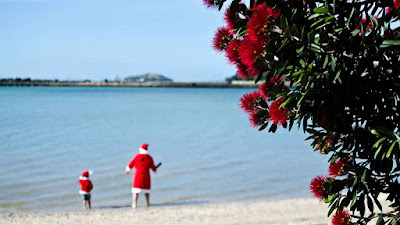
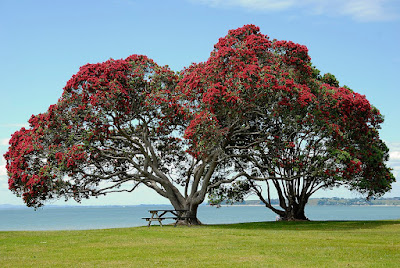
Because in New Zealand (like for our friends in Australia, South Africa, and other Southern Hemisphere climes), the holiday season was far from snowy. The only soft white stuff under our feet was sand on the beach. The nights were light until late, a great time for swimming up the river or at the beach or hanging out with friends, and barbeques were a favourite evening meal. So maybe "sausages roasting over open fires, sand flies nipping at your toes."
A more typical Kiwi meal during the festive season
I have a lot of fond memories of this time of year growing up in New Zealand. Unlike our friends in the UK and US, not only was it the 'opposite' season to what we saw on Christmas cards and in festive movies like Home Alone or National Lampoon's Christmas Vacation, it was also the end of the school year. The time between one school year and another, actually occurring at, you know, the end of the calendar year rather than in the middle. So Christmas was part of a six-week long summer holiday (longer when I was at high school or university).
With the long days full of sunshine and the light nights were the outdoors was still a playground until late, it was a time when you felt you had plenty of time: to relax, to explore, to spend with friends and family. All of this felt completely normal, but as young Kiwis we were aware that things were different in the US, UK, and elsewhere in the northern hemisphere - thanks to the Christmas cards, Christmas songs, and Christmas movies.
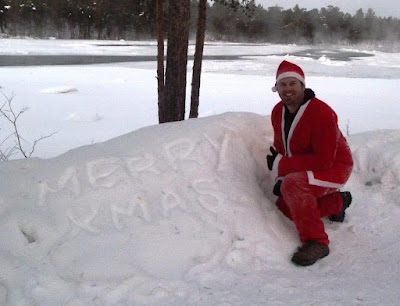
My first full-on Christmas in the snow, in northern Finland in 2012
So when I had my first 'northern' Christmas in 2009, in Koln, Germany, it wasn't too jarring. It was a fun, different, experience. Ditto my Christmas in Lapland in 2012, where I made snow angels and went reindeer sledding, along with cross-country skiing, dog sledding and nightly hunts for the Northern Lights. I've also had wintry Christmases in Belgium (great markets and tours of the Western Front) and the UK in recent years.
But even when I spent Christmas itself in the wintry north, I would most often still have many weeks of summer in New Zealand either side of that (either because I was living there, or more recently to visit family and friends during the holiday season, even if I spent Christmas Day and that week itself in the UK - eg volunteering with Crisis, a tremendous charity fighting homelessness - before heading 'home' for some summery times.)
Summery Santa in 2013 - a run through by the vineyards to kickstart Christmas Day
The funny thing is though, that while I've found most Kiwis and Aussies I know quite enjoy a Christmas or two in the north - getting to experience all those wintry things we grew up seeing from afar in movies and books - even if we prefer the summer festive seasons of our youth, that many of my northern friends get completely discombobulated by spending the festive season Downunder.
Even if they like it, it's just 'too weird' for them to grasp.
I guess that makes sense, given that while we've experienced wintry Christmases vicariously as kids, while enjoying the realities of summery Santa time, the idea of a summer Christmas with beaches and barbecues and sunshine and heat is just so very foreign for more of my American and European friends. It's not like you get summery Santa cards or films to watch as kids, even though a good chunk of the world actually has a non-wintry Christmas.
I was reflecting on the whole 'summer Christmas' thing over the weekend, when an Aussie pal of mine, the terrific crime writer Emma Viskic (award-winning series starring deaf private eye Caleb Zelic) tweeted about the Tim Minchin song "White Wine in the Sun". I'm a fan of Tim Minchin, from his silly songs to his more thoughtful ones - well many are both - he's a rather brilliant composer and artist (he was a musical comedian who more recently has written the musicals for Matilda and Groundhog Day). So I was aware of this song, and it was a Christmas favourite in recent years. And a rarity: an antipodean Christmas song about a summery version of this time of year.
Unfortunately due to the pandemic, I once again won't be spending the holiday season with friends and family back in New Zealand, which is a bit tough, to be honest. In the first forty years of my life, while I had several Christmas Days abroad, I only had two years where I wasn't back 'home' at all over the southern summer months - once when I was doing a yearlong backpacking trip through the Americas and had Christmas in southern Patagonia, and my first year in the UK when I was waiting four months for a visa decision so couldn't travel at all. Usually, even if I'm volunteering with the homeless in London on Christmas Day I'll be on a plane back to New Zealand soon after to spend New Years and a few weeks more with friends and family. Not this year, unfortunately. Three in a row now.
A Kiwi books pal, who used to run Penguin publishers in New Zealand, gave me a few 'Kiwi Christmas' kids picture books for Miss Almost-Seven when she was Miss One (eg A Kiwi Jingle Bells, A Kiwi Night Before Christmas), so we'll enjoy re-reading those again this year, to get a wee taste of summer Christmas along with plenty of Zooms with friends and family. Classic Christmas songs adapted for a summer setting, quite fun and clever.
A summery twist on the usual Christmas carols
So, to finish up, I hope you all have a really wonderful festive season, wherever you're spending it. If you get to be with those closest to you, cherish and enjoy it, despite any bickering or holiday stresses. If you're in Aotearoa or Australia or anywhere else south of the equator, enjoy the beaches and barbecues and raise a glass of white wine in the sun, for me. Hopefully we'll be able to join you next year.
Oh and PS, every year Tim Minchin donates all proceeds from any sales of his "White Wine in the Sun" song that occur during the festive season (November-January) to an autism charity. So if you like it too, nab it on Apple Music, Amazon, or wherever, and support a good cause. It is a time of giving, after all.
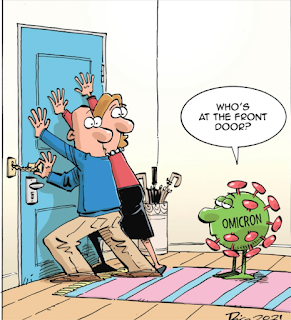
I was going to rant and rave in today's blog about the travel ban on southern African countries because of the omicron variant. Not only because I may not be able to fly to Cape Town when scheduled in a couple of weeks, but more so because it seems so hypocritical, with Europe now having over a hundred confirmed cases and few restrictions, and overall way more infections. The Business Maverick in South Africa had a cartoon which sums up the situation very well. Thank you Rico.
Instead of spewing fire and brimstone at the UK and Europe, I'm going to take a gentler approach and write about trees.
Not any old trees, but a special family that inhabit Africa, Madagascar, and Australia - the baobab.
There are eight species of baobab: one on the African mainland, six on Madagascar, and one in Australia.
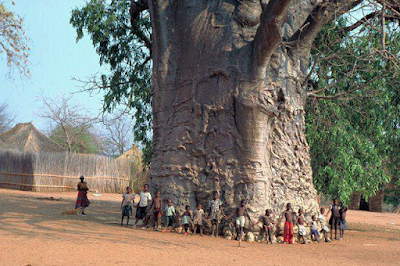
For those of us who grew up in Southern Africa, baobabs are a familiar sight. Specifically, the one African species is Adansonia digitata, named after French naturalist Michel Adanson. Some of them are extremely old and often huge. Some have been dated to be over 2000 years old. The owners of Sunland Farm in Limpopo, South Africa have built a pub called "The Big Baobab Pub" inside the hollow trunk of the 22 metres (72 ft) high tree. The tree is 47 metres (155 ft) in circumference. They claim the tree is over 6000 years old, but that claim may have something to do with the fact that one is told that in a pub.
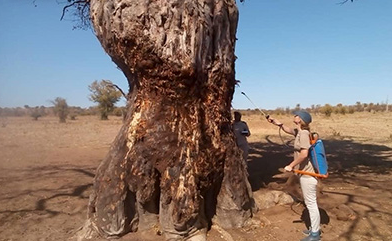
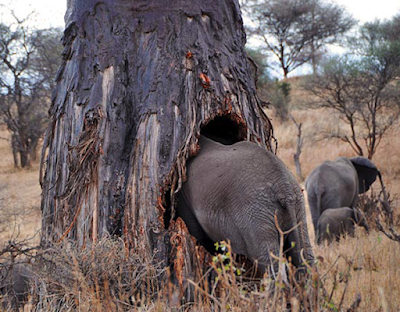
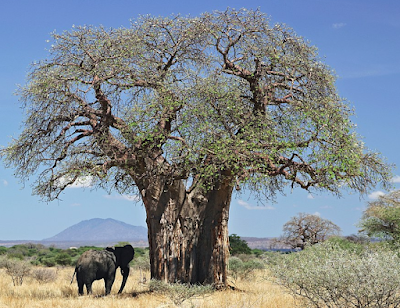
They are very fibrous, and elephants often use their tusks to dig into them for water, leaving unsightly wounds in their trunks - the trunks of the baobab, not the elephant!
Trying to protect a baobab gashed by elephants
An elephant pub
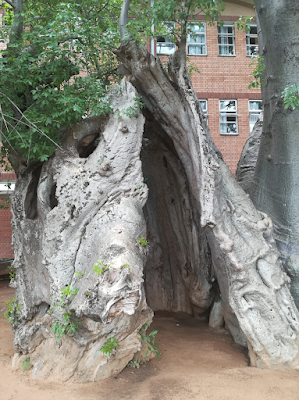
Michael and I have had a couple of baobab encounters while writing the Detective Kubu series. The first was in Kasane in northern Botswana. We were visiting the police station there, researching one of our books. The police station itself is modern, and set between two very old baobabs that had been used historically as a mail drop and a prison - one baobab for men, the other for women. We were very impressed that the Botswana Police Service had chosen a new building site that wouldn't mean getting rid of these historical trees.
The old jail with the new one in the background
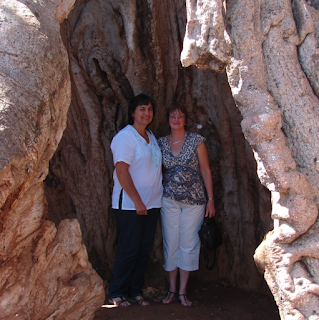
In jail
When we eventually were seated in front of the station commander, we told him that the country's police commissioner had told us to ask him to show us around to the holding cells and interrogation rooms. He didn't believe us. He pulled out his mobile phone and handed it to me, saying quite aggressively: "Phone the Commissioner and have him tell me."
Fortunately, I had the Commissioner's number, which I dialled and was extremely fortunate to have him answer. I explained the situation and handed the phone back to the station commander. After that we could see whatever we wanted.
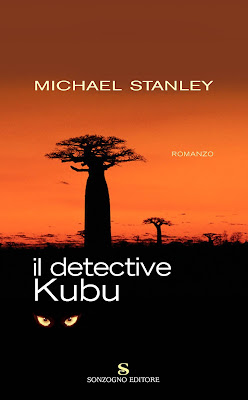
The second baobab story Michael and I have relates to the cover of the Italian edition of A Carrion Death, our story where in Chapter 1 a hyena is found eating what remains of a human. It was titled Il Detective Kubu and had a very dramatic cover, seen below, with a pair of eyes staring out at the reader, with some baobabs on the top half. Of course, when we received the cover from the publisher, it was accompanied by a note that indicated that they thought it was the greatest cover ever. That created somewhat of a quandary for us because the eyes were were those of something in the cat family - none of which makes an appearance in the book, and certainly not hyena eyes. And the baobabs were a species (Adansonia grandidieri) that grow only in Madagascar. We decided not to push out luck and wrote back that while we agreed it was the greatest cover ever, it would probably be good to put an African baobab on the cover. We didn't mention the eyes.
The outcome was as we expected - nothing changed.
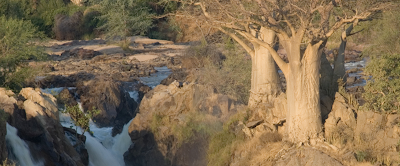
Here are a couple of photographs of Africa's Adansonia digitata.
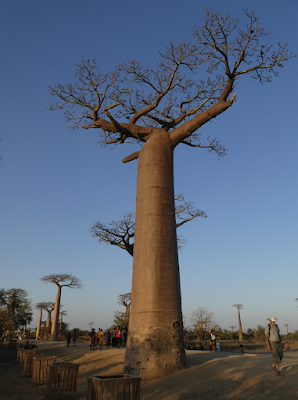
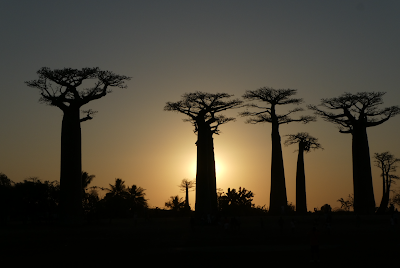
Michael and I and others visited Madagascar four years ago and enjoyed the famed Allée des Baobabs (Adansonia grandidieri).
A single Adansonia grandidieri
An avenue of Adansonia grandidieri
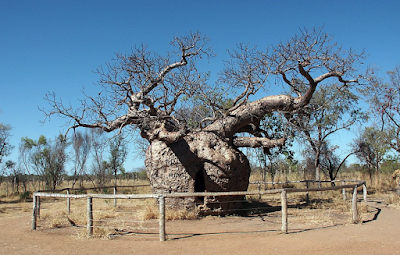
Across the Indian Ocean to the Kimberley District of Australia we find Adansonia Gregorio, another fat stemmed baobab - the baob or Australian baobab.
Adansonia Gregorio
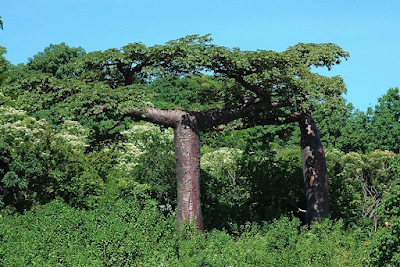
Back to Madagascar, there is Adansonia suarenzensis - very different.
Adansonia suarenzensis
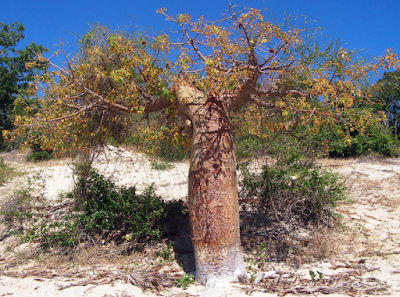
And finally, the strangest of all - the Adansonia rubrostipa, which comes in all shapes and sizes.
A little Adansonia rubrostipa
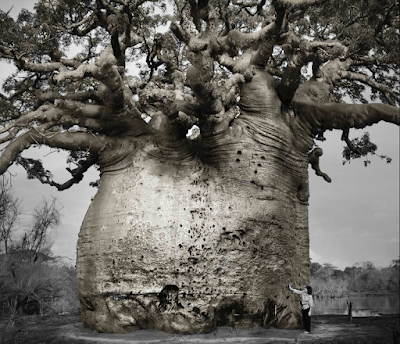
Adansonia rubrostipa (Photo: Beth Moon from her book Baobab)
Adansonia rubrostipa (Photo: Beth Moon from her book Baobab)
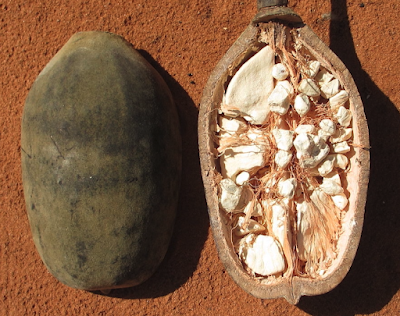
In Africa, the baobab is called the tree of life for its water and fruit. A mature baobab can hold up to 100,000 litres of water (about 25,000 gallons), and the leaves are sometimes used as vegetables. The fruit of the baobabs is one of their distinguishing features. It is large, oval to round, and berry-like in most species. It has a dry, hard outer shell of variable thickness. In most species, the shell is indehiscent (a word for Zoë), which means it does not break open easily. The fruit usually dried and the resulting powder used in a variety of foods.
Fruit of Adansonia digitata
The baobab is also called the upside-down-tree, for obvious reasons. It is worth a trip to Africa and Madagascar just to see these monsters.
Now I can get back to grumbling about the travel ban, particularly now that nine omicron cases were found in Scotland before the virus was identified in South Africa, none of whom had travelled to Southern Africa nor had any links to anyone there. Grrr.




%20Te%20Keu%20Bennett,%20Flight%20Lieutenant,%20485%20Squadron.jpg)
.jpg)