Showing posts with label Africa. Show all posts

Wednesday, November 23, 2022

Diasporan Guilt

Definition of diasporan guilt

Diasporan guilt is the term I've coined to define a pervasive feeling of bad conscience for being fortunate to live in a prosperous country (usually UK, France, USA, Canada etc.) while people suffer with poverty in one's birth country in the global south. 

What is the African diaspora?

The word diaspora comes from the Greek διασπορά, meaning "a scattering.” Originally, its most common usage was in connection with the Jewish diaspora, but it’s been extended to other groups, particularly this century. The African diaspora is the global collection of African descendants dispersed throughout the world as a result of historic events, specifically the 16th- to 19th century slave trade from primarily West and Central Africa to the US, Brazil, and Haiti. An aside note, although we hear more about slavery in relation to the US, less than 5% of the total number of slaves were trafficked to the US. More of them went to the Caribbean and South America, particularly Brazil. 

In addition, the African diaspora often refers to Africans who have migrated from the continent but maintain a deep interest in the “motherland” and a willingness to contribute in different ways to the development of the continent. In fact, the African Union defined the African diaspora as "consisting of people of African origin living outside the continent, irrespective of their citizenship and nationality and who are willing to contribute to the development of the continent and the building of the African Union."

An estimated 11 million Africans were dispersed by the Atlantic slave trade. The modern-day African diaspora numbers about 140 million while the African continent’s population is 1.4 billion.

The African diaspora and politics

The African diasporan phenomenon digs deep into sensitive issues of racism, colonialism, and global domination. Slavery was a system that reflected all of those things and along with slavery came internecine warfare on the African continent. The partition of Africa , also called the “scramble for Africa,” a divvying up of the continent by Europeans in their own interest and not Africa’s, occurred from 1881-1914, during which time the colonization occurred at full speed. In 1884 the German chancellor Otto Von Bismarck held a Berlin conference the purpose of which was essentially to prevent Europeans from fighting each other over territory--who cared about the Africans?

No one knows what Africa would have been like without the slavery and colonization. The African geographic divisions imposed by the Europeans often ignored natural landmarks and political ethnic histories. Could there have been more African unity and development without all these partitions? Whatever the case, Americans and Europeans and Africans came into contact with each other and account for the mixed ethnic nature on either side’s countries to the extent that it exists. In response to a British person’s objection to Indians coming to the UK, standup comedian Russell Peters retorted, “Wait a minute, you started the whole thing!” 

We know many Africans in the diaspora in general do extraordinarily well in their adopted countries, some becoming highly skilled individuals like neurosurgeons. There’s a cruel irony that Africa is suffering from brain drain, and the continent’s best brains are successfully living in the same countries that continue to exploit Africa, particularly in the extractive industries like gold and oil. Foreign aid goes largely into the pockets of the elite ruling class, and I agree with Dambisa Moyo that foreign aid, which arose out of colonization, is not an effective solution to underdevelopment in Africa. It perpetuates the dependency relationship Africa has with the west, and now, with the Chinese.


How diasporan guilt affects me

I have a theory that the dependency relationship Africa has with the west extends to individual Africans. In Ghana, there’s an odd preference given to “asking/begging for stuff” than working to get it--both governmentally and individually. My three brothers and I have family in Ghana on my father’s side and the requests for funds and phones etc. are common. Carlos, the ex-caretaker of our family property in Ghana is barely making it, especially since unemployment and inflation are soaring in Ghana.  I’ve covered Carlos's family’s hospital bills, rent, school for the kids, and so on--apart from the expensive phones and tablets I take for them on my visits. Two of my brothers are quite firm in not getting involved with any such “charitable deeds.” They just don’t see the point, and in some ways I think they’re correct; and like Dambisa Moyo, this giving to the poor can generate a dependency that never ends. Indeed, in a way, my supporting Carlos, his wife, and four kids is a little ridiculous, not to mention unsustainable. But I still do it. Why? Diasporan guilt. I live in a nice house and buy sh*t on Amazon while they suffer in Ghana. Rational or not, it’s a strong sentiment.

Maybe the diasporan guilt was born of my leaving Ghana decades ago when the going got rough with the then-military government and the country’s accompanying economic collapse. Perhaps I felt I had deserted or abandoned friends and family members. My late father was Ghanaian, and even though I don’t even have a Ghanaian passport, the ties to Ghana are clearly still strong. But my always matter-of-fact Black American mother pointed out that even though I was born in Ghana, I’m American through her (jus sanguinis), so I have every right to live in the States. And think about it: if I had never moved to the US, I might well not have created Darko Dawson and Emma Djan. Isn’t life strange?

Wednesday, February 16, 2022

Is China Colonizing Africa?

Wed--Kwei 


In 2013, I wrote a column in FPIF called Ghana’s Chinese Gold Rush. I was fascinated and alarmed by the migration of thousands of Chinese people to Ghana to illegally engage in small-scale gold mining. Researching for my novel GOLD OF OUR FATHERS (GOOF). Incidentally, in GOOF, a Chinese miner is found dead buried in gold ore.  

I was in Ghana to witness first-hand the destruction of the environment that invariably accompanies any kind of extractive industry, whether it be oil, gold, coal, or something else. Large Chinese excavators dig up the earth to uncover, hopefully, gold ore, which is washed and processed for the glittery metal. On their departure from the sites, none of these miners ever back-filled the pits they had dug.


Woman and child walk past mine abandoned by illegal Chinese miners in Ghana
Woman, child, and dog, walk past an abandoned alluvial mine (Photo: Kwei Quartey)

Small-scale mining (SSM), also called alluvial mining, is different from the large-scale mining of multinational companies like AngloGold Ashanti, and is technically illegal for foreigners to practice. But leaving aside SSM, China now plays a major role in the building vital infrastructure in Africa On my last visit to Accra, the capital of Ghana, I noted a China-backed port-construction project in its early stages at the beachfront.

An arch marking the beginning of a new port in Accra Ghana with the ocean in background
Site of future Chinese-built mega-port in Accra (Photo: Kwei Quartey) 

Chinese companies also built Ghana’s rather impressive gray stone edifice that houses the Ministry of Defense.

Whether China is Africa’s new colonizer is the subject of quite some debate. The NYT Magazine took up the topic in 2017, but there are scores of other pieces on the topic. Howard W. French’s influential book, China’s Second Continent, which I’ve read from cover to cover, examines the role of China in multiple African countries. But nothing demonstrates the influence better than the graphic representation of China’s influence in Africa and the indebtedness of the respective nations to China. Some of the countries most heavily invested in are the same nations with heaviest debt to China. One important example of that is Zambia.

Chinese investments in Africa and indebtedness of African countries (Source: @samramani


The case of Zambia
The country of Zambia, marked with a star on the map, is at the crossroads of Central, Eastern, and Southern Africa. Significant Chinese investment began in Zambia in the 1990s after the privatization of the copper mining industry. Not only is Zambia rich in copper, which the Chinese really need, but it has cobalt and lithium. The Chinese enjoy advantages in Zambia that would be impossible to attain in China, like cheap labor and a whole lot of land.

Zambia’s Chinese presence is unmistakable and even jarring in a large city like the capital, Lusaka, where Chinese signage on buildings often dwarf the English equivalent, where hotels and stores have Chinese names, and where some stores cater specifically to Chinese tastes. It’s reminiscent of the postcolonial era in Ghana when Europeans and Americans shopped only at certain stores.

China famously doesn’t let a silly thing like environment get in the way of their digging up or building up. Just take a look at the picture above--destruction of the landscape is not an issue, nor is pollution of rivers with toxic runoff from mining sites. In Zambia, a Chinese development company called Kingsland is building a massive retail and housing estate on a forest reserve that was previously protected by law. The law seems to have magically evaporated. Also on that “protected land,” the Chinese have constructed housing for the Zambian Air Force. Do I hear the words, “an offer we couldn’t refuse?”

But no Environmental Impact Assessment was done before construction of the housing estates, and now, sewage from the development has been dumping into the nearby Chalimbana River.


Chinese v the West
A colony is a territory belonging to or under the control of a distant nation. Is this the case with China in Zambia? Two stories repeatedly denied by the Chinese is that they have seized Uganda’s Entebbe Airport and Zambia’s Kenneth Kaunda Airport because the respective countries defaulted on their loans. If these rumors are true (the governments deny them), then this is a sort of tyranny and domination that smacks of colonization.

Arguments go back and forth about whether the “old” colonizers like the British and French were any better, or worse, than the Chinese. But the answers are not that clear-cut. It’s usually said that China goes into African countries without making demands on Africans to reform human rights the way the West does. The Chinese are mostly interested in relative political stability of the “colony” but only in regard to whether erratic politics may hamper the commercial endeavors, not because of some lofty ideal.

But in all colonization, modern or ancient, there is a lopsided codependence between the colonizers and the colonized, or owners and workers. The former depends on the latter to do the actual work of production, and the latter depends on the former to have a job and get paid. China often builds much-needed structures in rural areas that would otherwise never have received them. In Ghana, for instance, a village chief admitted to me, sure, the Chinese did come and bulldoze some of our farmland, but they also built us a functioning borehole. That made a big difference for villagers, who up until that time had had to take a 2-mile walk to and from a water source, sometimes a river. Now the village has clean water.

The Chinese also build schools and hospitals. Still, though, they remain firmly in the executive and owner position over subordinate Africans. This is a very colony-like situation where the classes are sharply drawn. But so what? some Africans say. We never had jobs until the Chinese arrived. The ultimate question for the Africans is, how much are you willing to lose?

In a YouTube video, a Chinese man asks a Congolese, “You were governed by the Belgians for so long. You should’ve learned how things work.” There, I agree with the Chinese man, but possibly for different reasons. Africans should have learned by now that when invaders arrive and start taking your s**t, no matter what the invaders assure you, the African side will never come out on top.

The bottom line
Whether China is a “colonizer" might be a semantic issue. The term seems to be slightly off the mark and I’m hard-pressed to find a suitable replacement. Settlers? Invaders? Infiltrators? Transplants? Ctrl-Cmd-Del? One term I think comes close is “uber-exploiters.” Watch this video by France 24 about the Chinese in Zambia, and you’ll see you how apt that characterization is. At the end of the day, the Chinese in Africa are very much there to stay.

                                                                            ~~~

Wednesday, December 8, 2021

O Mi Cron!

Wed--Kwei

November 24, one day before Thanksgiving, South African scientists notified the WHO that they had detected a new variant of SARS-CoV-2 called B.1.1.529. While using the customary PCR testing, a technician in a South African private lab had noticed that six different test samples showed an unexpected dropout in the virus’s gene sequence--a “missing snippet,” as it were. It was so unusual that they notified their boss, who, in a rare “you-gotta-see-this” moment, passed it up the chain to world-renowned South African epidemiologist Salim Abdool Karim 

Naming this strain omicron, the WHO designated it a variant of concern (VoC) because there are as many as fifty different mutations on the virus’s spike protein, some of them overlapping with the alpha, beta, gamma, and delta SARS-CoV-2 variants, and oddly enough with the common cold virus, which is in the same Coronaviridae family. These mutations are suspect for increased transmissibility of the virus, and the Covid-19 positivity rates in South Africa have correspondingly risen by 24 percent in the two weeks since the discovery of the variant. Omicron's doubling time is an astonishing 36 hours.

Eight southern African countries affected by the Biden administration travel ban
Countries affected by the Biden travel ban

Within only a couple of days of South Africa’s announcement, the Biden administration imposed a ban on travel from RSA and seven other surrounding countries. US citizens and/or their families are exempted from the ban, however. South African scientists were stunned by what appeared to be punishment for their due diligence and transparency. South Africa is one of the world’s leaders in genomic sequencing because it already has the needed infrastructure as a result of the HIV epidemic. In South Africa’s gene sequencing model, government and academic centers collaborate within a Network for Genomic Surveillance.

If it feels like you’ve seen this travel-ban movie before, it’s because you have. Eons ago in January, 2020, the former president of the United States instituted a ban on travel to the US from China, except for US citizens and their families. Impervious to anything even remotely factual, truthful, or scientific, the ex-president persisted in citing this as a prescient and wise move, even though it soon became clear that by the time the “China ban” had been imposed, the virus had already spread to Europe. This is the cockroach phenomenon: if you see one, they’re probably all over the place. The first omicron variant in the US was detected in San Francisco in a person who had recently traveled to RSA, but in the subsequent detected cases, some had no history of travel there, meaning that it had already been propagating in the US. 

Ineffective measures

The move by the Biden Administration was explained as a means of “buying time,” but it was in fact a weak rationale and a rash decision. Omicron is an equal-opportunity infector with no particular preference for US citizens versus non-citizens arriving from South Africa. As Mike Ryan, WHO’s emergencies director, put it, “. . .  Is it that some passport holders will have the virus, and some won’t? Does the virus read your passport?” UN Secretary-General António Guterres said,"We have the instruments to have safe travel. Let's use those instruments to avoid this kind of, allow me to say, travel apartheid, which I think is unacceptable.” [Bolding added.]

What the US should have done is tighten the travel requirements for everyone arriving from anywhere with a combination of Covid-19 testing and quarantining. Indeed, the Biden administration has now decreased the pre-travel Covid-19 negative test period from three days to one day. They should add a Covid test on arrival at international ports of entry, which is what the Republic of Ghana does at the Kotoka International Airport for the outrageous fee of $150.

Wake-up call

Predictions are tricky, but the omicron variant seems to be more transmissible while less deadly than delta. The irony is that in the US, we haven’t even dealt satisfactorily with delta, and the SARS-CoV-2 infection rate is still a staggering 120,494 per day, primarily in unvaccinated people. This scenario is like worrying that venomous snakes will get inside the house when we already have ferocious alligators in the kitchen.

 What omicron is telling us is that no country is safe until all countries are safe. In its report, The Tony Blair Institute for Global Change warns that the present global Covid vaccine inequity is a setup for the rise of potentially more virulent Covid strains if the virus is allowed to circulate unchecked in Africa. 

Bar chart showing share of people vaccinated against Covid-19 in different parts of the world

Only 7.2 percent of the African continent is vaccinated, and at this rate, Africa could become a reservoir for variants. Notwithstanding their promises, the world’s most advanced economies have failed miserably to share vaccines with low-income countries. 

Remedies

Blanket travel bans are ultimately an ineffective blunt weapon. We can’t implement a travel ban every time a new strain of the virus appears. Speaking on a WBUR Radio podcast recently, Dr. Karim  proposes steps the world’s governments and scientists can take: First, prepare for and expect emerging variants, because that’s what SARS-CoV-2 does. Second, to the extent possible, sharpen virus surveillance worldwide to detect and identify variants, and instead of reacting out of panic and fear when they emerge, countries should share information between and among themselves according to a governing set of agreed-upon rules.

This global cooperation is crucial, because SARS-CoV-2 is almost certainly here to stay and we may need a “booster” vaccine dose tweaked annually according to the virus’s profile. Another “new normal?” Probably. Just add it to masks and physical distancing.

Thursday, December 2, 2021

No rant today!

 Stanley - Thursday

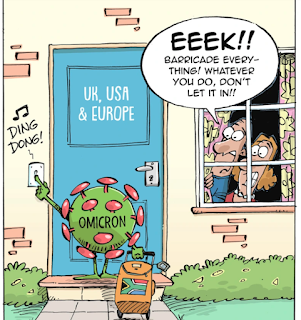
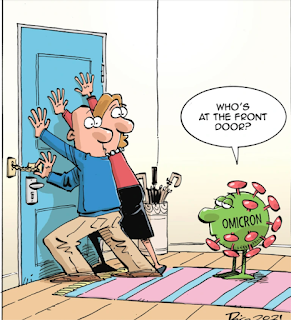
I was going to rant and rave in today's blog about the travel ban on southern African countries because of the omicron variant. Not only because I may not be able to fly to Cape Town when scheduled in a couple of weeks, but more so because it seems so hypocritical, with Europe now having over a hundred confirmed cases and few restrictions, and overall way more infections. The Business Maverick in South Africa had a cartoon which sums up the situation very well. Thank you Rico.


Instead of spewing fire and brimstone at the UK and Europe, I'm going to take a gentler approach and write about trees.

Not any old trees, but a special family that inhabit Africa, Madagascar, and Australia - the baobab.

There are eight species of baobab: one on the African mainland, six on Madagascar, and one in Australia. 

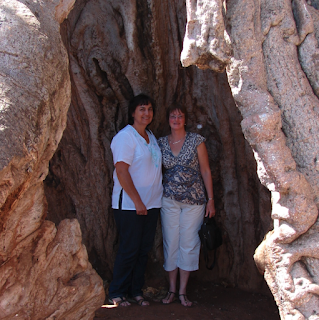
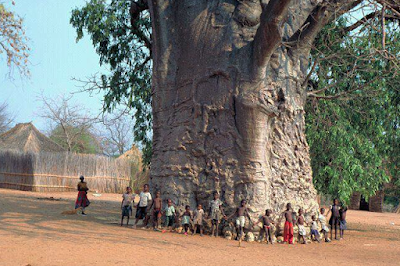
For those of us who grew up in Southern Africa, baobabs are a familiar sight. Specifically, the one African species is Adansonia digitata, named after French naturalist Michel Adanson. Some of them are extremely old and often huge. Some have been dated to be over 2000 years old. The owners of Sunland Farm in Limpopo, South Africa have built a pub called "The Big Baobab Pub" inside the hollow trunk of the 22 metres (72 ft) high tree. The tree is 47 metres (155 ft) in circumference. They claim the tree is over 6000 years old, but that claim may have something to do with the fact that one is told that in a pub.

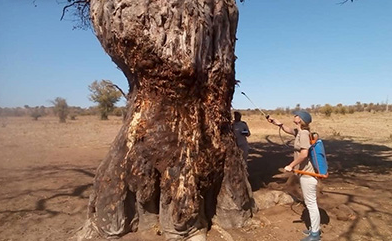
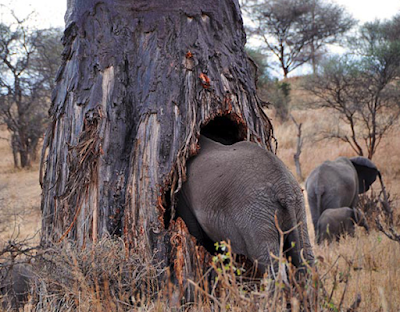
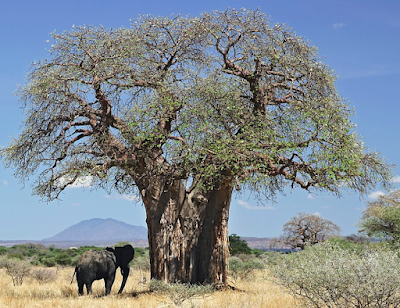
They are very fibrous, and elephants often use their tusks to dig into them for water, leaving unsightly wounds in their trunks - the trunks of the baobab, not the elephant!

Trying to protect a baobab gashed by elephants

An elephant pub

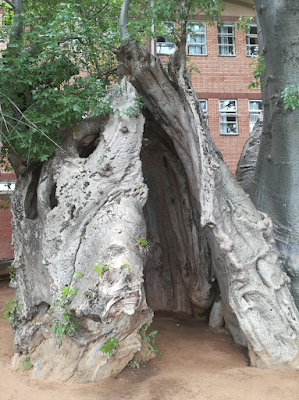
Michael and I have had a couple of baobab encounters while writing the Detective Kubu series. The first was in Kasane in northern Botswana. We were visiting the police station there, researching one of our books. The police station itself is modern, and set between two very old baobabs that had been used historically as a mail drop and a prison - one baobab for men, the other for women. We were very impressed that the Botswana Police Service had chosen a new building site that wouldn't mean getting rid of these historical trees.

The old jail with the new one in the background

In jail 

When we eventually were seated in front of the station commander, we told him that the country's police commissioner had told us to ask him to show us around to the holding cells and interrogation rooms. He didn't believe us. He pulled out his mobile phone and handed it to me, saying quite aggressively: "Phone the Commissioner and have him tell me."

Fortunately, I had the Commissioner's number, which I dialled and was extremely fortunate to have him answer. I explained the situation and handed the phone back to the station commander. After that we could see whatever we wanted.

The second baobab story Michael and I have relates to the cover of the Italian edition of A Carrion Death, our story where in Chapter 1 a hyena is found eating what remains of a human. It was titled Il Detective Kubu and had a very dramatic cover, seen below, with a pair of eyes staring out at the reader, with some baobabs on the top half. Of course, when we received the cover from the publisher, it was accompanied by a note that indicated that they thought it was the greatest cover ever. That created somewhat of a quandary for us because the eyes were were those of something in the cat family - none of which makes an appearance in the book, and certainly not hyena eyes. And the baobabs were a species (Adansonia grandidieri) that grow only in Madagascar. We decided not to push out luck and wrote back that while we agreed it was the greatest cover ever, it would probably be good to put an African baobab on the cover. We didn't mention the eyes. 

The outcome was as we expected - nothing changed.


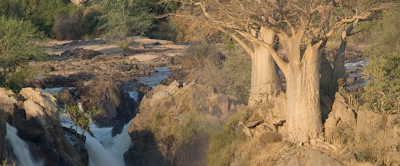
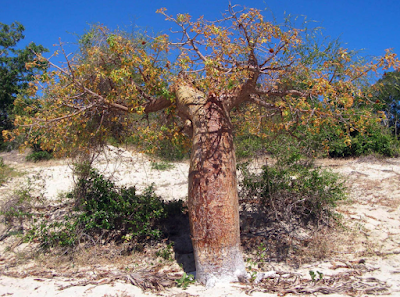
Here are a couple of photographs of Africa's Adansonia digitata.


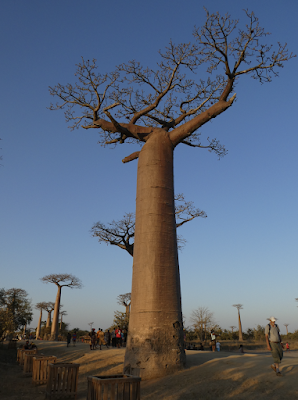
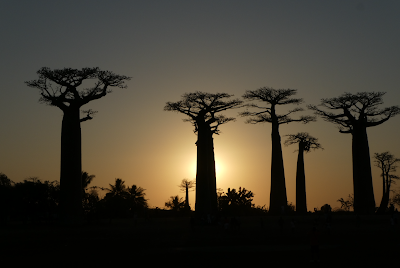
Michael and I and others visited Madagascar four years ago and enjoyed the famed Allée des Baobabs  (Adansonia grandidieri).

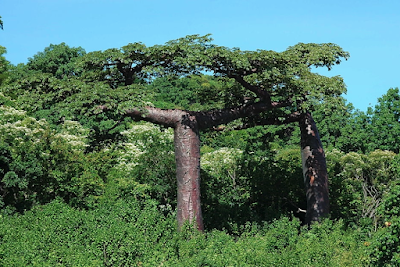
A single Adansonia grandidieri

An avenue of Adansonia grandidieri

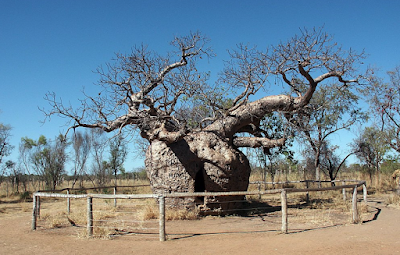
Across the Indian Ocean to the Kimberley District of Australia we find Adansonia Gregorio, another fat stemmed baobab - the baob or Australian baobab.

Adansonia Gregorio

Back to Madagascar, there is Adansonia suarenzensis - very different.

Adansonia suarenzensis

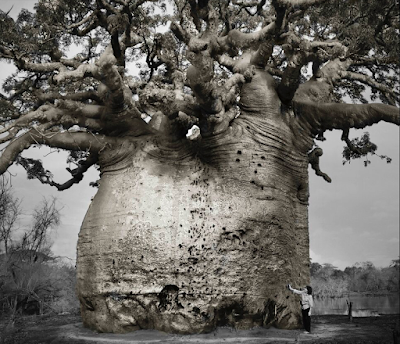
And finally, the strangest of all - the Adansonia rubrostipa, which comes in all shapes and sizes.

A little Adansonia rubrostipa

Adansonia rubrostipa (Photo: Beth Moon from her book Baobab)

Adansonia rubrostipa (Photo: Beth Moon from her book Baobab)

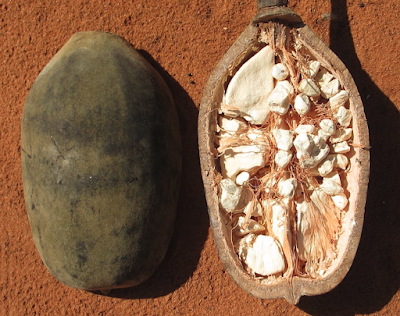
In Africa, the baobab is called the tree of life for its water and fruit. A mature baobab can hold up to 100,000 litres of water (about 25,000 gallons), and the leaves are sometimes used as vegetables. The fruit of the baobabs is one of their distinguishing features. It is large, oval to round, and berry-like in most species. It has a dry, hard outer shell of variable thickness. In most species, the shell is indehiscent (a word for Zoë), which means it does not break open easily. The fruit usually dried and the resulting powder used in a variety of foods.

Fruit of Adansonia digitata

The baobab is also called the upside-down-tree, for obvious reasons. It is worth a trip to Africa and Madagascar just to see these monsters.

Now I can get back to grumbling about the travel ban, particularly now that nine omicron cases were found in Scotland before the virus was identified in South Africa, none of whom had travelled to Southern Africa nor had any links to anyone there. Grrr.

Wednesday, October 27, 2021

Why there is no Halloween In Africa

 Wed--Kwei

Like many celebrations throughout the year, the meaning of Halloween has morphed over the centuries and lost its original meaning. As most sources will tell you, the word Halloween comes from All Hallows Eve, or the eve of All Saints' Day, which is the first of November; hence the eve is October 31. The Oxford English Dictionary records the earliest use of All in 1556, and the latest in Shakespeare's Measure for Measure of 1616 (Allhallond-Eue). After that, the "All" seems to have dropped out of use.

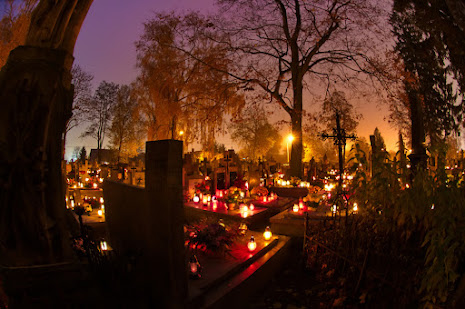
Decorated cemetery on All Saints' Day night (Shutterstock/Jaroslav Grudzinski)

All Hallows Eve(n) --> Hallows E'en --> Halloween

"Hallows" refers to a holy person, deriving from the old English word, halig for holy. We're familiar with the phrases "hallowed grounds," and "hallowed be thy name," in the Lord's Prayer, meaning venerated in those contexts. For an in-depth linguistic discussion of the history of Halloween, see this piece by Neal Whitman.

What might be less well-known is that although the word Halloween derives from a single source, the celebration itself draws on two historic celebrations: the ancient Gaelic (subset of Celtics) festival of Samhain, [pronounced, oddly enough, sow-win] (from sunset of October 31 to sunset November 1) and the Christian holiday of All Saints' Day. Here's a little bit about Samhain:

Samhain has pre-Christian roots and marks the end of the harvest season and the start of the darker half of the year. In Samhain, there was the belief that spirits, good and bad, could more easily enter the physical world. As part of the festival, people would gather to burn animals and crops in bonfires as sacrifices to the Celtic gods and deities. During the celebrations, people would dress up in costumes and dance around the bonfires. The point is, the festival was very much tied to the cycle of life and death. As was the habit of Christians, they annexed a "Christian" celebration, All Saints' Day, to a pagan one in the hopes of "converting" said pagans. (NB: paganism is not in itself evil, but it has become a derogatory word at the hands of monotheistic religions). The "trick-or-treat" tradition might have come from Irish and Scottish holidays in which people would dress up and visit homes to perform antics, sing a song, recite a poem, etc. in return for a treat.

Often discussed in this context is the Day of the Dead, or El Día de Los Muertos. This tradition dates back some three thousand years ago to the Aztec people. Celebrated in Mexico and elsewhere, it's sometimes incorrectly called, "Mexican Halloween." The "day" is actually Day of the Innocents on November 1, and Day of the Dead on November 2. Rather like the Celtic tradition of Samhain above, on the Day of the Dead, the border between the spirit world and the real world disappears. During this brief time, the souls of the dead come awake and return to the living world to celebrate. Hence, food and drink are left out at gravesides and on altars. Also prominent are decorative and elaborate skeletons and skull masks.


Dia de los Muertos festival in Mexico City (Shutterstock/IlanDerech)


Is there Halloween in Africa?


There is no original African celebration, event, or occasion on a selected day called "Halloween" as known in the US and other western countries that have adopted the tradition. Halloween's origins are not shared by African traditions, particularly as the history of Halloween is tied in part to the changing of the seasons from summer/autumn to winter. Certainly in West and Central Africa, there are only two seasons: wet and dry. Halloween has little relevance to most Africans. I asked a Ghanaian friend who has never been out of Ghana about it; he had never heard of Halloween or All Saint's Day. (Arguably, Christmas shouldn't be relevant in Africa either as its origins are tied up with pagan traditions around the winter solstice. But Christmas, for lots of reasons not the least of which is Jesus is at the center of the tradition, is in a league all of its own all over the world.)

If Halloween parties are held somewhere in Africa, they would be almost certainly "borrowed" from the West and perhaps held by expatriates. In Rwanda in 2013, Halloween parties did not go down well with the Rwandan government, which banned such gatherings, stating that "hono[u]ring the spirits of the dead is inappropriate and against Rwandan culture." One reason why that could be the case in Rwanda and other African countries is that phenomena like spirits, the ancestors, magic, and juju are taken seriously and can even be part of daily life. Essentially, the African perspective--certainly West Africa--is don't joke around with that kind of stuff. Placing a mock graveyard with ghosts and ghouls in your front-yard as Halloween "fun" would be seen as seriously bizarre in Africa and probably offensive as well. 

At the same time, there are many African ceremonies with a central theme of communicating with the ancestors, and some are performed with the wearing of elaborate masks, which represent the spirits of those ancestors e.g. FESTIMA in Burkina Faso, and Nigerian mask festivals. In other words, unlike modern Halloween, there is a deep meaning embedded in those traditions themselves. 

Ceremonial mask dance in Burkina Faso

                                                        (Shutterstock/Dietmar Temps)


The bottom line

Halloween has historical origins, but in modern times it's a commercialized celebration of dubious value in which children and adults dress up in costumes of all types--scary and not--often their alter egos or favorite superhero. It's also the warning that the interminable holiday season is about to begin, so start shopping.

And finally, what do pumpkins have to do with all this? All you need to know about this is there's an Irish legend with a guy called Jack whose ghost roams around restlessly. The carved pumpkin (originally carved turnips) is supposed to scare Jack away. 

As time passes, perhaps the occasion will be called Holloween. One celebrant, an adult, thought the name originated from the fact that your stomach is hollow before you get all that candy from trick-or-treating.