Friday, January 28, 2022

I say, I say


A nod is as good as a wink.......


A survey was published in an national paper recently about  some phrases and sayings that are vanishing from our language. They based it on a ‘nationally representative sample’ – whatever that is – of 2000 adults, all under 50 years of age.

Here are a few of them, with words of further explanation, should you need them…..

Zoe won’t!

The best one is ‘Colder than a witch’s tit,’ which can be used as a comment on the weather. Or for the cold hearted, another one might be ‘has the heart of a swinging brick.’

And what about ‘Pip Pip’?  I have no real idea what that means but it would be used along with ‘toodle doo’ as a way of herding small children out the door. Not really sure what it would mean in anybody else’s house.

 A nod is as good as a wink – very familiar to any Monty Python fans. A nod is as good as a wink to a blind wombat, say no more, say no more.

Ready for the knackers yard …. Exhausted.

Tickety boo means, all is good. It’s all just tickety boo. Having just typed that, I’ve realised that it’s now more said in sarcasm. Oh a complete rewrite? Well that’s just tickety boo! Famous for being in a Billy Connolly film  just before he blows the doors off the bank vault.

A curtain twitcher – well we all know what that is. We’ve all lived next to one. And run about in the garden dressed as a witch at midnight to scare the living bejesus out of them. Or is that just me?

Knickers in a twist. Is that a universal saying for somebody who is getting a bit overwrought about something, needlessly. Don’t get your knickers in a twist, it’s only a complete rewrite!

 A dog’s dinner. No idea why this refers to something messy as my Border Collie used to separate her dinner out into very neat piles and then eat what she fancied first. Strange dog.

Could not organise a piss up in a brewery. Governmental policy by any government anywhere.

Flogging a dead horse, self explanatory.

Toe the line – to behave in an expected way, with honour. It sometimes written as Tow The Line, but it is toe as it has something to do with standing with your toe on the line, and not over it to give yourself an unfair advantage at the start of a race. Duelling maybe?

 Popped her clogs- deceased! Same as Kicked the Bucket and Shrugged off her mortal coil.

 A few sandwiches short of a picnic. I think the Australians say One Kangaroo short in the top paddock. Just not quite mentally ‘on the ball.’

 A legend in one’s own lifetime. Or a legend in one’s own lunchtime. Or a legend in his own underpants (usually sarcastic)

Fell off the back of a lorry – nicked and sold on the black market. To go back to Monty Python, say no more, say no more.

 A bodge job, or Gerry built which was a common phrase after the war. Something not up to standard in a Richard Attenborough scale of standards.

 Eat humble pie, obvious.

As is Having a chinwag, which is an informal chit chat.

Put a sock in it means just stop it. Sounds more fun than cease and desist.

Spend a penny- to empty one’s bladder, obviously when it cost a penny to do such a thing.

It’s gone pear shaped …. Same as all gone tits up, all gone Pete Tong.

See a man about a dog, you need to spend a penny to see a man about a dog.

Pardon my French, an apology for  swearing

A Turn up for the books, a real surprise. Like ‘no rewrite required’

Toodle Pip!

Wednesday, January 26, 2022

Where do ideas come from?

 Stanley - Thursday

Every writer of mysteries has been asked where they get their ideas. I normally respond that there is no shortage of ideas. The real issue is whether the idea has enough meat to sustain a book-length story. I also say that Michael and I usually start with a backstory we're interested in, then brainstorm possible stories that can float on top of it.

However, that wasn't how our first book worked! We had a terrific premise - if you leave a body out for hyenas to consume, it would be nigh impossible for the police to have a case, because those wonderful animals eat both the flesh and the bones. As we often say "No body, no case." So we had to build a story, a plot, around that terrific idea. And A Carrion Death emerged.


Our second book, The Second Death of Goodluck Tinubu, started with the backstory of the Rhodesian Civil War, on which we built the story of two people who fought on opposite sides being at the same tourist camp in Botswana. The third book, Death of the Mantis, started with our interest in the demise of the Bushmen in Southern Africa, and became the story of a desparate quest to preserve a most sacred Bushman site.

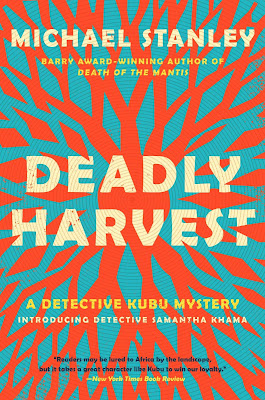
Deadly Harvest, our fourth book, was very different. When we were researching the series, before the first book was finished, we spent an afternoon with the Director of the Criminal Investigation Department of the Botswana Police Service. He drove us all over town, telling us stories, answering urgent calls from his staff, and so on. He suggested very strongly that we use the brutal practice of muti murders for one of our books. A muti murder is when a witchdoctor uses human body parts for concocting a powerful medicine (called muti locally). He told us of the infamous case of Segametsi Mogomotsi, a fourteen-year-old girl who was murdered for body parts, a case that had never been solved. We researched it and used it specifically as the backstory of our tale.


Books five, six, and seven (
A Death in the Family, Dying to Live, and Facts of Death) had contemporary issues as backstories: the increasing presence of Chinese in Africa; biopiracy; and the enormous importance of diamonds to Botswana's economy and politics.

We'll tell you more about the Detective Kubu book we have just finished sometime soon. It's called A Deadly Covenant. 

Switching to our thriller, Shoot the Bastards, featuring investigative reporter, Crystal Nguyen, we had the whole shocking story of rhino poaching and rhino-horn smuggling to work with as a backstory. Even so, we struggled with the writing, several times grinding to a halt at about 20,000 words. Eventually I suggested to Michael that I write a few chapters, a few stories, about what Crystal did in her job in Duluth, Minnesota. I did that and ended up with about 60,000 words, which, during COVID, I reworked into my first solo book, Wolfman.


An unsettling part of Wolfman is the fact that Crystal, an ambitious investigative reporter, creates news stories that she later reports on. I've been asked a number of times where that idea came from. It actually came from a blog I wrote many years ago here on Murder is Everywhere. Here's that blog.
______________________________

Most countries have criminals or criminal events that capture the public’s imagination, sometimes positively, but usually negatively.  Some that come to mind are Bonnie and Clyde, Al Capone, Ted Bundy, Jeffrey Dahmer, Charles Manson, Ronald Briggs and the Great Train Robbery, Jack the Ripper, and so on.  We all have heard of these people and the crimes they perpetrated.

In South Africa, it was what the media called the Stander Gang that caused newspaper sales to soar.  The public couldn’t get enough information (or speculation) about the gang and its exploits, and even today there are many South Africans who wish that the gang had got away with its daring exploits.  In fact, at one stage in the spree of bank robberies, it became a badge of distinction to have been robbed by the gang.

The gang was named after its leader, André Stander, son of a senior officer in the Correctional Services, Major-General Frans Stander.  After failing high school, the Major-General suggested (!) that André join the police.

In a surprising turnabout, André was selected as the Best Recruit in 1964.  After graduating he rose through the ranks and was promoted to captain in 1977 and headed the Criminal Investigation Department at the Johannesburg suburb of Kempton Park, near Johannesburg’s international airport.

Apparently his success in the police force didn’t meet all his needs, probably both emotional and financial.  So he took up robbing banks as a hobby.  On his days off from his police job, he would fly to Durban, don a disguise, rent or steal a car at the airport, and go and rob a bank or building society.  When he finished he would drive back to the airport, fly back to Johannesburg, and become a policeman again.

He did this for three years, leaving his colleagues in the police force bewildered, with no clues as to who was pulling off the audacious jobs.  As is so often the case, he became overconfident and boasted to one of his close friends about what he was doing.  The friend worked for the Bureau of State Security (BOSS) – one of the draconian arms of the apartheid government.  The friend reported the comments, and the police set up surveillance. 

Sure enough, after flying into Johannesburg from a heist in Durban, he was apprehended with money, disguises, and a firearm in his luggage.  He was found guilty on 15 of 28 charges of bank robbery and sentenced to an effective 17 years in a maximum-security prison.

At this stage in his career, he enjoyed only minor celebrity status, which included rumours that he would rob a bank during his lunch hour, then return to it later to investigate the crime.

 However, it’s what happened next that catapulted him to the spotlight and fame.

While in prison, Stander met and befriended two other bank robbers, Patrick Lee McCall and Allan Heyl.  In August 1983, Stander and McCall, with several other prisoners, were scheduled to meet with a physiotherapist.  While in the waiting room, Stander and McCall overpowered their guards and the poor physiotherapist and escaped.

About two moths later, Stander and McCall returned to the prison and sprung Heyl from the maximum-security facility.  Then the fun began.  

Over the next three months, what became called the Stander Gang, robbed at will.  They raided a gun shop and took an arsenal of weapons.  Stander took a yellow Porsche Targa for a test drive at a dealership and left the salesman gawping as the Porsche sped into the distance.  Far from coy, Stander used the Porsche to go to nightclubs and to transport girls from an escort agency to and from the gang’s three safe house in the affluent suburb of Houghton.

In the two months from mid-November 1983 to mid-January 1984, the gang robbed twenty banks, sometimes four in a day.  Each time they robbed a bank, the newspapers splashed their deeds all over the front page, and the public cheered.  They saw Stander as a modern day Robin Hood, a gentleman robber – although there is no evidence he did anything charitable with his money, and in fact the police were pretty sure he was a rapist.  The more the gang robbed, the more support the gang garnered from the public. 

Again over-confidence took hold.  Stander robbed a bank, in disguise, but without his sun glasses.  A camera caught him in action, and the police at last had a clear image of his face – which they gave to every newspaper in the country, as well as to TV.  Stander realized that time was running short and arranged to buy a yacht in Cape Town in which the three could sail to the United States.  Stander flew to the States on a false passport  to finalize details.

The day after he left, apparently based on information offered by some of the escort agency girls, the police surrounded one of the safe houses.  After a mighty gun battle, McCall was killed.  Heyl, who was elsewhere that evening, then fled the country and went to ground in Greece, on the island of Hydra.

Mugshots of Stander by Florida police
Stander meanwhile assumed the guise of an Australian writer in the Fort Lauderdale area of Florida.  He bought an old Ford Mustang, but was stopped by the police shortly afterwards for driving an unregistered vehicle.  They photographed and fingerprinted Stander (or Peter Harris, as he was known) and impounded the car.  Undaunted, Stander broke into the police impound lot and stole his car back.  Then he did something that boggles the mind – something that if any of us tried to use in one of our books, the editor would delete it immediately, rolling her eyes, thinking how stupid some writers can be.  Stander took the Mustang back to the second-hand dealer from whom he had bought it and asked for it to be sprayed a different color.

As luck would have it, the dealer had read in the local newspaper about the Stander Gang and recognised Stander when he walked in.  He called the police.  That evening the police surrounded Stander’s apartment, and when he showed up around 10:30 PM, they confronted him.  He tried to wrestle with one of the policemen, whose shotgun went off, fatally wounding Stander.

As for Allan Heyl, he left Hydra for England, where he pulled a small heist.  Eventually a confidence trickster he had befriended, turned him into the police.  He was arrested at a house in Surrey.  In May 1985, he was sentenced to nine years in prison.  When he was released, he was extradited to South Africa where he received an additional sentence from which he was paroled in 2005.  And guess what?  He is now a motivational speaker!

__________________________________

I so loved the idea of a policeman robbing banks, then returning a day or two later to investigate the robbery, that for a number of years I had toyed with ways I could use it. So, when I started writing about Crystal Nguyen, investigative reporter, it occurred to me that the same principle could be used. News reporter creates a newsworthy event, then later returns to report on it. Unethical? Certainly! But what's an ambitious, young, female reporter going do when she's sidelined on the news desk? 

Of course, the whole idea comes back to bite her, and her life's in jeopardy, as it was for Stander. Fortunately for me, Crystal is still alive.

Do you have an idea for a new adventure for Crystal? If so, please let me know! Then I won't have to look around for ideas, because they'll come from you.

A Dog's Tale

Sujata Massey 


I've invited a special guest writer this week. Daisy, approximately four years old by the human standard, is a Yorkshire terrier mix who has become the heart of our home. I am devoting most of my time this week to rewriting a manuscript, so Daisy kindly agreed to share her thoughts with Murder Is Everywhere Readers. My apologies if she runs on too long—she’s the kind of dog who does what she wants.


Greetings, gang! It's about time Sujata let me speak for myself. I may not write books, but I like to on top of them and laptop computers which have no business being on laps. 


I consider it one of my jobs to remind the writer I live with about reality. In the real world, dogs need to go outside, okay? And I need Sujata to know that when I stand on the back of the sofa, barking out the window, it’s because I am preventing possible crimes by other dogs and even humans. I am doing my job as household guardian. I may only be ten pounds, but I'm faster than anyone around here. 


I have lived with this family since 2018, when Pia walked into the living room with me in her arms and said to everyone that I belonged to a friend of hers and was just visiting for the afternoon. Above is a silly picture she took of me during this time. You can see how much love I feel.


Ha! I kept quiet, but the fact was, she had seen my picture on Facebook because someone wanted to sell me. I lived with two other families before the Masseys. The families were too busy to take care of me, so I didn’t learn a lot of puppy stuff—except for being friendly. But in the early months of my life, I saw people fighting. I was once thrown out of a window to show how mad someone was. I don’t like to go into the details, because it's traumatic. Because of what happened before, it was harder for me to become house-broken. I also am frightened by raised voices, and I freak out when people raise their arms high.


My new father, Tony, is a psychiatrist. He describes me as an empath. I'm not sure what that means, but it might have something to do with the fact that I look very closely at you if you might sneeze or seem very excited about something. If someone cries, I put my paws on their shoulders and kiss them until they are back to normal. 


I actually was the second dog in this house. Charlie was the only dog they expected to live with. When I met him, he was a twelve-year-old, extremely quiet Beagle who had almost forgotten how to play. I was about eleven months old, so I had a lot of energy and made him play with me. I teased him a lot in the early days, but he still fell in love with me. He followed me everywhere, even though I was so much smaller than him. Even though I was the second dog, I was never second banana.


2021 was the hardest year in my life. Just as spring was beginning, my buddy Charlie died. He was getting very sick and thin and finally went to sleep in the sunshine on the deck. I didn’t know that he was really gone forever, so that first night alone, I sat on the dining table all night, hoping he would come back through the door. 


A month later, Pia died. I get confused because I sometimes see girls with very long dark hair like hers, or who wear similar kinds of sweatshirts. I will always remember her letting me go off-leash outside and run. Pia liked to rev me up and made my life very exciting. I am fortunate that her brother Neel is home from college. I can snuggle with him in his room for hours. And what a room it is--often, I will find French fries or a pizza crust. It's better than doing book promotion with Sujata.


Still, I’ve been inside the house too much. Maybe you can relate? I sit next to Tony while he Zooms for work, and I get on Mom’s yoga mat when she gets into the play positions. I like yoga better than book promotion.


I know that dogs are very lucky not to catch coronavirus the way cats and tigers have. However, I don’t like masks. When Sujata takes me on walks, other people walking their dogs go on the other side. And that social distancing made me even more nervous about dogs than I already am. I get frightened if a dog looks at me. I have to bark back, so nothing terrible happens. 


My dog walker, Betsy, is a very nice lady. She kisses and cuddles me when she visits about twice a week. I don’t care that she wears a mask, because her eyes are always smiling. Betsy started some doggy playgroups during the pandemic. I was very scared the first time I went inside my special spot in her car which was jam-packed with four other dogs who all knew each other. They were a pack, and I was the newcomer. But nobody bit me or growled. They let me join them.


 Soon I was going with them twice a week, and if I could get away with it, I’d rush to the front of the pack to lead. During these walks, I visited parks and neighborhoods all around Baltimore. Occasionally my parents left home for important reasons, and I stayed overnight with Betsy and her daughter. Sleepaway camp! 


Right now, it’s the middle of winter. I believe this spring will be happier than the last one. I am already dreaming about the budding of daffodils and tulips and other lovely areas to leave some pee-mail for others. But for now, I am sitting comfortably on the radiator cover by the big window, keeping an eye out for our beloved mail carrier. I will whimper with joy when I see Tom step on our porch, and if he knows I'm here, he will wave at me. 


We will have our special moment.


And at exactly four o’clock, I will jump off the couch and appear in Sujata’s study to remind her it’s time for dinner. 


Love to all of you,


Daisy

Tuesday, January 25, 2022

Planted seeds and pleasing growth


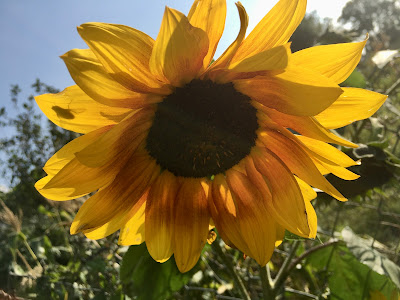
Unexpected sunflowers in our allotment garden last autumn

Craig every second Tuesday

Kia ora and gidday everyone. 

I hope you've had a good start to the year, even as we all continue to live through unprecedented times. It's hard to believe that we're coming up two years now dealing with a once-a-century pandemic that has upturned so much of life that we perhaps took a little for granted, whether it's international travel or being able to hug our friends or attend weddings or book festivals or concerts - or any events really, without stress or anxiety - pre-2020. 

I don't know about you, but I've found myself compartmentalising quite a bit over the past couple of years - trying to be really grateful for all the good things that I do have in my day-to-day life and not dwell too much on the many things that have been curtailed or lost. It can be a little overwhelming at times to think too much about the latter. 

A couple of things I've found really beneficial in the last couple of years is spending time in nature. Living in a big city like London now, I miss the natural surrounds that were easily at hand growing up in small-town New Zealand (beaches, forests, mountains, rivers, orchards and more all 15 mins or so drive from my suburban home). I miss the sea, I miss the mountains. But as my daughter has grown, and especially the past couple of years, we've spent more and more time exploring the nature we do have in London - whether riverside walks along the Thames, spending time in some cool parks, commons, and woodland areas in south London (eg Wimbledon Common), and also thanks to some friends we met, eventually creating our own rustic, rather wild garden area in a local allotment. 

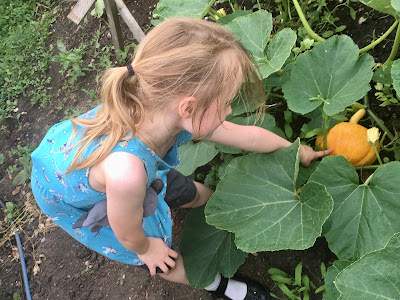
Miss Six is pleased with her 'pumpkin' (actually a Japanese squash)

After visiting our friends there regularly, having play dates and barbeques and helping with their produce in 2020 - allowable outdoors catch-ups during the pandemic - which was a great boon for the soul during tough times, last year we were offered the chance to have our own little patch. It was late in the planting season, but after working hard on the bindweed infested soil during the early summer, we planted a few things to see how they'd go (squash, pumpkins, tomatoes, a few sunflower plants etc), more using it as a test for next season than having any great hopes for lots of vegetables this time.

I remember thinking at the time about a saying I'd often heard or used in years past: 'plant seeds, pull weeds', talking about life in general and trying to take actions that may pay off later, and reduce or stop actions, habits or other things that may hurt later or are getting in the way. There was something therapeutic during the still-going pandemic to get my hands dirty, in the soil, literally pulling weeds and planting seed(ling)s. And it was really heartening when our pumpkin patch boomed beyond all expectations, and then later we got some late sunflowers - completely unexpected and very cheering. 

Physical work, nature, growth, learning. Lots to be grateful for. 

Finding ways to laugh and have fun each day

We've had lots of fun at the allotment, which feels like a wee oasis in our neighbourhood, close by yet somehow separate from the concrete jungle of the big city. Similarly it's been great to spend time nearly every day in local parks, as Miss Now-Seven and I have made 'nature walks' a commonplace thing (scenic detour on walks home from school or various extracurricular activities). Lately we haven't been doing much gardening in the allotment, as we pause over the winter a little before planning out what we're going to do for the coming seasons, but still enjoy hanging out there each week. 

Plant seeds, pull weeds. 

It's something worth doing in lots of areas of our lives. I've been plenty inconsistent on that front, so not trying to preach here, but along with the nature walks and allotment, lots of quality time with Miss Six-then-Seven, and a few other things that helped keep me sane in a very tumultuous year last year (a few personal things that I won't go into in much detail; suffice to say I deeply felt the distance from loved ones on the other side of the world in a way I hadn't previously, and time passing) - I did also plant a few other interesting seeds in 2021 that may flower rather wonderfully in the coming months. 

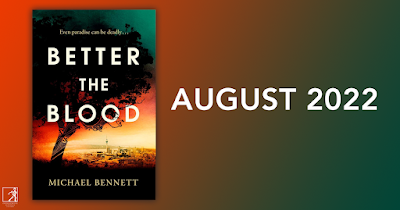
One that I can finally share publicly, as of last night: one of the coolest and most satisfying things I did in 2021 was play a wee part in terrific Māori screen storyteller Michael Bennett finding a home for his rather special debut crime novel, Better The Blood. You can read The Bookseller announcement here. 


This makes me feel really good on a number of levels - not just in terms of using some of my accumulated experience or connections to help someone else with their storytelling dreams, but in particular helping not just a talented Kiwi author but an indigenous author get notice and opportunities internationally. Over the 13 plus years I've been involved in crime fiction as a reviewer and features writer then events organiser, awards judge, festival chair, and occasional agent etc, I've increasingly become conscious of the need to bring a diverse array of voices into the genre we all love. 

And uplift them. Personally I think it makes crime and thriller fiction even better to have more and more writers of colour, LGBT+ storytellers, working class writers, translated authors, non-US/UK authors, and others involved and supported. So whether it's my reading, my writing, the events I'm involved with, or my advocacy, I'll be looking to support and celebrate a broad, inclusive genre. 

We're blessed with a startling array of crime and thriller writing nowadays. It's a great time to be a reader and fan of the genre. And that's another of the wee things that I've been thankful for the past couple of years, as we've dealt with so much real-life tumult. 

So whether it's gardens or nature walks or reading or time with your loved ones or whatever else it may be that you're using to get through these tough times, I hope that in the weeks and months ahead you can regularly enjoy some of those things. 

And maybe plant a few seeds and pull a few weeds along the way.

Thanks for reading. Until next time. Ka kite anō.

Whakataukī of the fortnight: 
Inspired by Zoe and her 'word of the week', I've been ending my fortnightly posts by sharing a whakataukī (Māori proverb), a pithy and poetic thought to mull on as we go through life.

He iti mokoroa e hinga pūriri

(A small mokoroa (grub) can fell a pūriri tree, ie small thjings can have great impact)

A mokoroa, the caterpillar of the Puriri moth which can chew through trees that grow up to 20m high


Monday, January 24, 2022

On Safari In Florence

Annamaria on Monday

I am determined to say something today and do it without cursing.  Using Blogger is so very painful, I want to scream.  No matter what I do, it will not let me open the page where I can write something new.  All I can do is search and open old posts--like this one.  So at least today I can offer this--from five years ago.

Until this past Wednesday, I could comment on other's fascinating posts as myself, but ONLY on my iPad.  Now I can only comment anonymously, still using only the iPad and then only if moon is full. 

 #$(*&?><%&&**^^!!


I returned from South Africa and, the very next day welcomed my friends Jean-Claude and Francoise visiting from Nice.  We launched into a marvellous week of art exhibitions, a studio visit, museums, and churches around this, the greatest art treasury in the world.  Our first stop was the Gozzoli chapel in the Palazzo Medici-Ricardi to view the splendid frescoes.


A strange compulsion overcame me there.   In all the richness of the images before me, my eyes began to do what they had been doing for the previous week when I was sitting behind Stan in the Land Rover, rolling and bumping our way through the South African bush:  Without intending to, I found myself scanning the terrain for birds and animals.  And so began my next great adventure--a safari in Florence.  Hence:

A Field Guide to Wildlife in Florence


Introduction

Travellers accustomed to African safaris will find some expected similarities, but also some marked differences between the African bush and game spotting in Florence.  
  • Birds will, obviously, most likely be found by looking up.  Not all, however.  Birds of prey, especially, can quite often be found at eye level.
  • Animals elusive and difficult to find in the sub-Saharan wilderness are often quite plentiful in the chapels and piazzas, as this guide will demonstrate.
  • Though their African cousins often flee when approached, all but two or three of the creatures you encounter in Florence will remain stationary and pose to show themselves to their best advantage.  You will find this positively delightful.
  • For convenience, this manual is organised in similar fashion to other Florentine guidebooks, by location, rather than by species.
My Terrace

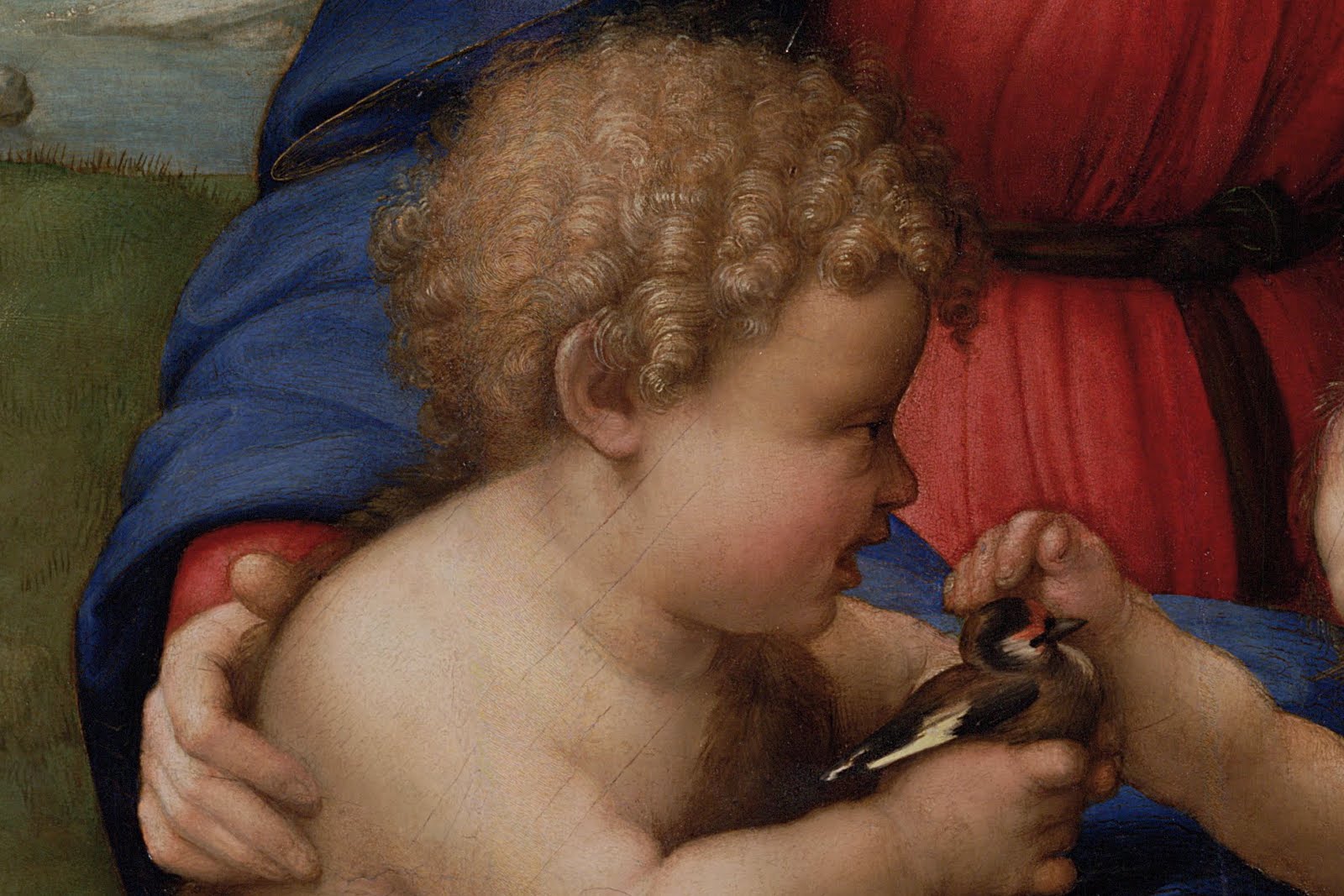
Swallows and pigeons are quite common in Florentine outdoor spaces.  Only a bit rarer is the European goldfinch or cardellino. (True to the arcane nomenclature of birds worldwide, this bird shows very little of the colour of its given name, but never mind.)  See also Galleria degli Uffizi.


Palazzo Medici-Ricardi

Go first to the Chapel where Benozzo Gozzoli's The Journey of the Magi (1459) offers a wide array of birds and animals.


Stan will recognise this as a typical safari scene of a waterhole at which
one can spot several different varieties of bird life.
Although the chapel is the most interesting to wildlife seekers in this palazzo's fortress-like structure, the determined visitor will not want to miss the state apartments, the ceilings of which offer wildlife difficult to spot elsewhere.

Extremely rare elephant.  Those on safari in
Italy determined to see elephants are better
 served in Rome.


Rare indeed, a lioness.  The macho Medici world,
it seems, much preferred the male of the species.

The Duomo, the Baptistry of San Giovanni, Museo dell'Opera del Duomo

Bird-lovers will want to concentrate on the Baptistry.  The Museo, on the other hand, offers thrilling sightings of felines.


Galleria degli Uffizi

The Uffizi is a paradise for birdwatchers.


Rafaello's Madonna del Cardellino
Detail of the above

The Church of San Lorenzo, The Laurentian Library, The Medici Chapels

All three of these locations abound with rare and exciting sightings.


Although, in the author's opinion, this image does not compare with the African
firmament, it has the added advantage of pleasing animal lovers as well as
stargazers.


Michelangelo's owl, unique in this genus.  Habitat: Medici Chapels

Piazza Signoria

Visitors with a sense of the dramatic will want to save this  locale for last.  Lions abound.  Here, along with the above golden cover art of this manual, is but a small sampling of the scores if kingly creatures on which to feast one's eyes.


The Signoria is also the precinct of the wild boar.


Florentines have a special affection (and taste for) the wild boar or cinghiale.    
Myth says that if visitors rub the nose of this porcellino, they will return to visit
Florence again.  The richness of wildlife viewing here requires several
visits, of considerable length.